
Robotics and automation are reshaping construction by tackling labor shortages, improving safety, and boosting productivity. Robots handle repetitive and hazardous tasks like bricklaying, demolition, and concrete finishing, allowing human workers to focus on oversight, quality control, and problem-solving. This shift is creating new job opportunities and transforming traditional roles.
Key Takeaways:
- Labor Shortages: Aging workforce and fewer young workers entering construction have driven the adoption of robotics.
- Safety: Robots reduce risks by taking over dangerous tasks like demolition and heavy lifting.
- Evolving Roles: Workers now perform tasks such as supervising robots, troubleshooting, and quality assurance.
- New Jobs: Careers like robotics operator, maintenance technician, and drone pilot are emerging.
- Upskilling: Training in robotics operation, safety protocols, and digital tools is critical for workers to stay competitive.
Quick Stats:
- Robotics Market Growth: Expected to reach $659.7 billion by 2030.
- Productivity Boost: Robots can lay up to 3,000 bricks per day, far exceeding human capabilities.
- Safety Impact: Robots help reduce injuries from repetitive strain and hazardous conditions.
By integrating robotics, construction companies can address workforce challenges while opening doors to higher-paying, tech-driven roles. Training programs and platforms like ABLEMKR play a key role in preparing workers for these changes.
Problems Driving Robotics Use in Construction
Labor Shortages and Aging Workers
The construction industry in the U.S. is grappling with a severe shortage of skilled workers in essential trades like carpentry, electrical work, welding, and equipment operation. This shortage is compounded by an aging workforce. Many seasoned tradespeople are retiring, often due to the physical demands of the job, while not enough younger workers are entering the field through vocational programs or apprenticeships to fill the gap.
To address this, robotics and automation are stepping in to perform tasks such as bricklaying, concrete work, and equipment operation. These technologies allow smaller crews to accomplish more, while experienced workers can focus on higher-value tasks like supervision and quality control. Platforms like ABLEMKR are also playing a role by connecting certified, pre-vetted workers with projects that require specialized skills. This ensures that both traditional and robotic systems are effectively utilized on job sites.
These labor shortages are accelerating the adoption of robotics, which not only mitigates risks but also boosts productivity.
Safety Risks and Productivity Demands
Construction sites are inherently risky, with hazards such as falls, struck-by incidents, and repetitive strain injuries being common. To reduce these risks, contractors are increasingly using robots for tasks like demolition, heavy lifting, and repetitive labor. This shift allows human workers to take on roles focused on monitoring, layout, quality control, and supervision – keeping them safer by moving them away from the most dangerous tasks.
At the same time, project owners are demanding faster timelines, tighter budgets, and higher-quality results. Rising material and labor costs make traditional construction methods harder to sustain. Robotics offer a solution: robots can lay thousands of bricks in a day, speed up concrete finishing, and perform precise earthmoving, which not only reduces rework but also shortens project schedules. By automating high-risk and repetitive tasks, companies aim to cut workplace injuries and workers’ compensation claims while maintaining or even increasing productivity.
The growing reliance on robotics is reflected in market projections. McKinsey estimates the general-purpose robotics market could reach approximately $370 billion by 2040, underscoring the importance of these tools for meeting safety and efficiency goals.
Skills Gaps for New Technology
As robotics become more integrated into construction, a significant skills gap has emerged. Many experienced tradespeople excel in traditional methods but lack the digital and technical skills needed to operate modern robotic platforms. On the other hand, younger workers with general tech expertise often lack the practical construction knowledge – such as reading blueprints, understanding building codes, and navigating job-site workflows – required to effectively use these technologies.
This disconnect slows the adoption of robotics and can lead to underutilized or misused equipment. Workers need training in areas like robot operation, troubleshooting, and safety protocols to ensure seamless integration of automated systems. Bridging this dual gap is essential for the industry to fully benefit from robotics.
The construction robots market is expected to grow significantly, potentially reaching $659.7 billion by 2030, driven by labor shortages, decreasing costs of robotics, and a heightened focus on safety. To keep pace, the industry must prioritize upskilling programs that equip traditional workers with tech expertise and help tech-savvy newcomers gain the field knowledge they need to thrive on construction sites.
The Construction Robots are Coming
How Robotics Changes Construction Jobs
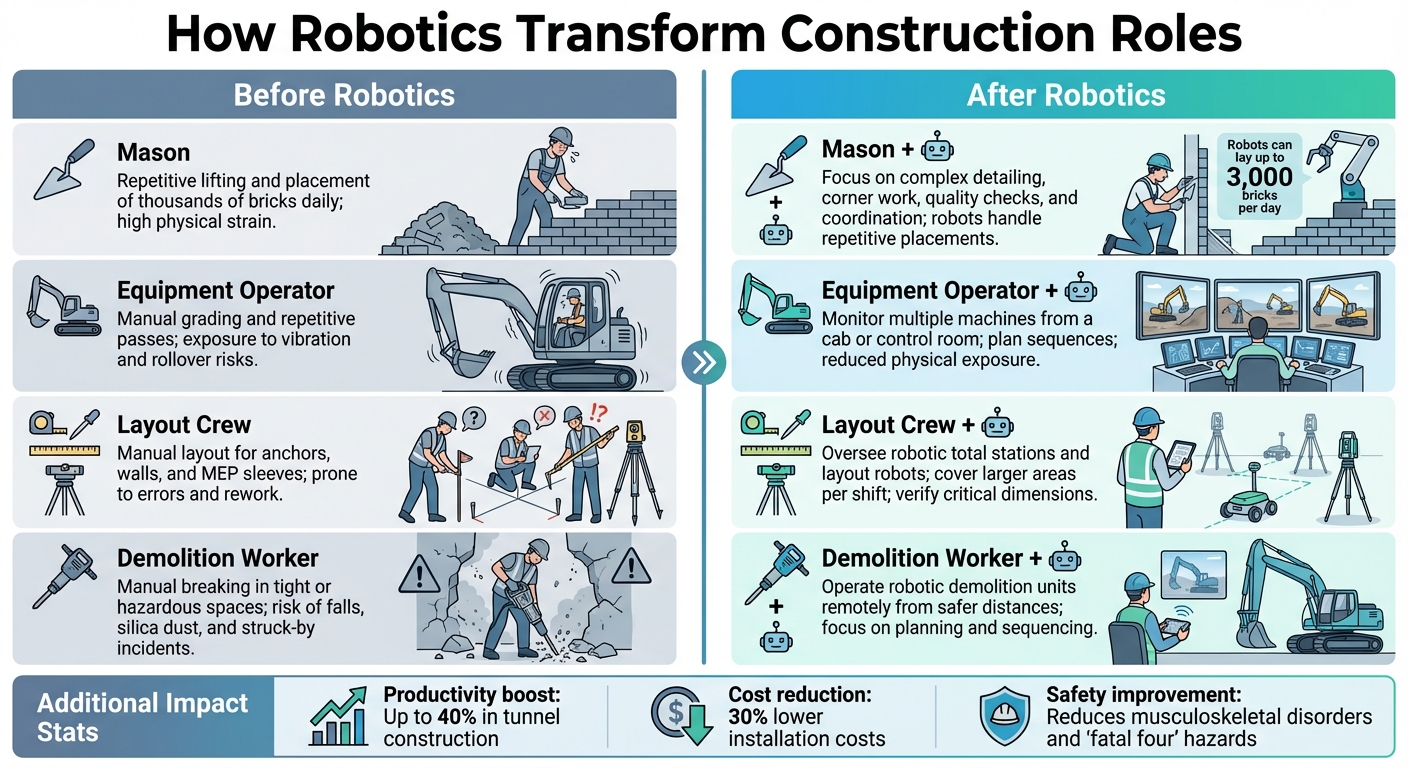
How Robotics Transform Construction Roles: Before and After Comparison
Changing Duties in Existing Roles
Robotics is transforming how tasks are carried out on construction sites rather than replacing jobs altogether. Workers now dedicate more time to setup, staging, inspection, and cleanup around robotic systems, integrating these tools into daily operations. For example, masons collaborate with automated bricklaying systems, which handle repetitive tasks. This allows masons to focus on more intricate work, like complex corners and detailed finishes. Similarly, equipment operators are shifting from direct machine control to managing multiple semi-autonomous machines, often using tablets or control consoles to guide paths, set boundaries, and define production goals.
Carpenters and formwork teams are also seeing a shift in their responsibilities. Instead of traditional field fabrication, they now work more closely with prefabricated and 3D-printed components, emphasizing layout verification, fit-up, and finishing. Despite these technological advancements, core skills like reading blueprints and detecting defects remain critical. When robots encounter unexpected conditions, human expertise ensures quality control. Overall, roles are evolving from hands-on labor to a blend of machine oversight, digital coordination, and quality assurance. This shift has also led to the creation of entirely new roles designed to manage and maintain these advanced systems.
New Jobs Created by Robotics
The rise of robotics in construction has brought about entirely new career opportunities. Emerging roles include robotics operator, robotics maintenance technician, construction drone pilot, and digital construction coordinator. Robotics operators are responsible for deploying, calibrating, monitoring, and troubleshooting various automated systems, such as bricklaying robots, rebar-tying machines, and autonomous equipment, ensuring their performance aligns with project plans.
Maintenance technicians focus on keeping these systems running smoothly, handling preventive maintenance, repairs, sensor calibration, software updates, and spare-parts management. Meanwhile, drone pilots play an increasingly important role by conducting site mapping, progress tracking, and safety inspections, then processing the data for project teams using tools like Building Information Modeling (BIM) or AI-driven platforms. Automation coordinators act as a bridge between the field and the office, ensuring that robot workflows, digital models, schedules, and data capture are seamlessly integrated into daily operations. Platforms like ABLEMKR are also connecting skilled, robotics-trained professionals to critical projects in construction, energy, and infrastructure, highlighting the growing collaboration between humans and machines.
Humans and Robots Working Together
Rather than replacing workers, robots act as force multipliers, enhancing the productivity and safety of existing crews. For instance, autonomous systems handle repetitive tasks like bricklaying, while human masons focus on complex detailing and final touches, significantly boosting wall production without reducing the workforce. In concrete work, robots take on repetitive jobs such as screeding or tying rebar, allowing crews to concentrate on site preparation, formwork adjustments, joint detailing, and curing oversight, which improves project timelines.
Studies show that automation in construction tends to increase productivity and overall employment rather than reduce headcounts. This is largely because the demand for infrastructure and housing remains high, and many tasks are too variable for complete automation. Safety also improves as robots take over physically demanding tasks like heavy lifting, repetitive motions, and work in extreme conditions or confined spaces, reducing injuries and long-term health issues. Workers benefit from spending less time on monotonous or hazardous tasks and more time on supervision, troubleshooting, planning, and quality assurance, which many find more engaging and sustainable over the course of their careers.
sbb-itb-aa28329
Training and Upskilling for Robotics
Skills Needed for Robotics Work
As robotics becomes a bigger part of construction, workers need a mix of technical know-how and soft skills to stay ahead. On the technical side, it’s crucial to understand the basics of operating robots – things like powering systems on and off, choosing tasks, and reading status signals. Workers should also be familiar with sensors and safety systems, such as light curtains, emergency stops, and proximity sensors. Basic programming skills, the ability to use teach pendants, and data literacy for interpreting dashboards are also essential.
Problem-solving and troubleshooting skills are key for handling unexpected robot behavior. Workers also need strong digital communication abilities to collaborate with remote supervisors and teamwork skills to integrate robotic tasks with traditional trades like electrical or mechanical work. Knowledge of OSHA and NIOSH safety guidelines – such as lockout/tagout procedures and exclusion zones – is critical for compliance.
Different roles in robotics-enabled construction require specific skills:
- Equipment operators focus on setting geofences, monitoring automated cycles, and intervening safely when robots encounter obstacles.
- Site supervisors coordinate workflows between humans and robots, analyze productivity reports, and adjust schedules based on real-time data.
- Safety managers must understand robot-specific hazards like pinch points and unexpected movements, conduct risk assessments, and create safe work procedures.
- Craft workers (e.g., masons, welders, concrete finishers) increasingly oversee robotic output, handle complex or custom tasks, and perform basic maintenance like tool changes, calibration checks, and sensor cleaning.
Training Options and Programs
There are several ways for U.S. workers and employers to develop robotics skills. Registered apprenticeships are starting to include training on automation, robotic total stations, and semi-autonomous equipment. These programs combine paid, on-the-job learning with classroom instruction, often at little to no cost for workers. Community and technical colleges offer certificates or associate degrees in fields like industrial robotics, mechatronics, and construction technology. These programs often cover PLC basics, robotics programming, and safety and may qualify for financial aid, including GI Bill funding.
OEM (Original Equipment Manufacturer) training is typically short – lasting one to five days – and focuses on specific robots or systems, such as bricklaying robots or drone surveying. These courses are sometimes included with equipment purchases or support contracts. Employer-led programs are highly customized to a company’s specific robots and processes. These often combine vendor training, internal protocols, and mentoring, with many offering micro-credentials to recognize worker achievements and support career growth.
Workers often combine these options, layering traditional trade skills with specialized robotics training. Platforms like ABLEMKR play a key role by tracking certifications – such as OSHA-10/30, NCCER, and OEM robot operator credentials – and matching workers with jobs that require specific skills. For workers, listing robotics-related certifications on ABLEMKR can lead to better-paying roles, more frequent assignments, and clearer career advancement. For employers, the platform ensures that the right, certified workers are assigned to critical projects, especially those involving high-tech construction or automation.
Building Effective Training Programs
To prepare for robotics in construction, contractors need well-designed training programs. Start by taking stock of the robotic systems planned for the next 12 to 36 months – like layout robots, rebar-tying robots, or autonomous equipment – and identify which roles will interact with each system. Then, define the specific skills required for each role, covering theoretical knowledge, operational tasks, and documentation responsibilities. Collaborate with vendors, unions, and local colleges to create training modules that include classroom basics, hands-on practice, and real-world experience on job sites.
Begin with a small pilot program on a single project to gather data on uptime, error rates, and safety performance. Use these insights to refine the curriculum. Once the program is fine-tuned, standardize it by creating clear procedures, integrating it into onboarding for new hires, and requiring completion before assigning workers to robotics-related tasks. Micro-credentials can help track progress and link training completion to pay increases or advanced roles.
Effective training programs combine theory and hands-on practice. Classroom sessions should cover robot basics, safety standards, and human–robot collaboration. Hands-on training should involve working with real or simulated robots on tasks like welding, bricklaying, or material handling, as well as scenario-based simulations that mimic actual job-site conditions. Safety drills – such as activating emergency stops, isolating power, and addressing sensor faults – are essential, along with supervised practice of pre-use inspections and lockout/tagout procedures. Training should also incorporate U.S.-specific standards, like OSHA requirements and imperial measurements, to ensure workers can apply their skills directly to real projects.
Employers can evaluate training effectiveness through metrics like completion rates, the number of workers certified in robotics or automation, and the time it takes for new hires to become independently operational. Operational metrics – such as robot uptime, task cycle times, and rework rates – provide insight into productivity, while safety metrics like near-miss reports and incident rates measure improvements in human–robot interaction. Platforms like ABLEMKR can help employers verify worker certifications, monitor training progress, and identify areas for further skill development, ensuring that workers are prepared for the demands of robotics-enhanced construction. This approach bridges traditional expertise with the skills needed for the future of the industry.
Putting Robotics to Work on Job Sites
Step-by-Step Robotics Adoption
Introducing robotics to construction sites works best when approached in stages. Start by identifying repetitive and high-risk tasks like layout work, rebar tying, and bricklaying – these are areas where robots can significantly improve safety and efficiency. Choose technology tailored to the specific task, such as layout robots, autonomous equipment, rebar-tying systems, or demolition units. Be sure to evaluate their safety certifications, service support, and compatibility with BIM systems.
Begin with a small pilot project – deploy one or two robots on a limited scope, such as a single floor or a specific trade package. Track key metrics like cycle times, rework rates, near-miss incidents, and how well the crew adapts. Use this data to fine-tune workflows, adjust crew sizes and schedules, and establish standard operating procedures. Gradually expand robotics to similar tasks on other projects, incorporating formal training programs and updating job descriptions to reflect hybrid human-robot roles. Finally, integrate robotics into enterprise systems like ABLEMKR, enabling robots to become part of standard estimating and staffing workflows. This phased approach helps create safer, more efficient job sites.
Updating Pay, Policies, and Career Paths
As robotics become part of daily operations, companies need to rethink pay structures, workplace policies, and career development. Hybrid roles like "Robotics Carpenter", "Autonomous Equipment Operator", or "Digital Layout Foreman" can include pay premiums to reflect the added skills and responsibilities. These premiums might come in the form of higher hourly wages, lead-pay differentials, or skill-based pay steps tied to certifications from manufacturers. Some firms also offer performance bonuses based on metrics like robot uptime, productivity goals, and safety records – though these incentives must never encourage compromises on safety.
Policies should address five key areas: minimum training hours and certifications, clear responsibilities for tasks like programming and inspections, rules for exclusion zones and PPE, procedures for logging and investigating robot-related incidents, and guidelines for using and retaining robot-captured data.
To help workers adapt to this shift, companies can establish clear career ladders. For instance, a laborer could progress to Robot Operator I (basic operation under supervision), then to Robot Operator II (independent operation and troubleshooting), and eventually to Robotics Technician or Supervisor (handling multiple robots, data analysis, and advanced maintenance). Each step should include defined skills, training, and pay levels. Platforms like ABLEMKR can track certifications such as OEM robot operator credentials, OSHA-10/30, and NCCER, matching workers with opportunities that reward their robotics expertise with competitive pay and premium assignments. These frameworks make the transition smoother and more transparent for workers.
Showing Role Changes and Benefits
Here’s a quick look at how robotics are reshaping key roles:
| Role | Before Robotics | After Robotics |
|---|---|---|
| Mason | Repetitive lifting and placement of thousands of bricks daily; high physical strain | Focus on complex detailing, corner work, quality checks, and coordination; robots handle repetitive placements |
| Equipment Operator | Manual grading and repetitive passes; exposure to vibration and rollover risks | Monitor multiple machines from a cab or control room; plan sequences; reduced physical exposure |
| Layout Crew | Manual layout for anchors, walls, and MEP sleeves; prone to errors and rework | Oversee robotic total stations and layout robots; cover larger areas per shift; verify critical dimensions |
| Demolition Worker | Manual breaking in tight or hazardous spaces; risk of falls, silica dust, and struck-by incidents | Operate robotic demolition units remotely from safer distances; focus on planning and sequencing |
For example, automated bricklaying systems can place up to 3,000 bricks per day, far surpassing human output and allowing masons to focus on higher-skill tasks. In the UK, a tunnel-construction robot has been tested with projections to boost productivity by 40%, lower installation costs by 30%, and reduce construction plant movements by 40%. According to CDC/NIOSH, construction robots can reduce musculoskeletal disorders and help mitigate the "fatal four" hazards – falls, struck-by incidents, caught-in/between accidents, and electrocutions – by taking over dangerous tasks. Workers who experience fewer manual lifts, spend less time in hazardous zones, and save time on layout or inspections are more likely to embrace robotics.
Conclusion
Robotics is transforming construction by taking on tasks that are repetitive, hazardous, or physically demanding, while still leaving room for essential human roles. With labor shortages, an aging workforce, and safety concerns pushing the industry toward innovation, automation is stepping in to handle jobs like heavy lifting, demolition, and tunnel installation. This shift allows workers to focus on higher-value responsibilities such as supervision, programming, quality control, and coordination. According to McKinsey, if global infrastructure and housing demands are met, construction employment could increase by as much as 200 million jobs by 2030.
To thrive in this evolving landscape, structured upskilling is key. Training workers to operate and maintain robotics not only opens doors to higher-paying, less physically taxing jobs but also boosts productivity and safety on job sites. Companies that invest in workforce training ensure smoother transitions, retain institutional knowledge, and prepare their teams to troubleshoot and manage advanced systems effectively.
A thoughtful approach to adopting robotics can further reduce risks. Start small by focusing on one or two high-impact use cases, such as robotic layout, automated bricklaying, or autonomous equipment. Launch controlled pilot programs and track metrics like cycle times and injury rates before expanding. This phased strategy ensures safer and more measurable integration. Engaging experienced tradespeople, foremen, and safety managers early in the process ensures that real-world site conditions guide the development of new workflows. Platforms like ABLEMKR can help by connecting projects with pre-vetted workers who have the necessary robotics and safety certifications for critical tasks.
FAQs
How are robotics making construction sites safer?
Robots are making construction sites safer by taking over tasks that often put workers in dangerous situations. With their ability to operate in high-risk areas, they reduce accidents linked to human error. Plus, remote operation of heavy or hazardous machinery means workers can stay out of harm’s way.
By handling repetitive or risky jobs, robots not only lower the chance of injuries but also contribute to a smoother, more efficient workflow. This change doesn’t just protect workers – it also improves the reliability and productivity of construction projects.
What kinds of jobs are being created by robotics in construction?
Robotics is reshaping construction, introducing a wave of new job opportunities centered around cutting-edge technology. Roles like robotics operators, automation technicians, robotics maintenance specialists, and remote monitoring technicians are becoming key to keeping advanced systems running smoothly on construction sites.
To step into these roles, workers can pursue specialized certifications and training in robotics and automation. This transformation is not just updating the industry – it’s creating pathways to lucrative, in-demand careers in a field that’s growing fast.
What skills do workers need to succeed in robotics-driven construction roles?
To excel in construction roles shaped by robotics, workers must develop a blend of technical expertise and flexibility. Essential skills include the ability to troubleshoot automation systems, program, and operate robotic equipment effectively. Additionally, a strong grasp of safety protocols and possession of relevant certifications are crucial for success.
Just as important is cultivating a mindset focused on continuous learning. With technology in the industry advancing rapidly, staying open to gaining new skills helps workers stay competitive and prepared for future opportunities.


