
Hiring delays can push oilfield work off schedule before the first worker shows up. If key roles stay open, a 21-day turnaround can start short by 60 workers, vacancy rates for some Gulf Coast tech roles can top 18%, and turnaround slip can average 5 days.
If I boil the article down, here’s the plain answer:
- Regional labor pressure is one part of the problem. In places like the Gulf Coast and Permian, companies often compete for the same welders, fitters, techs, and inspectors at the same time.
- Internal hiring delays are the other part. Slow approvals, screening, drug tests, background checks, badging, and travel planning can add days or weeks.
- The result is simple: crews start short, outage windows stretch, overtime grows, scope gets cut, and pipeline start dates move out.
- The fix is also simple: map the hiring funnel, track a small set of time-based metrics, build a pre-vetted labor pool early, and standardize onboarding from requisition to first shift.
Here are the main delay points the article covers:
- Local competition during shutdowns and turnarounds
- Slow screening and compliance checks
- Weak applicant flow for remote and rotational jobs
- Late requisitions that squeeze the whole hiring window
- Manual mobilization steps that slow starts
And here’s what teams should do:
- Track time to fill and time to start
- Separate market shortage from process delay
- Keep worker records current before the job opens
- Lock in travel, orientation, and site access ahead of day one
- Use one system to track worker status and compliance
Bottom line: when hiring is treated like part of project delivery instead of just recruiting, crews get on site faster and schedules are less likely to slip.
Where Hiring Bottlenecks Slow Field Execution
Labor Shortages and Local Competition During Shutdowns and Turnarounds
Shutdowns and turnarounds cram months of maintenance into a narrow window. That creates a sharp spike in demand for craft labor like welders, pipefitters, millwrights, boilermakers, and scaffold builders. And when multiple sites in the same region hit outage season at the same time, the same labor pool gets pulled in every direction.
That pressure shows up fast in the field. Crews arrive understaffed, critical work slows, and planned outage windows start to slip. A survey of refinery operators found that 62% reported difficulty sourcing skilled workers for turnarounds, with shortages directly tied to project delays and cost inflation. An EIA analysis also found average turnaround schedule slippage of 5 days, with lack of skilled labor named as a contributing factor. Five extra days may not sound huge on paper, but in practice it means idle equipment, more contractor spend, and a longer shutdown than planned.
Labor gaps also push employers toward short-term fixes that come with tradeoffs. Premium pay, heavy overtime, and bringing in less-experienced workers can help cover shifts, but they can also affect execution quality and increase rework risk. The core issue is simple: overlapping outages drain the same labor pool at the same time.
That leads straight to the next step: where, exactly, is hiring slowing down?
Slow Screening and Compliance Checks for Pipeline and Field Service Roles
Even when qualified workers are out there, clearance can take longer than the project can afford. For pipeline and field service roles, the pre-start checklist is long. Certification, training, drug testing, background checks, medical clearance, and site access all have to line up. On short-duration jobs, one delayed start can mean losing the worker altogether.
Each step adds time. Together, they can add weeks.
A contractor compliance survey found that the top delays are waiting for results (55%) and approval or sign-off (47%). One U.S. utility’s contractor onboarding process says background checks alone can take up to 10 business days, while drug screens must be completed within 48 hours of contact. If the start date slips beyond the 90-day validity window, a retest is required.
You can see how this turns into a mess fast. In remote locations or short project windows, a worker may already be booked somewhere else by the time clearance comes through. Manual workflows and email-based document collection only slow things down more.
The upside is that these delays are measurable, which makes them easier to spot inside the hiring process.
Weak Applicant Flow for Remote, Rotational, and High-Risk Jobs
Some jobs don’t get enough applicants in the first place. Welders, CDL drivers, equipment operators, and mechanics are already in short supply across the country. Add a remote location, rotational schedule, or higher-risk site, and the candidate pool gets smaller before compensation even enters the picture.
A lot of qualified workers pass on these jobs for practical reasons. Travel can be tough. Home time can be unpredictable. Safety demands are higher. So even if the pay is solid, these roles are often harder to fill than similar industrial jobs closer to where people live.
For project managers, that means the hiring problem often comes down to geography and logistics, not just job ads or recruiter effort. If applicant flow is weak at the top of the funnel, time to fill goes up no matter how smooth screening is.
Once those pressure points are visible, the funnel can be mapped from requisition to first shift.
sbb-itb-aa28329
How to Map Delay Points in the Hiring Process
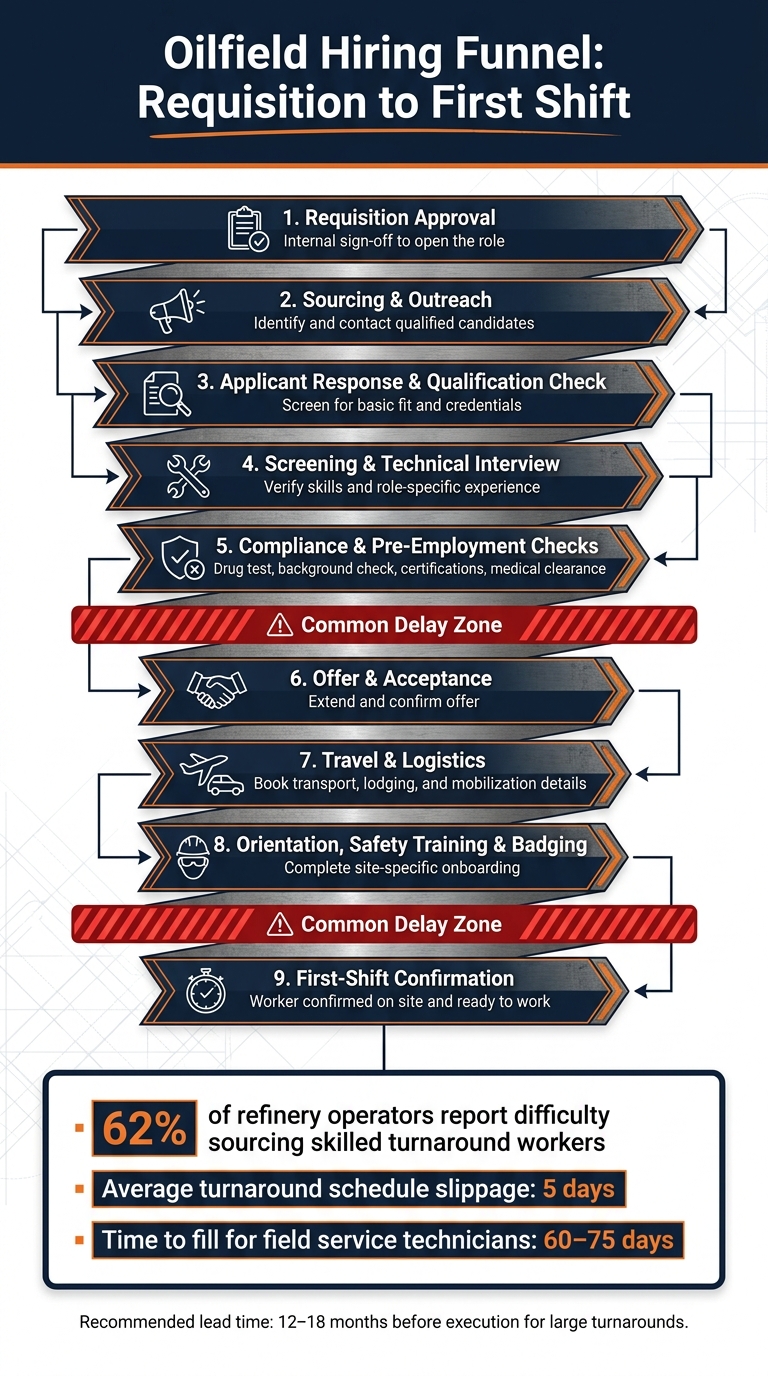
Oilfield Hiring Funnel: From Requisition to First Shift
Once bottlenecks are visible, the next move is to find out where the clock is burning.
Track the Hiring Funnel From Requisition to First Shift
Hiring delays often come from tiny gaps between steps. One requisition sits waiting for approval. A drug test comes back late. A worker misses travel details. On paper, each issue looks small. In practice, those small misses stack up fast.
The fix is simple in theory: map the full path from request to first day on site.
For U.S. oilfield and pipeline hiring, a practical funnel usually includes these nine stages:
- requisition approval
- sourcing and outreach
- applicant response and qualification check
- screening and technical interview
- compliance and pre-employment checks
- offer and acceptance
- travel and logistics
- orientation, safety training, badging
- first-shift confirmation
Each stage needs a clear owner and a target turnaround time. If nobody owns the step, or if no deadline exists, candidates drift. That’s when the process starts to clog.
The biggest slowdowns usually show up at two handoffs: from screening to orientation, and from orientation to first shift.
Use a Small Set of Metrics to Find Delay Points
You don’t need a huge dashboard to spot trouble. A small set of six metrics is often enough to show where things are breaking down before crews feel it in the field.
| Metric | What It Measures | Why It Matters |
|---|---|---|
| Time to fill | Requisition approval date → offer acceptance date | Shows total hiring cycle length by role and region |
| Time to start | Offer acceptance date → first shift on site | Reveals delays in compliance, travel, and onboarding |
| Screening cycle time | First candidate contact → all screening steps cleared | Flags overloaded compliance teams or repeat checks |
| Applicant drop-off rate | Percentage of candidates who exit before completing a stage | Identifies slow follow-up or application steps that are too complex |
| Offer acceptance rate | Accepted offers ÷ total offers extended | Signals pay that may not match the market or rotation terms that aren’t clear |
| Missed start rate | Workers who miss orientation or first shift ÷ workers scheduled | Points to logistics gaps or poor communication around start details |
Track these metrics by role type, project type, and region. Then line them up with project milestones. That way, when one slips past target, it shows up as a schedule risk early instead of blowing up on day one of a shutdown.
The next step is figuring out whether the delay comes from the labor market or from your own process.
Separate Regional Supply Issues From Internal Process Delays
Not every delay is a labor-market problem. Plenty start inside the hiring process, and at first glance the two can look almost the same.
Internal bottlenecks usually leave a pattern. You might see a long gap between requisition creation and approval. You might see screening moving slowly even when applicant volume looks healthy. Or you might see compliance times swinging from one worker to another for no clear reason. If people are applying but getting stuck in the middle of the funnel, that points to a process issue. If applicants aren’t showing up in the first place, that points to a supply issue.
One of the most common internal causes is the late requisition. When staffing requests come in less than 10–14 days before a project start, there’s barely any room to clear compliance on time, no matter how tight the local labor market is. Recommended planning windows for large turnarounds start 12 to 18 months before execution, with sourcing and vetting picking up in the 3 to 6 months before shutdown. If requisitions arrive just weeks ahead instead of months ahead, the whole funnel gets squeezed into a timeline that compliance simply can’t handle.
Platforms like ABLEMKR centralize requisition tracking, compliance status, and worker availability so teams can see whether a delay is market-driven or process-driven.
With delay points mapped, teams can focus on the slowest steps first and cut time to fill.
Ways to Shorten Time to Fill and Mobilize Crews Faster
Once you know where delays show up, the next move is simple: shorten the path from an approved requisition to a worker’s first shift.
Build a Ready-to-Deploy Workforce Before the Schedule Tightens
Remote and rotational roles in oil and gas often take 8–12 weeks from sourcing to first shift. Large shutdowns that need specialist trades often need 12–16 weeks of lead time. That sounds like a decent window – until late requisitions eat it up.
The practical fix is to build a pre-vetted worker pool before the project clock starts. Keep current records for certifications, safety training, drug screens, medical clearance, and availability. When all compliance items are up to date, workers can be marked as ready to deploy and mobilized in hours instead of weeks. If they’re not marked ready, the whole process starts looping through checks again. That’s where mobilization starts to drag.
Forecast labor demand by craft, shift, location, and project phase. Then line that up with the shutdown plan for each outage or pipeline segment. It also helps to carry a 10–20% contingency above baseline crew size to cover scope changes and overruns. Update the forecast every week as schedules move.
If workers are available but starts still slip, the issue usually sits in the process – not the labor pool.
Standardize Screening, Onboarding, and Mobilization Steps
Inconsistent workflows are one of the biggest hidden drivers of delay. When each project handles onboarding a little differently, workers get asked for the same documents twice, compliance steps fall through the cracks, and orientation dates drift away from actual start dates.
A standardized, role-based checklist gives each worker one clear path to first shift. That checklist should cover:
- Background checks
- Drug tests
- Site-specific safety orientation
- PPE requirements
- Travel details
Each step should also be time-stamped and assigned to one owner, such as HR, HSE, or a site coordinator. Lock in travel, lodging, and the mobilization packet 3–5 days before the start date.
Digital onboarding automation helps here too. Staffing research shows agencies can save 3–5 hours per hire through automation, and digital document collection can cut manual paperwork by 60% or more. That means less admin work slowing down crew assembly.
Once the workflow is consistent, software can help move people through it without the usual scramble.
Use Workforce Deployment Software to Match Qualified Workers Faster
When the labor pool is tight, the fastest win is figuring out who is already qualified and available. Manual coordination – spreadsheets, phone calls, and long email chains – falls apart fast when you’re trying to staff a 200-person turnaround across multiple crafts in a tight regional market.
ABLEMKR is built for this kind of work. Its mobile-first platform matches pre-vetted workers to job sites based on certifications, safety training, availability, and location. So if a last-minute shutdown opens up or a remote pipeline segment needs a crew, teams can identify qualified workers fast. Integrated compliance tracking and real-time worker status also give operations managers a clear view of who is en route, who is on site, and who has completed shifts – without manual tracking.
In a shutdown-focused case study, a digital credential and compliance system helped one operator reach 95%+ fill rates by giving teams real-time visibility into worker availability, location, and compliance status.
Conclusion: Fix Hiring Delays to Protect Project Schedules
Once the funnel is mapped, the main point is hard to miss: regional labor shortages are real, but many shutdown, turnaround, pipeline, and field service delays start with hiring problems that teams can fix. Slow screening, late requisitions, and manual compliance checks eat up time. Hiring has to be treated like part of project execution, not just an HR task. When time to fill stretches to 60–75 days for field service technicians, industrial electricians, or maintenance mechanics, the project can slip before the job even begins.
The next step is simple. Separate labor-market shortages from delays caused inside your own process. Map the funnel from requisition approval to first shift, then track where time disappears across sourcing, screening, compliance, and mobilization. That makes it much easier to tell the difference between a tight labor market and a slow internal workflow.
The fixes aren’t complicated, but they do need to happen early:
- Build a pre-vetted worker pool before schedules get tight
- Standardize screening and onboarding so each worker follows one clear path to first shift
- Use deployment tools that match workers by certification, location, availability, and safety training
For teams that need to move faster, platforms like ABLEMKR help match pre-vetted workers to open roles by certification, location, availability, and safety training, while giving teams real-time compliance visibility.
Close the gap between crew need date and first shift, and the schedule holds.
FAQs
How can I tell if delays come from hiring or the labor market?
Compare your time-to-fill numbers with regional averages. If technical roles are taking 85 to 120 days to close, the problem may not be your hiring process. It may point to a broader labor-market shortage.
A few other signs can hint at the same issue:
- Too many unqualified applicants
- Repeated negotiation stalemates
- Too few candidates with required certifications like H2S Awareness or BOSIET
That’s where ABLEMKR can help. It gives you real-time visibility into worker availability, location, and verified credentials, so you can spot exactly where the hiring process is getting stuck.
Which hiring step usually slows oilfield projects the most?
Administrative delays are usually what slow oilfield projects the most. Manual credential checks, background screening, and paper-based onboarding tend to create the biggest bottlenecks.
Delays also pile up when teams need more time to source, screen, and mobilize specialized workers. Digital platforms like ABLEMKR can cut that friction by automating matching, compliance tracking, and onboarding.
How early should crews be sourced before a shutdown or turnaround?
Project managers should define scope and start workforce planning at least six months in advance. That gives teams enough time to source specialized workers, verify certifications, complete background checks, and handle logistics. The payoff is simple: fewer last-minute hiring costs and less chaos when the project gets moving.
It also helps to offer assignments 4 to 6 weeks before a worker’s previous project wraps up. That timing can make a big difference when you’re trying to lock in top contractors before someone else does.
ABLEMKR can mobilize crews within 24 to 72 hours for urgent needs. Even so, early planning is still the best way to stay on schedule and cut downtime.


