
Struggling to find skilled workers and manage staffing efficiently? Cross-platform apps are transforming hiring in industries like construction and energy. These tools simplify the entire process, from job matching to scheduling, saving time and cutting costs for both employers and workers.
Key Benefits of Cross-Platform Staffing Apps:
- Faster Hiring: Automates job matching, reducing time-to-hire by up to 50%.
- Lower Costs: Saves an average of 42% on development expenses compared to traditional app methods.
- Improved Scheduling: Live tools reduce missed shifts by 35% and save 70% of time spent on scheduling.
- Verified Worker Profiles: Ensures reliable hires with credential checks and performance histories.
- Mobile Accessibility: Manage staffing on the go, with real-time updates and notifications.
Why it matters: Staffing challenges cause delays and cost overruns. Cross-platform apps provide a single, mobile-friendly solution to connect qualified workers with the right opportunities, ensuring projects stay on track and within budget.
Quick Comparison:
| Feature | Old Methods | Cross-Platform Apps |
|---|---|---|
| Time to Hire | Days or weeks | Minutes or hours |
| Scheduling | Manual, time-intensive | Automated, real-time |
| Worker Verification | Limited, error-prone | Comprehensive, reliable |
| Cost Savings | Minimal | Up to 42% savings |
These apps are reshaping staffing by making it faster, easier, and more reliable for industries where timing and precision are critical.
Build Apps Faster & Save 40%: Cross-Platform Development Explained!
Main Features of Cross-Platform Staffing Apps
Cross-platform staffing apps are transforming the way staffing is managed by automating job matching, verifying worker credentials, and enabling live scheduling. These tools address common issues like delays and miscommunication, making the hiring process smoother and more efficient. Let’s break down how these features enhance staffing workflows.
Automatic Job Matching and Alerts
Automatic job matching connects workers to opportunities that align with their skills, experience, and availability. Instead of sifting through irrelevant listings, workers receive job alerts tailored to their profiles. For businesses, this automation offers significant advantages: a 14% reduction in cost per hire, a 50% faster time-to-hire, and up to 8 hours saved weekly for recruiting teams by eliminating manual screening tasks.
Companies have seen impressive results with automated recruiting systems. For instance, Electrolux Group achieved an 84% increase in application conversion rates and a 51% drop in incomplete applications. Similarly, Mastercard grew its talent community from fewer than 100,000 to over 1 million profiles.
"We’ve reduced the time it takes to schedule an interview by more than 85%. This efficiency not only improves the candidate experience but is streamlining internal processes, reducing administrative burden, and helps us more efficiently land great talent."
– Matthias Leitzmann, Head of Global Talent Discovery, Mastercard
By automating tasks like resume screening, candidate matching, and interview scheduling, recruiters can shift their focus to more strategic activities.
Verified Worker Profiles and Reviews
Verified worker profiles are key to building trust in the hiring process. These profiles include background checks, skill certifications, and performance histories, ensuring that candidates are reliable and qualified. This is especially important as 58% of employers report finding discrepancies on resumes, highlighting the need for thorough verification. Pre-employment screening not only supports better hiring decisions but also reduces legal and reputational risks.
Worker reviews and ratings add another layer of transparency. With 93% of people checking online reviews before trying a product or service, and 89% preferring businesses that respond to reviews, this feature has become essential. Verified profiles help address the communication gaps often seen in traditional staffing methods.
Platforms like ABLEMKR prioritize verification by providing detailed worker profiles, complete with ratings and reviews from real job sites. This gives employers in industries like construction and energy the confidence to hire workers with proven track records.
Live Scheduling and Flexible Shifts
Scheduling is one of the most challenging aspects of staffing, especially when last-minute changes occur. Real-time scheduling tools simplify this process by allowing workers to view schedules, swap shifts, and communicate directly with managers. Businesses using these tools have reported up to a 30% improvement in schedule adherence, 70% less time spent on scheduling tasks, and a 35% reduction in missed shifts.
Features like real-time notifications, shift-swapping options, offline access, and biometric authentication further enhance efficiency. These tools deliver an average ROI of 143% within the first year. For industries like construction and energy, where timing is critical, these scheduling solutions ensure that the right workers are available when and where they’re needed, while also offering flexibility to adjust shifts or take on extra work as required.
How Cross-Platform Apps Make Staffing Easier
Cross-platform apps simplify staffing by providing a unified experience across devices. Instead of juggling multiple systems, employers and workers can access everything they need through one platform. This approach eliminates the inefficiencies often associated with traditional staffing methods. In fact, organizations using mobile-friendly scheduling systems have reported up to a 70% improvement in schedule visibility and a 45% reduction in no-shows. These benefits are driven by three standout features: a single interface, mobile accessibility, and automation. Together, these tools streamline hiring and workforce management.
Single Interface for Employers and Workers
Managing multiple systems can be a headache, but cross-platform apps solve this with a centralized hub for all staffing activities. Both employers and workers can handle tasks like posting jobs, reviewing schedules, managing shifts, and communicating – all in one place.
This setup addresses a major challenge in traditional staffing: scattered information. Instead of relying on email threads, phone calls, or separate software, everyone operates on the same platform. Built-in communication tools further enhance efficiency by connecting managers and employees directly within the app. This eliminates the need to switch between apps or platforms, ensuring faster responses and fewer missed messages when urgent staffing needs arise.
Mobile Access for Managing Tasks Anywhere
Mobile access has completely changed how staffing is managed. Workers can now browse job opportunities, accept shifts, and check schedules on the go. Employers, on the other hand, can post urgent openings, approve timesheets, and communicate with their teams without being tied to a desk.
Real-time notifications play a key role here. Push alerts inform employees about schedule updates, shift availability, or approvals instantly on their devices. This immediate communication minimizes delays and ensures critical updates reach the right people quickly.
Organizations have reported up to 35% fewer missed shifts thanks to updated schedules being available at all times. Mobile access also allows for practical features like shift trading, letting employees manage swaps directly from their phones. This not only reduces administrative work but also gives workers more control over their schedules. Additionally, geolocation tools help employers verify attendance and worker locations, cutting down on manual check-ins and paperwork. The result? Fewer scheduling conflicts and smoother operations.
Automated Processes for Faster Hiring
Automation takes care of the repetitive tasks that often slow down traditional staffing. By automating processes like timesheet tracking, job matching, and compliance checks, these apps save time and reduce errors. For example, digital timesheets automatically log hours worked, speeding up payroll processing and improving accuracy. Automated job matching connects qualified candidates to openings instantly, removing the need for manual screening.
Companies leveraging automation have seen dramatic results. AI-powered tools can cut time-to-hire by up to 50%, which is critical since top candidates are often unavailable after just 10 days. Monese, for instance, hired 100 employees in five months while slashing their average hiring time by 86% using automated skill assessment tools. They replaced a traditional five-step hiring process with a streamlined three-step approach for most roles. Similarly, Sked Social reduced candidate screening time by 80% and cut overall hiring time in half when bringing on remote employees.
"Implementing automation saved me approximately 5 hours every other week, especially by freeing me from copying and pasting job descriptions. While I know the total time saved is even greater than that, automation is the cornerstone of staffing efficiency." – Senior HRIS Analyst, Community Bank
Automation also ensures compliance with local, state, and federal regulations, reducing the administrative burden on HR teams. These systems handle everything from applications to onboarding without delays or errors.
For example, platforms like ABLEMKR help construction and energy companies quickly find verified workers for urgent projects. By combining automated matching, mobile tools, and streamlined workflows, these apps ensure the right workers are connected to the right jobs exactly when they’re needed.
sbb-itb-aa28329
Measuring Better Staffing Results
The numbers speak for themselves: cross-platform apps have reshaped staffing by delivering faster hiring, cutting costs, and boosting efficiency. Organizations leveraging digital staffing platforms are seeing these advantages in real time, leaving traditional methods struggling to keep up.
Old Methods vs. App-Based Staffing Comparison
Traditional staffing agencies rely on manual, time-consuming processes that slow down decision-making. Cross-platform apps, on the other hand, streamline these processes with automation and real-time connectivity. While traditional agencies often take days or even weeks to fill positions, digital staffing solutions can match candidates to jobs in just minutes or hours. This speed comes from automated systems that handle candidate matching and screening instantly.
| Feature | Traditional Methods | Cross-Platform Apps |
|---|---|---|
| Time to Fill Positions | Days & Weeks | Minutes & Hours |
| Development Costs | Higher baseline costs | Lower development costs |
| Administrative Overhead | Manual, time-intensive | Automated, streamlined |
| Schedule Management | Phone calls, paperwork | Up to 70% time savings |
"Significantly reduced recruitment time due to automated candidate matching and screening…" – Jombone Digital Staffing
The benefits don’t stop at hiring speed. Cross-platform app development also slashes costs and accelerates time-to-market. On average, organizations report a 42% reduction in development costs and a 35% faster time-to-market compared to traditional approaches. Real-world examples highlight these gains: Instagram achieved 85% code sharing between platforms with React Native, Uber Eats cut development cycles by 50% using Flutter, and Alibaba reduced development costs by half while maintaining high app performance. These results demonstrate how digital tools are transforming staffing with measurable, data-backed improvements.
Using Data to Make Better Decisions
Cross-platform apps don’t just streamline staffing – they also empower organizations with real-time data. Instead of relying on gut instincts, managers can access analytics that reveal trends, predict staffing needs, and optimize resources. Companies that embrace data-driven decision-making are three times more likely to see major improvements in outcomes compared to those that rely less on data . Despite this, 58% of business leaders still trust their instincts, a habit linked to up to 75% of hires being a poor fit .
Workforce analytics provide a range of insights – descriptive, diagnostic, predictive, and prescriptive – that guide smarter staffing decisions. A standout example is Google’s Project Oxygen. By analyzing over 10,000 performance reviews alongside retention data, Google pinpointed the traits of high-performing managers and developed training programs that raised median favorability scores from 83% to 88%.
"Big data is already being used to improve operational efficiency, and the ability to make informed decisions based on the very latest up-to-the-moment information is rapidly becoming the mainstream norm." – Randy Bean, CEO and Managing Partner, NewVantage Partners
Mobile technology makes these insights actionable. Managers can adjust staffing on the fly based on real-time analytics. For example, construction and energy companies using platforms like ABLEMKR can better plan projects and estimate costs. These tools help identify the types of workers in demand, peak hiring periods, and the ideal staffing levels for each phase of a project. This data-driven approach ensures resources are allocated effectively, saving time and money while improving outcomes.
Conclusion: Changing Staffing with Cross-Platform Apps
Cross-platform apps have reshaped staffing processes, replacing outdated manual methods with automated, real-time solutions. This shift isn’t just about adopting new technology – it’s about transforming workforce management into a faster, more efficient system that benefits both employers and workers. These advancements directly address the delays and mismatches that often plagued traditional staffing approaches.
Key Points
The rise of cross-platform staffing apps focuses on three major improvements: speed, efficiency, and accessibility. Instead of taking days or weeks to fill positions, these tools can connect candidates with job opportunities in just minutes or hours.
By unifying systems into a single app, development efforts are reduced by 50-80%, while ensuring seamless functionality across devices. Workers gain the flexibility to access job opportunities from any device, and employers can manage staffing needs effortlessly, no matter the platform.
Real-time connectivity has removed communication barriers, creating a more responsive staffing environment that can quickly adapt to changing demands.
Data-driven tools enhance decision-making, enabling employers to allocate their workforce more effectively. These advancements pave the way for tailored solutions that address industry-specific challenges.
How ABLEMKR Improves Staffing Efficiency
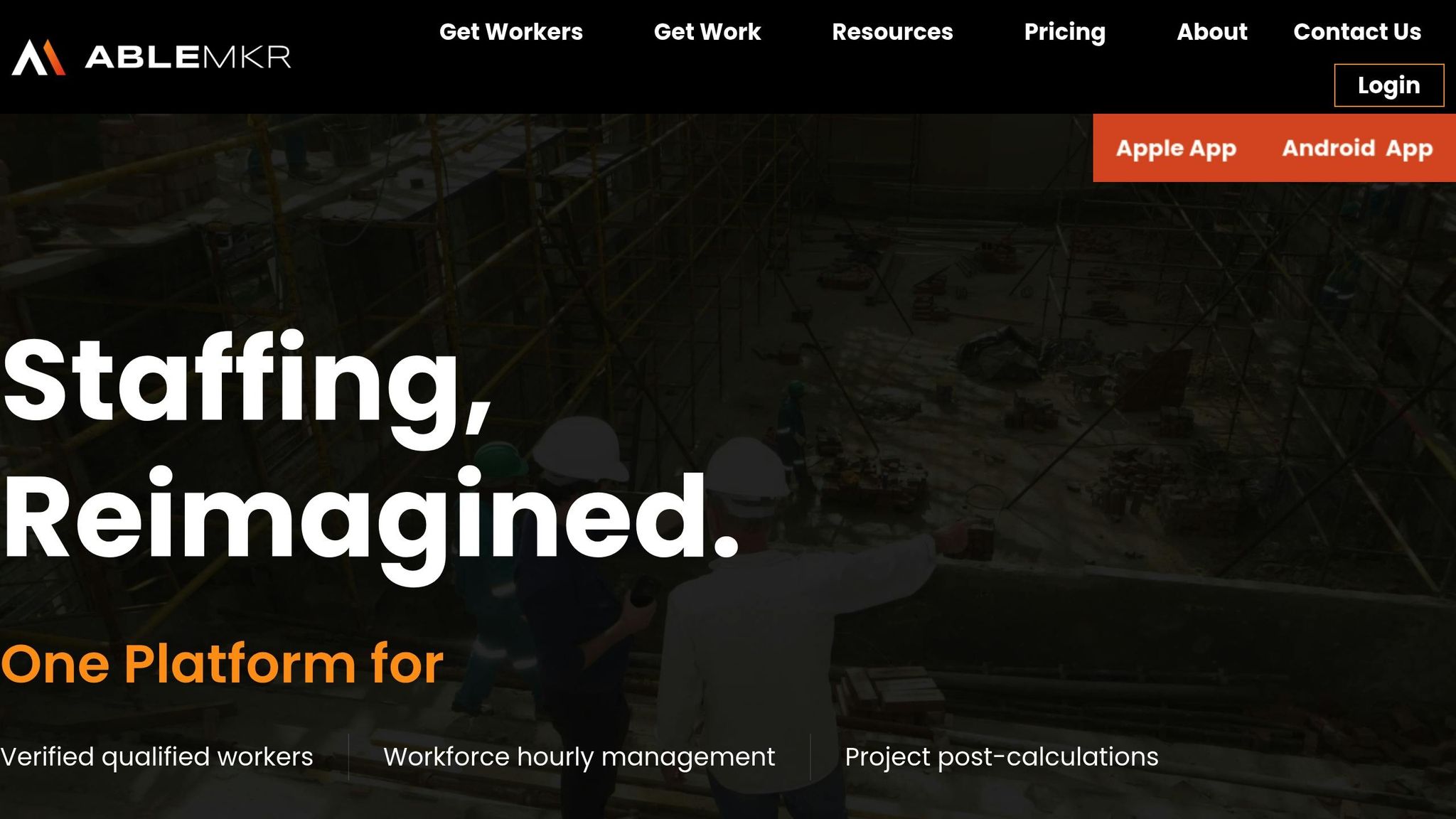
ABLEMKR exemplifies how cross-platform technology can tackle unique industry needs. Focused on the construction and energy sectors, ABLEMKR applies these innovations to streamline staffing processes and solve challenges specific to these fields. From verifying worker credentials to providing clear project cost calculations, the platform is designed with a mobile-first approach that fits seamlessly into the fast-paced realities of these industries.
The platform’s automated job-matching system connects workers – both skilled and unskilled – to relevant opportunities based on their qualifications, location, and availability. This automation reduces mismatches and simplifies candidate sorting. Workers receive instant notifications for jobs that fit their profiles, while employers can quickly access a pool of pre-screened candidates.
Tasks like invoicing and workforce management are simplified through real-time features, saving hours of manual effort. Project managers can track worker hours, calculate costs, and generate invoices automatically, cutting down on paperwork and minimizing billing disputes. The transparent cost structure ensures both employers and workers have a clear understanding of financial obligations, fostering trust and reducing surprises.
One of the platform’s standout features is its robust worker verification system. In industries like construction and energy, ensuring workers have the right skills and certifications is critical. ABLEMKR’s verified profiles, complete with ratings, work history, and credential checks, give employers confidence in their hiring decisions while helping qualified workers stand out in a competitive market.
With cross-platform accessibility, ABLEMKR allows construction supervisors and energy project managers to manage staffing directly from job sites using their mobile devices. Workers can update their availability, search for jobs, and communicate with employers on the go. This mobile-first design integrates smoothly into existing workflows, avoiding unnecessary disruptions.
ABLEMKR’s success highlights a larger trend: staffing solutions that address the entire hiring process. By creating a comprehensive ecosystem tailored to the construction and energy industries, ABLEMKR demonstrates how cross-platform technology can deliver efficiency while meeting the specific needs of demanding sectors.
FAQs
How do cross-platform apps verify worker credentials and track performance effectively?
Cross-platform apps rely on sophisticated verification tools to ensure worker credentials and performance records are trustworthy. Features like biometric authentication and real-time identity checks make it possible to confirm someone’s identity both quickly and securely. On top of that, many apps incorporate multi-factor authentication (MFA), adding an extra layer of protection to prevent unauthorized access.
These platforms also often connect with government or industry databases to instantly verify certifications and qualifications. By centralizing this process, employers gain confidence in the accuracy of worker profiles, which leads to smarter staffing decisions and a more seamless hiring experience.
How do cross-platform staffing apps help save costs and improve efficiency?
The Benefits of Cross-Platform Staffing Apps
Cross-platform staffing apps simplify operations and help businesses save money by relying on a single codebase that works across iOS, Android, and web platforms. This streamlined approach can cut development costs by up to 40% and speed up deployment times by around 35%. The result? Businesses can respond to market demands faster and more efficiently.
These apps also boost productivity by making communication and scheduling effortless. Whether you’re an employer or a worker, you can manage shifts, check schedules, and communicate in real-time – all from any device. This reduces administrative headaches and helps lower no-show rates. By making processes easier and more accessible, cross-platform apps deliver a smoother and more efficient staffing experience for everyone.
How do cross-platform apps with mobile access make staffing easier for employers and workers?
Cross-platform apps with mobile access make staffing much easier by keeping employers and workers connected and enabling quick actions. Employers can use their mobile devices to manage schedules, check worker availability, and fill open shifts in real time. This eliminates delays and helps ensure staffing decisions are made quickly and efficiently.
For workers, having mobile access means they can instantly check and accept job opportunities, confirm their schedules, and get updates on the go. This kind of convenience not only saves time but also keeps them engaged and satisfied by providing real-time information and the ability to act promptly. By cutting down on administrative work and simplifying communication, these apps help boost productivity and make staffing operations run more smoothly for everyone.


