
Crew retention in renewables usually breaks down for simple reasons: bad dispatch, weak onboarding, unstable schedules, missed certs, pay errors, and gaps between jobs.
If I had to sum up the article in one line, it would be this: workers stay when the job runs cleanly from assignment to next placement. The article argues that turnover is not just a hiring issue. It starts when a worker gets the wrong site, loses hours to delays, finds out a cert was missed, or gets paid late.
Here’s the short version:
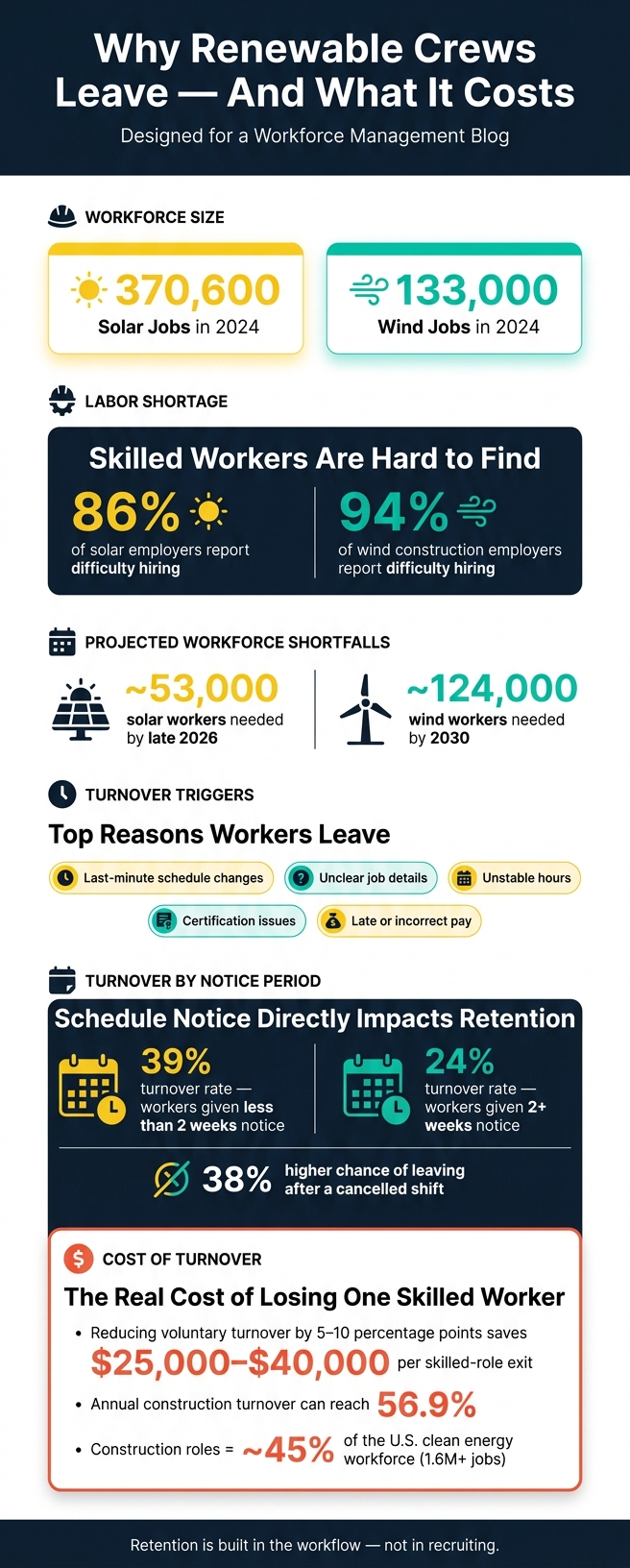
- Solar and wind jobs make up most renewable energy jobs, with about 370,600 solar jobs and 133,000 wind jobs in 2024.
- Labor is tight: 86% of solar employers and 94% of wind construction employers report trouble finding skilled workers.
- Future gaps are large: about 53,000 solar workers by late 2026 and 124,000 wind workers by 2030.
- Workers often leave because of last-minute changes, unclear job details, unstable hours, cert issues, and late pay.
- The fix is simple to describe: match the right worker, onboard them fast, give clear schedules, verify certs before travel, pay correctly, and line up the next job before the current one ends.
A few numbers stand out:
- Cancelled shifts can increase the chance a worker leaves by 38%.
- Workers with less than two weeks of notice had a 39% turnover rate, versus 24% for those with at least two weeks.
- Cutting voluntary turnover by 5 to 10 percentage points over 12 to 24 months can save $25,000 to $40,000 per skilled worker who would have left.
The article’s main point is clear: retention is built in the workflow. If dispatch, onboarding, scheduling, payroll, and redeployment are handled in one place, workers are less likely to lose trust and move on.
Renewable Energy Workforce: Retention Stats & Cost of Turnover
From Awareness to Employment: Co-Designing Workforce Activation for the Clean Energy Transition
sbb-itb-aa28329
Fix Dispatch First to Cut Idle Time and No-Shows
A lot of renewable projects still handle dispatch through calls, texts, emails, and spreadsheets. That sounds manageable until one update slips through the cracks.
Here’s what that looks like in the field: a worker is told to report on Monday, then later gets an email saying mobilization has been delayed. Nobody updates the spreadsheet. The worker shows up ready to go and loses a day without pay. That kind of miss isn’t small. It costs workers money and chips away at trust.
And when that keeps happening, experienced workers drift to crews that run a tighter ship. That’s why dispatch should be the first thing to fix. The simple move is to put every dispatch input in one place.
Replace Fragmented Crew Assignment with Real-Time Matching
Bring these four dispatch inputs into one system:
- availability
- credentials
- home range
- project timeline
When those inputs sit together, a dispatcher can run one search – like finding all tower climbers with valid certifications within 150 miles who are free starting September 9 – and get a usable answer in minutes instead of hours.
ABLEMKR matches pre-vetted workers to energy and renewable projects based on certifications, safety training, availability, and location. Workers keep verified profiles. Employers set project needs. The matching engine surfaces qualified workers right away and sends assignment offers straight to workers’ phones. Because compliance data is built into the workflow, only workers who meet the job’s safety requirements get dispatched. That cuts the risk of sending someone to a site only to turn them away because a credential was missed.
The gains show up fast. Platforms that centralize scheduling and dispatch have been shown to save dispatchers 8–12 hours per week that would otherwise go to manual rescheduling, and GPS-based tools have cut no-shows by about 35% in documented field service operations.
Manual Dispatch vs. Platform-Based Dispatch: A Side-by-Side Look
| Dimension | Manual Dispatch | Platform-Based Dispatch |
|---|---|---|
| Scheduling speed | Hours to days; requires multiple calls and spreadsheet updates | Minutes; digital matching surfaces qualified workers fast |
| Reassignment effort | Individual calls and texts to each affected worker; high risk of missed messages | Push notifications to affected workers; responses tracked in one place |
| Crew utilization | Workers are often overlooked or double-booked; utilization data is scattered | Real-time visibility helps avoid double-booking and surfaces idle workers |
| Communication clarity | Details split across texts, calls, and emails; inconsistent information | Assignments delivered in a single mobile interface with full job details |
| Worker confidence | Erodes after repeated last-minute changes and unpaid idle days | Builds as confirmed assignments consistently hold |
When confirmed assignments stay accurate, workers trust the schedule and stay on the roster. And once dispatch stops feeling chaotic, onboarding and schedule control get a lot easier.
Speed Up Onboarding and Give Workers Clear Schedules
Once dispatch is clean, onboarding and scheduling become the next big retention test. Paper forms, gate delays, and fuzzy first-day instructions send a bad message fast. They tell workers the jobsite is disorganized. And once the right worker is dispatched, the next question is simple: does the first-day process move just as fast?
Use Digital Onboarding to Shorten Time-to-Field
A renewable onboarding packet usually includes tax, identity, direct deposit, licensing, and safety forms. On paper, that can drag site access out by days. For workers, that often means lost paid hours before they even start earning.
Digital onboarding shifts that work to a worker’s phone before they travel to the site. Workers can upload ID documents for I-9 verification, complete tax forms, and sign safety acknowledgments from wherever they are. HR can review and approve everything ahead of time, so workers arrive already cleared.
ABLEMKR builds this into its worker profiles. Once a worker’s certifications, safety records, and trade documentation are verified and stored, they can be mobilized to a new project with little repeat work. That cuts down on duplicate onboarding and gets people field-ready faster. One energy sector case study found that using integrated scheduling software across 15 sites cut missed shifts by 78% and reduced regulatory violations by 92%.
The first month carries a lot of weight. Seventy percent of workers decide whether a job fits within 30 days, and employers have about 44 days to influence whether a new hire stays. A smooth onboarding experience sends a clear signal: this operator has its act together.
After clearance, the schedule has to be just as clear.
Give Workers Reliable Schedules and Change Alerts
Fast onboarding falls apart if workers can’t trust the schedule that comes next. They need the basics up front:
- Start date
- Shift times
- Site location
- Project duration
- Overtime expectations
- Change alerts
When those answers are vague, workers start looking elsewhere. Predictable income matters, and another offer can win simply because it feels more stable.
Schedule instability has a direct cost. Analysis of 1,827 hourly workers found that cancelled shifts raise the chance of leaving an employer by 38%, and workers with less than two weeks’ notice had a 39% turnover rate, compared with 24% for those who got at least two weeks of advance notice.
ABLEMKR tackles that head-on. Workers can see upcoming shifts, jobsite locations, expected duration, and overtime patterns in the mobile app. They also get push notifications the moment anything changes. No phone tag. No mixed messages. Just one place to check when a schedule moves.
That contrast is easy to see in the first week on the job.
Paper Onboarding and Reactive Scheduling vs. Digital Workflows: A Side-by-Side Look
| Dimension | Paper-Based & Reactive Scheduling | Integrated Digital Workflows |
|---|---|---|
| Onboarding time | Several days; workers travel to complete forms; errors require in-person corrections | Reduced to hours for repeat hires; mobile forms and pre-approved profiles allow workers to be field-ready before travel |
| First-week no-show risk | Higher; unclear start dates and incomplete paperwork cause confusion and lost trust | Lower; workers see confirmed shifts in the app and know they are cleared to work |
| Worker confidence in schedule | Low; cancelled or shifted assignments erode trust quickly | High; workers see confirmed shift details and receive immediate change alerts |
| Day-one worker readiness | Mixed; workers often arrive without full clearance or clear instructions, wasting paid hours | High; workers arrive with verified credentials, completed documentation, and clear first-day instructions |
Verify Certifications, Pay on Time, and Plan the Next Job
Once schedules settle down, retention comes down to what happens off the jobsite: credentials, pay, and redeployment. After dispatch and onboarding, three controls matter most: verified certifications, accurate payroll, and a clear next assignment.
Check Certifications Before Dispatch, Not After Arrival
Certification checks should happen during dispatch, not when a worker is already on site and the crew is stuck sorting out a problem.
Solar work may call for a journeyman electrician license. Wind tower climbers need GWO modules. Crane and aerial lift work may call for NCCCO certification. Many sites also require OSHA 10 or OSHA 30.
When a worker shows up with a missing or expired credential, everybody loses. The worker misses paid hours, and the project loses time. Pre-dispatch verification helps stop that before it starts.
ABLEMKR keeps verified worker profiles that track certification type, issuing authority, and expiration dates. Dispatchers see only workers whose credentials fit the job and are still valid. Automated alerts flag upcoming expirations at 30, 60, and 90 days, so a GWO card close to expiring doesn’t turn into a last-minute crew shuffle.
Qualified crews can still walk if payroll turns into a mess.
Make Payroll Accuracy Part of the Retention Plan
Late pay and pay disputes are a direct cause of crew loss. Research on construction payment delays shows that when payments run late, 56% of contractors move workers to other projects, 21% pause work entirely, and 6% lose workers for good. Payment mistakes also make workers less likely to come back to the same operator.
For renewable field workers, the usual trouble spots are missing travel time, mis-coded per diem, and overtime that never gets recorded. A cleaner process helps. Workers log hours on mobile, geofenced check-ins confirm site presence, and approved time moves straight into payroll. That cuts re-entry mistakes and lowers disputes.
Payday isn’t the finish line. Retention carries into the next assignment.
Plan the Next Job Before the Current One Ends
Start redeployment before demobilization. That gap between projects is where renewable crews often slip away.
Track end dates by role, then match workers to upcoming openings based on certification, travel radius, pay expectations, and shift preferences. ABLEMKR links worker availability and verified credentials to a pipeline of projects across the U.S., which lets operators pre-book experienced crews and cut idle time between assignments. Pre-booked next jobs help keep proven teams together across multiple projects. Reducing voluntary turnover by 5 to 10 percentage points over 12 to 24 months can save $25,000 to $40,000 per skilled-role exit.
Credential Tracking, Payroll Accuracy, and Job-to-Job Planning: Side-by-Side Comparisons
| Dimension | Manual Certification Tracking | Platform-Based Credential Verification |
|---|---|---|
| Expired-cert risk | High; reminders depend on individual managers; workers arrive on site with lapsed credentials | Low; automated alerts at 30/60/90 days before expiration prevent last-minute surprises |
| Placement accuracy | Dispatchers work from outdated or incomplete information; unqualified workers get assigned | Dispatchers only see workers whose credentials match the role and are currently valid |
| Dimension | Fragmented Payroll Process | Integrated Time and Payroll Workflow |
|---|---|---|
| Dispute frequency | Higher; missing hours, overtime errors, and per diem miscodes generate ongoing back-and-forth | Lower; digital time capture and clear rule engines reduce calculation errors at the source |
| Administrative burden | Heavy for both field supervisors and back-office staff managing corrections | Reduced; approvals, records, and calculations are handled in one system |
| Dimension | One-Off Staffing | Job-to-Job Placement Planning |
|---|---|---|
| Downtime between assignments | Longer; workers are brought in only when a project need arises, creating gaps | Shorter; next assignment is identified before demobilization, minimizing idle periods |
| Crew continuity | Low; experienced teams are reassembled from scratch each time | High; operators retain proven workers across multiple projects |
Conclusion: Build a Retention System for Renewable Crews
Put it all together, and the pattern is pretty clear: renewable crew retention is an operations problem, not a recruiting problem. People don’t just leave because there aren’t enough hires coming in. They leave when dispatch, onboarding, scheduling, credential checks, payroll, and redeployment fall apart.
That friction adds up fast and turns into expensive churn. Annual turnover in construction can reach 56.9%, and construction roles account for about 45% of the U.S. clean energy workforce, or more than 1.6 million jobs. When turnover stays high in construction-heavy clean energy roles, project costs go up and delay risk goes with them.
The answer is one connected workflow: match, onboard, schedule, verify, pay, and redeploy.
A single system makes that workflow repeatable. ABLEMKR brings dispatch, onboarding, compliance, payroll, and redeployment into one workflow for renewable crews.
Crews stay when operators remove friction at every step, consistently, project after project.
FAQs
Where should we start to improve crew retention?
Start with onboarding and payroll. If paperwork drags, credentials haven’t been checked, or a worker’s first paycheck is wrong, trust can take a hit fast. And once that happens, morale usually slips too.
Put your attention on the basics first:
- Automate documentation so forms don’t pile up or get missed
- Verify credentials before day one
- Keep payroll accurate and on time
Then look past the first week. Long-term retention often comes from giving people a clear path forward, chances to build new skills, and a sense that their work matters. In renewable energy, that last part matters a lot. People want to know they’re not just filling a role – they’re helping build something bigger.
How do schedule changes affect worker turnover?
Frequent or sudden schedule changes can push turnover up because they disrupt project stability. When people don’t know when they’ll work, the job can start to feel temporary. Over time, that uncertainty can wear down trust.
Clear, timely updates can help. So can giving workers more control over their schedules through shift swaps, availability blocking, and mobile access. ABLEMKR supports this with real-time, transparent schedule communication.
Why does job-to-job planning matter so much?
Job-to-job planning keeps work moving. That matters because it helps projects stay on schedule and cuts down on costly downtime.
When companies line up the next job ahead of time and make site transitions smoother, skilled laborers are more likely to stay engaged and keep earning a steadier paycheck. It also shows workers that the company is thinking past the current project and taking their career path seriously.
For employers, the upside is simple: less last-minute hiring and a better chance of keeping qualified crews ready as project needs shift.


