
If your job runs more than 6–8 weeks and workers spend 1+ hour each way getting to site, a man camp will often beat hotels on total cost and crew control. Hotels are still the better pick for small crews, short jobs, and city work where rooms are close to the site.
Here’s the short version:
- Hotels fit short-term, urban, and mobile projects
- Man camps fit remote, larger, and longer jobs
- Hotel rates were about $158–$162 per room per night in mid-2025, before taxes, parking, and meals
- Man camps often run about $120–$200 per worker per day with lodging, meals, laundry, and utilities included
- Commute time can cost workers 1–2 hours per day
- Near-site camps can cut that to about 5–10 minutes, which means more rest and less fatigue
- Hotels give more privacy
- Man camps give more site control, stricter rules, and meal service built around shifts
What I’d look at first is simple:
total daily cost per worker, commute time, crew size, privacy needs, food access, and safety control.
Joey Trappey l Century Lodging l EP. 52
sbb-itb-aa28329
Quick Comparison
| Factor | Hotels | Man Camps |
|---|---|---|
| Cost structure | Per room, per night | Per person, per day |
| Extra costs | Taxes, meals, parking, mileage, per diem | Often bundled |
| Commute | Often 30–60+ minutes | Often on-site or near-site |
| Privacy | Higher | Lower |
| Food | Usually off-site | Usually on-site |
| Site control | Lower | Higher |
| Best fit | Small crews, city jobs, short work | Remote jobs, big crews, multi-week or multi-month work |
If you’re planning crew lodging, I’d treat this as a jobsite decision, not just a booking choice. The right setup can cut travel time, steady daily costs, and make shift starts easier to manage.
Hotels for Temporary Construction Lodging
Hotels make sense for small crews, short jobs, and urban projects where workers are already close to the site. They’re also a good fit when a crew needs to move between locations. One of the biggest upsides is flexibility. Rooms can usually be booked, changed, or canceled fast when schedules shift. That kind of flexibility helps on short jobs, but it also means more travel time and less control.
Hotel Costs, Commute Times, and Worker Comfort
Hotel lodging usually includes the nightly room rate, taxes, and sometimes parking or amenity fees. Meals are often separate, so crews usually depend on a per diem instead of bundled dining. Centralized booking tools can help lock in negotiated rates, roll billing into one system, and track costs by job number.
The hidden cost is commute time. A 30- to 60-minute drive each way can turn into as much as two hours per worker per day. That time adds up fast. It can wear people down and create schedule risk.
Hotels do have a comfort advantage. After a long shift, a private room and familiar amenities can give workers a real break from the jobsite. On longer assignments, that separation can matter.
Site Control and Safety Oversight Limits at Hotels
That comfort comes with a tradeoff: less employer control. Hotels are third-party environments, which means the property sets the rules. Contractors have limited ability to enforce crew standards or monitor activity.
For short urban jobs, that may be acceptable. But on projects that need tighter site control, it becomes a clear limit.
Man Camps for Remote and Large-Crew Projects
When a remote project needs a big crew on site, hotels stop making much sense. Hotels scatter workers across town. Man camps keep housing close to the job and tied to the work schedule.
Man camps – on- or near-site housing built for crews – work well for remote oil and gas, pipeline, mining, and large civil jobs where local lodging is limited and long drives add risk. That tighter setup matters even more during shutdowns and turnarounds, when a late arrival or poor sleep can throw off the whole work sequence. For shutdowns and turnarounds, camps keep arrivals more predictable and crews closer to shift start times.
Bundled Pricing, Meals, and Near-Site Productivity
The cost edge mostly comes from bundled pricing and shorter commutes. Man camps often use a per-person, per-day bundled rate that covers lodging, utilities, three daily meals, housekeeping, and laundry. That makes budgeting simpler because each worker-day has a fixed cost.
The productivity upside is pretty direct. Near-site housing can shrink commute time from 30–60+ minutes each way to a 5–10 minute shuttle ride or even a short walk. In plain terms, that can give workers back up to 90 minutes a day for rest and recovery.
Meals are usually planned around shift schedules. In well-run camps, hot food is available early in the morning and late at night so day and night crews can eat on schedule. That means workers do not need to hunt down meals off-site before an early start or after a late shift.
Camp Rules, Privacy Tradeoffs, and Site Control
The tradeoff is a more structured place to live. Man camps run with controlled access, strict conduct standards, and zero-tolerance policies for drugs and alcohol. Those rules usually line up with the project’s own HSE requirements. Visitor limits, ID check-ins, and quiet hours are common. That setup also makes safety briefings, emergency response, and rule enforcement easier.
For workers, the biggest downside is less privacy and fewer personal choices. Rooms are often smaller than hotel rooms and may be double-occupancy. Dining choices are also limited to what the camp serves. Crews used to remote rotations often accept that tradeoff without much fuss. For others, it can feel more like an institution than a hotel. Planners can ease some of that friction with steady Wi-Fi, fitness space, and more menu variety.
Hotels vs. Man Camps: Direct Comparison
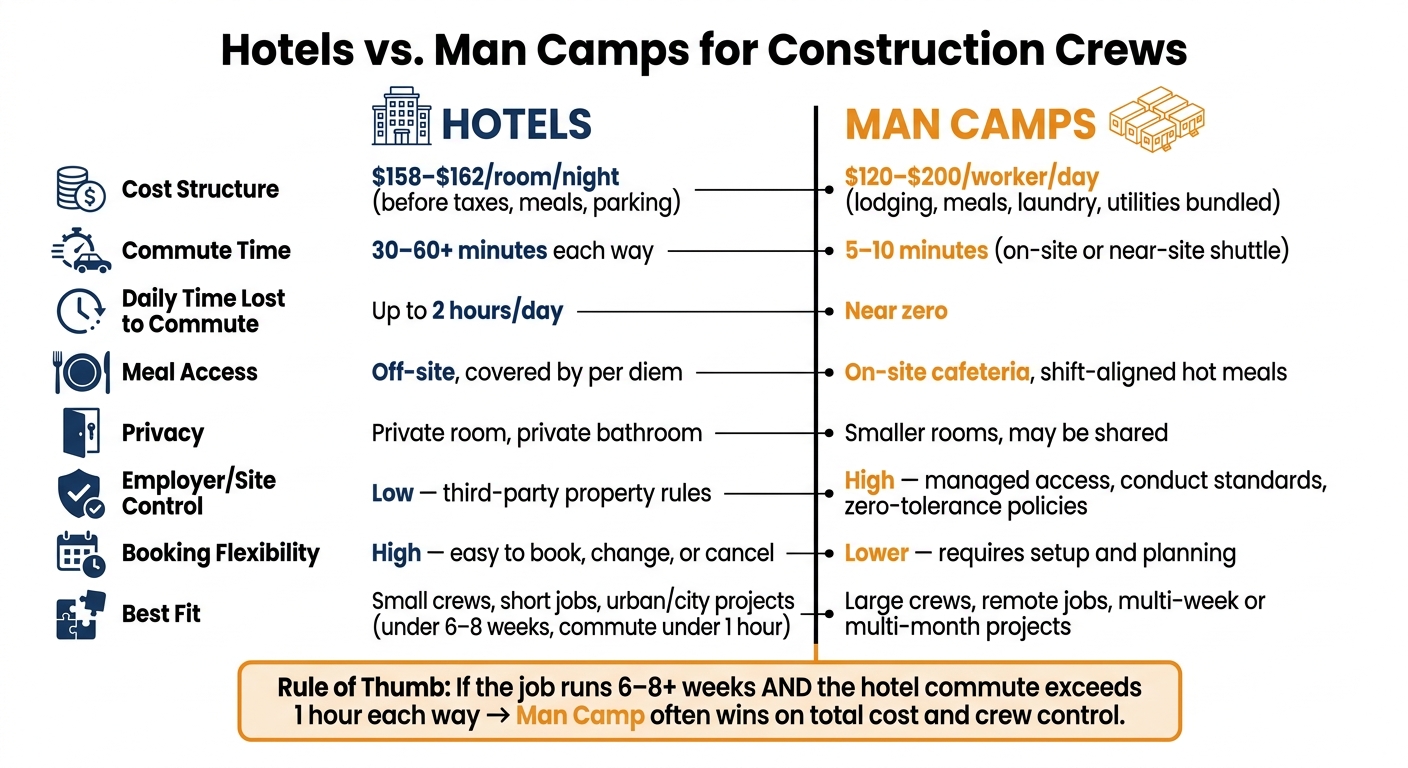
Hotels vs Man Camps for Construction Crews: Cost, Commute & Control
Once you put these two options side by side, the trade-offs get pretty clear. The decision usually comes down to four things: cost, distance from the jobsite, crew size, and how much control the project team needs.
| Factor | Hotels | Man Camps |
|---|---|---|
| Pricing model | Per room, per night, plus taxes and separate meals | Per person, per day, often bundled with lodging, meals, and services |
| Meal access | Usually off-site, with meals covered by per diem or expense reimbursement | On-site cafeteria or catered meals aligned with shift schedules |
| Commute distance | Often 30–60 minutes or more from remote jobsites | Usually on-site or within a short shuttle ride |
| Worker privacy | Typically private rooms with independent bathrooms | Ranges from private pods to shared units; less privacy overall |
| Safety control | Lower employer control in a third-party setting | Higher control with managed access and site-specific rules |
| Ideal project length | Short-term, urban, or dispersed work | Remote, larger crews, multi-week or multi-month projects |
Total Cost, Travel Time, and Productivity
The hotel room rate never tells the full story. Once you add meals, mileage, per diem, and daily travel, the cost per worker can climb well past the listed nightly rate. By contrast, camp pricing often wraps lodging, meals, and site services into one daily charge. In many remote setups, all-in camp costs usually land around $120–$200 per worker per day.
Travel time changes the math even more. A worker driving 30 to 60 minutes each way to a remote site can lose 1–2 hours of non-productive time every day. And after a 10- or 12-hour shift, that extra drive can mean more fatigue and more safety risk. That’s why many teams use a simple rule of thumb: if the job lasts more than 6–8 weeks and the hotel commute is more than one hour each way, a man camp often wins on total cost.
Worker Experience, Food Access, and Safety Compliance
Hotels give workers more freedom. They usually get private rooms, their own bathrooms, their own thermostat, and the option to come and go after a shift. For some crews, that setup feels more normal and more comfortable.
But there’s a flip side. Employer oversight more or less ends at the hotel door. Sleep routines, conduct, and substance use are mostly outside direct site control. Man camps work differently. They trade some personal freedom for more structure. Access is managed, conduct rules are enforced, and meal service is built around shift timing so day crews and night crews can both eat on schedule.
That matters more than it might seem. On 12-hour shift sites, the full day can stretch to 13–14 hours once commute and prep time are included. In places like refineries, chemical plants, and high-voltage utility projects, camps can make HSE enforcement much easier than hotels.
Best Fit for Shutdowns, Turnarounds, and Long Projects
Project type is often the fastest way to sort this out.
| Project Type | Crew Size | Duration | Location | Better Fit |
|---|---|---|---|---|
| Short maintenance outage | Under 20 workers | Under 1–2 weeks | Urban or non-remote | Hotels |
| Refinery or plant turnaround | 150–500+ workers | 3–8 weeks | Rural or remote | Man camp |
| Long remote build or spread work | Larger crews | Multi-month | Remote corridor | Man camp |
| Urban infrastructure or road work | Variable | Weeks to months | City-adjacent | Hotels |
| Remote substation or mine development | Larger crews | Multi-month | Rural or semi-remote | Man camp |
For small crews on short urban jobs, hotels are usually the simple choice. They’re easy to book, they don’t require setup, and local room supply can often handle the crew size without much trouble.
For big shutdowns, turnarounds, and remote long-duration builds, man camps tend to make life easier. You get tighter logistics, steadier day-to-day costs, and more control over the site conditions that high-risk work calls for.
Conclusion: Choosing the Right Lodging Model for Your Crew
Choose housing based on project length, crew size, distance to site, and how much control you need. That shifts the decision away from personal preference and puts it where it belongs: on project conditions.
Hotels work well for short jobs in urban areas. They give workers private rooms and more booking flexibility. Man camps make more sense for remote jobs with tighter site control because they keep crews close to where the work happens.
Key Factors to Carry Into Project Planning
Run the numbers on total cost, not just the nightly rate. Once you add per diem meals, transportation, and lost productive time, the picture can change fast. A camp rate may look higher at first glance, but it can end up costing less after all the extra expenses are included.
Treat commute fatigue like a real line item. A 60-minute one-way drive after a 12-hour shift isn’t just a hassle – it’s a safety concern. Housing near the site gives workers that time back as rest, which can help productivity and cut fatigue-related risk.
Plan housing around the full crew schedule, not just the room rate.
FAQs
How do I compare all-in hotel and camp costs?
Compare total project cost, not just the daily lodging rate. That means adding both direct and indirect expenses.
For hotels, look at:
- Nightly room rates
- Meal per diems
- Repeat travel costs, such as fuel or mileage reimbursement
That gives you a clearer view of what the stay will actually cost over time.
For man camps, weigh upfront mobilization and setup costs against savings that may show up later. Those savings can come from lower daily transportation costs, less fuel use, and less downtime. You should also factor in maintenance, utilities, and any effect on productivity tied to worker morale.
When does a man camp make more sense than a hotel?
A man camp often makes more sense for remote projects where commercial housing is limited or unavailable. It tends to work best for large, long-term jobs that need on-site amenities and a fast response when operational issues come up.
Compared with off-site lodging, a camp can cut commute time, ease worker fatigue, and lower safety risks. It also gives employers more control over day-to-day logistics and keeps crews close to the job site.
How does lodging choice affect safety and fatigue?
Lodging choice has a direct effect on safety and fatigue. Where people stay shapes commute time, sleep, and how well they recover between shifts.
Housing close to the job site cuts travel time, lowers strain, makes shift scheduling easier, and allows a faster response in an emergency. That matters more than it might seem at first glance. A short trip back to lodging can mean more rest, less stress, and fewer chances for something to go wrong on the road.
Long commutes can wear workers down, especially on rough roads or during bad weather. That extra travel adds physical strain and increases risk before and after demanding shifts.
Comfort also plays a big part. Lodging with rest areas, kitchens, and laundry gives workers a better chance to recover, reset, and get ready for the next day.


