
Hiring skilled oil and gas workers quickly is a challenge due to workforce shortages, certification requirements, and shifting industry trends. Here’s how you can speed up the process:
- Define Roles and Certifications: Be specific about job responsibilities and required certifications (e.g., BOSIET, H2S Awareness, IWCF).
- Use Specialized Platforms: Post jobs on platforms like ABLEMKR to connect with pre-vetted workers who meet your criteria.
- Automate Screening: Leverage tools that match candidates based on certifications, location, and availability, reducing manual effort.
- Streamline Onboarding: Use digital tools for compliance checks, payroll, and real-time worker tracking.
- Deploy Efficiently: Utilize GPS-enabled scheduling and timecards to manage on-site teams effectively.
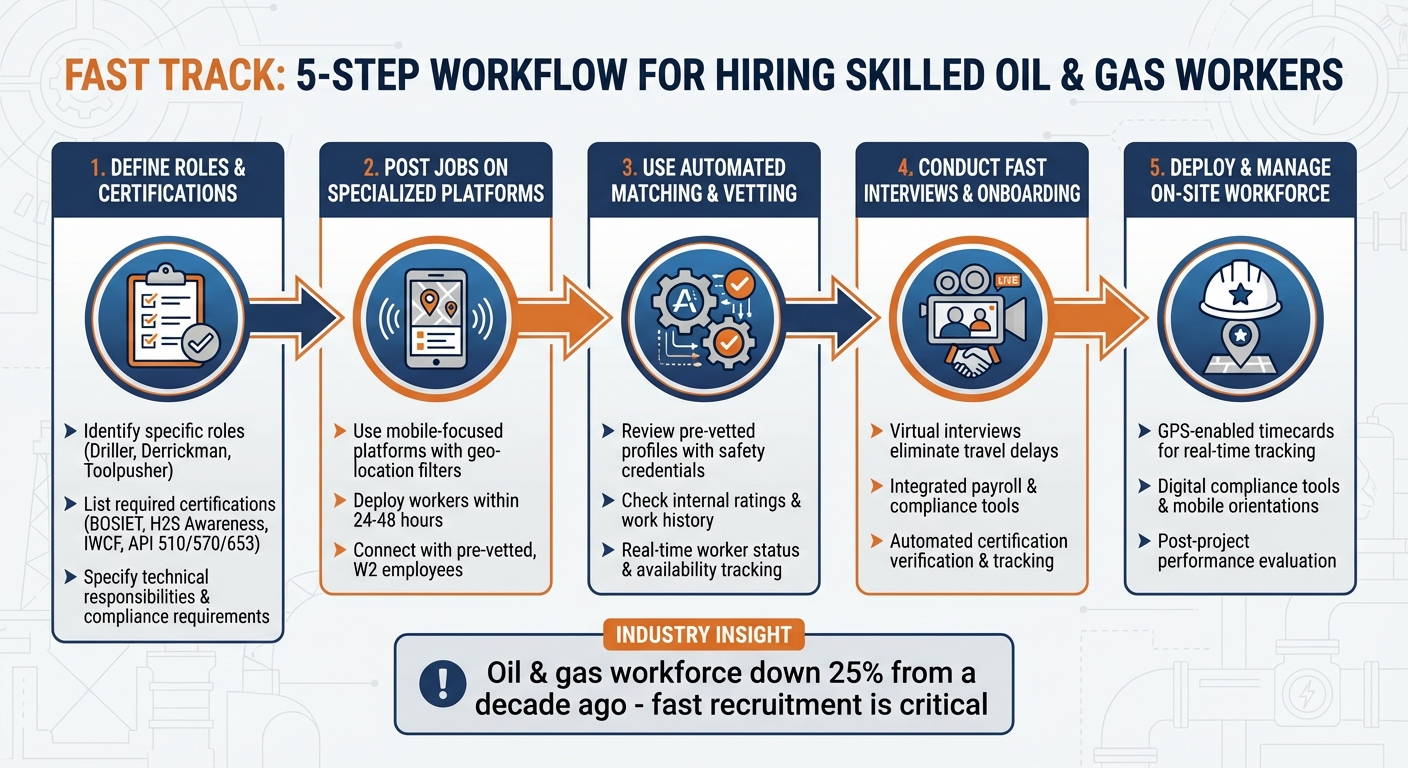
5-Step Process to Hire Skilled Oil and Gas Workers Fast
Step 1: Define Job Requirements and Required Certifications
Identify Key Roles and Responsibilities
Work closely with senior engineers and project managers to outline specific roles – such as driller, derrickman, or toolpusher – to ensure everyone knows their responsibilities. This clarity not only boosts productivity but also keeps safety a top priority. Each position comes with unique duties that directly impact the efficiency and safety of operations.
When it comes to technical roles, be as detailed as possible about the tasks involved. For example, a production engineer is responsible for monitoring wells after drilling and finding ways to improve extraction rates. On the other hand, a reservoir engineer focuses on estimating recoverable oil or gas volumes and overseeing operations to maximize recovery. If inspectors are part of the team, specify exactly what they’ll inspect. For instance, API 510-certified inspectors handle pressure vessels, API 570 inspectors focus on piping systems, and API 653 inspectors specialize in storage tanks. Providing this level of detail upfront helps attract the right candidates and ensures compensation aligns with the job’s demands.
Once roles are clearly outlined, include the certifications needed to meet compliance standards.
List Required Certifications for Compliance
Each project comes with its own set of safety and compliance requirements. For example, roles involving maritime facilities often require a TWIC card, while offshore positions typically demand BOSIET certification. If the project involves sour gas, H2S Awareness training is essential. For inspectors, certifications like API 510, API 570, or API 653 are crucial, while drilling roles often require IWCF or IADC Well Control credentials.
For specialized positions, the certifications get even more specific. Certified welders working on process piping may need ASME/API certifications, and heavy equipment operators should hold valid licenses for machinery like cranes, forklifts, or refinery-specific equipment. Don’t forget to clearly list required training, such as OSHA 10 or OSHA 30, in job postings. This transparency can help avoid unnecessary credentialing costs.
sbb-itb-aa28329
Step 2: Post Jobs on Specialized Platforms
Connect with Skilled Workers Using Digital Tools
After defining your job requirements and certifications, the next step is posting the job to reach qualified candidates. Mobile-focused platforms like ABLEMKR make this process faster and more efficient. These platforms let you post jobs with features like geo-location filters, certification requirements, and real-time availability of workers. By skipping traditional temp agencies, you can directly connect with pre-vetted professionals who meet your needs, often deploying workers within just 24 to 48 hours. This approach simplifies the hiring process by instantly matching your criteria with available candidates.
Using automated matching, these platforms align your specific job details – such as required trades, certifications like BOSIET or H2S Awareness, and project timelines – with workers who are ready to go. You can also filter candidates based on safety credentials (OSHA 10/30), trade-specific licenses, and specialized training, ensuring you only see qualified applicants. This eliminates unnecessary back-and-forth communication and speeds up hiring. Plus, workers on these platforms are typically W2 employees, which means they already have workers’ compensation and general liability coverage in place.
Write Job Listings That Attract the Right Talent Quickly
A well-crafted job post can help you find skilled workers in no time. Start by clearly listing all mandatory certifications upfront, whether it’s API 510 for pressure vessel inspectors or IWCF Well Control for drilling teams. This ensures that only candidates with the necessary qualifications apply, saving you from sorting through irrelevant resumes. Including transparent pay rates in your listing can also help avoid delays caused by negotiations, making it easier to attract candidates who are ready to commit.
Don’t forget to include details about project timelines and logistics. The more specific your job post, the quicker you’ll connect with workers who are ready to hit the ground running. Platforms like ABLEMKR simplify the entire process by offering tools to manage everything from posting job requirements and reviewing worker ratings to tracking daily timecards and handling payroll – all through a single mobile app. With your job listings optimized, you’ll be ready to move on to screening and onboarding candidates efficiently.
Step 3: Use Automated Matching and Vetting Systems
Speed Up Candidate Selection with Pre-Vetted Profiles
Once you’ve crafted precise job postings, automated matching systems take over to simplify the candidate screening process. Platforms like ABLEMKR maintain pre-vetted profiles that include work history, safety credentials, and supervisor ratings. This means you can quickly review qualified candidates through the mobile app, checking who is available and ready to step in.
The platform also features an internal rating system, giving you insights into a worker’s reliability and past performance before making a hiring decision. For positions that demand specific certifications, the system automatically filters candidates to ensure only those with the required credentials appear. Plus, you can opt for flex-to-hire arrangements, allowing you to assess a worker’s skills on-site before committing to a full-time placement.
With these filtered profiles and tools, the hiring process becomes quicker and more efficient, letting you focus on the final selection with confidence.
Make Faster Decisions with Real-Time Worker Status
What truly sets modern hiring platforms apart is the ability to track worker status in real time. ABLEMKR provides a clear view of which workers are currently available, their location, and when they can start. This eliminates frustrating back-and-forth phone calls or delays. In fact, most job postings attract qualified applicants within 24 to 48 hours, and same-day placement is often an option for urgent needs. As ABLEMKR promises, "Our automated matching system connects you with available workers in your area. Post today, get crews tomorrow".
The platform’s GPS-enabled tools go a step further by confirming a worker’s availability and location in real time. This means you’ll know if someone is on their way or ready to be deployed immediately. Such transparency minimizes the risk of no-shows, which is crucial for high-pressure projects like last-minute shutdowns or remote pipeline repairs. Additionally, all workers on the platform are classified as W2 employees, meaning they’re already covered by workers’ compensation and general liability insurance. This not only simplifies compliance but also allows you to focus on staffing your project without unnecessary delays.
Step 4: Conduct Fast Interviews and Simplify Onboarding
Use Virtual Interviews to Screen Candidates Faster
Once you’ve pinpointed qualified candidates using automated matching, the next step is conducting interviews quickly and effectively. Virtual interviews are a game-changer – they eliminate travel delays and let you evaluate several candidates in just one day. Tools like ABLEMKR’s mobile platform make this process even smoother by enabling direct messaging, quick interview scheduling, and easy access to candidate profiles, including resumes, safety certifications, and drug test results.
Structured questions are key to assessing both technical skills and behavior. For oil and gas roles, it’s helpful to involve senior engineers or project managers in crafting questions that reflect real-world challenges, such as handling pressure in critical situations or working with specific equipment. Pre-interview questionnaires can also help filter out candidates lacking essential certifications like BOSIET or Well Control, saving time by ensuring you’re only interviewing those who meet your exact requirements. This approach significantly cuts down the screening process.
After narrowing down your candidate pool through efficient interviews, the focus shifts to getting your team onboarded and ready to work.
Speed Up Onboarding with Integrated Payroll and Compliance Tools
Following the fast-paced interview process, onboarding becomes the next priority. Integrated tools, like those mentioned earlier, help eliminate unnecessary delays. Once you’ve chosen the right candidates, platforms such as ABLEMKR provide a centralized system where workers can upload their certifications to a verified repository. A dedicated vetting team checks these certifications against issuing authorities, while automated compliance tracking monitors expiration dates for credentials like H2S Awareness or API certifications. The system even flags upcoming renewals, helping you avoid last-minute scrambles to update credentials.
Since workers are classified as W2 employees, you sidestep the legal challenges tied to contractor classification. The platform’s integrated payroll system simplifies payment processing by digitizing time cards through a mobile app, reducing administrative work and ensuring timely payments.
"An EOR takes care of payroll, benefits, onboarding, and compliance, turning a once-complicated process into a simple, strategic move that can give you a competitive edge." – MBO Partners
Step 5: Deploy and Manage On-Site Workforce
Manage On-Site Teams with Real-Time Scheduling Tools
Once you’ve streamlined hiring and onboarding, the next critical step is managing your on-site workforce effectively. Swift deployment is key, and tools like real-time scheduling and digital compliance platforms can make all the difference in maintaining project momentum.
Using GPS-enabled timecards, you can automate the tracking of workers’ locations and hours. This not only reduces administrative headaches but also minimizes errors, giving supervisors a clear, real-time view of who’s on-site and for how long. It’s a game-changer for keeping projects on track.
Digital compliance tools also simplify the process of meeting safety and certification requirements. Workers can store certifications – like H2S Awareness or BOSIET – in a digital wallet. This allows them to complete mandatory orientations directly from their mobile devices, saving time and reducing delays. As Jeff Carper, Sr. Health & Safety Specialist at Summit Midstream Corporation, explains:
"That Empower app is great. It’s common that people show up without taking the orientation. Now we don’t have to send people home, which helps prevent delays with jobs".
By leveraging these digital tools, you ensure that your teams are not only deployed efficiently but are also operating under a system that enhances compliance and accountability. With teams in place, the next focus is on evaluating their performance to refine future processes.
Post-Project Performance Evaluation
Evaluating performance after a project wraps up isn’t just about quality control – it’s also a smart way to improve staffing decisions for the future. Modern tools now allow for data-driven reviews, offering objective insights that go beyond word-of-mouth feedback.
Metrics like GPS-tracked timecards and supervisor ratings provide a clear picture of each worker’s punctuality, on-site presence, and overall job performance. These insights are invaluable when making flex-to-hire decisions, ensuring you bring back the most reliable and effective team members for future projects .
A Site Superintendent from a General Contractor summed it up well:
"The app made managing daily timecards and weekly payroll simple, saving us countless admin hours".
Conclusion
Bringing skilled oil and gas workers on board quickly without compromising quality is entirely possible. By following these five key steps – defining your requirements, posting on industry-specific platforms, leveraging automated matching tools, conducting efficient interviews, and utilizing real-time deployment tools – you can significantly reduce hiring timelines while maintaining high standards for safety and compliance. Together, these steps create a hiring process that’s both efficient and effective.
With the oil and gas workforce down by 25% compared to a decade ago, fast recruitment is more important than ever to keep projects on track. Starting your hiring efforts early in Q1 can lay the groundwork for a successful year. Platforms like ABLEMKR are designed to tackle these challenges head-on, offering access to pre-vetted talent pools with verified certifications, which can save weeks of manual screening time.
ABLEMKR’s mobile-first platform uses advanced matching technology to pair workers with jobs based on criteria like certifications, location, and availability. It also integrates compliance and payroll, simplifying the entire process. The flex-to-hire option minimizes risk by allowing employers to assess workers on temporary assignments before making permanent hires. Features like GPS-enabled timecards, real-time scheduling, and upfront all-in rates provide full transparency and reduce administrative burdens. This streamlined system aligns with the principles outlined in this guide.
Whether you’re staffing offshore rigs or pipeline projects, ABLEMKR simplifies every step – from job posting to deployment and performance tracking. Most job postings on the platform attract qualified candidates within 24 to 48 hours, ensuring you can secure skilled workers quickly while maintaining safety and compliance standards.
FAQs
What certifications are required to hire skilled oil and gas workers quickly?
To efficiently hire skilled oil and gas workers, it’s crucial to focus on certifications that emphasize safety and compliance. Key credentials include BOSIET (Basic Offshore Safety Induction and Emergency Training), mandatory for offshore roles, well-control certifications like IWCF or IADC, and API (American Petroleum Institute) certifications such as API 1104 for welding or API 650 for tank inspections. These certifications highlight a worker’s technical skills and adherence to industry standards.
Additional qualifications like H₂S awareness, confined-space entry, rigging and hoisting, and first-aid/CPR are equally important. Platforms like ABLEMKR make it easier for employers to verify these certifications in real time, ensuring compliance and enabling quick deployment for tasks like shutdowns, repairs, or new projects.
By focusing on these certifications and using digital tools, companies can streamline the hiring process, ensuring they bring on safety-conscious, qualified workers while cutting down on hiring delays.
How does ABLEMKR help hire skilled oil and gas workers quickly?
ABLEMKR transforms the hiring process for oil and gas companies by offering a mobile-first platform that connects employers with pre-vetted, certified workers. Its advanced matching technology ensures candidates are selected based on their certifications, safety training, availability, and proximity, often filling roles in as little as 24 to 72 hours.
The platform also includes features like real-time worker status updates, a simplified onboarding process, and integrated tools for payroll and compliance tracking. This makes it easier for companies to quickly assemble crews for critical tasks such as shutdowns, pipeline repairs, or new project phases. By cutting down hiring timelines, ABLEMKR helps keep projects running smoothly with minimal interruptions.
What are the advantages of using automated systems for hiring and vetting workers?
Automated hiring and vetting systems bring major advantages to employers in industries like oil and gas. These tools can slash hiring timelines by as much as 50%, often allowing companies to onboard workers in just 24 to 72 hours. On top of that, they can trim staffing expenses by 20–30%, all while ensuring employees meet rigorous standards for certifications, safety, and compliance.
Another key benefit is real-time visibility into crew deployment. This not only boosts accountability but also enhances operational efficiency. By simplifying the hiring process, these systems make it easier to quickly deploy skilled workers for critical tasks – whether it’s handling an urgent repair or tackling a large-scale development project.


