
If you run or work on a U.S. job site, medical leave rules can affect safety, staffing, pay, and job protection on the same day. I’d boil the article down to this: first identify the worker’s status, then check FMLA, then check state or local sick leave rules, and finally document everything before the worker returns to a safety-sensitive task.
I’d keep these points front and center:
- Worker classification comes first. A direct employee, temp worker, and independent contractor can have different leave rights.
- FMLA only applies when both the employer and worker qualify. Common tests include 12 months of service, 1,250 hours worked, and the 50 employees within 75 miles rule.
- Joint employment matters on staffed sites. The staffing agency often handles notices, tracking, benefits, and reinstatement, while the host site must not interfere and may need to return the worker to the assignment.
- State sick leave rules depend on where the work is done. As of 2026, about 22 states plus Washington, D.C. have statewide paid sick leave rules for at least some private employers.
- Supervisors should pass the issue up, not decide it on the spot. They should document the report, notify HR or the staffing contact, and avoid asking for diagnosis details.
- Records can decide the outcome later. FMLA records usually must be kept for at least 3 years, while some state laws require 5 or 6 years.
- Return-to-work planning is a safety step. For jobs like crane operation, welding, confined-space work, and high-voltage work, written restrictions and fitness-for-duty clearance may be needed before reassignment.
One number from the article stands out: in 2023, construction had 173,200 nonfatal injuries and illnesses, including 75,100 cases with days away from work. That’s why I’d treat leave handling as site risk control, not just HR paperwork.
This guide is mostly about one thing: making sure leave decisions on fast-moving job sites are documented, lawful, and safe.
FMLA Explained Eligibility, Rights, and Employer Obligations
sbb-itb-aa28329
Worker Status and Leave Eligibility
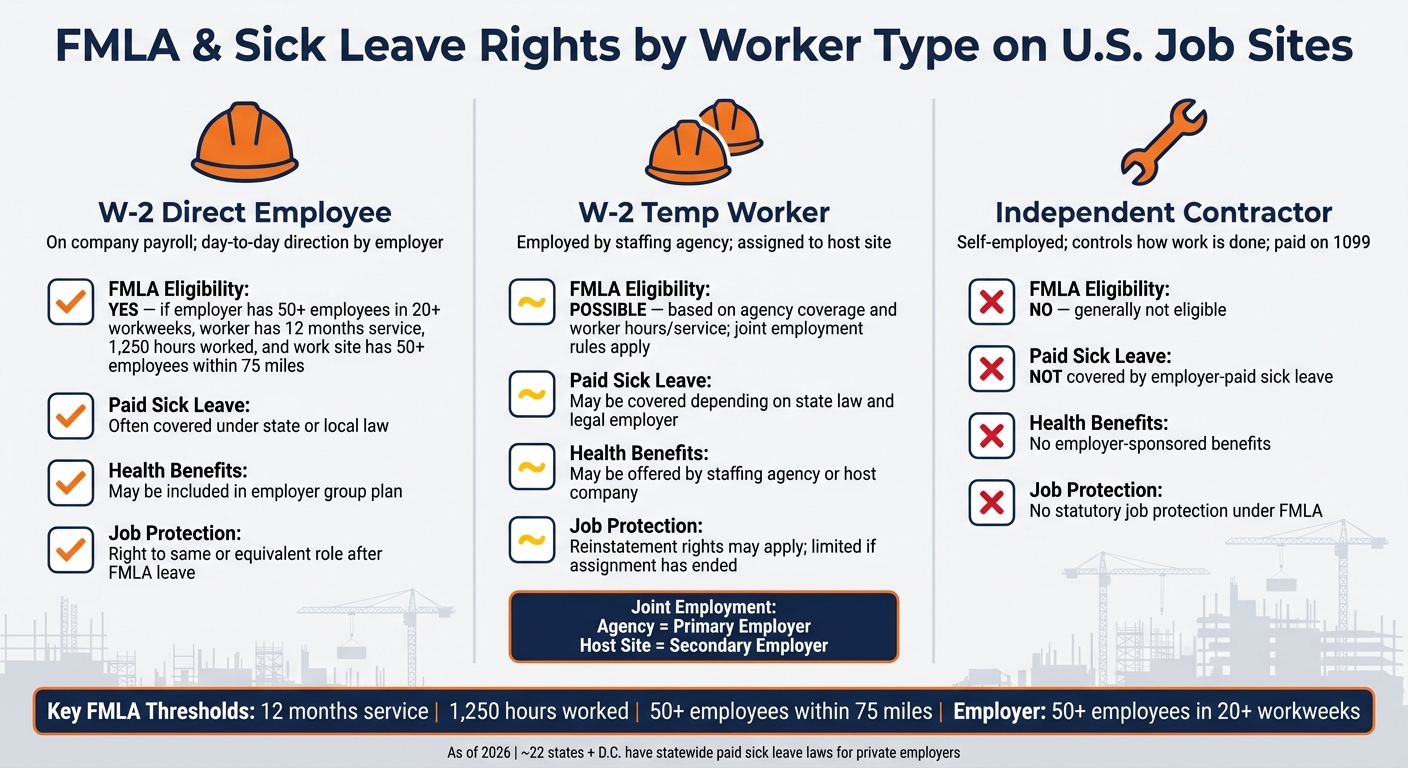
FMLA & Sick Leave Rights by Worker Type on U.S. Job Sites
On shared job sites, leave compliance starts with worker classification. That one call shapes who can take leave, who has to manage it, and where legal risk lands. If a company gets classification wrong, the fallout can be serious – especially on sites where several employers use the same crew.
Employees, Temp Workers, and Independent Contractors: Key Differences
A direct W-2 employee is on the company’s payroll and works under its day-to-day direction. A temporary worker is usually employed by a staffing agency and assigned to the site. An independent contractor is self-employed, decides how the work gets done, and is usually paid on a 1099 basis.
This matters most when someone asks for medical leave. Two people can work side by side on the same site and still have different leave rights because they do not share the same legal employer.
| Category | FMLA Eligibility | Paid Sick Leave | Health Benefits | Job Protection |
|---|---|---|---|---|
| W-2 direct employee | Yes, if employer and worker thresholds are met | Often covered under state or local law | May be included in employer’s group plan | Right to the same or an equivalent role after FMLA leave |
| W-2 temp worker (staffing agency) | Possible, based on the agency’s coverage and the worker’s hours/service | May be covered depending on state law and who the legal employer is | May be offered by the staffing agency or host company, depending on the plan | Reinstatement rights may apply; limited if the assignment has ended |
| Independent contractor (1099) | Generally not eligible | Usually not covered by employer-paid sick leave | No employer-sponsored benefits | No statutory job protection under FMLA |
When FMLA Coverage Applies
FMLA applies only if two things line up: the employer must be covered, and the worker must qualify.
For the employer, coverage usually means a private-sector employer with 50 or more employees in 20 or more workweeks in the current or preceding calendar year.
For the worker, the rule is more specific. The person must have:
- At least 12 months of service
- At least 1,250 hours worked during the 12 months before leave starts
- A work location where the employer has 50 or more employees within 75 miles
That sounds simple on paper. On a spread-out job site, it often isn’t. A company may be large overall, but the 75-mile rule can still knock out coverage for a given worker. And if someone works part time or on an intermittent schedule, the 1,250-hour mark can be tougher to pin down. That’s why payroll records do so much of the heavy lifting here.
How Joint Employment Works on a Job Site
When a staffing firm sends a worker to a host site, joint employment will often exist. In that setup, both the agency and the host company may have FMLA duties.
Most of the time, the staffing agency is the primary employer. It handles payroll, tracks eligibility, sends FMLA notices, keeps health coverage in place, and deals with reinstatement.
The host company is the secondary employer. Its job is different but still matters. It must not interfere with protected leave, and it must return the worker to the assignment when the agency does.
Here’s what that can look like in practice: a welder sent by a staffing agency to a refinery turnaround takes FMLA leave for a serious medical condition. The agency handles the FMLA notices and benefit continuation. The refinery still has to respect the worker’s leave rights and avoid steps that interfere with protected leave.
Once those employer roles are sorted out, the next step is applying the federal FMLA rules that control qualifying leave and job protection.
Federal FMLA Rules Job Sites Must Follow
Once worker status and joint employment are sorted out, the next layer is the federal FMLA framework. FMLA gives eligible employees of covered employers up to 12 workweeks of unpaid, job-protected leave during a 12-month period. Employers also have to keep group health coverage in place and bring the worker back to the same job, or an equivalent one.
Qualifying Reasons for Leave and What Job Protection Means in Practice
On job sites, FMLA usually comes up in four situations:
- A worker’s own serious health condition. In the field, that might mean surgery after a fall, a chronic back injury, heat illness, or a mental health condition.
- Caring for a spouse, child, or parent with a serious health condition. For example, a crane operator may need time off to care for a parent going through chemotherapy.
- Birth, adoption, or foster placement of a child. This applies to both field crews and site office staff.
- Military-related reasons, including qualifying exigency leave and up to 26 workweeks of military caregiver leave in a single 12-month period.
Supervisors do not need to hear the word FMLA before passing a leave issue up the chain. If a worker says they need surgery and will be out for a few weeks, or brings up a serious family medical issue, that’s enough to alert HR or the staffing firm. The supervisor’s role is simple: pass the information along. They should not try to rule on eligibility in the moment.
On a job site, job protection has a plain meaning. Leave can’t be used as a way to push someone aside because the schedule is tight. If a project wraps up while a worker is on leave, the employer still can’t treat the leave itself as the reason for a demotion, pay cut, or termination. An equivalent position has to line up on pay, benefits, duties, schedule, and location.
Primary and Secondary Employer Responsibilities
The table below shows how responsibilities are usually split on a staffed job site.
| Function | Primary Employer (e.g., staffing firm) | Secondary Employer (e.g., host contractor/operator) |
|---|---|---|
| Eligibility & notices | Confirms FMLA coverage; issues eligibility and rights/responsibilities notices | Provides hours and assignment data |
| Leave administration | Receives requests, tracks usage, approves or denies leave | Coordinates scheduling based on primary employer decisions; avoids informal denials |
| Health benefits | Maintains group health coverage and handles premium payments during leave | Maintains any host-provided benefits for direct employees |
| Recordkeeping | Keeps FMLA records for agency workers: hours, leave dates, certifications, and notices | Maintains site-level time and assignment records; shares needed data with the primary employer |
| Job restoration | Returns workers to equivalent assignments and pay at the end of leave | Restores workers assigned back to the site to equivalent duties, schedule, and working conditions |
What Supervisors Should Do When a Worker Reports a Medical Issue
When a medical issue comes up, a foreman’s job is to facilitate, not decide. The minute a worker mentions needing time off for a health reason, the supervisor should get the right people involved instead of making a call on eligibility.
In practice, that means a few basic steps. The supervisor should notify HR or the staffing firm contact the same day or by the next shift. They should also note the date, time, and the basic nature of what the worker reported. Then they should point the worker to the right HR or staffing contact for next steps. One line supervisors should not cross: they should not collect diagnosis or treatment details.
Some mistakes are especially risky in the field. A supervisor must never tell a worker the company can’t afford to have them out, mark the absence as unexcused, or shift the worker into worse assignments after a leave request comes up. Those moves can amount to FMLA interference or retaliation, and both are unlawful.
Short, scripted guidance for foremen and superintendents is considered best practice in high-risk industries because consistent, legally sound responses in the field are hard to improvise under pressure.
FMLA is the federal baseline. State sick leave laws may go further by adding paid time off and broader coverage.
State Sick Leave Laws and Staffing Platform Operations
FMLA sets the federal floor. State and local sick leave laws add paid-leave rules, and those rules change based on location.
How Paid Sick Leave Rules Vary by State
For private-sector workers, paid sick leave is mostly driven by state and local law. That means the rule depends on where the work happens, not just where the employer is based. As of 2026, about 22 states plus Washington, D.C. require statewide paid sick leave for at least some private employers.
Most of these laws use hourly accrual. But the details don’t line up neatly from one place to the next. Annual caps, carryover, waiting periods before use, and payout rules at separation can all shift by jurisdiction.
| State | Accrual Rate | Annual Use Cap | Carryover | First-Use Waiting Period | Cash-Out at Separation |
|---|---|---|---|---|---|
| California | 1 hr / 30 hrs worked | 40 hrs/yr | Required; employer may cap total accrual at 80 hrs | 90 days of employment | Not required unless time is part of PTO treated as wages |
| Washington | 1 hr / 40 hrs worked | – | At least 40 hrs must carry over | – | Special construction-worker payout rules apply if separation occurs before the 90th day |
| New York | Accrual-based; all private-sector employees covered | 40 hrs (5–99 employees); 56 hrs (100+ employees) | – | – | Not required in most cases |
Minnesota and Illinois also use accrual-based models, but the exact thresholds, caps, and separation rules depend on state law and employer size. And if a state doesn’t have a statewide mandate, that doesn’t always mean you’re in the clear. A city where the project is located may still have its own ordinance, so it’s worth checking before assuming no paid sick leave rule applies.
On crews that move from state to state, this can change from one assignment to the next. One week’s setup may not match the next week’s.
Multi-State and Construction-Specific Compliance Issues
For mobile job-site crews, sick leave rules follow the job site, not the employer’s headquarters. So if a worker spends three weeks on a pipeline project in Washington and then moves to a site in Nebraska, Washington’s rules apply during those three weeks, no matter where the employer is based.
That’s where things get messy. Short, intense assignments like shutdowns or emergency repairs can move workers past accrual thresholds fast. In plain English: even a brief assignment can trigger leave rights.
Rehire rules can also trip teams up. Seasonal workers who come back within a set window, often six to twelve months, may have a right to get prior sick leave balances reinstated. So staffing plans may need to account for returning workers who show up with leave already on the books.
Union settings add another moving part. Collective bargaining agreements (CBAs) may include their own sick leave terms, and some states allow those terms if the total benefit meets or beats the legal minimum. But don’t assume the CBA handles everything. The contract still needs to be checked against the statute.
And when both a state law and a local ordinance apply at the same site, use whichever rule gives the worker more.
How ABLEMKR Supports Staffed Job Site Compliance

On mobile job sites, sick leave administration comes down to one thing: clean assignment and location data. ABLEMKR helps teams track worker location, status, and leave data so they can apply the right sick leave rules and place qualified backup workers on fast-moving job sites.
Records to Keep and Return-to-Work Planning
FMLA and Sick Leave Records Employers Should Keep
Document every leave request. If an audit or dispute shows up later, your records are the paper trail that matters.
Under FMLA, covered employers must keep leave-related records for at least 3 years. That includes:
- Basic identifying and payroll data
- Leave dates and hours
- Employee notices and designations
- Records showing any paid leave used at the same time as FMLA
- Benefits records showing health insurance and other benefits were maintained
- Written dispute records for any leave designation issue
All of that is part of the employer’s recordkeeping duty under FMLA.
State paid sick leave laws add their own timelines. New York requires 6 years of payroll records, including sick leave accrued and used. New Jersey requires 5 years of records showing hours worked and earned sick leave activity. Colorado requires 3 to 4 years of detailed records covering accruals, usage, dates, and general reasons for leave. The safest move is simple: use the longest retention period that applies.
Medical certifications, fit-for-duty notes, and other health-related documents must be kept in a separate, access-controlled file – not in the personnel file. Supervisors should get only what they need to do the job safely, such as functional limits like lifting restrictions or no work at heights, on a need-to-know basis. Those records also help site leadership, HR, and staffing firms stay aligned during handoff.
Return-to-Work Steps for Safety-Sensitive Roles
Once the records are in place, use them to control clearance and reassignment. For workers returning to hazardous tasks – crane operators, pipeline welders, confined-space workers, and high-voltage technicians – a documented clearance process should come before they return to the job.
If your organization has a uniform, consistently applied fitness-for-duty certification policy for a given role, FMLA permits you to require a certification for the condition that caused the leave when that rule is applied to all similarly situated workers. After that certification comes in, HR should turn any restrictions into plain job limits that guide assignment choices.
That can mean:
- Shorter shifts
- Ground-level work instead of elevated tasks
- Shop-based fabrication instead of overhead welds on scaffolding
- Temporary reassignment to inspections or documentation roles
Write those changes down. Include clear start and end dates, plus a scheduled review, such as after 30 days or after a follow-up medical appointment.
Site leadership, HR, and the staffing firm should all clear the return before any high-risk reassignment. ABLEMKR gives site employers and staffing firms real-time visibility into certifications, safety training, and restrictions so they can clear workers before assignment.
Conclusion: Core Rules Every Job Site Should Know
Taken together, these rules form the return-to-work playbook for staffed job sites. Classification sets the baseline. State sick leave follows the job site. Joint employers must split notice and restoration duties. Records must be complete and kept for the right period. And for safety-sensitive returns, clearance, written restrictions, and a documented handoff are what keep the process tight.
FAQs
How do I know if I qualify for FMLA on a job site?
To qualify for FMLA at a job site, you usually need to be a W-2 employee. Your eligibility also depends on things like how long you’ve worked there and how many hours you’ve put in.
Check with your HR department or your employee handbook to see if you qualify. It’s also smart to look at your state’s leave laws, since some states give workers more protection than federal law.
Who handles leave when I work through a staffing agency?
When you work through a staffing agency, you’re usually a joint employee. In plain English, that means both the staffing agency and the host employer often share responsibility for your workplace rights, including leave and safety protections.
To keep things clear, check with both your staffing agency contact and your on-site supervisor about who handles leave requests and what paperwork you need. In many cases, the agency keeps payroll and benefits records, while the host employer handles your day-to-day work and site safety.
What should happen before I return to a safety-sensitive job?
Before you return, make sure your required certifications, safety training, and medical clearances are current and properly documented.
If you were on medical leave, complete any fitness-for-duty evaluations or respiratory fit testing you need. Also check that your site-specific training and credentials are up to date in your employer’s or platform’s compliance tracking system.


