
If a job involves contaminated soil, hazardous waste, or a spill response, I need to match each worker to the right HAZWOPER training before dispatch. Miss one item – like the wrong course level, a past-due refresher, or missing field time – and the crew may not be cleared to work.
Here’s the short version:
- HAZWOPER applies by task and exposure risk, not job title
- 40-hour training is common for higher-exposure work, plus 3 days of supervised field time
- 24-hour training fits some limited-exposure tasks, plus 1 day of supervised field time
- Supervisors need worker training first, then 8 more hours
- Annual refresher training is due every 12 months
- Emergency response roles use a different training track
- Dispatch should verify records before mobilization, not at the gate
- OSHA fines can reach $14,502 per violation and $145,027 for repeat or willful cases
A few checks make the difference: confirm the site falls under HAZWOPER, line up training with the actual job, make sure the refresher is current, and verify field experience, medical records, and site briefing status where needed.
If I had to boil the whole article down to one point, it’s this: HAZWOPER is not just a safety topic – it’s also a dispatch check. When records are clean and current, crews can be assigned with fewer delays and fewer last-minute changes.
HAZWOPER Basics for Construction and Energy Field Work
HAZWOPER is OSHA’s rule for work that involves hazardous substances during cleanup, waste handling, and emergency response. It sets the rules under 29 CFR 1910.120 and 29 CFR 1926.65. For field staffing, the main issue isn’t what HAZWOPER stands for. It’s whether the job actually falls under it.
OSHA’s scope covers uncontrolled hazardous waste sites, voluntary cleanups at government-designated uncontrolled hazardous waste sites, RCRA corrective actions, treatment, storage, and disposal facilities, and emergency response to actual or threatened hazardous substance releases that require a response. That matters in the field because emergency response can trigger HAZWOPER at construction, refinery, and power-plant sites. Once a job falls under HAZWOPER, the next call is figuring out the right training level and crew assignment.
In construction and energy work, this often comes up in jobs like removing contaminated sludge from process units during a refinery turnaround or cleaning up contaminated ash basins or PCB-contaminated transformers at a power plant. Routine construction on a clean, undeveloped site does not trigger HAZWOPER. The rule comes into play when contamination is present, hazardous waste is being handled, or crews are expected to take on emergency response duties.
When a Field Crew Needs HAZWOPER
Three plain-language questions can help before dispatch.
- Is hazardous substance exposure expected? If workers are likely to encounter hazardous chemicals, vapors, contaminated soils, or waste above permissible exposure limits or other safety thresholds, HAZWOPER applies.
- Is the site recognized as an uncontrolled hazardous waste site? Superfund sites, brownfield designations, and RCRA corrective action classifications are clear signs.
- Will any crew members perform emergency response duties? Spill containment, leak mitigation, or incident response involving hazardous substances brings those workers under HAZWOPER’s emergency responder rules.
"Uncontrolled" means the contamination itself isn’t under active regulatory containment – its extent may still be uncertain. Those triggers help determine the training level each worker needs.
What Employers Must Do Before Hazardous Work Begins
Before hazardous work starts, employers must complete a site characterization and hazard assessment. That means reviewing environmental reports, regulatory listings, and planned tasks to identify exposure routes and the scope of contamination. From there, the employer can decide which training level workers need, what PPE is required, and what controls belong in the site-specific safety and health plan.
Employers also need to provide training that matches each worker’s actual role and exposure risk. They must confirm that supervised field experience rules are met – 40-hour workers must complete a minimum of three days of supervised field experience before working independently on a hazardous site – and keep documentation current before dispatch.
The written safety and health program must also cover site controls, decontamination procedures, medical surveillance, and emergency response protocols. That documentation check is what feeds into dispatch verification.
sbb-itb-aa28329
HAZWOPER Training Levels and Annual Refresher Requirements
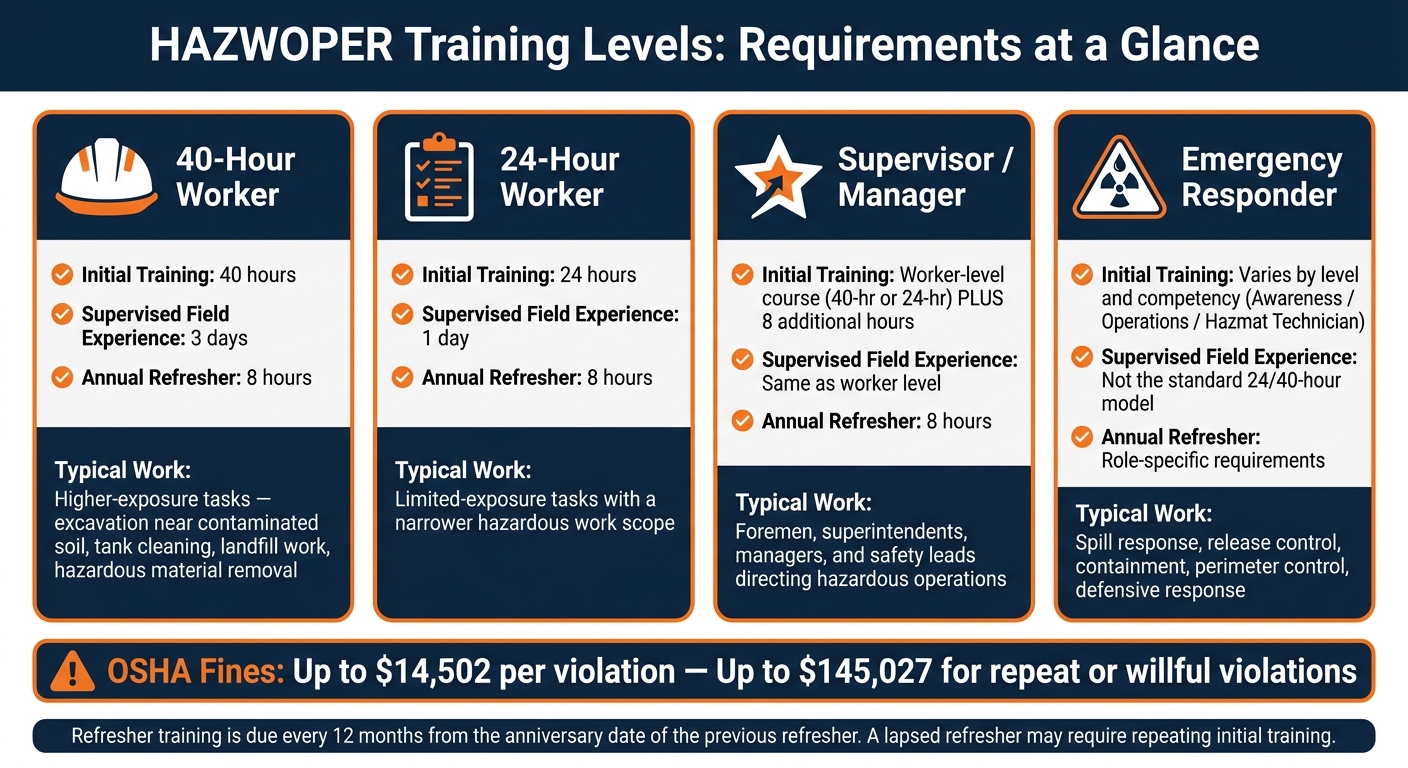
HAZWOPER Training Levels: Requirements at a Glance
Once site hazards are identified, dispatch needs to pair the job with the right HAZWOPER level. If an assignment falls under HAZWOPER, each worker has to be cleared for the training level tied to that role before anyone is sent out. That training level sets the line on who can do what once the crew is on site.
24-Hour, 40-Hour, and Supervisor Training Explained
The main HAZWOPER tracks for field crews are 24-hour HAZWOPER, 40-hour HAZWOPER, and 8-hour supervisor training. The 24-hour and 40-hour courses are the two main starting points for workers, and the right one depends on exposure risk and the scope of the job.
Workers assigned to higher-exposure work – like excavation near contaminated soil, tank cleaning, landfill-related tasks, or hazardous material removal – will usually need the 40-hour course plus three days of supervised field experience. Workers handling more limited-exposure tasks may fit the 24-hour path, which includes one day of supervised field experience.
Dispatch shouldn’t just check the course hours and move on. The file also needs to show that the supervised field piece is done. In plain terms, both parts matter: classroom time and supervised field experience.
Supervisor training is its own requirement. It does not replace initial worker training. Foremen, superintendents, managers, and anyone else directing hazardous operations must first complete the worker-level course that fits their job, then add at least 8 hours of supervisor-specific training. That training covers site control, worker readiness, and stop-work authority. For dispatch, that matters because the role on paper has to match the training in the file.
Emergency Responder Levels That May Affect Crew Assignments
Standard site-worker HAZWOPER training is different from emergency responder training. OSHA’s HAZWOPER guidance also separates emergency responder levels such as First Responder Awareness, First Responder Operations, and Hazmat Technician for cases where a worker’s duties include responding to a hazardous substance release.
Most day-to-day field assignments don’t call for those levels. They matter when the job includes spill response or release control, or when someone on the crew may be expected to help with containment, perimeter control, defensive response actions, or more specialized hazmat work. In those cases, dispatch should assign only workers whose training lines up with the responder level tied to that role. If the assignment doesn’t include response duties, these responder levels usually don’t come into play.
Refresher Timing and Training Level Comparison Table
Workers and supervisors who finished 24-hour or 40-hour initial HAZWOPER training must complete an 8-hour annual refresher to stay current. OSHA requires that refresher by the anniversary date of the previous refresher. The 8 hours can be completed in more than one session, as long as it’s finished before that anniversary date.
When a refresher has lapsed, OSHA says the employer should review whether the worker needs to repeat initial training based on how familiar the worker still is with the material, document the delay, and record the new completion date in the worker’s file. For dispatch teams, that can change an assignment fast. A worker may have years of field time and still be ineligible if the refresher is out of date.
Use the table below as a quick check before mobilization.
| Training Level | Initial Hours | Supervised Field Experience | Annual Refresher | Typical Field Scenario |
|---|---|---|---|---|
| 40-hour worker | 40 hrs | 3 days | 8 hrs | Higher-exposure work: cleanup, excavation near contamination, tank or pipeline work |
| 24-hour worker | 24 hrs | 1 day | 8 hrs | Limited-exposure tasks with a narrower hazardous work scope |
| Supervisor/manager | Initial worker training plus 8 additional hours | Same as worker level | 8 hrs | Foremen, superintendents, managers, and safety leads directing hazardous operations |
| Emergency responder levels | Varies by level and competency requirements | Not the same 24/40-hour model | Role-specific refresher requirements | Response assignments tied to hazardous substance releases |
How Site Roles Change HAZWOPER Training and Safety Duties
Training level gets someone cleared to enter. After that, the worker’s role, work zone, and decision-making authority decide what they can actually do on site.
Training Needs by Role: Laborers, Operators, Foremen, and Safety Leads
General laborers working in exclusion zones usually need 40-hour HAZWOPER.
Equipment operators need HAZWOPER clearance that matches the zone they enter and the tasks they handle.
Foremen and crew leads do more than assign work. They direct the job, check that controls are in place, and make on-the-spot calls when site conditions change. That means they need worker-level HAZWOPER plus 8-hour supervisor training.
Site safety officers are the people enforcing the HASP, controlling access, overseeing decon, and stopping unsafe work.
Site Control, Decontamination, and Job-Specific Briefings
HAZWOPER work splits the site into three zones: the exclusion zone for the highest hazard and restricted entry, the contamination reduction zone where decontamination takes place, and the support zone, which serves as the clean area for equipment and personnel staging. Crossing those boundaries depends on training level, authorization, and current site conditions, not job title or convenience. That’s the part dispatch should check, not just what the safety plan says on paper.
The buddy system should be used on all HAZWOPER work. Workers must keep visual contact with a partner, and only one worker should be in a particularly hazardous area at a time so the buddy can call for help if needed.
Decontamination has to follow the site’s sequence before workers or equipment leave the contaminated area.
Daily briefings should cover site-specific hazards, zone changes, weather, PPE, and stop-work triggers.
Role-to-Requirement Table for Dispatch Decisions
Use the table below to line up role, task, and the records that need to be checked before dispatch. If one column doesn’t line up, the assignment shouldn’t move ahead.
| Role | Minimum HAZWOPER Level | Typical Tasks | Key Safety Responsibilities | Documents to Verify Before Assignment |
|---|---|---|---|---|
| Laborer | 40-hr (or 24-hr for limited exposure) | Contaminated material handling, site cleanup | PPE compliance, buddy system, hazard reporting | HAZWOPER certificate, refresher date, site orientation record |
| Heavy equipment operator | 40-hr | Operating excavators, loaders, or haul trucks in controlled zones | Exclusion zone awareness, decon route compliance | HAZWOPER certificate, refresher date, role-specific qualification record |
| Foreman / crew lead | Worker-level training (40-hr if applicable) + 8-hr supervisor training | Directing hazardous work, verifying controls, managing crew readiness | Site control enforcement, daily briefings, stop-work decisions | HAZWOPER certificate, supervisor training record, refresher date |
| Site safety officer | 40-hr HAZWOPER | Hazard monitoring, decon oversight, HASP enforcement, emergency coordination | Stop-work authority, air monitoring, recordkeeping, hazard communication | HAZWOPER certificate, role-specific qualification record |
How to Verify HAZWOPER Records Before Dispatch
Once the role and training level are set, dispatch still has one more job: verify the records behind that assignment before anyone mobilizes.
That step matters. OSHA fines for HAZWOPER violations can reach $14,502 per violation and $145,027 for repeat or willful offenses.
What Records to Check and How to Review Them
Review each worker’s file for:
- Training level
- Completion date
- Refresher date
- Supervised field experience
- Trainer or provider
- Site orientation
- Medical clearance or fit-test records, when required
Here’s the big thing: a certificate by itself is not enough.
If a record is missing, doesn’t match other documents, or can’t be tied to a named provider and date, don’t dispatch that worker yet. Put the assignment on hold until the gap is fixed.
Using a Centralized System to Cut Dispatch Delays
A centralized system puts training status, expiration dates, refresher windows, and site readiness into one verified record set.
That makes a big difference on shutdowns, remote pipeline repairs, or short-notice project starts. In those moments, coordinators don’t have time to dig through paper certificates on the morning of mobilization.
ABLEMKR tracks certifications, HAZWOPER status, availability, and location-based readiness for field crews across construction, energy, and extractives projects. That gives coordinators a clean way to dispatch only workers whose records have already been verified.
Pre-Dispatch Workflow Table and Key Takeaways
Use this workflow to clear crews before mobilization.
| Workflow Stage | Data Needed | Responsible Party | System or Tool | Common Breakdowns |
|---|---|---|---|---|
| Onboarding | Current HAZWOPER certificate, trainer/provider info, supervised field experience records, site-specific orientation records | Staffing Coordinator / Safety Team | Centralized database (e.g., ABLEMKR) | Missing supervised hours; no provider name on certificate |
| Annual Refresher Tracking | Last refresher completion date, 12-month expiration window, written documentation of any delay | Safety Team / Dispatcher | Automated alert system | Refresher expired; no written documentation of a delay |
| Pre-Dispatch Audit | Role-to-hazard alignment, site-specific orientation acknowledgment, medical clearance and fit-test records where applicable | Project Manager / Safety Lead | Workforce deployment platform | Worker assigned to a role that exceeds their training level; missing site orientation sign-off |
| On-Site Verification | Physical or digital credential, site roster, orientation badge | Site Supervisor | Site access log / mobile app | Missing project-specific hazard briefing; credential not matching worker’s name on roster |
A simple table like this helps everyone work from the same playbook. Onboarding checks the base records. Refresher tracking catches expired training before it turns into a dispatch problem. The pre-dispatch audit makes sure the worker fits the role and site. Then on-site verification acts as the last checkpoint before work starts.
Conclusion: Key HAZWOPER Points for Field Crews and Dispatch Teams
HAZWOPER covers uncontrolled hazardous waste sites, corrective action cleanups, and hazardous substance emergency response. Getting that scope call right at the start helps dispatch teams avoid over-preparing for some jobs and missing the mark on others.
Once the scope is clear, the next step is to match the training level to the worker’s role, keep the annual refresher up to date, and document any required field experience before dispatch.
Training alone isn’t enough. Workers also need a site-specific briefing on current hazards, controls, PPE, decontamination, and emergency steps. After that, dispatch closes the loop by checking the records that show the crew is cleared for that site.
That last check should live in one system, not across paper files and scattered folders. Keep certificates, refresher dates, field-experience records, and site-briefing attendance in one place so dispatch can verify crews fast. ABLEMKR keeps those details visible in one place, which helps crews get mobilized faster.
For crews and dispatch, the checklist is simple:
- Confirm scope
- Match training to role
- Verify current refresher status
- Brief the site
- Keep records in one place
Those five steps separate a cleared crew from a dispatch failure.
FAQs
How do I know if a job site falls under HAZWOPER?
A job site falls under HAZWOPER when the work involves hazardous materials during emergency response, large-scale hazardous waste handling, or industrial accidents.
Under OSHA 29 CFR 1910.120, this often applies to oil and gas, mining, and heavy infrastructure projects where workers may face exposure to toxic or contaminated materials. If a project involves chemical exposure, spill cleanup, or hazardous waste management, HAZWOPER-trained personnel are often required.
Can a worker go to a hazardous site before supervised field time is complete?
No. A worker should not go to a hazardous site before finishing the required training, supervised field time, and safety certifications.
Employers must verify credentials before site entry. Letting an uncertified worker on-site can lead to safety risks, regulatory fines, and project delays.
What should dispatch do if a HAZWOPER refresher expires?
If a worker’s HAZWOPER refresher has expired, dispatch should pull them off active projects and keep them off any job site until the credential is renewed.
That simple step can help avoid safety risks, legal liability, and job delays. To keep things from slipping through the cracks, teams should track expiration dates, set alerts before credentials lapse, and schedule training or assign qualified replacements ahead of time.


