
If your team uses hazardous chemicals, HazCom comes down to 5 things: a written program, a current chemical list, clear labels, easy-to-find SDSs, and training before exposure. Under OSHA’s 29 CFR 1910.1200, employers must make hazard information available through labels, Safety Data Sheets, and worker training.
Here’s the short version of what I’d want to know right away:
- Who is covered: employees, temp workers, and contract workers
- What labels need: product name, signal word, hazard statements, pictograms, precautionary statements, and supplier contact info
- What SDSs need: the standard 16-section format, with access during every shift
- When training happens: at initial assignment and when a new chemical hazard shows up
- Who does what on shared sites: staffing firms usually handle basic training; host employers usually handle site-specific training
- What proof matters: written program, chemical inventory, SDS access, labels, and training records
A few points stand out. OSHA does not require a training certificate by name, but employers still need records that show training happened. SDS Sections 1–8 are the parts crews use most on the job, and Sections 12–15 are not enforced by OSHA. Also, a secondary container usually needs a workplace label unless it is for one worker’s immediate use.
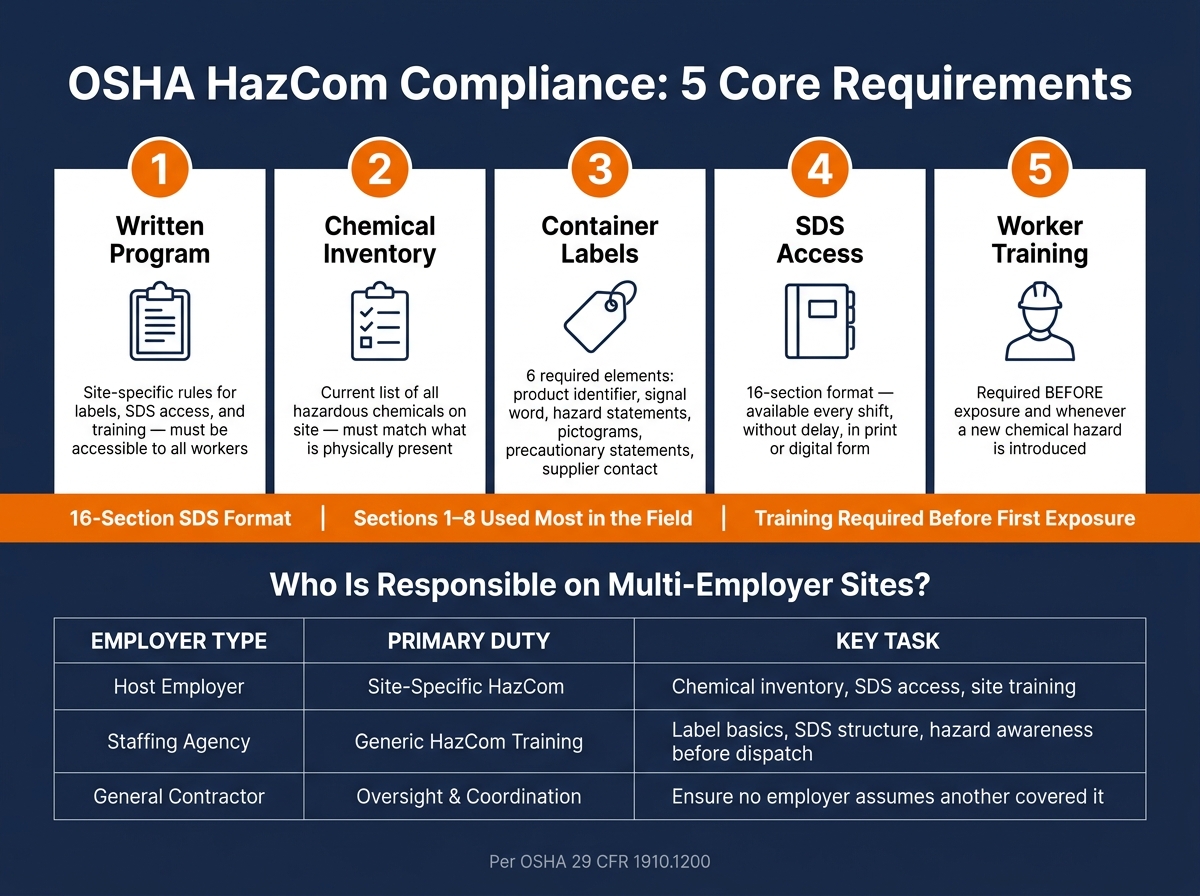
OSHA HazCom Compliance: 5 Core Requirements at a Glance
Get Your Hazard Communication Training and Certificate | OSHA Workplace Safety Course
sbb-itb-aa28329
Quick Comparison
| Topic | What OSHA looks for | What this means on the job |
|---|---|---|
| Written program | Site rules for labels, SDSs, and training | A clear plan workers can find |
| Chemical inventory | Current list of hazardous chemicals | The list matches what is on site |
| Labels | GHS shipped labels or workplace labels | Workers can tell what is in the container and the hazard |
| SDS access | Available without delay every shift | No locked office, missing password, or long wait |
| Training | Before exposure and for new hazards | Workers know how to read labels and SDSs |
| Multi-employer sites | Duties split by role | No employer can assume someone else handled it |
| Records | Program, SDSs, inventory, rosters | Proof during an OSHA inspection |
Bottom line: if you can show those records and your workers can use them in the field, your HazCom program is in much better shape.
OSHA HazCom basics for construction and energy worksites
Construction and energy sites deal with a lot of hazardous chemicals. The catch is that crews change, work areas move, and products on site can shift from one day to the next. That means HazCom can’t sit in a binder and collect dust. It has to stay current. On these jobsites, compliance comes down to five day-to-day controls.
The core parts of a compliant HazCom program
A compliant HazCom program has five basics: a written plan, a current chemical inventory, container labels, SDS access, and worker training.
The written program should spell out how labeling, SDS access, and training will work at each site where chemicals are used or stored. On staffing-heavy and mobile worksites, every location needs an up-to-date inventory that matches the products actually on hand.
SDSs need to be available on every shift, either in print or digital form, without delay. Every container must be labeled, including transfer containers, with hazard details that match the SDS.
Workers also need to know how to read the labels and SDSs behind those controls. If the paperwork is in place but the crew can’t use it, the system falls apart fast.
Who is covered, including temporary and contract workers
HazCom covers all workers exposed to hazardous chemicals, including temporary and contract workers. On multi-employer sites, responsibility is split by role. Coverage follows the worker, but responsibility follows the role.
Host employers handle site-specific HazCom. That includes the chemical inventory, labels, SDS access, and site training. Staffing agencies handle generic HazCom training before assignment. On shared worksites, OSHA’s multi-employer citation policy means a general contractor, subcontractor, or staffing agency can each be cited based on their role in creating, controlling, or exposing workers to the hazard.
That split matters in day-to-day work. It affects who trains workers, who checks labels, and who keeps records current.
How HazCom connects to other OSHA chemical rules
HazCom is the base layer for other OSHA chemical rules. That includes HAZWOPER and the substance-specific standards in Subpart Z, which add exposure limits and control requirements.
HazCom sets the baseline for labels, SDSs, and related chemical safety steps. When employers treat those duties as connected instead of as separate checklists, the program does a better job of protecting workers.
The next section breaks down the label and SDS system workers use on the ground. Those controls start with labels, pictograms, and SDSs.
Labels, pictograms, and Safety Data Sheets workers must understand
Labels, pictograms, and SDSs turn chemical hazard info into action on the job. Labels give the first warning, pictograms flag the type of hazard, and SDSs fill in the details. Workers need all three before handling a product. Start with the label. Then use the pictogram and SDS to figure out how to do the work safely.
GHS label elements and workplace labeling rules
Under OSHA’s HazCom standard, every shipped container must include six label elements: a product identifier, a signal word, hazard statements, pictograms, precautionary statements, and the manufacturer’s name, address, and phone number. The signal word will be either Danger or Warning, based on the most severe hazard.
Workplace labels for secondary containers – like spray bottles, jobsite tanks, or drums filled from a larger supply – do not have to copy the full shipped-label format. But they still must clearly identify the product and state its hazards. In plain terms, workers should be able to look at the container and know what it is and what can go wrong. The exception is narrow: if an employee fills a container for their own immediate use, that container does not need a label under 29 CFR 1910.1200(f)(8).
A simple reading order helps people move fast without guessing. Check the product identifier first so you know you have the right chemical. Then read the signal word to judge the level of danger. After that, look at the hazard statements and pictograms to spot the main risks – like flammability, corrosivity, or toxicity. From there, workers can choose the right PPE, ventilation, and storage setup.
Once the label tells you what the product is, the pictogram points to the hazard class.
OSHA pictograms and what they signal on the job
OSHA recognizes eight core hazard pictograms. Each one uses a black symbol on a white background inside a red diamond frame. The environmental pictogram belongs to GHS, but OSHA does not require it. A manufacturer may still include it on a voluntary basis.
| Pictogram | Hazard | Field action |
|---|---|---|
| Flame | Flammables, self-reactives, pyrophorics, self-heating substances, organic peroxides | Eliminate ignition sources; store away from heat |
| Corrosion | Skin burns, serious eye damage, corrosive metals | Use chemical-resistant gloves, face protection, compatible containers |
| Gas cylinder | Gases under pressure | Secure cylinders upright; protect from heat and impact |
| Skull and crossbones | Acute toxicity | Use the highest-level controls; have emergency response ready |
| Exclamation mark | Irritation, narcotic effects, mild health hazards | Verify ventilation and basic PPE before use |
| Health hazard | Carcinogenicity, respiratory sensitization, reproductive toxicity, target-organ toxicity, aspiration hazards | Use stronger controls; substitute if possible |
| Exploding bomb | Explosives, self-reactives, organic peroxides | Follow strict storage and handling protocols |
| Flame over circle | Oxidizers | Keep away from flammables and combustibles |
There is one detail workers often miss: OSHA uses precedence rules to keep labels from getting crowded. If the skull and crossbones is used for acute toxicity, the exclamation mark cannot also appear for that same hazard. And when the corrosion or health hazard symbol is present, some exclamation mark uses are removed.
If the symbol gives only part of the picture, the SDS gives the handling steps workers need.
The 16-section SDS format and access requirements
Every SDS uses the same 16-section format under Appendix D to 29 CFR 1910.1200. That standard layout matters because workers need to find key details fast, not dig through a different format every time. Sections 1–8 cover identification, hazards, composition, first aid, fire-fighting, accidental release, handling and storage, and exposure controls and PPE. These sections guide immediate decisions in the field.
Sections 12–15 cover ecological, disposal, transport, and regulatory information, but OSHA does not enforce those sections. For day-to-day jobsite use, the most important sections are often Section 4 for first aid, Section 6 for spills, and Section 8 for PPE. Match the section to the task, then act.
OSHA also requires SDSs to be accessible in the work area during every shift. Paper binders can work. Digital systems can work too. The rule is simple: workers must be able to get the information without delay. If someone has to track down a password, wait for another person, or leave the work area just to find an SDS, that setup does not meet the standard.
Next comes training: workers must know how to use these tools before they are exposed.
Training requirements and daily duties for employers and workers
What HazCom training must cover and when to deliver it
Once workers know how to read a label and an SDS, the next step is using that information on the job. OSHA requires HazCom training before a worker begins work with hazardous chemicals and again whenever a new hazard is introduced into the work area. A new use or process that changes the chance of exposure can also mean more training is needed.
At a minimum, training must cover:
- the HazCom standard
- the operations where hazardous chemicals are present
- where the written program and SDSs are located
- how to spot a chemical release
- the physical and health hazards in the work area
- the protective steps workers can take, including engineering controls, safe work practices, and PPE
Workers also need to learn how to use labels and SDSs in the field, not just where to find them.
For mobile crews, short training modules often work better than one long session. Breaking the material into labels, SDSs, hazards, controls, and spill response can make it easier to use on the job. Brief toolbox talks can help too, especially when they walk through one SDS for a chemical the crew is using right now.
Employer duties on staffing-heavy and multi-employer sites
Employers must keep the written program, chemical inventory, labels, and SDS access in place on every shift. The written program must spell out how labeling, SDS management, training, and coordination on multi-employer sites will work, and workers need to know where that program is kept.
On staffing-heavy and multi-employer projects, duties may be shared, but no one gets to assume the other party handled it. In most cases, the host employer carries the main duty for site-specific HazCom training because the host controls the chemicals, the work processes, and access to SDSs. Staffing agencies are expected to give basic HazCom training before dispatch. That basic training should cover label basics, SDS structure, and general hazard awareness. Then the host employer fills in the site-specific part during onboarding.
Written agreements are a smart move here. They should spell out who delivers each part of the training and how training records will be shared.
One point that trips people up: under OSHA’s multi-employer enforcement framework, an exposing employer can still be cited if its workers were not told about hazards, even when another employer created or controls that hazard. Put simply, no employer may assume someone else covered it.
Worker duties that support compliance on the ground
Workers play a direct part in keeping HazCom in place day to day. They must complete training, read labels and SDSs, and follow the required controls. That means finishing training before any chemical exposure, reviewing labels and SDSs for each chemical they handle, and using assigned PPE the right way.
Labels must remain intact and easy to read on all containers, including secondary containers. Workers should not use unlabeled containers. If there’s an unlabeled drum or an SDS can’t be found, the right move is to report it to a supervisor, not work around it. Workers also must not transfer chemicals into unlabeled containers or store incompatible products together.
Supervisors can keep these habits from going stale by building HazCom checks into pre-task planning and daily huddles. A few direct questions can go a long way:
- Which chemicals are in use today?
- What hazards come with them?
- Where is the SDS?
That kind of routine helps make worker participation normal and keeps training tied to the work in front of them. Supervisors should also document each briefing and refresher so training status stays clear from project to project.
Tracking HazCom proof and keeping records across projects
What documentation staffing and safety teams should keep
After workers finish training, the next job is showing that training clearly across each project. OSHA does not require training records, but those records are the clearest way to show HazCom compliance.
A solid paper trail should cover four main items: the written HazCom program, a current chemical inventory tied to each project or site, an accessible SDS library with records showing workers can retrieve SDSs on every shift, and training records for every session delivered.
For training records, rosters should include:
- Date
- Course title
- Topics covered
- Trainer
- Worker acknowledgment
That level of detail matters. A simple sign-in sheet can show attendance, but it does not show whether workers understood the material. That’s why it also helps to keep quiz results or skills checks on file.
SDS management needs the same level of care. Keep current SDSs on site, and archive obsolete SDSs for 30 years after last use. It also makes life easier for staffing teams if each record is tagged with the site, project scope, and chemical group. Then, when a worker moves to a new assignment, coordinators can quickly check whether that person’s training matches the hazards on that job.
Using ABLEMKR to verify HazCom training status
This is where speed can make or break compliance. When crews move from one site to another, paperwork can’t lag behind.
ABLEMKR keeps HazCom status visible during dispatch. Staffing coordinators can filter workers by HazCom training, verify uploaded credentials before activation, and flag missing or expiring records before assignment. In plain English, verification stays inside the dispatch flow instead of turning into a last-minute scramble.
Conclusion: The key HazCom standards to get right
When records move with the worker, compliance is easier to keep intact from one job to the next. The core items are the written program, a current chemical inventory, accessible SDSs, correct labels, training, and records tied to each worker and project.
FAQs
What counts as immediate use?
Under HazCom, immediate use means a worker transfers a chemical into a portable container and uses it during the same shift.
In that situation, the portable container doesn’t need a full GHS label.
There’s one catch: the original labeled container still has to remain available to that worker. And if the portable container is kept after the shift ends, or used for storage, it needs a full label.
Can OSHA cite multiple employers?
Yes. Under OSHA’s Multi-Employer Citation Policy, more than one employer at a worksite can be cited for hazards, even when they don’t directly employ the worker who was exposed.
On shared worksites, employers need to work closely on safety. That means:
- coordinating safety programs
- sharing hazard information
- clearly assigning responsibility for protective measures
If those steps aren’t handled well, communication breaks down and safety gaps can open up fast.
How should digital SDS access be set up?
Use a cloud-based system so workers can pull up the latest SDS information from any device.
If your team works off-site or in the field, offline access matters too. Preload mobile devices with the documentation they need so they can still get it without a signal.
Digital access should make things easier, not harder. It should support:
- fast searches
- automatic updates
- inventory integration
When an SDS changes, replace old versions right away. Update alerts can also help show proactive maintenance during OSHA inspections.


