
If you choose the wrong certification, you can be blocked from the jobsite. Hazardous and biohazard training are not the same thing: one deals with chemical and physical risks, while the other deals with infectious materials like blood, sharps, sewage, and medical waste.
Here’s the short version:
- Hazardous materials training fits work with fuels, solvents, acids, toxic waste, compressed gases, and chemical spill response.
- Biohazard training fits work with bloodborne pathogens, trauma cleanup, lab materials, sewage, and medical waste.
- HAZWOPER 40-hour is often used for contaminated cleanup sites, but it does not automatically cover blood or trauma cleanup.
- OSHA BBP training is tied to exposure to blood or other potentially infectious materials under 29 CFR 1910.1030.
- Some jobs need both because one material can create chemical risk and infection risk at the same time.
- Renewal rules matter: HAZWOPER needs an 8-hour annual refresher, DOT hazmat refreshers are due every 3 years, and BBP training is annual.
If you’re hiring, staffing, or applying for this kind of work, the rule is simple: match the card to the hazard, not the job title.
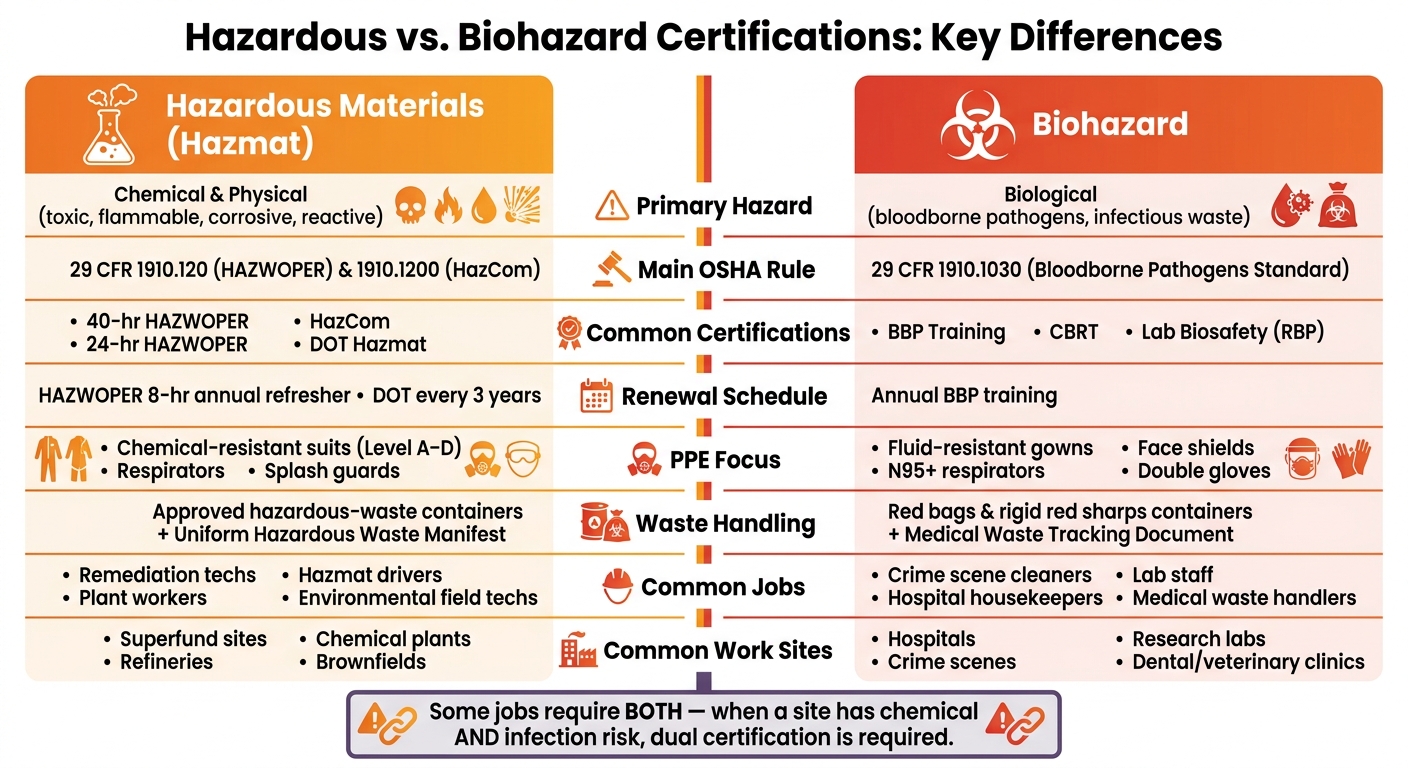
Hazardous vs. Biohazard Certifications: Side-by-Side Comparison
What Certifications Are Required for Biohazard and Crime Scene Cleanup Specialists | Scene Clean
sbb-itb-aa28329
Quick Comparison
| Criteria | Hazardous Certifications | Biohazard Certifications |
|---|---|---|
| Main risk | Flammable, toxic, corrosive, reactive materials | Bloodborne pathogens and infectious waste |
| Main OSHA rule | 29 CFR 1910.120 and 1910.1200 | 29 CFR 1910.1030 |
| Common training | 40-hour or 24-hour HAZWOPER, HazCom, DOT Hazmat | BBP, CBRT, lab biosafety training |
| Common jobs | Remediation techs, plant workers, hazmat drivers | Crime scene cleaners, hospital staff, lab staff |
| PPE focus | Chemical resistance, respirators, splash protection | Fluid resistance, puncture protection, face protection |
| Waste paperwork | Hazardous waste manifest | Medical waste tracking documents |
| Renewal timing | Annual HAZWOPER refresher; DOT every 3 years | Annual BBP training |
I’d sum it up this way: chemical exposure points you toward hazmat training; infection exposure points you toward biohazard training; mixed sites can require both.
Hazardous Materials Certifications: Scope, Rules, and Jobs
U.S. Standards That Drive Hazardous Materials Training
In the U.S., hazardous materials training is shaped by four main rule sets: HAZWOPER, HazCom, RCRA, and DOT.
OSHA 29 CFR 1910.120 (HAZWOPER) applies to workers who clean up contaminated sites, handle hazardous waste, or respond to chemical emergencies. OSHA 29 CFR 1910.1200 (Hazard Communication) requires training for workers exposed to hazardous chemicals, with a focus on chemical labels and Safety Data Sheets (SDS). EPA RCRA (40 CFR 260–299) covers how hazardous waste is generated, transported, treated, and disposed of, based on traits like ignitability, corrosivity, reactivity, and toxicity. And DOT 49 CFR 171–180 sets the rules for shipping and transporting hazardous materials. Under DOT rules, covered employees must complete refresher training every three years.
Common Certifications and What Workers Learn
HAZWOPER training comes in three tiers tied to exposure level.
The 40-hour initial course is meant for general site workers who have frequent contact with hazardous waste. The 24-hour course fits workers who are on-site only from time to time for limited duties, such as groundwater monitoring or land surveying. Both paths require an 8-hour annual refresher to stay current.
Here’s the plain-English difference: the 40-hour HAZWOPER course allows full site access and hands-on waste handling. The 24-hour course is narrower and limits workers to lower-exposure tasks.
HazCom training focuses on the basics workers use every day: how to read labels and how to use SDSs. DOT Hazmat training is required for drivers and logistics staff. It covers shipping papers, container labeling, security awareness, and driving safety.
Jobs and Work Sites Where These Certifications Apply
The table below lines up common hazmat jobs with the main training and the rule behind it.
| Role | Primary Certification | Regulatory Driver |
|---|---|---|
| Remediation Technician | 40-hour HAZWOPER | OSHA 1910.120 |
| Refinery or Plant Worker | HazCom / 24-hour HAZWOPER | OSHA 1910.1200 / 1910.120 |
| Industrial Maintenance Worker | HazCom / HAZWOPER | OSHA 1910.1200 / 1910.120 |
| Hazmat Truck Driver | DOT Hazmat Training | 49 CFR 172.704 |
| Environmental Field Technician | 40-hour or 24-hour HAZWOPER | OSHA 1910.120 |
You’ll see these credentials used across refineries, petrochemical plants, power plants, pipeline projects, brownfields, and contaminated excavation sites.
If the job involves chemical exposure, spill response, waste handling, or regulated transport, hazmat certification is usually the right lane. If the risk is biological rather than chemical, the training path shifts.
Biohazard Certifications: Scope, Rules, and Jobs
U.S. Standards That Drive Biohazard Training
Hazmat work is about chemical control. Biohazard work is about infection control.
That distinction matters because the rules are different. Hazmat rules deal with chemical hazards, while biohazard rules center on stopping exposure to infectious material. In the U.S., the main federal standard is OSHA 29 CFR 1910.1030, the Bloodborne Pathogens (BBP) Standard. It applies to workers who can expect job-related exposure to human blood or other potentially infectious materials (OPIM), such as semen, cerebrospinal fluid, synovial fluid, amniotic fluid, and body fluids visibly contaminated with blood.
The BBP Standard requires employers to maintain a written Exposure Control Plan and provide annual training at no cost to the employee. It also uses Universal Precautions, which means human blood and certain body fluids must be treated as if they are infectious. If cleanup happens during an emergency or as part of post-emergency response, HAZWOPER also comes into play.
Lab work adds another set of rules. In those settings, BSL-1 through BSL-4 standards shape training and PPE based on the risk level of the biological agents being handled. Waste disposal adds one more layer, since biohazard waste must follow state medical-waste rules and DOT transport rules.
Common Certifications and What Workers Learn
These rules shape the kind of training a worker needs. In some jobs, annual awareness training is enough. In others, workers need a cleanup-level credential.
Many jobs with blood exposure require annual BBP training. That training usually covers transmission routes, exposure control plans, sharps containers, and what to do after an exposure incident. For hands-on cleanup work like trauma scenes, unattended deaths, or sewage backups, CBRT-level training is often used.
The Certified Bio Recovery Technician (CBRT), issued by the American Bio Recovery Association (ABRA), is an entry-level credential for this line of work. To qualify, a worker must already hold an OSHA BBP card and a HAZWOPER 40-hour card.
CBRT training focuses on cleanup skills used in the field. Workers learn the difference between disinfection and sterilization. They also learn how to use disinfectants the right way, including dwell times and ATP cleanliness checks. PPE use is a big part of the training too, especially donning and doffing. Doffing gets extra focus because that’s when contamination risk is highest.
In laboratory settings, a different path is common. The Registered Biosafety Professional (RBP) credential from ABSA International is used by biosafety officers in research or government labs, and it has a five-year recertification cycle.
Jobs and Work Sites Where These Certifications Apply
These certifications line up with very different job sites. A hospital housekeeper doesn’t need the same training as someone cleaning a crime scene, and a lab biosafety officer works under a different setup than a medical waste handler.
| Job Role | Required/Common Certifications | Settings |
|---|---|---|
| Biohazard Remediation Tech | CBRT, HAZWOPER 40-hr, BBP | Crime scenes, suicides, unattended deaths, hoarding |
| Hospital Housekeeper | BBP | Hospitals, clinics, long-term care facilities |
| Lab Support Staff | Facility-specific biosafety training, RBP | Research laboratories, clinical screening sites |
| Medical Waste Handler | DOT Hazardous Materials, BBP | Waste transport vehicles, TSDFs, incinerators |
Hazardous vs. Biohazard Certifications: Direct Comparison
Risk Type, Regulations, and Training Focus Compared
Start with one simple split: chemical exposure or infection? That answer sets the rules, the PPE, and how often refresher training comes up.
Once you separate the rule sets, the differences become pretty clear. Training covers different risks. PPE is chosen for different reasons. Waste handling follows different paperwork and container rules.
| Feature | Hazardous Materials (Hazmat) | Biohazard |
|---|---|---|
| Primary Hazard | Chemical/Physical (toxic, flammable, corrosive, reactive) | Biological (infectious pathogens, bloodborne disease) |
| Governing Standards | OSHA HazCom, HAZWOPER, EPA RCRA, DOT HMR – chemical control | OSHA BBP (1910.1030), CDC/NIH BSL Guidelines – infection control |
| Training Emphasis | Site control, spill containment, air monitoring | Pathogen transmission, sharps safety, decontamination |
PPE, Decontamination, and Waste Disposal Compared
This is where the day-to-day split gets more obvious.
Hazmat workers pick PPE based on chemical permeation charts. Put plainly, they need to know which glove material stands up to which solvent, acid, or other chemical. Biohazard workers look harder at fluid resistance and puncture prevention, because the main danger is contact with infectious material through skin or mucous membranes.
Waste handling is just as different. Hazmat waste goes into approved hazardous-waste containers and moves under a Uniform Hazardous Waste Manifest. Biohazard waste goes into red bags or rigid red sharps containers marked with the international biohazard symbol, then gets tracked with a medical waste tracking document.
| Feature | Hazardous Materials (Hazmat) | Biohazard |
|---|---|---|
| PPE Focus | Chemical-resistant suits (Level A–D), respirators, splash guards | Fluid-resistant gowns, N95+ respirators, face shields, double gloves |
| Cleanup Method | Neutralization, absorption, spill containment | Disinfection (EPA-registered), autoclaving |
| Container Types | Approved hazardous-waste containers | Red bags, rigid red sharps containers |
| Labels | "Hazardous Waste" + contents + start date | International Biohazard Symbol |
| Transportation | Uniform Hazardous Waste Manifest | Medical Waste Tracking Document |
One rule stays the same in both tracks: when a material falls into both categories – like chemotherapy waste or formaldehyde-preserved specimens – you use the stricter standard.
Career Fit, Pay, and Where the Two Paths Overlap
The easiest way to choose is to look at where you want to work.
Hazmat certifications are common in oil and gas, mining, chemical manufacturing, and construction. That often means places like Superfund sites, Brownfields, and industrial plants. Biohazard certifications fit healthcare, research labs, veterinary work, hospitals, dental clinics, and forensic scenes.
A few jobs land right in the middle. Hazmat firefighters, biosafety officers, and chemotherapy waste handlers often deal with both sets of risks.
Use the comparison above to line up the credential with the job. That should be the thing that guides your certification choice.
How to Choose the Right Certification Path
Match Your Certification to Your Actual Job Duties
Pick the credential based on the hazard and the task. That’s the simplest way to get it right.
Start with the main hazard at the jobsite. If the work involves fuels, solvents, corrosives, or chemical cleanup, go with HAZWOPER or DOT HazMat training. If the job involves blood, sharps, lab cultures, or cleanup of blood, sharps, or contaminated waste, you need the biohazard route under OSHA’s Bloodborne Pathogens Standard (29 CFR 1910.1030).
Workers do not choose the rule set; the job hazard does.
Some sites aren’t so neat and tidy. A mixed-hazard site can call for both sets of credentials. If a waste review shows hazardous-waste traits and infection risk, plan for both from the start.
Renewal dates matter more than many teams expect. If a certification expires, site access can stop on the spot.
How ABLEMKR Helps Track Certifications and Staff Compliant Crews

For employers, the next step is proving those credentials before dispatch. ABLEMKR helps with that by tracking verified certifications, training records, and renewal dates. It also matches workers to job requirements using those credentials, along with availability and location.
Employers can also see real-time worker status and compliance tracking, which cuts down the manual work of chasing paperwork.
Conclusion: Key Differences to Keep in Mind
Once the job hazard is clear, the next job is verification and renewal tracking. The main split stays the same: hazardous certifications cover chemical hazards such as flammability, corrosivity, toxicity, and reactivity, while biohazard certifications cover infectious biological hazards such as bloodborne pathogens, contaminated sharps, lab cultures, and medical waste.
The rules are different. The PPE is different. The waste-handling paperwork is different. Match the credential to the hazard, and check for dual coverage when both risks are on the table.
FAQs
How do I know if I need hazmat training, biohazard training, or both?
It comes down to what you do at work, what risks you’re around, and which rules cover your role.
You need hazmat training if your job involves transporting, handling, or managing hazardous chemicals. You need biohazard training if you could come into contact with blood, body fluids, or other infectious materials. And if you clean up hazardous waste or respond to spills, you may also need HAZWOPER.
The easiest place to check? Your employer’s safety plan. You can also look at your local labor agency for the exact rules that apply to your job.
Does a 40-hour HAZWOPER card cover blood or trauma cleanup?
No. A 40-hour HAZWOPER card does not automatically cover blood or trauma cleanup.
HAZWOPER applies to hazardous substance cleanup and emergency response at uncontrolled waste sites. For routine crime or trauma scene cleanup, OSHA requires compliance with the Bloodborne Pathogens standard instead.
If a biohazard worker responds to a declared hazardous substance emergency, HAZWOPER may also be required.
What certifications are most commonly required for mixed-risk jobsites?
Workers at mixed-risk jobsites often need bloodborne pathogen (BBP) training and HAZWOPER certification. In many cases, the 40-hour HAZWOPER course serves as the standard starting point, especially in chemical and biological spill settings.
For bioremediation work, teams may also need specialized credentials from ABRA or IICRC. It’s also smart to verify state-specific licensing, since hazardous waste handling and trauma cleanup rules can differ from one jurisdiction to another.


