
If you need short-term crews for construction or energy work, H-2B can help – but only if your timing, paperwork, and proof all line up.
I’d boil the whole process down to this: H-2B is for temporary, full-time, non-farm jobs when U.S. workers are not available. It can work for trades and field roles like equipment operators, concrete workers, roustabouts, scaffold builders, and plant maintenance staff. But it does not fix year-round hiring gaps, and the annual cap can shut employers out if they file late.
Here’s the short version:
- Construction still needs labor: about 499,000 more workers in 2026
- H-2B is limited: 66,000 visas per year, split across two fiscal-year halves
- Construction used about 14% of FY 2025 H-2B visas: around 18,400
- Extra visas can be added: FY 2025 had 64,716 supplemental slots, but they went fast
- You need to prove temporary need: one-time, seasonal, peakload, or intermittent
- You usually need 5 to 6 months of lead time
- Work must be full-time: usually 35+ hours per week
- Pay must meet the top rate that applies: prevailing wage, federal, state, or local minimum wage
- Workers can usually stay up to 3 years total in H-2B status
The part I’d watch most closely is the temporary-need category. In many construction cases, seasonal is harder to prove than employers expect. If your company has a permanent crew and just needs extra hands for a short surge, peakload may fit better.
The filing path is pretty fixed:
- Get a prevailing wage determination
- File the job order and temporary labor certification
- Complete U.S. worker recruitment
- File Form I-129 with USCIS
- Send workers through consular processing
A few mistakes tend to cause the most trouble:
- filing outside the DOL window
- using weak proof of temporary need
- mismatched job details across forms
- poor recruitment records
- not planning for consulate wait times
Here’s the main takeaway: if I were hiring through H-2B, I’d start early, match the right temporary-need category, and keep every filing detail consistent from start to finish. That’s what gives employers the best shot at getting workers on-site when the job starts.
H-2B Eligibility: The Question Every Employer Should Ask First
sbb-itb-aa28329
H-2B Eligibility Rules for Construction and Energy Employers
For construction and energy employers, the main issue is proving temporary need. Before filing, the employer has to show a temporary need, full-time work, and no available U.S. workers for the certified period. H-2B is meant for defined labor surges, not chronic understaffing or permanent headcount growth.
USCIS looks at whether the employer’s need is temporary, not whether the duties themselves are temporary. That point matters a lot. A construction company may do the same trade work all year, but a pipeline replacement campaign with a clear start and end date can still qualify as temporary. The work can be routine. The need has to be time-limited.
The 4 Temporary-Need Categories Employers Must Match
Every H-2B petition has to fit one of four temporary-need categories. Pick the wrong one, or fail to support it with solid records, and an otherwise good case can fall apart.
| Category | When It Applies | Typical Proof Needed | Common Misclassification in Construction/Energy |
|---|---|---|---|
| One-time occurrence | A one-off project or short event creates a temporary need that the employer does not expect to repeat | Signed contracts, project scopes, engineering schedules, affidavits explaining why the work is one-off | Calling routine large projects "one-time" when the company regularly bids similar work |
| Seasonal need | Work ties to a specific, recurring time of year and has a clear off-season | Past payroll records showing the same seasonal spike; work orders or DOT schedules confirming the pattern | Claiming seasonal need based on weather swings or general market slowdowns instead of a true recurring pattern |
| Peakload need | The employer already has permanent crews but needs extra workers for a temporary surge | Org charts showing permanent baseline staff; payroll data showing the spike above baseline; project contracts for the surge period | Using peakload to describe chronic understaffing or year-round vacancies |
| Intermittent need | The employer does not keep permanent workers in the role and only occasionally needs temporary workers for short projects | Past records of infrequent jobs; proof no permanent staff is employed for this specialty, such as subcontractor invoices | Using intermittent need for work that is infrequent but still predictable and recurring |
In plain English, the right category depends on what kind of demand you’re dealing with: a one-off job, a recurring time-of-year pattern, a short-term surge, or occasional project work.
Why Seasonality Is Often the Hardest Issue in Construction
Seasonal need sounds simple. In construction, it’s often the hardest category to prove. DOL treats work as nonseasonal when the off-season is unpredictable or tied to employee vacation time.
That’s where many employers hit a wall. Construction demand often doesn’t move on a clean calendar. Funding cycles shift. Permits get delayed. Weather can help one month and wreck the next. So when adjudicators see demand driven by client financing or project approvals, instead of a clear recurring seasonal pattern, they tend to push back. That can lead to a Request for Evidence or a denial.
If your company already keeps permanent crews year-round but runs into a temporary spike in workload, peakload is often the safer category. The job then is to show your permanent staffing baseline clearly, document the extra labor needed above that baseline, and confirm that H-2B workers will leave when the surge ends rather than move into normal operations. That category choice affects the wage, recruitment, and filing steps that come next.
The H-2B Filing Process: From Wage Determination to Worker Arrival
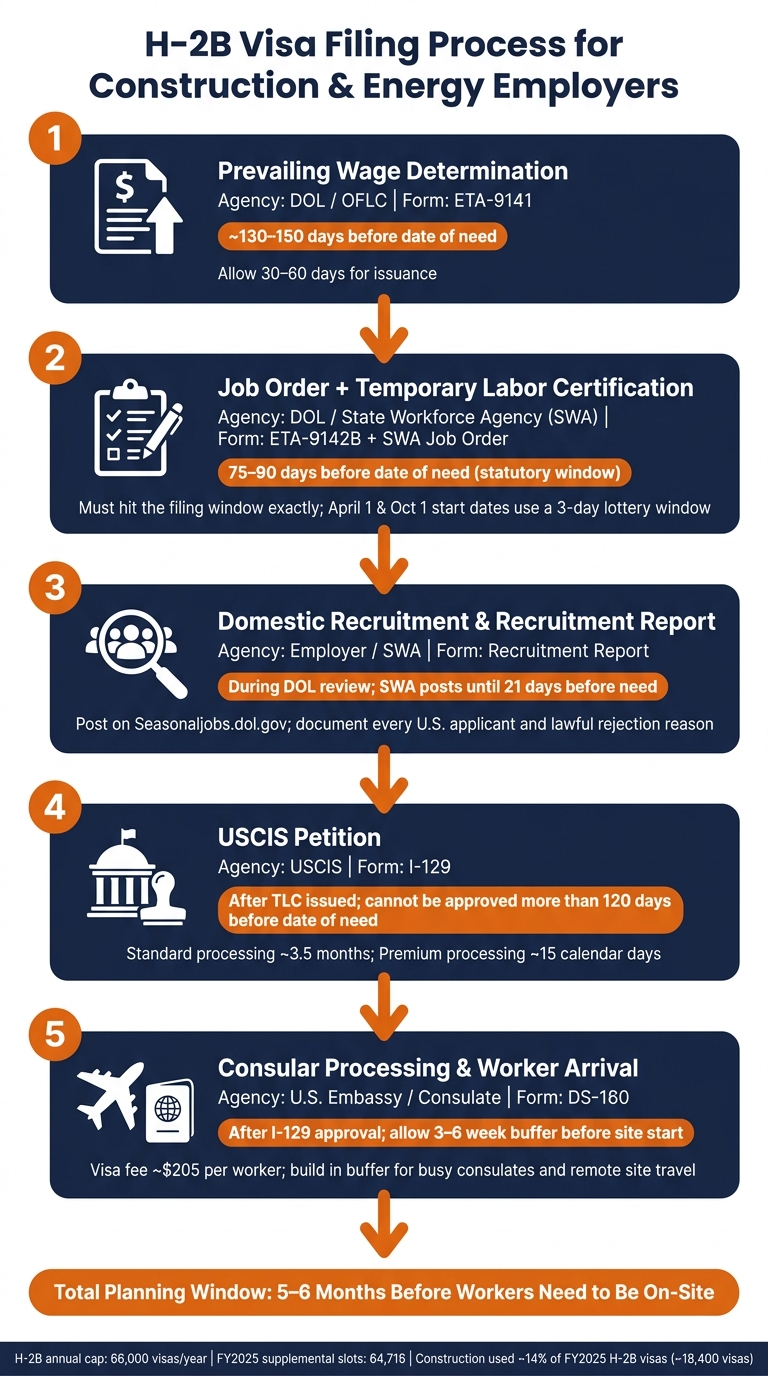
H-2B Visa Process for Construction & Energy Employers: Step-by-Step Timeline
Once you’ve classified the need, the next hurdle is timing. And with H-2B, timing drives almost everything.
This process follows a fixed order. One step feeds the next, so a delay early on can ripple through the whole case. For construction and energy employers, the practical planning window is usually 5 to 6 months before workers need to be on-site, not a few weeks before mobilization. That initial category choice also shapes the records and support you’ll need for wage, recruitment, and certification filings.
Prevailing Wage, Job Order, and Temporary Labor Certification
Start with a Department of Labor prevailing wage determination using Form ETA-9141. File the request at least 60 days before the target date, and expect issuance to take about 30 to 60 days.
Pay has to meet the highest of these four wage floors:
- the DOL prevailing wage
- the federal minimum wage
- the state minimum wage that applies
- any local minimum wage ordinance
In many cases, the prevailing wage ends up being the highest number. Still, don’t assume. Check state and local rates for the exact project location.
After the PWD is issued, file Form ETA-9142B with DOL’s Office of Foreign Labor Certification and, at the same time, place a job order with the State Workforce Agency (SWA) in the area of intended employment. Both filings must land within the 75- to 90-day window before the date of need. Miss that window, and the case can be denied.
Some start dates draw heavy demand, especially April 1 and October 1. For those periods, DOL uses a three-day filing window and then runs a randomized lottery, so filing on the exact date matters.
Recruitment, USCIS Filing, and Consular Processing
Once DOL issues a Notice of Acceptance, the employer has to complete good-faith domestic recruitment. That means running the approved ads, posting the job on Seasonaljobs.dol.gov, and contacting former U.S. workers in similar roles.
Every U.S. applicant must be reviewed against the posted minimum requirements. Employers can reject applicants only for lawful, job-related reasons. Common examples include a missing required certification, an inability to work the full-time schedule, or failure of a drug or safety screening that is applied the same way to all candidates.
Each applicant needs to be documented, and the employer must summarize the outcome in a Recruitment Report submitted to DOL.
After DOL issues the Temporary Labor Certification, the employer files Form I-129 with USCIS. Standard processing often takes about 3.5 months. Premium processing can cut that to about 15 calendar days, which can matter a lot when a project has a fixed outage window or a tight mobilization schedule.
USCIS cannot approve the petition more than 120 days before the date of need. So even here, cap timing still shapes filing strategy.
After I-129 approval, workers move to consular processing at a U.S. embassy or consulate abroad. They file Form DS-160, pay a visa fee of about $205, and attend an interview.
This is where many timelines get squeezed. Busy consulates can push appointments back by several weeks, and simple document mistakes can trigger administrative delays. A 3- to 6-week buffer between expected visa issuance and the on-site start date is a smart cushion, especially for remote energy locations where travel takes extra coordination.
Process Table: Forms, Purpose, and Timing Windows
Use this sequence to work backward from the date of need.
| Stage | Agency | Primary Form | Typical Timing Before Date of Need |
|---|---|---|---|
| Prevailing Wage Determination | DOL / OFLC | ETA-9141 | About 130–150 days out; allow 30–60 days for issuance |
| Job Order + Temp. Labor Certification | DOL / SWA | ETA-9142B + SWA job order | 75–90 days out (statutory window) |
| Domestic Recruitment & Report | Employer / SWA | Recruitment Report | During DOL review; SWA posts until 21 days before need |
| USCIS Petition | USCIS | I-129 | After TLC is issued; may not be approved more than 120 days before need |
| Consular Processing & Arrival | U.S. Embassy / Consulate | DS-160 | After approval; allow a 3–6 week buffer before site start |
Treat the table as a planning map, not a guarantee. Timing still shifts based on filing volume and how clean the submission is. The safest move is to count backward from the target start date and begin pay and recordkeeping prep while the wage request is still in motion. Once the calendar is locked, pay terms and compliance terms have to line up with the certification.
Pay, Worker Terms, and Day-to-Day Compliance Obligations
Once the certification is approved, your pay and scheduling choices need to line up with the terms you filed.
Wages, Hours, and Length of Stay
Every H-2B role must be full-time, which usually means at least 35 hours per week. From that point on, the certified job terms guide day-to-day work. Employers need to pay for all hours worked. That includes pre-shift safety meetings, required training, and travel between job sites during the workday.
Wages must be paid without deductions that push earnings below the certified rate or the minimum wage. If workers covered their own inbound transportation or subsistence, those costs must be repaid by the midpoint of the certified period. Visa fees, border-crossing costs, and other government-required fees should be paid or reimbursed in the first workweek. If someone works more than 40 hours in a week, overtime must be paid at no less than 1.5 times the regular rate when the FLSA and state law require it.
H-2B status only lasts for the approved temporary period, and workers can usually remain in H-2B status for no more than three years total. After that, they generally need time outside the U.S. – often at least three months – before they can qualify again. For multi-year construction or energy jobs, it makes sense to plan for rotating crews or staggered petitions instead of assuming the same workers can stay for the whole project.
Records Employers Should Be Ready to Maintain
Pay rules are one thing on paper. Records are what show you followed them.
DOL requires employers to keep core H-2B records for three years from the date of certification. That covers the certified job order, the petition, recruitment records, payroll records, and documents tied to transportation reimbursements.
At a minimum, keep weekly timesheets for each worksite that show actual start and stop times, job site codes, and overtime hours. Payroll registers should show hourly rates in U.S. dollars, gross pay, net pay, itemized deductions, and pay dates in MM/DD/YYYY format. Workers must also receive pay stubs each payday showing hours worked, the pay period, any deductions, and employer identifying information.
It also helps to keep a separate H-2B compliance file for each project. That file should include:
- Recruitment ads and proof they ran
- Applicant disposition records
- Certified job descriptions
- Worker acknowledgments of site policies
- Transportation and subsistence reimbursement receipts
If a crew moves from one site to another – for example, from a wind farm in West Texas to a transmission line job in New Mexico – document that move by worksite and make sure it stays within the certified geographic area or has been properly amended.
Where ABLEMKR Can Support Labor Operations After Hiring Approval
ABLEMKR can bring onboarding documents, certifications, safety training, check-ins, assignments, and payroll data into one place. That gives employers a clear way to track crews by job site and keep records ready for review. For teams spread across many sites, that kind of visibility can make audits much less messy.
Weak records and missed reimbursements are also common triggers for delays later.
Common H-2B Roadblocks and Key Planning Takeaways
What Causes Delays, Denials, or Missed Start Dates
Once filing starts, the biggest problems usually come down to three things: the cap, weak proof, and bad timing.
H-2B is capped at 66,000 visas per year, and demand often runs past that limit. Supplemental visas may help, but there is no promise they will be available.
After cap pressure, paperwork is where many cases start to wobble.
A lot of denials trace back to weak proof of temporary need. Employers need to connect labor demand to a clear short-term event and show that it lines up with the actual operating calendar.
Small mismatches can also cause trouble. If the job order, labor certification, and petition do not line up on duties, work locations, dates, or wage rates, delays or denials can follow.
And then there is the most avoidable problem: filing too late. Miss one date early in the process, and the rest of the timeline gets squeezed fast. Every step after the wage request adds more lead time.
Treat these trouble spots like a pre-filing gut check.
| Roadblock | Why It Matters | Fix |
|---|---|---|
| Annual cap pressure | Project timelines can miss start dates while waiting on visa availability | File early and monitor cap counts closely |
| Weak temporary-need proof | Turnaround and outage work can look recurring unless documented properly | Tie demand to a specific short-term event |
| Inconsistent job descriptions | Mismatched duties can trigger delays or denials | Standardize descriptions across all filing stages |
| Missed deadlines | Shutdown and mobilization dates are often fixed | Back-plan from the actual project start date |
| Incomplete recruitment records | Missing applicant logs can weaken the certification file | Track dates, contacts, responses, and lawful rejection reasons |
Final Summary for Construction and Energy Employers
For construction and energy employers, H-2B tends to work only when three things happen together: temporary need is proven, the case is filed early, and the record stays consistent from the wage request through worker arrival.
FAQs
How do I know which temporary-need category fits my project?
Your project must involve a temporary labor need that fits one of four categories: seasonal, intermittent, peakload, or a one-time occurrence.
In plain English, this means the role can’t be for steady, year-round staffing. H-2B work is usually limited to up to 10 months, so it generally doesn’t fit ongoing construction or energy jobs that run throughout the year.
You’ll also need to document why the labor need is temporary. That paperwork matters for compliance and helps show that the role meets H-2B rules.
What if my project timeline slips after I file?
If your project timeline slips after you file your H-2B petition, handle it with care to stay compliant. H-2B visas are tied to a specific seasonal or intermittent need, so even a small schedule change can affect your certifications and wage obligations.
Keep clear records of the hours you offer and the hours employees actually work. If delays cut into available hours, you still need to meet the three-fourths guarantee. That means offering work for at least 75% of the workdays in each 12-week period – or paying workers for the gap if you fall short.
Can H-2B workers move between multiple job sites?
Yes. H-2B workers can work at more than one job site, but employers need to follow strict wage and recordkeeping rules.
If workers move between locations, your tracking system must apply the highest Prevailing Wage Determination (PWD) across every site where the work happens. A centralized tracking system can help you keep accurate, audit-ready records for certifications, hours worked, and wage rules.


