
Yes – some construction crews can use H-2B, but only for short-term labor needs with a clear end date. If you need workers for year-round jobs, H-2B is usually the wrong fit. The program works best for a defined project spike, a weather-based work season, or a short-term crew gap tied to one location.
Here’s the short answer:
- H-2B is for temporary, nonfarm work
- Construction jobs can qualify
- The employer must prove there aren’t enough U.S. workers available
- The employer must pay at least the prevailing wage
- The job must fit one of 4 temporary-need types: one-time, seasonal, peakload, or intermittent
- Each case is tied to a job, employer, worksite, and date range
- Timing matters a lot, because filing windows are tight
- The annual cap is 66,000 visas, split into 33,000 for each half of the fiscal year
- Late filing can kill the plan, even if the project is ready
Put another way: if you’re trying to staff a 6- to 9-month project phase, H-2B may work. If you’re trying to fill a long-term labor shortage across many jobs, it likely won’t.
A few numbers show why this matters. U.S. construction is projected to need 499,000 more workers in 2026, and construction had 11,025 H-2B certifications in FY 2024. That tells me the program is being used – but within strict limits.
| Issue | What it means for you |
|---|---|
| Temporary need | You need a clear start and end date |
| Worksite | The case is tied to one area of intended employment |
| U.S. worker test | You must recruit in the U.S. first |
| Wage rule | You must pay at least the local prevailing wage |
| Worker limits | Workers can only do the approved job for the approved employer |
| Filing clock | Most steps start 60 to 120 days before the start date |
| Cap risk | Spring and summer cases often face more pressure |
Bottom line: I’d treat H-2B as a short-term surge tool, not a fix for year-round hiring problems.
H-2B Eligibility: The Question Every Employer Should Ask First
sbb-itb-aa28329
Eligibility Rules for Construction Employers and Workers
With H-2B, everything starts with the employer. If the employer doesn’t qualify, the case stops there. No worker can move forward. Worker eligibility comes from the approved temporary labor certification and the USCIS petition tied to that job.
Employer Eligibility: Temporary Need, U.S. Worker Test, and Business Requirements
Three standards decide whether a construction employer can use H-2B at all.
First, the employer must show that there are not enough U.S. workers who are able, willing, qualified, and available to do the temporary construction work at the time and place needed.
Second, hiring H-2B workers can’t lower wages or working conditions for similarly employed U.S. workers. In plain English, that means the employer must offer at least the prevailing wage for the job and area. The employer also has to use the same wage and working-condition terms for U.S. workers recruited for that role.
Third, the employer must be a real U.S. business with a valid FEIN and an actual U.S. business and worksite presence. That usually means things like payroll records, business licenses, and project contracts.
If the employer meets those tests, the next move is to file the temporary labor certification that supports the H-2B petition.
The 4 Temporary-Need Categories for Construction Crews
Every H-2B case has to fit into one temporary-need category: one-time occurrence, seasonal need, peakload need, or intermittent need. Here’s how that plays out in construction.
| Category | Definition | Construction Example |
|---|---|---|
| One-time occurrence | A single project or event creates a temporary need. | Certified welders for a single refinery expansion or artisans for a one-time historic restoration |
| Seasonal need | Work goes up and down with a recurring season or weather pattern. | Summer asphalt paving crews where work stops in winter |
| Peakload need | Permanent staff need short-term help during a brief surge. | A general contractor adding concrete finishers for a large commercial build-out layered on top of ongoing projects |
| Intermittent need | The employer needs workers only from time to time. | A small developer that undertakes specialized infrastructure work only a few months every couple of years |
Worker Eligibility Under an Approved H-2B Job
Once the employer has an approved labor certification and USCIS petition, worker eligibility becomes job-specific and employer-specific. An H-2B worker may work only in the job listed in the petition, for that employer, at the certified location, during the approved period.
Here’s what that means in practice: a concrete finisher approved for a peakload commercial project in Texas can’t just switch to another contractor or move into a residential role without a new petition and a new labor certification. H-2B status does not transfer to other employers or other construction jobs on its own.
At the consular stage, workers usually submit:
- A valid passport
- Proof of relevant experience, such as letters from prior employers or training certificates
- Evidence of ties to their home country that support temporary intent
Employers should make sure each worker’s experience, training, and certifications line up with the approved job description.
That’s why crew selection has to match the certified project from day one.
Construction Jobs That May Qualify and Where H-2B Fits Staffing Plans
Roles and Job Phases Tied to Temporary Construction Demand
Construction accounted for 11,025 H-2B certifications in FY 2024, which shows that employers already use the program for short-term project labor. So the next step is pretty direct: which construction jobs meet the temporary-need test, and which ones usually miss it?
The jobs most often linked to H-2B are the ones tied to a clear project phase. That usually includes general laborers, concrete finishers and masons, roofers, framers, drywall finishers, painters, equipment operators, and site-prep crews. USCIS decisions have also recognized cement masons, reinforcing metal workers, and mechanical construction workers when the employer can show that the need is temporary.
In plain terms, the job title alone doesn’t decide the case. The timing and purpose of the work do. If workers are being brought in for a defined phase of a project, the fit is much stronger.
Roles That Usually Do Not Fit H-2B
Baseline, year-round crews usually do not qualify. That includes general laborers, carpenters, roofers, or equipment operators who are scheduled nonstop across multiple projects. Permanent supervisory roles such as project managers and site superintendents also sit outside the program because their duties continue over time instead of lining up with one temporary spike. Skilled trades that stay in steady, year-round demand run into the same problem.
This is where many employers get tripped up. A worker may do the same type of task as someone on an H-2B petition, but if that role is part of the company’s normal staffing pattern, it usually won’t pass the test.
How H-2B Fits Into Job-Site Workforce Planning
For contractors, the main point is simple: treat H-2B as a short-term surge tool, not a permanent staffing layer. Use it for surge labor, not baseline headcount. One practical way to show that line is to separate baseline crews from temporary project labor with 1 to 3 years of payroll and project history.
H-2B workers should be assigned only to the surge tasks and dates listed in the petition, not mixed into general operations. When contractors blur that line, they can run into petition denials, compliance findings, and project delays.
Employer Filing Process, Timing, and Recordkeeping
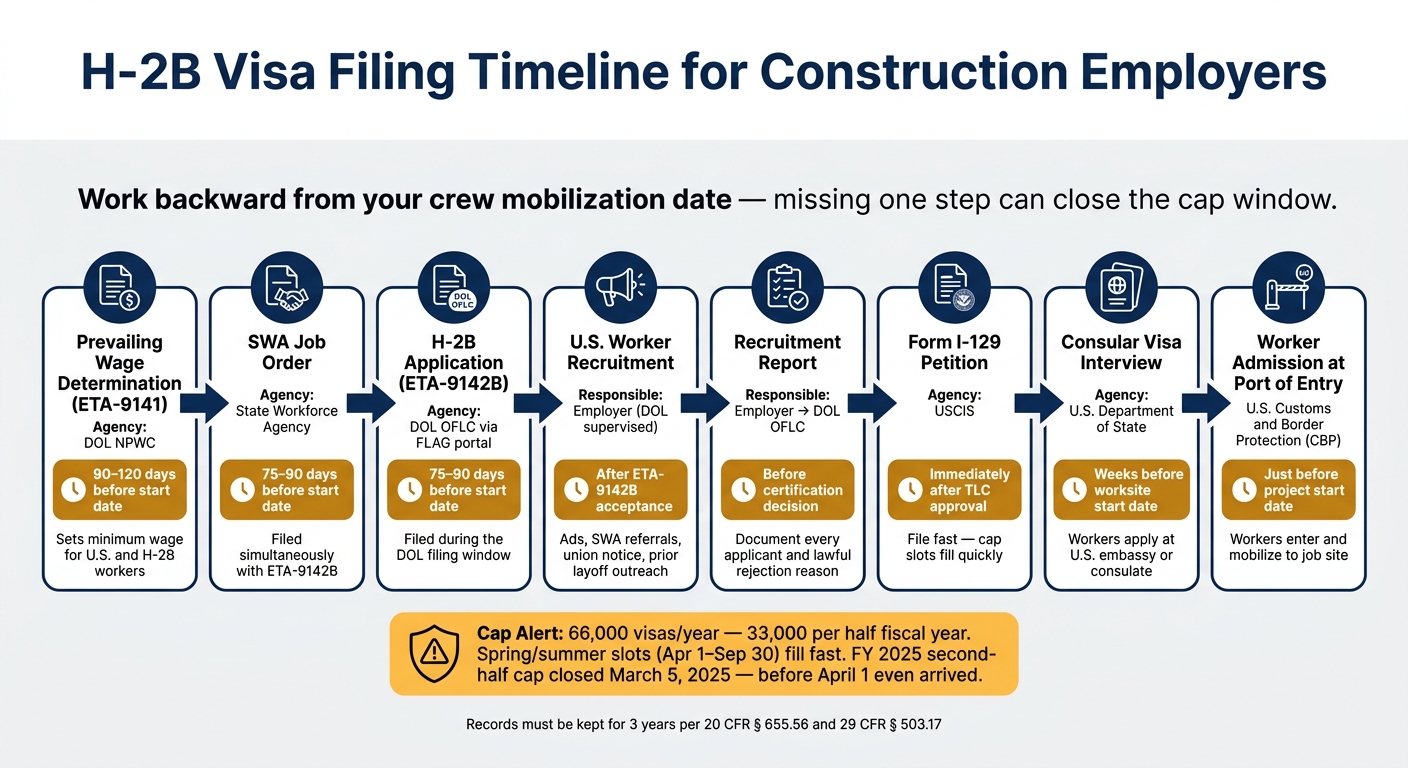
H-2B Visa Filing Timeline for Construction Employers
Once the job and crew meet H-2B rules, the filing sequence sets the whole schedule. Each filing has to line up with a temporary project need, not a long-term staffing shortfall.
Step-by-Step Filing Sequence
Here’s how the process usually moves from start to finish:
- Prevailing Wage Determination (ETA-9141) – File with DOL NPWC to set the minimum wage that must be paid to both U.S. workers and H-2B workers on the project.
- SWA Job Order + ETA-9142B – File the SWA job order and ETA-9142B together during the DOL filing window. DOL prefers electronic filing through FLAG.
- U.S. Worker Recruitment – Start the required recruitment after DOL accepts ETA-9142B. That includes SWA referrals, newspaper ads, union notice when required, and contact with U.S. workers laid off in the past 12 months.
- Recruitment Report – Record every recruitment step, every applicant, and the lawful reason for each rejection. Submit that report to DOL before the certification decision.
- Form I-129 – File with USCIS as soon as DOL issues the certified TLC so you don’t lose time against the cap.
- Consular Processing – After DOL certification, workers apply for visas at a U.S. embassy or consulate, then seek entry through CBP.
Key Timing Windows for Construction Hiring Plans
In construction, timing is everything. The cleanest way to plan is to start with the date workers must be on site, then work backward from there.
The prevailing wage request must be filed at least 60 days before the crew mobilization date. The SWA job order and ETA-9142B must be filed during the 75- to 90-day window before the start date.
| Filing Step | Responsible Agency | Timing (relative to start date) |
|---|---|---|
| Prevailing Wage Determination (ETA-9141) | DOL NPWC | At least 60 days before; ideally 90–120 days out |
| SWA Job Order | State Workforce Agency | 75–90 days before project start date |
| H-2B Application (ETA-9142B) | DOL OFLC | 75–90 days before project start date |
| U.S. Worker Recruitment | Employer, under DOL supervision | After ETA-9142B acceptance; within the 75–90 day window |
| Recruitment Report | Employer to DOL OFLC | Before certification decision |
| Form I-129 Petition | USCIS | As soon as TLC is approved |
| Consular Visa Interview | U.S. Department of State | After I-129 approval; weeks before worksite start date |
| Worker Admission at Port of Entry | U.S. Customs and Border Protection | Just before project start date |
Miss one window, and the rest of the plan can slide with it. That’s why many contractors build the hiring calendar around the labor start date first, then map each filing deadline to it.
Documents to Keep and Compliance Records
Under 20 CFR § 655.56 and 29 CFR § 503.17, H-2B employers must keep all application and compliance records for 3 years from the date of certification, denial, or withdrawal of the TLC.
That file should include the certified TLC, prevailing wage determination, recruitment proof, payroll records, reimbursement records, and all DOL, USCIS, and consular correspondence for the full 3-year period. DOL and GAO audits treat recordkeeping failures as substantive violations, not minor paperwork slipups, because missing records can hide wage and recruitment issues.
For construction firms handling more than one H-2B project at a time, a centralized digital archive is usually the most practical setup. Organize records by project and certification date, then index them by worker, recruitment step, and pay period.
Even perfect timing does not solve the next constraint: the annual H-2B cap.
Cap Limits, Planning Constraints, and Final Takeaways
How the Annual H-2B Cap Affects Construction Scheduling
After certification and recruitment are done, one more hard stop remains: the cap.
The H-2B program has a statutory cap of 66,000 visas per fiscal year, split into two equal parts: 33,000 for employment start dates from October 1 through March 31 and 33,000 for start dates from April 1 through September 30. If numbers from the first half go unused, they can roll into the second half. But if visas are left over at the end of the fiscal year, they do not carry into the next one.
For construction, the squeeze usually hits hardest in the second half. That’s when spring and summer outdoor work ramps up, and many employers are chasing the same 33,000 slots. For contractors planning crews for spring and summer, that timing can make or break the schedule.
USCIS reported that March 5, 2025 was the final receipt date for second-half FY 2025 cap-subject petitions. That means the cap closed before the April 1 employment window even opened. In plain English: if you file too late, the job may be lined up, the workers may be ready, and none of it may matter.
Some fiscal years come with supplemental visas above the cap. Still, contractors should not build project schedules around extra numbers that may fill fast or vanish before filing even begins.
Early Preparation for Contractors and Crew Managers
H-2B can help with defined labor surges, but only when planning starts early.
The best way to handle it is backward scheduling. Start with the day workers need to be on site, then work backward through each filing step and deadline. In many cases, that means starting the prevailing wage request 120 days or more before the target start date.
Using H-2B as a last-minute patch for chronic understaffing is where trouble starts. It adds compliance risk, and it can throw off the whole project timeline, especially when cap numbers are already tight.
Conclusion: Key H-2B Rules Construction Employers Should Know
H-2B is a narrow, deadline-driven program built for temporary labor needs. It is not a general staffing fix. The table below sums up the main limits construction employers need to keep in mind.
| Rule | What It Means in Practice |
|---|---|
| Temporary need is required | The job must be seasonal, peak-load, intermittent, or one-time – not part of normal year-round operations |
| U.S. worker protections apply | Employers must recruit domestically first and pay at least the prevailing wage |
| Filing is deadline-driven | Missing one step can push the entire schedule past the cap window |
| The cap is a hard constraint | The annual cap is 66,000 visas, split evenly between the two fiscal-year halves |
| H-2B is for defined surges | Core, long-term roles should be staffed through domestic hiring or other lawful channels |
Used as a workaround for ongoing labor gaps, H-2B can create compliance exposure and scheduling risk that lasts longer than the project itself.
FAQs
Can one H-2B crew work at multiple construction sites?
Yes – if the employer follows the rules closely.
Because H-2B visas are tied to a specific temporary need, every worksite has to stay within the scope of the approved labor certification.
If crews work across different sites, the employer must use the highest prevailing wage determination tied to those locations. The employer also needs to keep records that meet federal audit standards.
What happens if the H-2B cap is reached before I file?
If the H-2B annual cap is hit before you file, your petition won’t be approved for that capped fiscal year. The program is limited to 66,000 visas per year, and demand can be higher than the number of slots available.
In most cases, that means you’ll need to wait for the next H-2B filing cycle instead of expecting approval for the current period.
How do I prove my construction labor need is truly temporary?
To prove your construction labor need is temporary for an H-2B visa, you need to show that it connects to a specific, non-permanent event and falls into one of these categories: one-time, seasonal, peak-load, or intermittent.
That means your request can’t look like year-round hiring for permanent roles. It needs to show a short-term labor gap tied to a project cycle, busy period, or other limited-time demand.
You also need to state that your business would suffer irreparable harm without these workers. In plain English: the labor shortage would cause damage your business can’t easily fix.
Clear records help a lot here. Things like project timelines, past staffing patterns, work schedules, and labor demand during each phase can help back up your petition.


