
The U.S. renewable energy sector is growing fast, but the workforce isn’t keeping up. By early 2026, the solar industry alone faces a shortfall of 53,000 workers to meet federal deadlines for tax credit eligibility. Key challenges include:
- Skill shortages: 86% of solar employers struggle to hire, with 53% citing lack of experience or training.
- Compliance hurdles: Federal tax credits require 15% of labor hours to be completed by apprentices, but apprenticeship programs are limited.
- Safety training gaps: Only 43% of the workforce has access to specialized safety training.
- Digital and technical expertise: Workers are unprepared for AI-driven tools and high-voltage systems.
Solutions include updating training programs, expanding apprenticeships, integrating compliance and safety training, and using workforce technology to track certifications and streamline hiring. These steps are critical to meeting renewable energy goals and ensuring projects remain eligible for federal incentives.
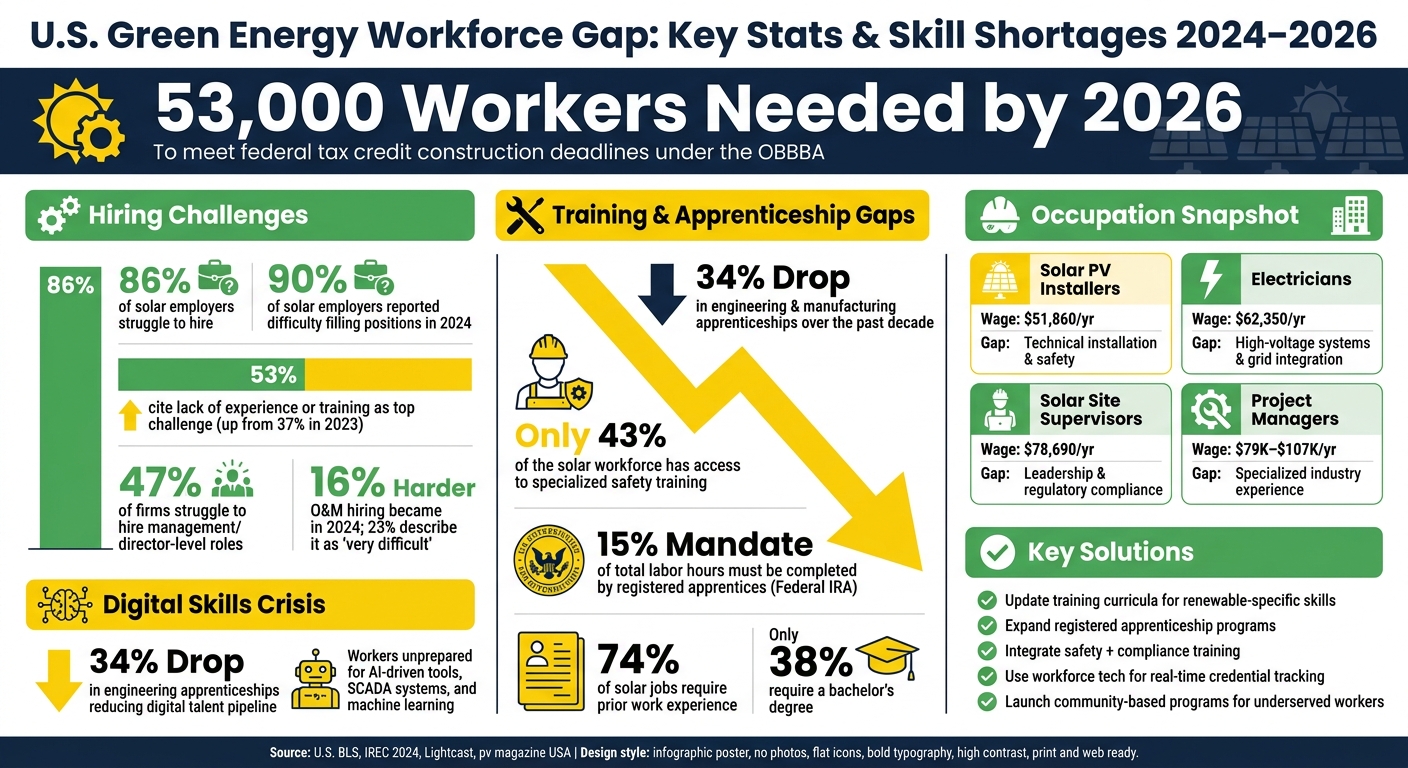
U.S. Green Energy Workforce Gap: Key Stats & Skill Shortages 2024–2026
Resilient Clean Energy Workforce in TImes of Uncertainty
sbb-itb-aa28329
Skill Gaps in the Renewable Energy Workforce
The renewable energy sector in the U.S. is facing a workforce challenge. From technical trades to digital expertise and regulatory understanding, gaps in skills are slowing progress and creating bottlenecks. Here’s a closer look at the areas where the workforce is falling short and the challenges that come with them.
Technical Skills for Renewable Energy Construction
There’s a significant shortage of skilled workers in trades such as licensed electricians, solar PV installers, wind turbine technicians, and general construction workers. For instance, in 2024, 90% of solar employers reported struggling to fill open positions. The competition for licensed electricians is particularly tough, as the demand spans not only solar companies but also EV infrastructure and traditional construction.
Operations and Maintenance (O&M) is feeling the most strain. Hiring in O&M roles became 16% harder in 2024, with 23% of employers describing it as "very difficult" to find qualified candidates. As solar and storage systems multiply, the need for technicians to maintain and repair these systems will only increase.
| Occupation | Median Annual Wage | Key Skill Gaps |
|---|---|---|
| Solar PV Installers | $51,860 | Technical installation, safety |
| Electricians | $62,350 | High-voltage systems, grid integration |
| Solar Site Supervisors | $78,690 | Leadership, regulatory compliance |
| Project Managers | $79,000–$107,000 | Specialized industry experience |
Source: U.S. BLS/IREC 2024
The shortage isn’t confined to field roles. 47% of renewable energy firms reported major challenges in hiring for management and director-level positions in 2024. To address this, companies like ReVision Energy have introduced apprenticeship programs aimed at training managers.
As technical roles remain tight, the industry is also grappling with the growing importance of digital skills.
Digital and Emerging Technology Skills
Data is at the heart of modern renewable energy projects. From SCADA systems to AI-driven monitoring and machine learning tools, these technologies are essential for grid management. However, the workforce is lagging behind in digital literacy. Apprenticeships in engineering and manufacturing have dropped by 34% over the past decade, reducing the pipeline of workers with the technical expertise needed for these roles.
"Without an upskilled workforce, there will be no energy transition. The increasing ambitions mean that demand for workers is rising faster in the renewable sector than in other industries." – Derrick (as cited in Frontiers in Sociology)
Adding to the challenge, renewable energy companies are now competing with the tech sector for data scientists and software developers. This competition is tough, especially when it comes to salary offerings.
Environmental and Regulatory Compliance Skills
Compliance skills are another critical area. Federal tax credits under Sections 45Y and 48E of the Inflation Reduction Act require that 15% of total labor hours on a project be completed by qualified apprentices. This requirement demands a workforce that understands compliance documentation, apprenticeship standards, and federal reporting – areas where many workers lack experience.
"The apprenticeship and compliance component is also a big shift. It’s not just hiring anymore, it’s about structured workforce strategies, documentation, and alignment with evolving federal requirements." – Amanda Perez, The Imagine Group
Basic academic skills, such as math, writing, and communication, further complicate compliance efforts. Research from Lightcast highlights that many entry-level workers lack the foundational skills to complete compliance paperwork accurately.
Safety and High-Risk Operational Training
Working on large-scale solar farms, wind turbines, and high-voltage systems comes with serious risks. Specialized safety training is essential for tasks like turbine maintenance, confined space entry, and arc flash hazard management. Yet, only 43% of the U.S. solar workforce currently has access to the targeted safety training needed for these high-risk environments. This leaves a significant portion of workers unprepared for the physical demands and dangers of their jobs.
Transition Skills for Fossil Fuel Workers
Workers transitioning from the oil, gas, and coal industries bring valuable experience to renewable energy projects. Their expertise in high-voltage systems, safety protocols, and complex project environments often aligns well with solar and wind energy needs. Jessie Arevalo, a Construction Superintendent at Nexamp, explains:
"I know a lot of coworkers who didn’t go to university or study solar. They came from adjacent industries where they were working on power plants or refineries and they were able to transition all that knowledge from the construction field into solar."
The problem is that these transferable skills often go unrecognized without formal certifications. Federal apprenticeship requirements mandate documented credentials, not just experience. For example, a worker with 20 years of pipeline maintenance experience may still lack the certifications needed to qualify as a "compliant" worker under current regulations. Addressing this issue requires targeted bridge programs to help these workers transition seamlessly, rather than forcing them to start from scratch. This approach ensures their expertise isn’t wasted while meeting regulatory standards.
Barriers to Effective Training and Workforce Development
Pinpointing skill gaps is just the beginning. Structural hurdles in training systems make it even harder to address workforce shortages, especially in fields essential to renewable energy. These challenges not only slow workforce readiness but also jeopardize compliance with federal mandates like the OBBBA and related tax credit deadlines.
Misalignment in Education and Vocational Training
Renewable energy technology evolves at a breakneck pace, but educational programs often fail to keep up. This leaves workers unprepared for emerging fields like grid-scale battery storage and AI-driven energy systems.
Another issue is the disconnect between employer needs and what institutions provide. For example, in the solar industry, 74% of jobs require prior work experience, but only 38% require a bachelor’s degree. Traditional four-year programs often fail to produce candidates ready for the job market. In fact, 53% of solar employers identified a lack of experience, training, or technical skills as the top hiring challenge in 2024, a sharp rise from 37% in 2023. These gaps in formal education ripple into other areas, such as apprenticeships and accessible training opportunities.
Limited Apprenticeships and Work-Based Learning
Apprenticeships are one of the most effective ways to prepare workers for hands-on roles. Unfortunately, the number of available programs has dwindled. Over the past decade, apprenticeships in engineering and manufacturing have dropped by 34%, reducing the talent pipeline at a time when demand has never been higher.
The federal Inflation Reduction Act has added urgency to this problem. Under Sections 45Y and 48E, projects must ensure 15% of total labor hours are completed by registered apprentices to qualify for full tax credits. Without enough apprenticeship programs to meet this requirement, developers risk losing key financial incentives. This shortage has forced some companies to invest in costly internal training programs to fill the gap.
"The ACE Network has helped our company immensely… we went from 1 occupation, 1 employer, and 20 apprentices to 4 approved programs, 11 employer partners, and 160 apprentices in just 9 months." – Nikki Kasper, Director of Business Strategy Consulting and Management Services, Cam Solar Training
Cam Solar’s success highlights what’s possible when support systems are in place. However, such rapid growth remains the exception, not the norm.
Access and Inclusion Challenges
Even when training programs exist, practical barriers often limit who can participate. Many programs are prohibitively expensive or located far from underserved communities, making them inaccessible for those who need them most. For example, green energy projects are often based in remote areas, far from where potential workers live. For individuals dealing with childcare, transportation issues, or financial instability, unpaid or costly training programs simply aren’t feasible.
The issue isn’t just logistical – it’s also about representation. The energy workforce is still overwhelmingly white and male, and without intentional outreach and structural changes, these disparities are unlikely to improve. Many underserved communities remain unaware of available opportunities, further widening the gap. Addressing these challenges means more than just creating programs; it requires removing the obstacles that prevent participation in the first place.
Solutions for Closing Green Energy Training Gaps
The challenges are clear, but so are the pathways to overcome them. Addressing the renewable energy workforce gap requires targeted efforts in curriculum development, apprenticeship expansion, safety-compliance integration, and community-focused programs.
Building Industry-Aligned Curricula
Most traditional vocational programs stick to general electrical and mechanical training, leaving out key skills needed for renewable energy jobs. For instance, they often don’t include training on high-voltage DC systems, AI-powered solar arrays, or the regulatory framework specific to renewable projects.
Employers can bridge this gap by collaborating with community colleges, technical schools, and workforce boards to create programs tailored to industry needs. Here’s a comparison of current training versus renewable-focused curricula:
| Training Component | Standard Curricula | Renewable-Focused Curricula |
|---|---|---|
| Technical Focus | General electrical/mechanical principles | High-voltage DC, AI-integrated solar, battery storage |
| Safety | Standard OSHA/construction safety | High-voltage DC and rooftop/climbing safety |
| Regulatory | General building codes | NEC Article 690, IRA/OBBBA labor compliance |
| Technology | Traditional power systems | AI-integrated systems and smart inverters |
Additionally, employers can refine hiring strategies by creating competency-based job descriptions. This approach makes it easier to recruit workers with transferable skills, such as power plant technicians, refinery operators, and military veterans.
Hands-on training programs are essential to complement these updated curricula, ensuring workers gain the practical expertise needed on job sites.
Scaling Apprenticeships and On-the-Job Training
Apprenticeships have long been a reliable way to develop skilled workers. In the renewable energy sector, they are even more critical, as companies risk missing out on Inflation Reduction Act incentives if they lack structured programs.
The Apprenticeships in Clean Energy (ACE) Network provides resources to help employers design registered apprenticeship programs. For example, Freedom Forever, a residential solar company, launched a multi-state electrical apprenticeship program in November 2024. Their goal? Train 200 apprentices by 2028, after achieving certification for National Guidelines for Apprenticeship Standards.
ReVision Energy took a different route, developing an apprenticeship program aimed at preparing managers. This addresses a significant industry challenge – 47% of companies report difficulty filling supervisory roles.
When safety and compliance training are integrated into these programs, the workforce becomes even more prepared to meet project demands.
Combining Safety and Compliance Training
Merging safety and compliance training creates a dual benefit: it ensures worker safety while also meeting the documentation requirements needed for federal incentives. This integration helps workers prevent injuries, track apprenticeship hours, and document compliance with prevailing wage laws – all of which are critical for securing funding.
Here’s how combined training compares to basic safety training:
| Training Component | Basic Safety Training | Combined Safety & Compliance Training |
|---|---|---|
| Primary Goal | Physical injury prevention (OSHA) | Injury prevention plus eligibility for federal incentives |
| Documentation | Safety logs and incident reports | Real-time apprenticeship hour tracking and wage reporting |
| Workforce Impact | Reduced workplace accidents | Improved project bankability and access to federal incentives |
| Skill Level | Entry-level awareness | Mid-level management and supervisory readiness |
This dual focus not only boosts workforce readiness but also enhances project viability, a crucial factor given the OBBBA’s 2026 construction deadline.
Community-Based Training for Underserved Groups
Formal education and apprenticeships are vital, but they often miss workers in rural areas or those unable to take unpaid time off for training. Community-based programs address these gaps by offering local access, support services like childcare and transportation, and outreach to underrepresented groups.
For example, the city of Katowice, Poland, established an Engineering Training Center as part of its transition from coal. This initiative successfully reskilled 70,000 workers for roles in green energy and other technical fields. Programs like this, paired with "energy skill passports" – portable credentials that verify expertise across sectors – can help displaced fossil fuel workers transition into renewable energy roles more effectively.
Using Workforce Technology for Green Energy Projects
As we tackle the challenges of training and recruitment in the green energy sector, advanced workforce technology is stepping up to simplify compliance and deployment processes. While training programs focus on building skills, these platforms ensure credentials are tracked and compliance is maintained efficiently.
Real-Time Certification and Skill Visibility
The looming shortage of 53,000 workers ahead of the July 4, 2026, construction deadline under the One Big Beautiful Bill Act highlights the urgency of efficient workforce management. Manual credential verification simply can’t keep up with such tight timelines. Tools like ABLEMKR are designed to match pre-vetted workers to projects based on certifications, safety training, availability, and location – helping projects secure skilled workers quickly.
Having real-time access to worker credentials is now a cornerstone of project bankability. Ryan Kennedy from pv magazine USA explains:
"In 2026, the ability to secure a compliant, documented workforce has become a determining factor in project bankability, along with interconnection and supply chain stability."
This capability ensures that developers can demonstrate workforce compliance at any project stage, which is essential for readiness and meeting regulatory demands.
Compliance Tracking and Reporting
The federal requirement to meet the 15% apprenticeship labor hour mandate for full tax credit eligibility has turned compliance tracking into a critical financial issue. Missing this mandate could mean forfeiting an entire tax credit. Relying on manual tracking methods across multiple subcontractors often leads to errors and inefficiencies.
Technology-enabled systems eliminate these risks by automating compliance processes. These platforms log apprenticeship hours, verify adherence to prevailing wage standards, and generate real-time documentation. Here’s how they compare to manual methods:
| Feature | Manual Tracking | Technology-Enabled Platforms |
|---|---|---|
| Certification Visibility | Delayed; relies on physical paperwork | Real-time access to pre-vetted worker credentials |
| Apprenticeship Tracking | Difficult to aggregate across multiple subs | Automated tracking of the 15% labor hour mandate |
| Compliance Reporting | Prone to human error; hard to audit | Automated documentation |
| Project Bankability | Higher risk of forfeiting tax credits | Verifiable data for investors and regulators |
Amanda Perez from The Imagine Group highlights the shift:
"The apprenticeship and compliance component is also a big shift. It’s not just hiring anymore, it’s about structured workforce strategies, documentation, and alignment with evolving federal requirements."
By automating these processes, projects can maintain eligibility for federal incentives while staying aligned with regulatory changes.
Using Labor Market Data to Guide Training Investments
Labor market analytics are proving invaluable in guiding where training investments should go. For example, California, Texas, and Florida currently lead in solar job postings, making them prime locations for workforce development. A review of 82,000 solar job postings between March and August 2025 found that Solar PV Installers and Sales Representatives are the most sought-after roles.
At the management level, the challenges are even more specific: 47% of firms report difficulties in hiring directors and supervisors. Identifying these gaps early allows companies to focus on developing mid-level leadership, ensuring workforce strategies align with both market demands and project timelines.
Conclusion: Building a Skilled Renewable Energy Workforce
The renewable energy sector in the U.S. is grappling with a significant labor shortage, with an estimated 53,000 workers needed by late 2026. Adding to the challenge, 86% of solar employers are finding it difficult to fill key positions. Addressing this issue requires a collaborative push involving robust training programs, thoughtful policy adjustments, and the integration of advanced technology. To meet federal energy goals, we need industry-specific training curricula, expanded apprenticeship opportunities, and localized training initiatives. Experts emphasize that workforce readiness is a pivotal challenge in the transition to clean energy.
Technology also plays a crucial role in bridging these gaps. Platforms like ABLEMKR streamline the process by quickly connecting qualified workers to projects, automating compliance processes, and improving project viability – essential for securing federal tax incentives.
The path forward is clear: accelerate training and certification programs, refine credentialing systems, and ensure skilled workers are deployed efficiently. The success of the energy transition hinges on building a workforce that is prepared to meet the demands of this rapidly evolving industry.
FAQs
How can companies meet the 15% apprentice-hours rule on projects?
Companies aiming to meet the 15% apprentice-hours rule should consider adopting Registered Apprenticeship Programs (RAPs). These programs blend practical, on-the-job training with technical education, ensuring that a designated percentage of labor hours are handled by skilled apprentices. By doing so, businesses not only adhere to regulations but also tackle workforce challenges by building a pool of trained professionals. This can lead to smoother project timelines, enhanced safety measures, and a more prepared workforce for the renewable energy industry.
What green energy certifications matter most for getting hired fast?
Key green energy certifications that can help you land a job quickly include industry-recognized credentials and technical training programs. Certifications connected to registered apprenticeships stand out, as they offer nationally recognized qualifications and hands-on experience, making candidates more attractive to employers in the green energy sector.
How can ABLEMKR help track credentials and tax credit compliance?
ABLEMKR simplifies the process of managing credentials and staying on top of tax credit compliance. By using digital tools and automated site tracking, the platform ensures that workers meet the required certifications and labor standards tied to tax incentives and apprenticeship rules. This helps employers maintain compliance while improving overall efficiency.


