
Your oil and gas experience can help you move into geothermal drilling – but it isn’t a job qualification on its own. I’d start by choosing a target role, matching your rig and well experience to its duties, and asking the employer which training and field checks you need.
This guide covers deep geothermal wells for power generation, not home heat-pump installations. Heat can change the job: Newberry well NWG 55-29 reached about 10,062 feet and 628°F.
Here’s what I’d check before making the move:
- Skills and career paths: How rig work, directional drilling, cementing, fluids, logging, engineering, geology, HSE, and site support fit geothermal roles.
- Well conditions: Depth, rock, pressure, heat, fluid chemistry, tool limits, and well design – not just the industry label.
- Training and approval: Required licenses, site training, equipment checks, supervised work, and employer sign-off.
- Assignment terms: Pay, overtime, rotation, travel, lodging, and who pays for training.
- Job matching: Where ABLEMKR can help with profiles and availability – and where employer checks still apply.
My bottom line: <u>match your experience to the specific assignment</u>, then get the training requirements and offer terms in writing. A familiar job title doesn’t mean a familiar well.
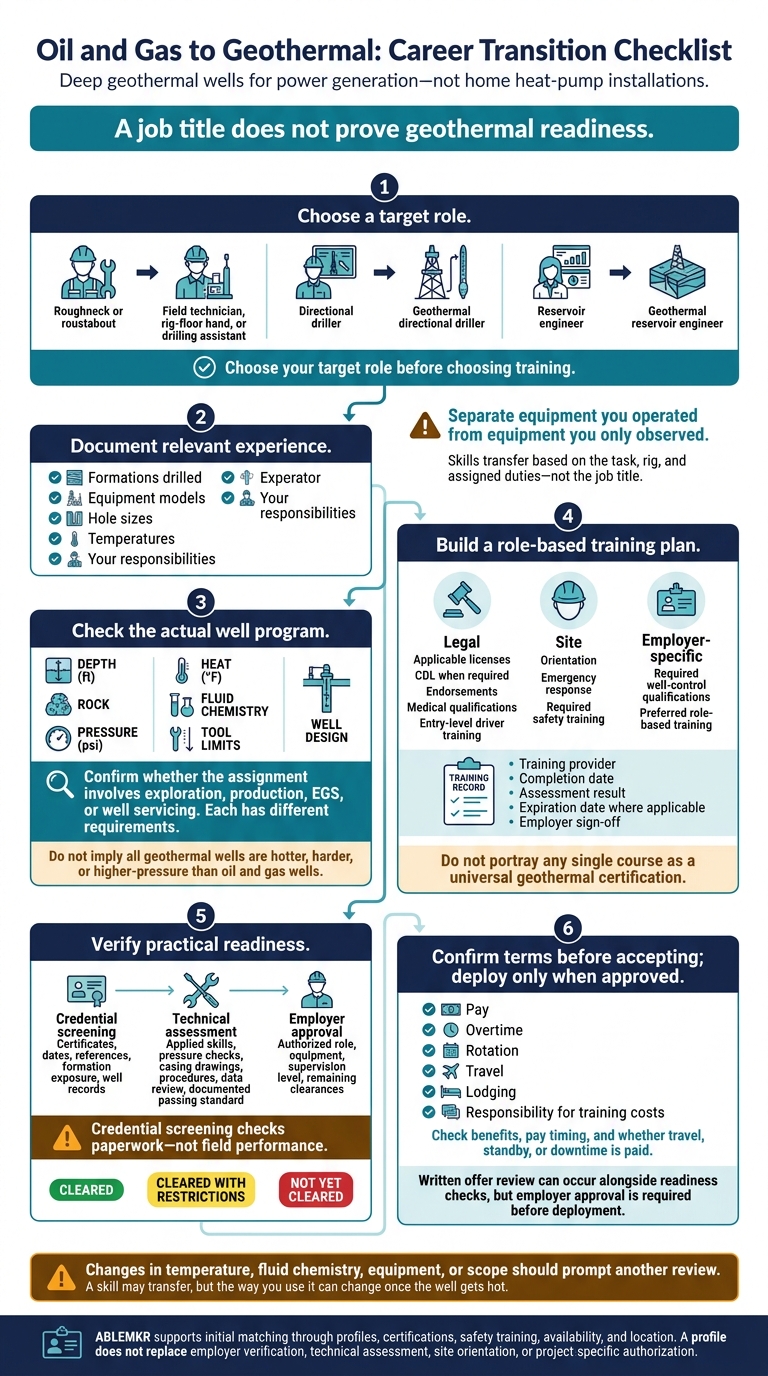
Oil and Gas to Geothermal: Career Transition Checklist
Oil and Gas vs. Geothermal Drilling
Which Drilling Skills Transfer?
Skills transfer based on the task, rig, and assigned duties – not the job title.
| Oil and gas experience | Geothermal application | Transferability |
|---|---|---|
| Rig-up, pipe handling, tripping, maintenance, and crew handoffs | Running the rig and handling shift handoffs | Direct, with equipment orientation |
| Directional drilling and survey control | Reaching production or injection targets | Requires adjustments for formations, trajectories, and tool limits |
| Casing and cementing | Isolating fractured zones and maintaining well integrity at high temperatures | Requires knowledge of high-temperature cement qualification |
| Drilling fluids and hydraulics | Managing hot fluids, changes in rheology, and lost circulation | Requires geothermal fluid and loss-control training |
| MWD, wireline, and downhole surveys | Measuring temperature, pressure, fractures, permeability, and well condition | Requires temperature-rated tools and measurement-specific training |
| Pressure and flow testing | Evaluating injectivity, mass flow, enthalpy, and pressure response | Requires training in geothermal test execution and interpretation |
| Reservoir engineering and geoscience | Modeling heat extraction, fracture connectivity, and reinjection | Requires geothermal thermal modeling and resource assessment training |
| HSE, barrier management, and emergency response | Controlling steam, hot water, and gas hazards where present | Direct safety baseline; geothermal-specific training for unfamiliar hazards |
| Permitting, scheduling, procurement, and cost control | Managing approvals, specialized equipment, water supply, and drilling costs | Requires adjustments for project rules and operating requirements |
These ratings do not grant regulatory authorization. Employers must verify applicable licenses, well-control qualifications, site training, and task-specific skills. On your résumé, list the formations drilled, equipment models, hole sizes, temperatures, and your responsibilities – not just years in oil and gas.
A skill may transfer, but the way you use it can change once the well gets hot.
How Geology, Heat, and Well Design Differ
Compare the actual well programs. Geothermal doesn’t always mean harder rock or higher pressure: some resources sit in sedimentary basins, and oil and gas wells can also involve extreme heat and difficult formations.
Temperature, rock type, and completion goals drive the differences.
| Dimension | Oil and gas drilling | Geothermal drilling |
|---|---|---|
| Objective | Maximize economic hydrocarbon recovery | Sustain usable heat delivery through fluid flow or closed-loop heat transfer |
| Formations | Often sedimentary, though conditions vary widely | Hard or fractured rock can increase bit wear, vibration, and drilling time |
| Fluids and pressure | Mud, hydrocarbons, brines, and gas require pressure control | Hot water, steam, mineralized brines, and gases where present; fracture losses can reduce hydrostatic control |
| Temperature exposure | Tools and materials match expected conditions | Heat can limit electronics, seals, cement, and additives |
| Well economics | Balance drilling costs against recoverable hydrocarbons | Balance depth, temperature, permeability, drilling cost, and sustained heat delivery |
| Completion priorities | Containment, reservoir access, and hydrocarbon deliverability | Durable flow paths, injectivity, thermal performance, casing integrity, and sustained mass flow; larger wellbores and paired production-injection wells can support circulation |
| Production cycles | Track pressure, production decline, and recovery performance | Track temperature, chemistry, corrosion, scaling, and thermal drawdown alongside pressure |
Newberry well NWG 55-29 reached about 10,062 feet and 628°F bottom-hole temperature.
Enhanced geothermal systems may require stimulation; closed-loop designs differ. For a job-specific comparison, ask for planned depth in feet, operating temperatures in °F, pressure limits in psi, tool ratings, and expected fluid chemistry. Pressure alone doesn’t establish readiness. Hot-fluid handling, thermal cycling, and loss-control procedures matter, too.
On fractured-rock projects, watch returns, pit volume, torque, penetration rate, standpipe pressure, and temperature together. When readings change, follow site procedures rather than improvising. Lost circulation can create drilling, cementing, and well-control problems at the same time.
sbb-itb-aa28329
WING UK 2021 Career Transition Panel: From Oil & Gas to Geothermal
Geothermal Career Paths for Oil and Gas Workers
Choose your target role before choosing training. An oil and gas background can lead to several geothermal jobs, depending on whether a project needs drilling, completion, or field support. Your skills need to match the job and its well program.
Field technician, drilling assistant, and site-support jobs can provide a way in. Specialist roles usually call for extensive technical experience and project-specific checks. Openings and entry requirements differ by employer and project type, particularly between conventional hydrothermal and next-generation geothermal work.
| Current role | Geothermal target role | Transferable experience | Technical gap | First training step |
|---|---|---|---|---|
| Roughneck or roustabout | Field technician, rig-floor hand, or drilling assistant | Pipe handling and rig-floor work | Geothermal operating procedures | Employer orientation on geothermal drilling |
| Derrickhand | Derrickhand or assistant driller | Fluid checks and tripping support | Hot-fluid handling and circulation losses | Geothermal field training |
| Driller | Geothermal driller | Rig control | Project-specific drilling practices | Employer qualification on the assigned rig |
| Rig manager | Drilling superintendent, rig manager, or site-operations lead | Crew and contractor coordination | Geothermal well-program requirements | Well-construction orientation |
| Directional driller | Geothermal directional driller | Steering and surveys | High-temperature tool operation | High-temperature operations training and supervised fieldwork |
| Cementing specialist | Geothermal cementing specialist | Slurry placement and isolation | Thermal cycling and geothermal cement systems | Geothermal cementing course |
| Mud engineer | Geothermal drilling-fluids specialist | Fluid testing and treatment | High-temperature chemistry and loss control | Geothermal fluids training |
| Wireline specialist | Geothermal logging specialist | Logging and tool deployment | Temperature limits and geothermal measurements | Tool-rating and logging-procedure training |
| Completion engineer | Geothermal well-completion engineer | Completion design and integrity | Thermal stress, injection, and facility interfaces | Geothermal well-design course |
| Reservoir engineer | Geothermal reservoir engineer | Modeling and pressure analysis | Heat flow, reinjection, and thermal breakthrough | Geothermal reservoir-modeling coursework |
| Geologist | Geothermal geologist | Core and structure interpretation | Alteration, fractures, and hydrogeology | Geothermal resource-evaluation coursework |
| HSE professional | Geothermal site HSE role | HSE experience | Site-specific steam, hot fluid, and gas hazards | Hazard-register review and field shadowing |
| Heavy-equipment operator or construction worker | Pad-construction, excavation, or drilling-support worker | Equipment operation and site preparation | Geothermal site procedures and task requirements | Site orientation and equipment qualification |
These are possible career paths, not automatic promotions. Specialist and supervisory jobs still require geothermal-specific validation.
Site Conditions, Schedules, and Pay
Compare assignments, not industry labels. Deep drilling may follow oilfield-style rotations, while support jobs may be local, daytime, or seasonal. Working conditions depend on the resource, rig, location, and project phase.
| Area | Possible geothermal difference | What to confirm |
|---|---|---|
| Remote-site logistics | Difficult access and water or fuel supply needs | Travel arrangements, lodging, and transport |
| Equipment wear | Heat, abrasive formations, or corrosive fluids | Maintenance duties, inspection routines, and spare-parts support |
| Hazards | Site-specific hazards | Required training and emergency procedures |
| Team coordination | Coordination with geoscience, civil, facilities, and power-generation teams | Reporting lines, handoffs, and work boundaries |
Ask for written terms covering rotation, travel, lodging, overtime eligibility, benefits, and pay timing. Check the base pay and whether travel, standby, or downtime is paid. Compare the full package with your current oil and gas compensation, rather than just the advertised hourly rate. Pay differs by role, site, and rotation.
Assignment details also shape how employers check readiness through training, equipment checks, and supervisor validation. Before accepting an offer, ask which skills the employer will test during training and on-site qualification.
Training and Readiness Before Deployment
Training for Geothermal Equipment and Fieldwork
Once a worker fits the role, employers check training and field readiness before deployment. Create a written, role-based training plan that covers equipment limits, field procedures, and sign-off dates. Oil and gas experience can shorten the ramp-up, but workers still need geothermal-specific training.
Cementing specialists need training in high-temperature cement placement, thermal cycling, and evaluation. Drillers and logging crews need to understand temperature limits for seals and electronics. Fluids roles require geology and fluid chemistry, brine handling, corrosion, scaling, and safe handling practices. Production and reservoir roles need flow testing, reinjection, and monitoring of temperature, pressure, and injection data.
For each requirement, record the training provider, completion date, assessment result, expiration date where applicable, and employer sign-off.
Separate requirements into three categories:
- Legal: Applicable licenses and a CDL when vehicle duties require one. Endorsements, medical qualifications, and entry-level driver training may also apply.
- Site: Orientation, emergency response, and required safety training.
- Employer-specific: Required well-control qualifications and preferred role-based training.
Use this record as the first screening step before technical review.
How Recruiters and Supervisors Check Readiness
Credential screening checks paperwork – not field performance. Recruiters should review certificates, dates, references, formation exposure, and well records. Match that experience to the earlier transferability factors: rig type, depth, temperature, tools, and duties. Workers should clearly separate equipment they operated from equipment they only observed.
A technical supervisor then checks applied skills through pressure checks, casing drawings, procedures, and data review. Assessments should address lost circulation, unstable formations, high temperatures, corrosion, and well-control indicators, with a documented passing standard.
Discuss stop-work calls, remote-site availability, fatigue, and handoffs across drilling, geology, fluids, and HSE teams. Record the evaluator, assessment date, remedial training, and duties that require supervision.
Employer approval is a separate step. The record should state the authorized role, equipment, supervision level, and any remaining clearances. Changes in temperature, fluid chemistry, equipment, or scope should prompt another review. The employer should approve deployment only after that review.
Workforce Matching and Mobilization With ABLEMKR
ABLEMKR supports initial matching through pre-vetted profiles, certifications, safety training, availability, and location. Real-time status and compliance records also support deployment. A profile does not guarantee a geothermal opening or deep-geothermal expertise. It also does not replace employer verification, technical assessment, site orientation, or project-specific authorization.
Conclusion: Confirm Skills Before Making the Move
After comparing transferable skills with geothermal training gaps, confirm readiness for the exact assignment. A job title does not prove geothermal readiness. Match the worker to one role, one well program, and one training path.
For workers, choose a role, document relevant experience, and complete only the training that role requires. Before accepting, get pay, overtime, rotation, travel, lodging, and responsibility for training costs in writing. Confirm whether the assignment involves exploration, production, EGS, or well servicing. Each has different requirements.
For employers, define the role, check the evidence, and test practical judgment before approving mobilization. Make the clearance status explicit: cleared, cleared with restrictions, or not yet cleared. Identify who approves independent work and the conditions the worker must meet before approval.
FAQs
How long could my transition into geothermal drilling take?
Your timeline depends on your experience and the role you want. If you’re starting from scratch, a trade certificate generally takes 6–12 months, while an associate degree takes about 2 years. Oil and gas experience may shorten the transition, since skills in pressurized systems and site safety carry over.
When you’re ready to apply, ABLEMKR helps simplify deployment by connecting pre-vetted workers with mission-critical projects.
Can I get geothermal training while working in oil and gas?
Yes. Your oil and gas experience can carry over to geothermal work, including mechanical repair, drilling support, piping, and electrical systems. Subsurface and rig experience also applies to drilling geothermal boreholes.
To build on those skills while you work, look into trade-specific certifications, community college HVAC/R programs, or employer-sponsored training. Depending on the job, credentials may include EPA Section 608 for handling refrigerants in geothermal heat pumps and OSHA 10 or 30 for field safety.
How can I demonstrate geothermal readiness without geothermal experience?
Highlight HVAC, plumbing, electrical, or drilling support skills that carry over to geothermal work. Include experience with pressurized systems, piping, wiring, controls, and safe tool use. On your resume, document your field hours and specific tasks, rather than listing job titles alone.
Build your profile with OSHA 10- or 30-hour cards and EPA Section 608 certification for refrigerant handling. Use ABLEMKR to match your credentials to geothermal-adjacent roles, such as mechanical technician or installer helper.


