
Freelancers are transforming the upstream oil and gas industry, filling critical roles with flexibility and expertise. These professionals are essential for project-based tasks like drilling, safety inspections, and equipment maintenance. With 30% of the workforce in 2025 being freelance – and this number projected to reach 40% by 2027 – demand for skilled contractors continues to rise. Platforms like ABLEMKR are streamlining hiring, matching certified workers to projects in as little as 48 hours.
Here are the top seven freelance roles driving the industry forward:
- Rig Operators: Manage drilling equipment and ensure safe, efficient well construction. Pay ranges from $8.23 to $18.57/hour, with annual salaries up to $75,040.
- Welders: Handle pipeline and equipment repairs. Certifications like AWS CW and API 1104 are essential.
- Safety Inspectors: Ensure regulatory compliance and safe operations. API and OSHA certifications are mandatory.
- Drilling Engineers: Plan and oversee well construction. Salaries average $204,000/year, with freelance opportunities for specialized projects.
- Subsea Engineers: Design and maintain underwater systems. Salaries range from $88,000 to $204,000 annually.
- Instrumentation Technicians: Calibrate and maintain control systems. Certifications like IBEW-UA are key.
- Project Managers: Oversee large-scale operations, requiring PMP certification and expertise in petroleum economics.
Freelancers in these roles benefit from competitive pay and flexibility, while companies gain access to specialized talent for short-term needs. Platforms like ABLEMKR simplify hiring, ensuring compliance and rapid deployment in this fast-paced industry.
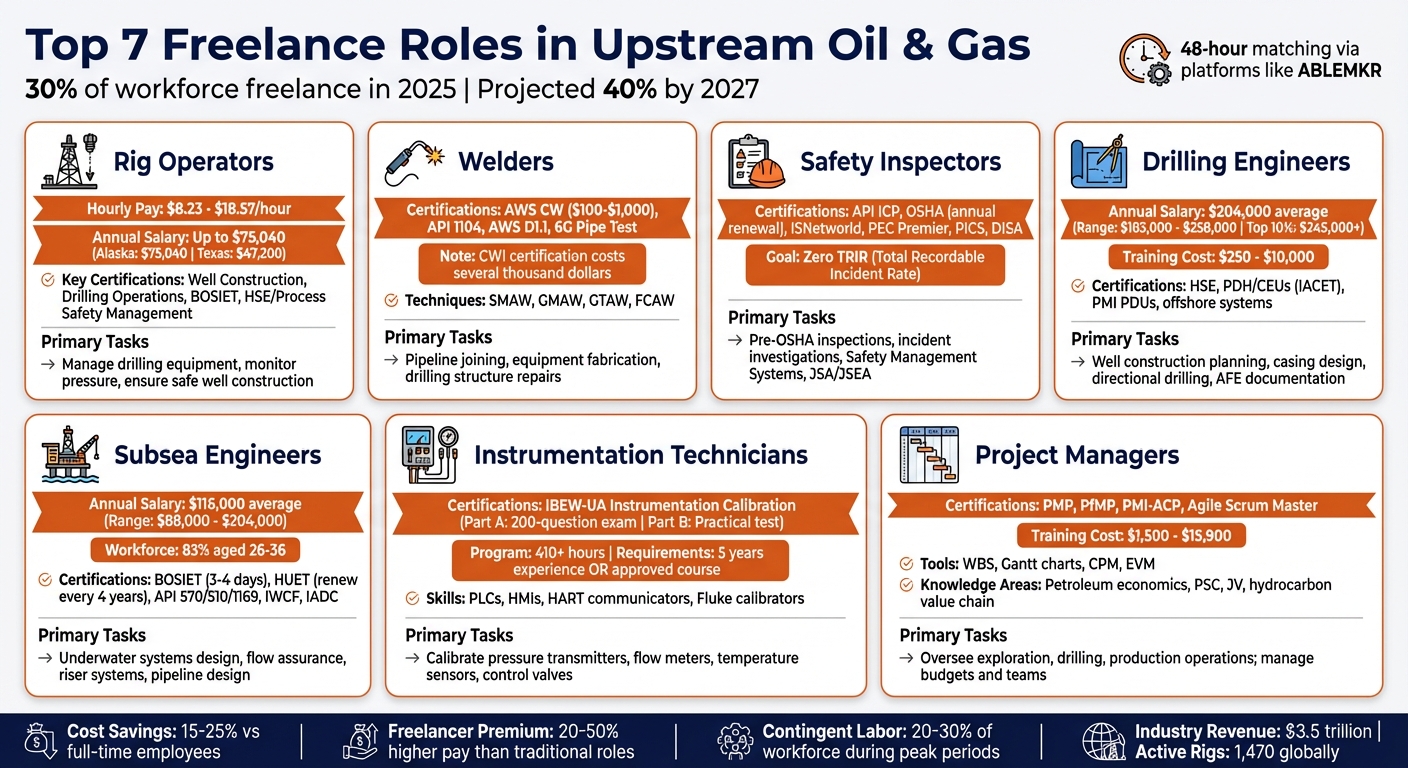
Top 7 Freelance Roles in Upstream Oil & Gas: Salaries, Certifications & Requirements
Is Oil And Gas Production A Good Career Path?
sbb-itb-aa28329
1. Rig Operators
Rig operators are responsible for managing heavy drilling equipment, keeping an eye on pressure levels, and ensuring the crew works together effectively to construct wells safely and efficiently.
Certifications and Training Requirements
To work as a rig operator, you need specific training and certifications. This includes competency-based programs focused on Well Construction, Drilling Operations, using hand tools, and handling valves. Additionally, mandatory HSE (Health, Safety, and Environment) training, particularly in Process Safety Management, is essential. Operators must also have an offshore medical certificate and complete Basic Offshore Induction and Emergency Training (BOSIET). Expanding skills in areas like Carbon Capture and Hydrogen technologies can make candidates more competitive in the job market.
Demand Trends in Upstream Oil and Gas
Globally, there are approximately 1,470 active rigs, with the oil and gas sector generating a staggering $3.5 trillion in revenue. Freelance rig operators often see strong earning potential. For example, drilling consultants can earn up to $305,000 annually, while Offshore Installation Managers average around $247,000 per year. Recruitment agencies such as Brunel play a key role in connecting experienced freelance professionals with major industry players for short-term or project-specific roles around the world.
Average Hourly Pay Rates
In the U.S., pay rates for rig operators vary widely. Entry-level operators typically earn about $8.23 per hour, while experienced professionals can make up to $18.57 per hour. Annual salaries also differ based on location. For instance, operators in Alaska earn an average of $75,040 annually, compared to $47,200 in Texas. Entry-level positions generally pay between $50,000 and $80,000 per year, with drillers averaging around $65,000.
Suitability for Freelance or Project-Based Work
The nature of upstream oil and gas work – such as drilling campaigns, shutdowns, and seasonal operations – makes freelancing a great fit. Platforms like ABLEMKR simplify the process by matching pre-vetted rig operators to projects based on their certifications, safety training, and location. This enables quick crew mobilization and allows operators to maintain flexible schedules.
Up next, we’ll take a closer look at freelance welders, another critical role in upstream operations.
2. Welders
Welders in the upstream oil and gas sector play a crucial role in ensuring the functionality and safety of operations. They handle tasks like joining pipelines, fabricating essential equipment, and repairing drilling structures. Their work supports both onshore and offshore projects, maintaining the integrity of high-pressure systems.
Certifications and Training Requirements
For welders, the American Welding Society (AWS) Certified Welder (CW) is the standard entry-level certification. The cost typically ranges from a few hundred dollars to about $1,000, covering testing fees and materials. Depending on the type of work, different standards apply – pipeline welders are tested under API 1104, while structural projects require AWS D1.1 certification.
To qualify, welders must pass performance exams, including the highly regarded 6G Pipe Test, which demonstrates their ability to work in multiple positions. They also need certifications for various welding techniques, such as:
- Shielded Metal Arc Welding (SMAW)
- Gas Metal Arc Welding (GMAW)
- Gas Tungsten Arc Welding (GTAW)
- Flux-Cored Arc Welding (FCAW)
As the American Welding Society explains:
A 6G pipe test is one of the most respected because it covers all positions on a fixed pipe.
For those pursuing advanced roles, certifications like the Certified Welding Inspector (CWI) are often necessary. These can cost several thousand dollars, factoring in preparatory courses and exam fees. Starting January 15, 2026, AWS will require all applications and renewals to be submitted through the online My AWS Portal. These stringent requirements reflect the critical nature of welding in upstream operations.
Demand Trends in Upstream Oil and Gas
The upstream oil and gas sector consistently shows strong demand for welding professionals, particularly in roles classified under "Trades & Technicians", "Maintenance & Inspection", and "Procurement & Construction". Activity in established energy hubs and emerging markets drives the need for welders who are adaptable and ready to deploy to remote locations when needed.
Suitability for Freelance or Project-Based Work
The cyclical nature of pipeline construction, facility expansions, and maintenance shutdowns creates ideal opportunities for freelance welders. AWS certifications are portable, allowing welders to bring their credentials with them as they move between projects.
Platforms like ABLEMKR connect pre-vetted welders to projects based on their certifications, specific techniques, and geographic location. This allows companies to quickly mobilize skilled welders for urgent shutdowns or repairs in remote areas.
Next, we’ll shift focus to safety inspectors, who are essential in maintaining operational standards across upstream facilities.
3. Safety Inspectors
Safety inspectors play a critical role in upstream oil and gas by ensuring that drilling, wellsite, and production facilities meet regulatory standards. Freelance safety inspectors, often deployed quickly through platforms like ABLEMKR, handle urgent compliance needs. They perform tasks such as pre-OSHA inspections, incident investigations, and the creation of Safety Management Systems to safeguard both workers and assets. Their work directly supports the goal of achieving a Zero Total Recordable Incident Rate (TRIR).
Certifications and Training Requirements
Safety inspectors must meet stringent training and certification standards. The American Petroleum Institute (API) provides key Individual Certification Programs (ICP) necessary for safety and mechanical inspectors in this sector. Inspectors are also trained in guidelines from the Center for Offshore Safety and the Onshore Safety Alliance, with additional resources offered through API Learning and specialized courses like Mechanical Integrity 101.
Key requirements include:
- Obtaining and maintaining API certifications.
- Annual renewal of OSHA training.
- Proficiency in Job Safety Analysis (JSA), Job Safety and Environmental Analysis (JSEA), Stop Work Authority (SWA), and behavior-based safety practices.
- Membership on contractor management platforms such as ISNetworld, PEC Premier, PICS, and DISA.
Demand Trends in Upstream Oil and Gas
The demand for freelance safety inspectors is on the rise as upstream operators face increasing regulatory complexities. Companies are turning to external consultants to oversee Quality, Health, Safety, Security, and Environmental (QHSSE) practices, ensuring smooth and incident-free operations. Upstream International highlights the importance of this role:
"Upstream International’s goal is to earn the reputation of establishing a set of core values to achieve a Zero Total Recordable Incident Rate (TRIR)."
Third-party vetting has become a standard practice for many operators. As noted by Upstream International:
"Several of our clients use these programs [ISNetworld, PEC Premier, PICS] as a resource to ensure they are connected with a safe and reliable contractor."
Suitability for Freelance or Project-Based Work
The project-oriented nature of upstream operations creates steady opportunities for freelance safety inspectors. Their responsibilities often go beyond routine inspections, encompassing tasks like creating safety protocols, leading safety meetings, and analyzing safety programs. Platforms like ABLEMKR streamline the process by connecting certified and pre-vetted safety inspectors with operators based on location and specific compliance needs, whether for urgent assignments or scheduled audits.
Next, we’ll delve into the role of drilling engineers, who specialize in designing and overseeing well construction.
4. Drilling Engineers
Drilling engineers are responsible for planning and overseeing well construction. Their work includes managing casing design, directional drilling, AFE documentation, and drilling programs for various environments, including onshore, offshore, and deepwater operations. They handle high-pressure conditions, complex wellbores, and multilateral wells with precision and expertise.
Certifications and Training Requirements
Given the technical complexity of this role, drilling engineers require extensive training in areas like well construction, drilling operations, completions, and reservoir engineering. Additionally, mandatory HSE certifications ensure they meet safety standards and regulatory requirements. To keep their professional engineering licenses active, engineers must earn PDH and CEUs through IACET-accredited providers.
Training costs can vary significantly – from $250 for online courses to $10,000 for more intensive programs. Engineers working on offshore projects often need specialized certifications in offshore systems and subsea technologies. For those managing large-scale projects, obtaining PDUs for Project Management Institute (PMI) certification is a common step.
Average Hourly Pay Rates
As of April 2026, full-time drilling engineers in the U.S. earn an average annual salary of $204,000, with most falling between $183,000 and $258,000. The top 10% of earners exceed $245,000 annually. Hourly rates for freelancers aren’t standardized, but project-based contracts are a popular option. This allows companies to bring in top-tier expertise without the financial commitment of a full-time hire. According to Upstream International:
Companies seeking engineers for idea review or technical assistance can access the industry’s finest without the long-term expense or commitment of a direct hire.
This flexibility makes freelance arrangements particularly appealing for specialized projects.
Suitability for Freelance or Project-Based Work
Many companies hire drilling engineers on a freelance basis for specific technical needs, such as idea reviews, sidetrack planning, re-entry projects, or developing specialized drilling programs. This approach works well for projects with defined scopes, like designing high-temperature/high-pressure wells or overseeing critical drilling phases. Freelance drilling engineers are often praised for their professionalism, as noted:
indistinguishable from direct employees in terms of skill, talent, and work ethic.
5. Subsea Engineers
Subsea engineers are responsible for designing, installing, and maintaining underwater systems used in oil and gas extraction. Their expertise covers areas like flow assurance, subsea hardware, riser systems, and pipeline design for deepwater operations. Working in harsh offshore environments, they tackle unique challenges to ensure equipment reliability under extreme conditions. Let’s dive into the certifications and market factors shaping this field.
Certifications and Training Requirements
For offshore roles, certifications like BOSIET (Basic Offshore Safety Induction and Emergency Training) and HUET (Helicopter Underwater Escape Training) are mandatory for site access. BOSIET courses, which typically last three to four days, focus on sea survival and lifeboat deployment. HUET, on the other hand, requires renewal every four years.
On the technical side, certifications from the American Petroleum Institute (API) are highly valued, including:
- API 570: Piping Inspector
- API 510: Pressure Vessel Inspector
- API 1169: Pipeline Inspector
For engineers involved in drilling, certifications from the International Well Control Forum (IWCF) or the International Association of Drilling Contractors (IADC) are often required. Additionally, many employers expect compliance registration before hiring.
Graduate-level certificates in subsea engineering are also gaining traction, with enrollment tripling over the past three years. These programs, which cover topics like flow assurance and AI/ML applications in subsea operations, are designed to help professionals upskill without leaving their current roles.
Average Hourly Pay Rates
As of April 2026, subsea engineers in the U.S. earn an average annual salary of $116,000. Salaries typically range from $88,000 to $204,000, depending on experience and the complexity of projects. The workforce skews younger, with 83% of professionals aged between 26 and 36. While freelance rates vary, project-based contracts are common for specialized tasks like deepwater installations or flow assurance studies.
These high pay rates reflect the specialized knowledge required, making freelance opportunities particularly appealing for skilled professionals.
Suitability for Freelance or Project-Based Work
Subsea engineers are often hired on a contract basis for specific tasks such as subsea tie-ins, pipeline integrity evaluations, or flow assurance modeling. The technical and time-limited nature of these projects aligns well with freelance arrangements. Additionally, many offshore certifications are transferable to the offshore wind industry, opening doors to broader energy-sector opportunities for freelancers.
6. Instrumentation Technicians
Instrumentation technicians play a key role in ensuring that control systems in upstream operations are calibrated accurately. Their tasks include working with tools like pressure transmitters, flow meters, temperature sensors, and control valves. These devices help monitor critical parameters such as wellhead pressure and pipeline flow rates. They also troubleshoot these systems to maintain safe and efficient production processes.
Certifications and Training Requirements
The IBEW-UA Instrumentation Calibration Certification is widely regarded as the industry benchmark for this role. To earn this certification, candidates must pass two rigorous assessments:
- Part A: A 4-hour, 200-question closed-book written exam.
- Part B: A hands-on Practical Test where candidates demonstrate their ability to calibrate transmitters and field devices, such as the Rosemount 1151.
Eligibility for the exam requires candidates to either complete an approved instrumentation course or document at least five years of professional calibration experience. The certification process includes a comprehensive 410+ hour program covering maintenance, electrical systems, and mechanical systems.
For advanced roles, technicians are expected to have expertise in Programmable Logic Controllers (PLCs), Human-Machine Interfaces (HMIs), and robotics programming. Freelancers should also ensure their certifications are registered with the Electric Power Research Institute (EPRI) and gain hands-on experience with essential tools like HART communicators, Fluke calibrators, and pressure pump kits.
Suitability for Freelance or Project-Based Work
Instrumentation technicians are highly sought after for freelance and project-based roles, especially during shutdowns, upgrades, and commissioning phases. Many projects in upstream operations specifically look for Electrical/Instrumentation Systems Technicians skilled in both electrical maintenance and control system troubleshooting. Platforms like ABLEMKR help connect these technicians to critical projects, allowing them to quickly mobilize to remote job sites across major U.S. energy corridors. These qualifications make them an integral part of the industry’s reliance on a project-based workforce model.
7. Project Managers
In the upstream oil and gas sector, project managers play a pivotal role in steering operations through exploration, drilling, production, and distribution. They manage large teams and budgets, balancing technical execution with financial oversight. As Roberto Nava, Partner at Bain & Company, highlights:
A shortage of technical talent in the industry – destined to become more acute over the next seven years as a generation of experienced engineers retires – complicates the problem.
Certifications and Training Requirements
Project managers in this field are expected to hold a PMP certification, with additional credentials like PfMP, PMI-ACP, and Agile Scrum Master offering an edge. Knowledge of petroleum economics, fiscal systems (such as PSC and JV), and the entire hydrocarbon value chain is essential. They also need proficiency in tools and methodologies like Work Breakdown Structure (WBS), Gantt charts, Critical Path Method (CPM), and Earned Value Management (EVM).
Training costs can vary significantly. For example, PetroKnowledge offers a 10-day certification program priced between $11,900 and $15,900, depending on the location. Alternatively, the Petroleum Engineers Association provides courses costing $1,500 for early registration and $2,000 for standard enrollment.
Demand Trends in Upstream Oil and Gas
The demand for skilled project managers is rising, driven by factors like portfolio restructuring, increased LNG exports, and industry mega-mergers. Freelance project managers are particularly sought after for their ability to identify cost overruns early and address challenges related to tariffs on materials and equipment. By 2025, around 70% of U.S. oil and gas companies were planning to restructure portfolios and optimize costs by 2026. LNG exports from the U.S. are also projected to grow by 7% in 2026, with volumes potentially tripling by the early 2030s.
Suitability for Freelance or Project-Based Work
Freelance project managers are well-suited for segmented projects, especially in areas like deepwater drilling, LNG facilities, and renewable energy integration. Companies increasingly turn to external specialists to address talent shortages and bring focused expertise to critical phases of a project. Platforms like ABLEMKR help connect pre-vetted project managers with high-stakes opportunities, ensuring fast deployment across key energy regions.
As the industry embraces strategic procurement and digital transformation, freelance project managers who combine traditional skills with data-driven approaches will stand out. By bringing in these professionals, companies can enhance project oversight and complement on-site technical teams effectively.
Conclusion
Freelancers are proving to be a game-changer for upstream oil and gas operations, offering companies the ability to scale their workforce quickly in response to market shifts. This flexibility can lead to cost savings of 15–25% compared to full-time employees, while also cutting idle workforce expenses by up to 30%.
Skilled freelancers often earn 20–50% more than their traditionally employed counterparts. Their competitive pay is frequently enhanced with per diem allowances for remote assignments. These financial incentives, combined with specialized certifications and the ability to deploy rapidly, make freelance work an attractive option for top-tier professionals in energy hubs like Texas, North Dakota, and the Gulf Coast.
Platforms like ABLEMKR simplify this process by matching companies with pre-vetted professionals based on qualifications, safety training, location, and availability. This technology allows crews to mobilize in hours instead of weeks. Businesses gain real-time insights into worker statuses, streamlined payroll, and built-in compliance tracking for OSHA and API standards. On the other side, freelancers benefit from guaranteed payments and swift access to high-demand projects.
With contingent labor now accounting for 20–30% of the workforce during busy periods in the upstream sector, the freelance model is becoming a vital component of the industry. Whether you’re a company needing to expand your team quickly or a certified professional looking for your next project, freelancing offers clear advantages in today’s fast-moving energy market.
FAQs
Which upstream freelance role is the easiest to start with?
If you’re considering breaking into upstream freelancing, becoming a safety inspector is often the most straightforward starting point. Why? Unlike more technical roles – such as rig operators or welders – this position doesn’t demand years of specialized training. Instead, you’ll need to complete specific safety training and obtain certifications, which can be achieved in a relatively short amount of time. It’s a practical way to enter the industry without a lengthy preparation period.
What certifications do I need before working on offshore jobs?
For offshore jobs, having the right certifications is crucial. For roles like inspectors, auditors, and technicians, API certificates are often required. These certifications confirm your skills and ensure you meet industry standards. Always double-check that your certifications are current and align with the specific requirements of the job or employer.
How do I price my rate for contract work in upstream oil and gas?
When setting your rate for contract work in upstream oil and gas, it’s important to balance industry norms with the specifics of your project. Daily rates typically fall between $200 and $1,200, influenced by your expertise and experience level. Don’t forget to factor in additional costs like overtime, per diems, and travel expenses. To remain competitive while still covering your costs and earning a fair profit, take time to research current market rates for your role.


