
Construction and energy companies face rising overtime costs, safety concerns, and worker dissatisfaction. Flexible scheduling offers a way to manage these challenges effectively. Here’s how it helps:
- Lower Overtime Costs: Smart scheduling aligns staffing with workload, reducing unnecessary overtime expenses.
- Improved Safety: Fatigue-related mistakes drop as workers get adequate rest between shifts.
- Better Worker Retention: Employees value control over their schedules, leading to higher satisfaction and reduced turnover.
- Regulatory Compliance: Automated tools ensure adherence to labor laws, avoiding costly fines.
For example, companies using digital scheduling systems report up to an 18% reduction in overtime costs and a 22% improvement in crew utilization. Tools like ABLEMKR simplify operations by automating worker assignments, tracking compliance, and giving employees control over their schedules. This approach ensures projects stay on track while keeping costs and risks in check.
When I Work Review: Employee Scheduling Demo
Overtime Problems in Construction and Energy
Overtime Violation Penalties and Fines in Construction 2025
How Overtime Increases Project Costs
Contractors often pay time-and-a-half for overtime hours, which many see as a financial strain that makes profitability challenging. However, the visible cost of overtime is just the tip of the iceberg – hidden expenses can quietly stack up.
Poor planning that leads to overtime brings unexpected costs. For instance, companies may pay extra for expedited material deliveries outside normal hours or extend equipment rental periods to accommodate around-the-clock work schedules. Thomas C. Schleifer, PhD, a turnaround expert, highlights an interesting paradox about productivity:
"The actual amount of work time is plus-or-minus 6.6 hours, or 82.5% of the day. An hour of overtime, however, is 60 minutes of work or 100% of productive time".
While this might seem efficient on the surface, fatigue gradually diminishes these productivity gains.
Excessive overtime often leads to fatigue-induced mistakes, which can derail project timelines and budgets. Fatigue Science explains:
"Errors caused by fatigue often necessitate rework, consuming valuable time and resources. This inefficiency can strain project budgets and extend timelines".
When mistakes happen on critical tasks, companies pay twice – once for the initial work and again to fix it. On top of that, employee burnout leads to higher turnover rates, adding recruitment and training costs to the already strained budget.
Regulatory Violations and Fines
Overtime regulations are strict, and even small errors can result in hefty fines. Federal laws require employers to calculate overtime weekly – averaging hours across two weeks to avoid paying overtime is not allowed.
One of the most frequent errors is misclassifying workers to sidestep overtime pay. Employers sometimes incorrectly label employees as independent contractors or claim they’re "exempt" under executive or administrative roles. To qualify for exemption, workers must earn at least $684 per week and meet specific job duty criteria. Missteps in classification can lead to significant penalties.
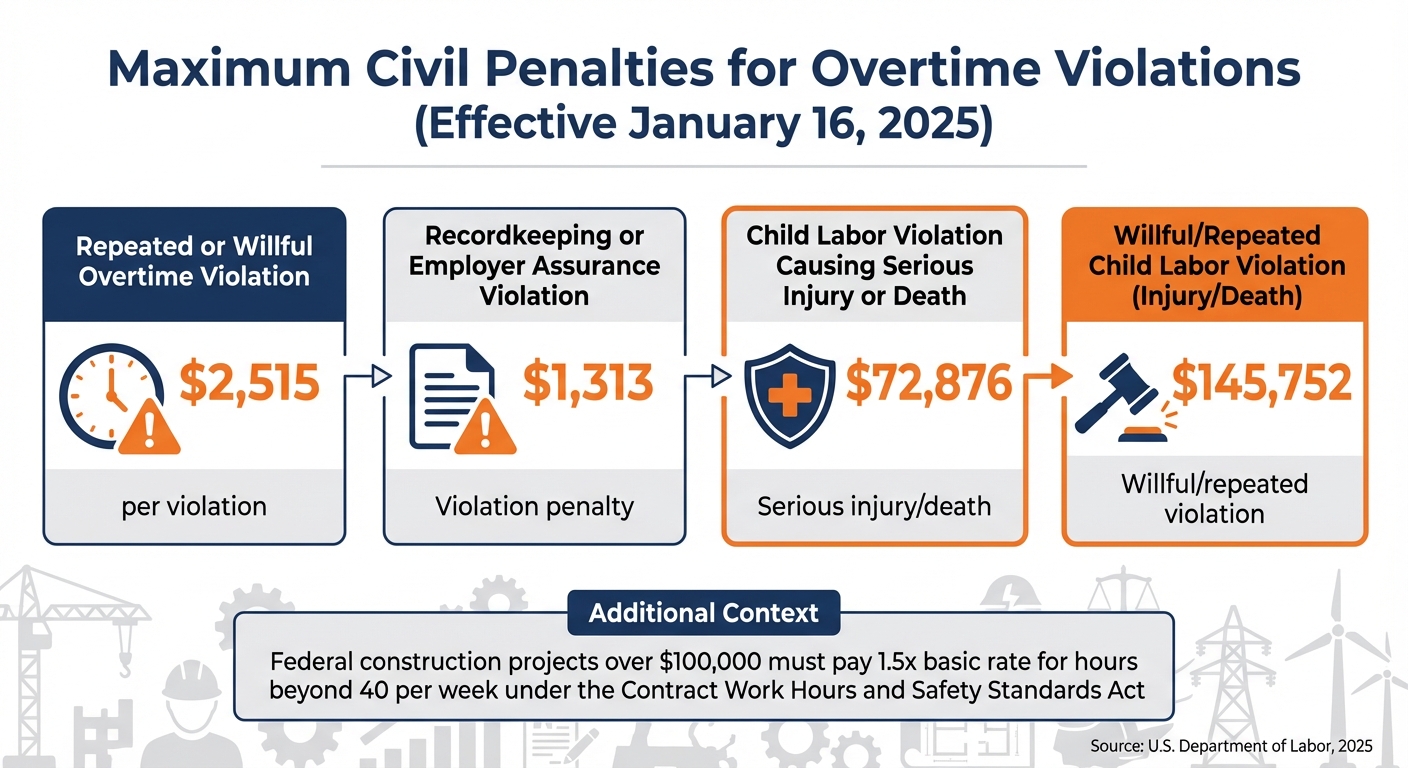
| Type of Violation | Maximum Civil Penalty (as of January 16, 2025) |
|---|---|
| Repeated or willful overtime violation | $2,515 per violation |
| Recordkeeping or employer assurance violation | $1,313 |
| Child labor violation causing serious injury or death | $72,876 |
| Willful/Repeated child labor violation (injury/death) | $145,752 |
For federal construction projects over $100,000, the Contract Work Hours and Safety Standards Act requires contractors to pay 1.5 times the basic rate for hours worked beyond 40. Failing to meet these standards not only results in fines but can also tarnish a company’s reputation and hurt its chances of securing future contracts.
Worker Fatigue and Safety Issues
Beyond financial concerns, overtime poses serious safety risks. Around 60% of shift workers report unsafe practices due to fatigue. The risks increase with longer hours – working 12-hour days raises the likelihood of injury by 37%. Evening and night shifts are particularly dangerous, with accident rates 18% higher during evenings and 30% higher at night compared to day shifts.
The potential consequences are severe. The 2005 BP Texas City refinery explosion, which killed 15 workers and injured 180 others, is a sobering example. Investigations revealed that worker fatigue and reduced alertness from grueling schedules contributed to the tragedy. The Occupational Safety and Health Administration warns:
"Fatigue can cause weariness, sleepiness, irritability, reduced alertness, impaired decision making, and lack of motivation, concentration and memory".
In high-risk industries like oil and gas, fatigued workers are 8.5 times more likely to be involved in vehicle accidents. Even in fields like medicine, the dangers are clear – each additional extended shift in a month increases the risk of a motor vehicle crash during the commute home by 16.2%. These risks aren’t just theoretical; they translate into staggering costs. Fatigue-related lost productivity costs U.S. employers an estimated $136.4 billion annually.
How Flexible Scheduling Reduces Overtime
Matching Workers to Shift Needs
Flexible scheduling technology helps cut overtime by instantly assigning the right workers to shifts based on their certifications, location, and current workload. This approach eliminates overstaffing and reduces the need for emergency overtime shifts. For instance, skill-based matching ensures that workers with specialized abilities – like handling high-voltage systems or working in confined spaces – are assigned to tasks that require those exact qualifications. Real-time dispatching further adjusts schedules to account for employee absences or sudden increases in demand, lowering the reliance on overtime.
Utilities that use advanced scheduling systems have reported an 18% drop in overtime costs and a 22% boost in crew utilization. AI-powered platforms also factor in worker locations relative to job sites, cutting down on travel time and fuel expenses while ensuring more productive hours within a standard shift. Not only does this approach save money, but it also improves worker satisfaction and retention.
Better Worker Satisfaction and Lower Turnover
Self-service portals and mobile apps have made it easier for employees to swap shifts, claim assignments, and manage their personal lives, leading to better work–life balance. For example, one mid-sized electric utility introduced a shift marketplace, allowing employees to voluntarily pick up shifts. This resulted in a 22% decrease in overtime costs and an increase in morale. Preference-based scheduling has shown a 30% rise in worker satisfaction and a 25% reduction in turnover rates – critical improvements in industries where hiring and training new staff can be costly. A major natural gas provider, after adopting a digital scheduling platform, saw a 78% drop in missed shifts and a 92% decrease in regulatory violations.
Compressed workweek options, like 9/80 or 4/10 schedules, also enhance work–life balance by giving employees longer stretches of time off while maintaining full-time hours. For example, Portland General Electric‘s Boardman plant implemented a schedule that provided workers with 31 weekends off and up to 10 weeks of vacation annually, all while ensuring 24/7 coverage. Similarly, an offshore drilling company shifted from a 14/14 rotation to a 21/21 model, cutting helicopter transport needs by 33% and improving employee satisfaction. These changes not only boost morale but also help retain skilled workers, laying the groundwork for seamless compliance tracking.
Built-In Compliance Tracking
Scheduling platforms with built-in compliance tracking help organizations avoid overtime-related risks while meeting regulatory requirements. Automated systems prevent shifts that would violate safety standards, such as PHMSA or API RP 755 rules, and enforce mandatory rest periods between shifts. During unpredictable events like storms, these platforms can quickly reassign crews while ensuring hours and safety rules are followed.
The financial return on these systems is impressive, with most investments paying off within six months due to reduced overtime costs. Digital tracking also ensures accurate overtime payments and minimizes disputes. For example, a nuclear power plant saw a 68% drop in communication errors after implementing a digital shift handover tool. Since 2020, spending on automated overtime tracking technologies has risen by 14%, as companies increasingly recognize the dual benefits of better compliance and cost savings.
sbb-itb-aa28329
ABLEMKR: Flexible Scheduling for Overtime Control

ABLEMKR takes a tech-driven approach to managing overtime and simplifying operations as part of its flexible scheduling strategy.
Automated Worker-to-Job Matching
With its mobile-first platform, ABLEMKR connects pre-vetted workers to job sites based on factors like certifications, safety training, availability, and location. This eliminates scheduling gaps and prevents costly overtime. For example, when an unexpected pipeline shutdown occurs or a remote mining site needs extra hands, the system quickly identifies qualified workers ready to step in.
By ensuring workers aren’t overbooked for long 12–16 hour shifts, ABLEMKR also helps reduce fatigue-related errors. Fatigue can lead to costly mistakes, extending project timelines and inflating labor costs. With real-time visibility into worker availability across multiple sites, employers can better balance workloads and keep projects on track. Plus, this matching system integrates seamlessly with ABLEMKR’s payroll and compliance tools, making it easier to manage operations from start to finish.
Payroll and Compliance Tools
ABLEMKR simplifies payroll and compliance by automating processes like tracking hours, enforcing rest periods, and flagging potential violations. Contractors get instant insights into labor costs and trends, while the platform automatically handles overtime calculations to ensure workers are paid accurately.
It also keeps detailed records of certifications, training completions, and work hours – essential for audits or meeting regulatory requirements. These tools not only streamline payments and compliance but also give employers peace of mind. Workers benefit too, as the system ensures timely and accurate pay while maintaining compliance with federal and state labor laws.
Flexible Work Options for Laborers
Through a mobile app, workers can take control of their schedules. They can claim assignments, view shifts, and manage their availability, giving them the freedom to balance work and personal life while ensuring on-time payments. This self-service approach lets workers choose jobs that match their skills, location, and preferences.
For those in industries like oil & gas, mining, utilities, and heavy infrastructure, ABLEMKR offers access to critical projects across the country. Whether workers prefer a steady schedule or want to pick up extra shifts during busy periods, the platform supports different work styles without forcing employers to rely on mandatory overtime. It’s a win-win for both workers and employers.
Conclusion
Flexible scheduling offers a smart way to reduce overtime costs while boosting productivity. By aligning workers with shifts based on their availability and qualifications, businesses can cut down on unnecessary overtime expenses and still ensure projects run smoothly. For example, a Citrix study revealed that productivity increased by 50% in flexible work environments where job policies matched employees’ work styles. This happens because employees perform better during their peak efficiency periods rather than being pushed into extended hours.
The benefits don’t stop at productivity. Compliance is another key advantage. Automated systems that track certifications and rest periods help reduce violations and fines. Additionally, giving workers control over their schedules leads to greater job satisfaction. According to a FlexJobs survey, 80% of employees said they’d be more loyal to companies offering flexible arrangements. This loyalty directly impacts turnover rates, which is a critical factor in industries struggling with a shortage of skilled labor.
Safety also gets a boost with flexible scheduling. Well-rested employees are less prone to errors, reducing both burnout and the risk of accidents. When workers have the flexibility to balance personal commitments, unplanned absences drop, and engagement during work hours improves. These safety improvements contribute to smoother and more efficient operations overall.
For businesses managing crews across multiple locations – whether it’s last-minute pipeline repairs or planned mining projects – tools like ABLEMKR simplify the process. By automating worker-to-job assignments, integrating payroll, and offering mobile access, these platforms eliminate the need for mandatory overtime. Clear scheduling reduces costs, lowers turnover, and ensures adequate coverage. The benefits are clear: decreased overtime expenses, fewer compliance issues, safer workplaces, and better employee retention.
FAQs
How can flexible scheduling help lower overtime costs?
Flexible scheduling gives managers the ability to manage workloads more efficiently through staggered or interchangeable shifts. This setup ensures tasks are handled during regular working hours, cutting down on the need for expensive overtime.
By promptly addressing scheduling gaps and aligning worker availability with demand, businesses can keep operations running smoothly without overspending. This strategy not only reduces overtime costs but also boosts compliance and enhances employee satisfaction.
How does flexible scheduling improve workplace safety?
Flexible scheduling plays a key role in reducing overtime and worker fatigue – two significant factors behind workplace accidents. When employees can select shifts that fit their personal routines, companies can avoid overly long or consecutive shifts that often lead to reduced alertness and, unfortunately, injuries.
Pairing this approach with a mobile-first workforce platform amplifies safety measures. These platforms make sure only properly trained and certified workers are assigned to high-risk tasks. Tools like real-time worker tracking and geo-fencing add another layer of protection by preventing unqualified personnel from accessing restricted or hazardous areas, reducing the chance of unsafe situations.
By addressing fatigue-related mistakes and ensuring compliance with safety protocols, flexible scheduling not only promotes a healthier and safer work environment but also helps maintain productivity and operational flow.
How does flexible scheduling enhance employee satisfaction and reduce turnover?
Flexible scheduling empowers employees to take charge of their work hours, which can significantly boost job satisfaction. Research highlights that many hourly workers place just as much – if not more – importance on having flexible schedules as they do on pay when deciding whether to stay with a job. By offering options like adjustable start times, shift swaps, or compressed workweeks, employers help workers juggle responsibilities such as caregiving, education, or personal health. This not only enhances satisfaction but also cuts down on absenteeism.
Tools like ABLEMKR make managing flexible schedules simple and efficient. Through a mobile app, workers can swap shifts or update their availability in real time, while managers retain oversight to ensure proper coverage and compliance. This system fosters trust and engagement, reducing turnover rates – particularly in demanding industries like construction, energy, and mining. Plus, it helps avoid burnout from excessive overtime, keeping teams refreshed and productive for the long haul.


