
If I want more solar or wind job leads, I start with the right states – not the biggest job boards. Solar work is strongest in California, Texas, Florida, Arizona, Nevada, and North Carolina. Wind work is heaviest in Texas, Iowa, Oklahoma, Kansas, Illinois, and other Great Plains and Midwest states.
Here’s the short version: I pick 2–3 target regions, set location-based alerts, track contractors and union halls, watch project queues, and make sure my OSHA, NABCEP, GWO, and license info is current. That cuts wasted applications and points me toward places where crews are hiring now.
If I were doing this today, I’d focus on these moves first:
- Target active markets first
- Solar: California, Texas, Florida, Arizona, Nevada, North Carolina
- Wind: Texas, Iowa, Oklahoma, Kansas, Illinois
- Search by place + job title
- Example: “solar installer Phoenix, AZ”
- Example: “wind technician Amarillo, TX”
- Use filters that match how I want to work
- 25 miles for local jobs
- 100–200 miles for travel jobs and per diem
- Contract for build-outs, full-time for O&M work
- Go past public job boards
- Follow project activity
- Match your credentials to the region
- OSHA 10 is often the baseline
- NABCEP helps for solar
- GWO modules matter for wind
- Some states need trade or contractor licenses
A few numbers help show where demand sits. California had about 80,056 solar jobs in 2023. Texas led wind with about 27,381 wind jobs. Solar job growth in 2023 was strong in Arizona (+17%), Florida (+15%), Nevada (+14%), and Texas (+10%).
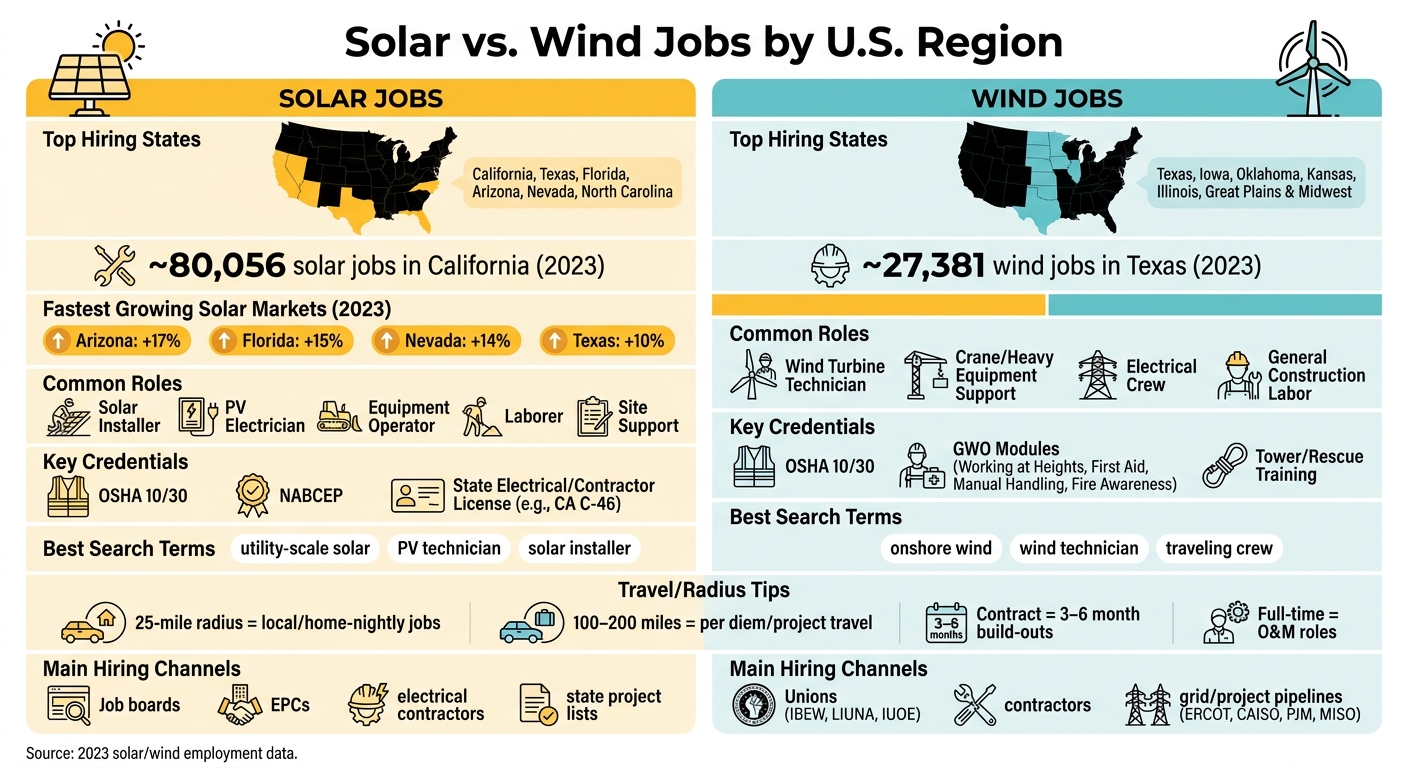
Solar vs. Wind Jobs by U.S. Region: Key Stats, Roles & Credentials
Renewable Energy Jobs: The 2026 Job Search Strategy That Works | SolarPunkPro Podcast Ep. 52
sbb-itb-aa28329
Quick Comparison
| Focus area | Solar jobs | Wind jobs |
|---|---|---|
| Strongest regions | California, Texas, Florida, Arizona, Nevada, North Carolina | Texas, Great Plains, Midwest |
| Common roles | Installer, PV electrician, equipment operator, laborer, site support | Wind tech, crane support, electrical crew, laborer |
| Best search terms | “utility-scale solar,” “PV technician,” “solar installer” | “onshore wind,” “wind technician,” “traveling crew” |
| Main hiring channels | Job apps, contractors, state project lists, workforce platforms | Job apps, unions, contractors, grid/project pipelines |
| Key credentials | OSHA 10/30, NABCEP, state electrical/contractor licenses | OSHA, GWO modules, tower/rescue training, state electrical rules |
| Travel setup | Local radius or per diem project travel | Rotation, travel crews, maintenance corridors |
Bottom line: I’d search where projects are already moving, not everywhere at once. Then I’d tighten the search with location, pay, travel radius, schedule, and credentials so I spend time on jobs I can actually land.
1. Map where solar and wind hiring is active
Before you start applying, choose 2–3 target regions. That one move shapes everything that follows: which job apps matter, which contractor lists are worth checking, and which project pipelines you should track.
To judge demand, look at a few simple signals: project volume, clean-energy targets, utility queue activity, and local contractors that are hiring now. Those clues help you decide whether to lean into solar, wind, or both.
Solar hiring by U.S. region
Solar hiring is strongest in California, Texas, Florida, Arizona, Nevada, and across the Southeast. California leads the country, with about 80,056 solar jobs in 2023. In 2023, some of the fastest-growing markets were Arizona (+17%), Florida (+15%), Nevada (+14%), and Texas (+10%). In the Mountain West, Nevada, Colorado, and Utah also sit in the national top ten for solar employment.
That work covers a mix of project types, including utility-scale construction, commercial PV, substation work, and operations and maintenance (O&M). Common roles include:
- Solar installer
- PV electrician
- Equipment operator
- Laborer
- Site support
Next, connect those markets to your location alerts and contractor searches.
Wind hiring by U.S. region
Wind hiring is heaviest in Texas, the Midwest, and the Great Plains. Texas leads the country with about 27,381 wind jobs. Other top wind-employment states include Illinois, Colorado, Indiana, and Iowa.
Hiring in these areas is tied to onshore wind farms, turbine repowering projects, transmission upgrades, and maintenance corridors. Common roles include wind turbine technician, crane and heavy equipment support, electrical crews, and general construction labor.
From there, narrow your search to the state, metro area, or travel radius that fits your schedule.
How to pick a target state, metro, or travel radius
Start with your home ZIP code and search within a 50-mile radius if you want local daily work. If you’re open to per diem or rotational assignments, expand to a statewide or multi-state search.
A few things matter here: whether the market supports local commutes or rotation-based schedules, whether per diem is offered, and how far you’re willing to travel for short-term project work. It also helps to mirror employer language in your resume and job alerts. Use terms like utility-scale solar, onshore wind, traveling crew, and per diem so your profile lines up with the way these jobs are posted.
2. Use job apps and workforce platforms to search by location
Once you’ve picked a target region, combine the job title with a city, ZIP code, or state. Then save the search and turn on alerts.
Set up location alerts for solar and wind job keywords
Start with role terms plus a place. Searches like "solar installer Phoenix, AZ", "PV technician Denver, CO 80216", or "wind technician Amarillo, TX" give you much better results than broad searches. If you’re open to nearby roles, add terms like "renewable energy construction" and "substation labor."
After that, save the search and switch on push or email alerts. Utility-scale field roles can get filled fast, so it’s smart to check alerts every day.
Filter openings by pay, distance, schedule, and role type
Once your region is set, narrow the list based on what fits your situation. Set a minimum hourly rate that makes sense for your local market. Many entry- to mid-level solar roles start around $20–$25/hour, while more specialized jobs can pay $40/hour or more.
Distance matters too. A 25-mile radius works well for home-nightly jobs. If you’re open to project work and per diem, expand that to 100–200 miles.
You can also filter by role type:
- Contract if you want a 3–6 month build-out
- Full-time if you want a longer-term operations and maintenance role
As you scan postings, look for terms tied to overtime and rotation schedules.
Use ABLEMKR to match with region-specific energy and construction work
ABLEMKR helps match pre-vetted workers with project-based jobs in energy corridors across the U.S. You can use it for solar, wind, substation, and grid work.
Build out your mobile profile fully. Add your certifications, safety training, and site experience. Then set your availability window, preferred shift type, and travel preferences, whether that means local-only, statewide, or regional. Your location, availability, and compliance status help surface matched roles fast.
From there, move on to contractor, union, and project-pipeline channels for jobs that never make it to public boards.
3. Find openings through contractors, unions, and project pipelines
Public job boards miss a lot of utility-scale roles. In many cases, jobs get filled through contractor rosters, union dispatch, labor halls, and referrals before they ever show up in public listings.
Once you’ve picked a target region, shift your search to contractor, union, and pipeline sources. That’s often where you’ll find roles that never make it to the big job boards.
Track regional contractors and local hiring channels
Start by figuring out which firms are building in your target region. EPCs, electrical contractors, civil contractors, and wind service firms often staff solar and wind projects through internal rosters and subcontractor networks instead of open postings.
A good way to find those firms is to check:
- Project announcements in local business journals and regional media
- City and county planning and permitting records
- Utility procurement updates or renewable portfolio updates
These sources often list the developer, general contractor, and key subcontractors tied to a project.
Once you have a few contractor names, go straight to their careers pages, subcontractor portals, or local branch offices. Ask about upcoming solar or wind scopes and whether they keep preferred subcontractor lists.
If those contractor rosters don’t show much, move over to local unions and labor halls.
Use unions, labor halls, and site contacts for regional placements
If you’re a union member, or thinking about joining, this can be one of the most direct ways into regional solar and wind work. Unions like IBEW, LIUNA, and IUOE use dispatch systems to assign members to utility-scale projects based on seniority and certifications.
Talk with your local union rep or dispatch coordinator. Ask which solar or wind projects are expected to start in the next 60 to 90 days and whether the hall will be dispatching for them. Share your availability with hall staff so you’re on the radar for short-notice dispatches.
There’s also a simple, old-school move that still works: talk to people on active job sites. Ask site supervisors and crew members what project the crew is headed to next and where it’s located. Those conversations often bring up openings weeks before any public posting appears.
If there’s no live dispatch yet, look at state energy offices and interconnection queues to see where hiring is likely to start next.
Read state energy offices, utility queues, and project maps
Use state energy office sites and utility queues to spot counties where projects are moving into hiring territory. State energy office websites publish renewable energy program reports, grant awards, project trackers, and siting information.
Then pair that with interconnection queue data from grid operators like MISO, PJM, ERCOT, and CAISO. When projects move into later queue stages, such as active or under construction, that can point to hiring starting soon in those counties.
When you spot a cluster of projects in one corridor, reach out to local contractors, check in with your union hall, and update your region, trade, certifications, and availability in ABLEMKR.
Keep your contractor names, hall contacts, and project pipeline notes in one place so your search stays tied to places where work is actually moving.
4. Filter regional jobs by certifications, licenses, and site requirements
After you pick your target regions and employers, narrow the list based on the credentials they ask for. That step matters more than a lot of people think. Your certifications and licenses shape which regional jobs you can actually get. On utility-scale solar and wind projects, employers often screen candidates by safety cards, industry certifications, and trade licenses before a person ever looks at the application.
Add OSHA, NABCEP, GWO, and trade credentials to your profile
OSHA 10 Construction is the starting point, and many utility-scale sites require it before you can enter the jobsite. OSHA 30 often shows up for lead and foreman roles. If you don’t have OSHA 10 yet, get it done before you send out your first application. It’s one of the fastest credentials to finish.
For solar roles, add your NABCEP credentials. For wind roles, list your current GWO modules – Working at Heights, First Aid, Manual Handling, and Fire Awareness – along with completion dates and issuer names. Put each module, completion date, and issuer in its own field. Wind employers often require current GWO modules, and some sites also ask for Advanced Rescue, especially on more complex projects.
On ABLEMKR, filling out all credential fields can help surface region-specific jobs faster.
Once your cards are current, check whether your target state also requires a separate license.
Check state licensing rules before targeting a region
Licensing rules change from state to state, so check them before you go after a region. Solar licensing rules vary by state and often call for electrical or contractor licensing. California, for example, has a specific C-46 Solar Contractor classification for solar work in that state.
Before you target a new state, look at the state electrical licensing board and the state energy office website. IREC‘s National Solar Licensing Database is a good place to start. It gives a state-by-state view of licensing and certification rules for solar work across all 50 states.
For wind, verify whether electrical or maintenance work at your target sites calls for a state electrician license or apprentice registration. A quick check up front can save you from wasting time on dead-end applications.
Use that license review to tighten up your next 30 days of applications.
Build a 30-day action plan to start applying
A focused 30-day stretch is enough to line up your credentials with the 2–3 target regions you’ve already picked and start sending applications that have a real shot.
- Week 1: Choose target regions using state energy office project lists and interconnection queue data. Review your current credentials and spot the gaps, such as missing OSHA 10, an expired GWO module, or a state license you still need. Sign up for short courses you can finish within a few weeks.
- Weeks 2–3: Update every job profile and platform you use, including ABLEMKR, with your full credential list, expiration dates, preferred travel radius, and availability. Set keyword and location alerts for "solar installer", "wind technician", and similar roles tied to your target metros. Put together a short list of regional contractors, union halls, and labor contacts to contact directly.
- Week 4: Review state project pipelines and new job postings at least twice a week. Send tailored applications that put the most relevant credentials front and center – NABCEP and your state electrician license for Northeast solar markets, or GWO and tower rescue training for Great Plains wind corridors.
Conclusion: Focus on active regions, the right filters, and consistent follow-up
Solar and wind hiring tends to cluster in a handful of places. That means it makes sense to start where projects are already moving. States like California, Texas, Florida, and Iowa account for much of the demand.
Once you choose a region, narrow your search with filters and project data. The main play is pretty simple:
- Use location filters
- Track project pipelines
- Keep your credentials current
ABLEMKR matches workers based on location, certifications, and availability. Add direct outreach to regional contractors and labor halls, and you’re covering both sides of the market: the jobs that are posted and the ones that never make it to a public board.
After you spot active markets, make sure you meet site requirements. Access often comes down to credentials, so keep NABCEP, GWO, OSHA, and site-specific licenses up to date, and list them correctly on every profile.
Then it comes down to steady follow-up. Pick 2–3 active regions, update your credentials, set alerts, and keep checking project pipelines on a regular basis.
FAQs
How do I choose the best region to target first?
Start with your career focus. Wind jobs tend to cluster in the Midwest and Great Plains. Solar roles are more spread out, with strong growth in Florida, Texas, California, and Arizona.
From there, compare regions based on a few simple factors:
- Project pipelines
- State-backed training programs
- Labor supply versus demand
- Whether you’re open to relocating or would rather target newer markets
ABLEMKR can help narrow your search by certifications, safety credentials, and travel radius.
Which certifications matter most for solar and wind jobs?
The most important certifications are the ones that show safety compliance and job-specific skills.
For solar, NABCEP credentials and OSHA 10/30 are the big ones. For wind, employers usually look for GWO Basic Safety Training, OSHA 10/30, and often GWO technical training or NCCER. Some specialized roles also call for NFPA WTT-I, rope access, or offshore Sea Survival.
How can I find jobs that never reach public job boards?
Many jobs never make it to public job boards. They get filled through professional networking instead.
That’s why LinkedIn matters. Reach out to people in your field, especially industry professionals and project managers, and ask for short informational calls. These conversations can give you a clearer picture of what employers want and, in some cases, lead to direct referrals.
You can also use specialized platforms like ABLEMKR. It lets you build a pre-vetted profile that lines up your certifications, safety training, and location with employers looking for workers like you.


