
If you hire a fabricator when you need a welder, or a welder when you need a fabricator, your crew build can slow down before work even starts.
I see the split like this: fabricators build parts to size and fit, while welders make welds that pass code and inspection. On energy jobs, that changes who you test, what papers you check, where they work, and how fast they can get through the gate.
Here’s the short version:
- Fabricators handle layout, cutting, forming, and fit-up
- Welders follow a WPS and make welds that pass visual checks, RT, UT, or bend tests
- Shop roles often lean fabricator
- Field tie-ins, outages, and pipeline work often lean welder
- Fabricator hiring centers on tolerance, squareness, and fit-up
- Welder hiring centers on process, position, code, and first-pass results
- Site access can block a start date even after a passed test
In plain terms, I’d hire by work scope, not by title alone. A worker may be good with steel, but if the test, papers, and site-readiness do not match the job, the hire can still fail.
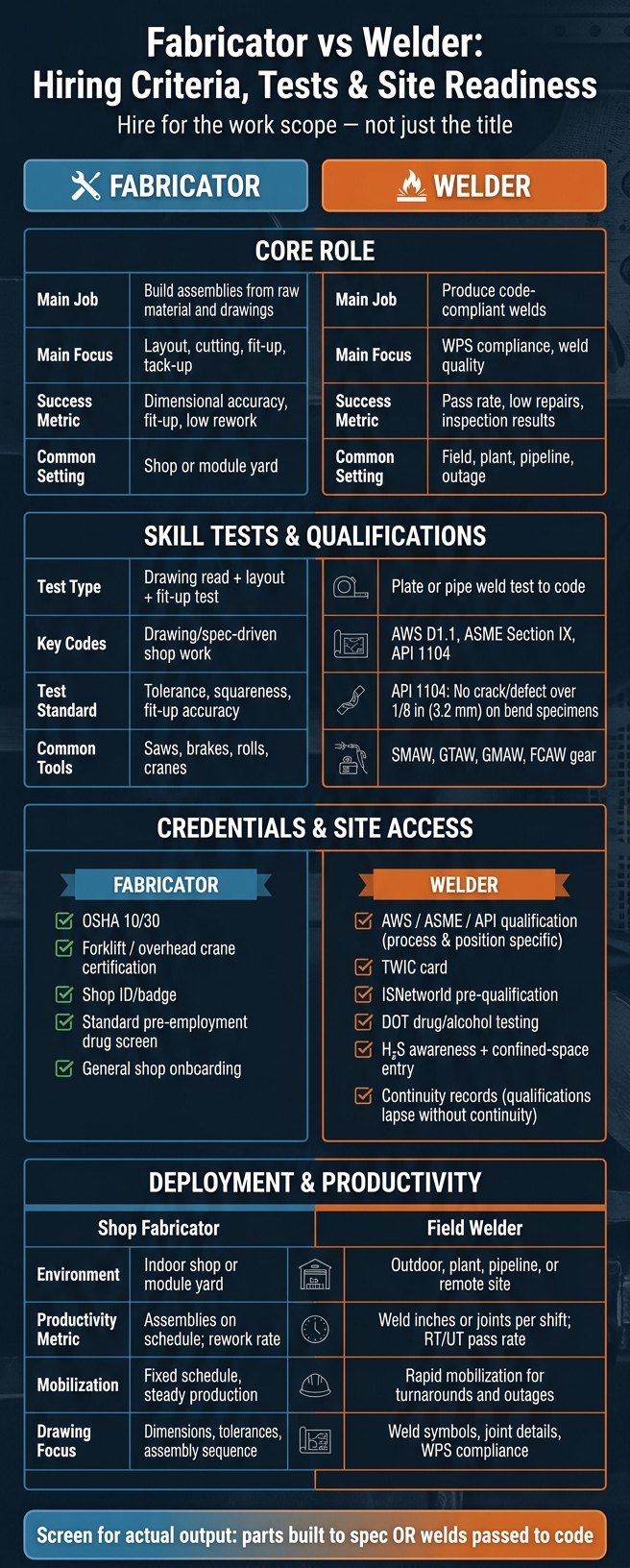
Fabricator vs Welder: Hiring Criteria, Tests & Site Readiness
Welder vs Fabricator: What’s the Difference?
sbb-itb-aa28329
Quick Comparison
| Criteria | Fabricator | Welder |
|---|---|---|
| Main job | Build assemblies from raw material and drawings | Make code-ready welds |
| Main focus | Layout, cutting, fit-up, tack-up | WPS compliance, weld quality |
| Main scorecard | Dimensional accuracy, fit-up, low rework | Pass rate, low repairs, inspection results |
| Common setting | Shop or module yard | Field, plant, pipeline, outage |
| Common test | Drawing read + layout + fit-up test | Plate or pipe weld test to code |
| Common codes | Drawing/spec-driven shop work | AWS D1.1, ASME Section IX, API 1104 |
| Common tools | Saws, brakes, rolls, cranes | SMAW, GTAW, GMAW, FCAW gear |
| Common access needs | OSHA 10/30, shop training | Certs, continuity, TWIC, site safety, DOT testing |
One detail stands out: under API 1104, bend tests allow no crack or defect over 1/8 in (3.2 mm) on the convex surface of root and face bend specimens. That tells me welder hiring is judged by inspection results, while fabricator hiring is judged by fit and measurement.
So if you want the right person on the first try, screen for the job’s actual output: parts built to spec, or welds passed to code.
Core role differences that change hiring criteria
For a fabricator, success means delivering an assembly that fits, measures to spec, and is ready for the next step. For a welder, success means producing a weld that passes inspection. That split changes how you screen each person.
What fabricator hiring focuses on
A fabricator is hired to handle layout, cutting, fit-up, and tack assembly. Dimensional accuracy and fit-up quality are the main performance checks. If a fabricator sends out assemblies that are out of square, out of tolerance, or misaligned, the problem doesn’t stop there. It slows down welders, creates issues for inspectors, and causes trouble for field crews.
In shops and module yards, employers look hard at how often fabricators get the job right on the first pass. That’s why dimensional accuracy is the first hiring filter.
What welder hiring focuses on
A welder is screened for procedure compliance and inspection-ready welds. In plain terms, that means following a WPS, controlling heat input and interpass temperature, welding in the required position, and laying down a bead that passes visual review and any required nondestructive testing.
Energy employers care about process control and pass rate, not just broad metalworking skill. A welder who gets steady first-pass results helps cut repair welds and rework. That’s why procedure control and pass rate sit at the center of the hiring process.
Use this comparison to line up the job post with the candidate test:
| Fabricator | Welder | |
|---|---|---|
| Core function | Layout, cutting, fit-up, and assembly | Producing code-compliant welds |
| Main success metrics | Dimensional accuracy, rework reduction | Weld quality, inspection pass rate |
| Inspection focus | Fit-up tolerance before welding begins | First-pass results after NDT |
Those differences shape which skill tests and credentials matter most.
Skill tests and qualifications: what to check before hiring
The test should match the job.
A fabricator needs to show layout accuracy and clean fit-up. A welder needs to show procedure control and welds that can pass inspection. That split starts with the screening test.
How to test fabricators for shop accuracy and fit-up
A good fabricator test should look like normal shop work, not a trick exercise.
Give the candidate a structural or piping drawing. Then ask them to lay out the material, mark cut lines, and fit the parts together. Score the work against clear tolerances for layout, squareness, and fit-up. Also check whether they can read drawing views and weld symbols the right way.
Candidates who stay within tolerance and work safely are usually ready for shop or module yard work. On the flip side, repeated measurement mistakes or constant hand-holding while reading the drawing are major warning signs on energy infrastructure projects. One bad fit-up can slow down every trade that comes after it.
If the role includes tack welding, add a basic weld check. The goal is simple: confirm the candidate can hold parts in place without defects.
Welders should be tested to a different bar: code compliance, not assembly accuracy.
How to test welders for process skill and inspection readiness
Welder testing on energy projects should line up with the code and the actual work scope.
For structural work, that often means AWS D1.1 with plate tests in the 3G or 4G position. For process piping and pipeline work, it usually means ASME Section IX or API 1104, often with a 6G fixed-pipe test.
Test to the WPS, then verify the weld through visual inspection and any required NDT. Under API 1104, guided bend tests require no crack or defect exceeding 1/8 in (3.2 mm) on the convex surface of root and face bend specimens. For high-integrity scopes like pressure piping, pipeline tie-ins, and refinery work, radiographic (RT) or ultrasonic (UT) examination of the coupon may also be required.
Many pipeline contractors also want a live first-day weld test. In plain English, they treat prior certifications as provisional until the welder proves current procedure compliance on site.
Test results alone don’t solve the whole hiring problem. If the worker can’t mobilize, the result doesn’t help much.
Credentials that carry more weight in energy work
In energy work, paperwork often decides who gets on site.
The checks that matter most are role-based certifications, site access, and continuity.
| Credential Type | Fabricators | Welders |
|---|---|---|
| Core certifications | OSHA 10/30; equipment certifications such as forklift or overhead crane | AWS, ASME, or API qualification tied to the specific process and position |
| Site access | TWIC card for secure or maritime facilities | TWIC card for secure or maritime facilities |
| Compliance | DOT drug/alcohol testing | DOT drug/alcohol testing; documented continuity records |
Welder qualifications lapse when continuity expires, so check status before mobilization. On tightly regulated sites like LNG plants or refineries, workers also need background checks and site-specific safety modules completed before they can mobilize.
Shop vs field deployment, tools, and production pace
Where someone works changes almost everything: the tools they use, the pace they work at, and how much schedule pressure they feel. It also affects site-readiness needs and how teams judge day-to-day output.
Why fabricators are usually placed in shops and module yards
Shops and module yards are set up for fabricators. They usually have stable power, level floors, overhead cranes, and fixed machinery that make layout, cutting, forming, fit-up, and assembly easier to manage under controlled conditions.
That setup matters. A fabricator in a shop can move through work with fewer outside disruptions, which is why teams often track them on things like on-time assemblies, fit-up quality, and rework rate.
Why welders are often placed on field work and outage schedules
Field welders deal with a very different kind of pressure. They work around weather, access limits, and outage timelines. In refinery turnarounds and pipeline shutdowns, the schedule window can be tight, and one missing certified pipe welder can hold up the next crew in line.
Because of that, speed to mobilize becomes part of the hire. Teams often measure welders by completed weld inches or joints per shift, along with RT/UT and visual pass rates. In the field, it’s not just about making the weld. It’s about making it on time, under pressure, and to code.
How drawing reading differs between fabricators and welders
Fabricators and welders both read drawings, but they look for different things.
Fabricators focus on fabrication drawings. They need dimensions, tolerances, and the assembly sequence so parts come together the way the job requires.
Welders focus more on weld symbols, joint details, and WPS documents. Their job is procedure compliance, so the drawing set needs to tell them exactly how the weld should be made.
| Shop Fabricator | Field Welder | |
|---|---|---|
| Work environment | Indoor shop or module yard | Outdoor, plant, pipeline, or remote site |
| Key equipment | Saws, press brakes, rollers, overhead cranes, forklifts | Mobile welding rigs, grinders, rigging gear |
| Productivity metric | Assemblies completed on schedule; rework rate | Completed weld inches or joints per shift; RT/UT pass rate |
| Drawing focus | Fabrication drawings, dimensions, tolerances, assembly sequence | Weld symbols, joint details, WPS compliance |
| Common assignments | Pipe spools, structural modules, skids, pipe racks | Tie-ins, outage repairs, pressure vessel work, pipeline joints |
Site readiness and faster crew deployment for energy projects
Site readiness for field welders vs shop fabricators
Once the role is clear, readiness becomes the last hiring checkpoint.
For shop fabricators, that usually means standard shop PPE, basic site access, and internal safety records. For field welders, the bar is higher. They need the same core gear, plus FR coveralls, fall protection, a gas monitor, and task-specific respiratory protection.
Access and compliance also split fast between the two roles. Field welders may need a TWIC card, ISNetworld pre-qualification, H₂S awareness, confined-space training, and DOT drug/alcohol testing. Shop fabricators, by contrast, usually need a shop ID, OSHA training, and internal compliance records.
| Readiness Factor | Shop Fabricator | Field Welder |
|---|---|---|
| PPE baseline | Safety glasses, hearing protection, steel-toe boots, gloves, FR clothing for hot work | All shop PPE plus FR coveralls, fall protection, gas monitor, task-specific respiratory protection |
| Access credentials | Shop ID/badge | TWIC card, ISNetworld pre-qualification, site badging |
| Safety training | OSHA 10/30, shop safety | OSHA 10/30 plus H₂S awareness and confined-space entry |
| Compliance testing | Standard pre-employment drug screen | DOT drug/alcohol testing, API 1104 weld qualification |
| Site orientation | General shop onboarding | Site orientation and pre-job safety briefings |
| Deployment speed | Fixed schedule, steady production | Rapid mobilization for turnarounds and outages |
A worker can be strong on the weld test and still not be ready to step onto a field site. That’s the part that slows crews down. On paper, the hire looks fine. In practice, they can’t get through the gate.
How ABLEMKR supports role-based hiring and mobilization
This is where teams often lose time, especially when the mobilization window is tight.
ABLEMKR matches pre-vetted workers to shop or field roles based on certification, safety training, availability, and geo-location. It also tracks compliance and payroll in real time, which helps crews move without chasing paperwork at the last minute.
Conclusion: hire for the work scope, not just the job title
Readiness matters because the wrong hire can stall site access before the first weld or fit-up starts.
Hire for the actual work scope, not just the title. The wrong title can lead to the wrong PPE, the wrong access path, the wrong pace, and the wrong inspection result.
FAQs
How do I know if I need a fabricator or a welder?
It depends on the job.
A welder is usually hired to join metal parts. That often means holding certifications tied to safety rules and code compliance, especially for piping and other critical infrastructure.
A fabricator covers more of the build process. They read technical drawings, cut and shape materials, and get parts ready before field installation.
If you need assembly and material prep, hire a fabricator. If you need on-site metal joining and strong structural welds, hire a welder.
Can one worker do both fabrication and welding?
Yes. One worker can do both fabrication and welding, depending on their skills and credentials.
The roles are still separate. Fabricators usually handle layout, cutting, and fitting. Welders focus on joining materials.
In industrial settings, cross-trained workers give teams more flexibility during projects and emergencies.
What delays site access after passing a weld test?
Even if a welder passes the weld test, that doesn’t always mean they can head straight to the jobsite. Access can still get held up if site-specific credentials aren’t ready. In many cases, workers also need to clear final dispatch items, including documents like a TWIC card for secure or maritime facilities.
Safety paperwork can cause the same kind of delay. If a worker has an expired or missing certification – such as an annual HAZWOPER refresher, MSHA, or a regional safety council card – they may not be allowed on-site. Those items need to be done before arrival to keep the job moving.


