
Home Level 2 charger work is turning into steady electrician work, and hiring data points to one clear baseline: licensed electricians with EVITP and code-safety training are in the best position for this jobs.
If I boil the article down to the main points, here’s what stands out:
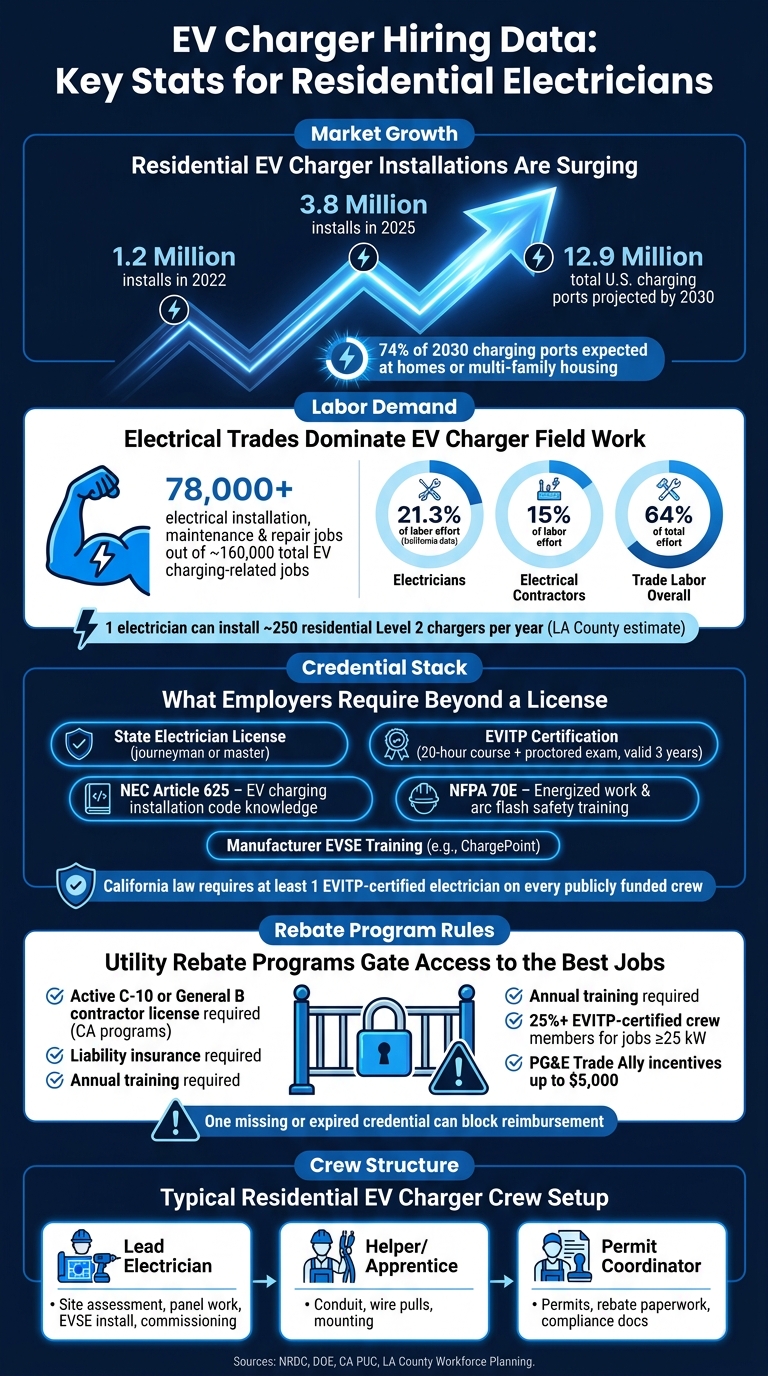
- Home charger installs are growing fast, with U.S. installations estimated at 3.8 million in 2025, up from 1.2 million in 2022.
- By 2030, about 74% of U.S. charging ports are expected to be at homes or multi-family housing.
- Employers are not just looking for a license. They often want EVITP, NEC Article 625, and NFPA 70E training too.
- Utility rebate programs can limit who gets the work by requiring approved licenses, insurance, annual training, and crew rules.
- In some funded jobs, one missing or expired credential can block reimbursement.
- Crew demand leans toward a simple setup: a lead electrician, a helper, and support for permits or rebate paperwork.
- New technician paths are showing up for commissioning, diagnostics, firmware, and connectivity support, but installation still belongs to licensed electrical workers.
Here’s the short version: if you hire or plan residential EV charger crews, I’d treat this as a license-and-compliance problem first, and a staffing problem second. A worker may know how to install a charger, but if they lack the right state license, EVITP status, or safety training, they may not qualify for the job at all.
That’s the core hiring signal: residential EV charger work is growing, but access to the best jobs often depends on stacked credentials, not just field experience.
EV Charger Hiring Data: Key Stats for Residential Electricians (2025)
Learn How to Get Certified for Electric Vehicle Charger Installations
sbb-itb-aa28329
What the Data Shows About Residential EV Charging Labor Demand
Residential EV charger installation is growing fast. One analysis puts U.S. installations at 3.8 million in 2025, up from 1.2 million in 2022. That’s more than a threefold jump in just three years.
The longer-term picture points the same way. By 2030, the U.S. is projected to have 12.9 million charging ports, and about 74% of them are expected to be in single-family or multi-family homes. Put simply, a big share of charger work is headed straight to residential properties, which means steady demand for electrical crews that know home installs.
Electrical Roles Make Up Most Home Charger Field Work
Most of that field work sits with electrical trades. National research projects that more than 78,000 out of roughly 160,000 U.S. EV charging-related jobs will be in electrical installation, maintenance, and repair. That’s close to half of the total.
California data tells a similar story for light-duty charging infrastructure. Electricians account for 21.3% of labor effort, while electrical contractors make up another 15%. Altogether, trade labor represents 64% of total effort.
On the ground, residential crews usually follow a familiar setup: a licensed journeyman or master electrician leads the job, while helpers take care of conduit, wire pulls, and mounting work. When the job gets tougher – say a 200-amp service upgrade or trenching out to a detached garage – the crew may also need site prep or concrete labor.
There’s also a useful output benchmark here. Los Angeles County workforce planning estimates that one electrician can install about 250 residential Level 2 chargers per year.
That blend of licensing, field labor, and local rules shapes what employers look for when they hire.
State and Utility Programs Are Driving Local Hiring Demand
Local utility rebate programs have a big effect on hiring. In many cases, they steer work toward approved, licensed contractors. That creates repeat jobs for a fairly small group of electrical firms that already meet the program rules.
California is a strong example. Southern California Edison’s Charge Ready Home program requires contractors to hold a C-10 electrical or General B license. Its incentives also cover new 200-amp main service panels along with EV-ready circuits and wiring.
PG&E’s Trade Ally Network has its own gatekeeping rules. Contractors need an active C-10 or General B license, liability insurance, and annual training. Its panel-plus-charger incentives can reach up to $5,000.
SMUD’s "Go Electric" bonus rebates link EV circuits with panel upgrades, which gives contractors more retrofit work in a single visit. That matters because one truck roll can turn into a larger home electrical job instead of a basic charger install.
For workforce planners, the pattern is pretty plain: residential charger work tends to favor crews that already have the right license and can clear rebate-program screening. And as more rebate programs add EVITP rules on top of standard licensure, employers have one more filter to check for – licenses, code training, and EVITP-linked eligibility.
Training Pathways and Credentials Employers Look For
Licensed Electrician Plus EVITP Is the Core Hiring Baseline
Residential EV charger installation is electrical work. In most U.S. jurisdictions, a Level 2 home charger needs a dedicated 240-V circuit and a permit. That means licensed electricians usually do the job.
When employers hire, they now look for more than a license alone. They want crews that pair legal license coverage with EV-focused training and problem-solving skills in the field. The main EV-specific credential here is the Electric Vehicle Infrastructure Training Program (EVITP). To qualify, applicants need a state electrician license or at least 8,000 hours of hands-on electrical construction experience in states that don’t require licensing.
The program takes about 20 hours and ends with a proctored exam. Certification stays active for three years. The coursework covers key parts of the job, including NEC Article 625, residential load calculations, service panel capacity checks, grounding and bonding, and safe EVSE installation practices.
EVITP also matters for a very practical reason: it affects who can get work. In California, public funding rules make it a screening tool. Licensed contractors must have at least one EVITP-certified electrician on crews installing chargers under 25 kW, and 25% EVITP-certified electricians on larger crews. So for rebate-funded residential programs, this isn’t just a nice extra. It can decide which contractors are able to bid.
Community College, Manufacturer, and Private EVSE Training Options
Beyond the license-and-EVITP baseline, employers also look at shorter training programs tied to specific roles. These programs help identify people who can do more than basic installation. They may be ready for commissioning, troubleshooting, or field support.
A few examples stand out:
- Heartland Community College‘s EV Charging Technician micro-certificate is 7 credit hours and can be finished in one semester. It covers EVSE installation, maintenance, and repair, with hands-on labs in wiring, power distribution, and troubleshooting.
- Wake Technical Community College‘s EVSE Field Technician Certificate is a 6-week hybrid course aligned with SAE EVSE Field Technician credentialing.
Manufacturer training adds another layer. Programs from companies like ChargePoint give partner technicians and installers product-level training in commissioning, firmware, and diagnostics through short online or hybrid formats. Private training providers fill in more gaps with short modules, including some 4-hour Level 2 charger courses backed by state workforce programs.
For employers, these credentials make hiring a bit less of a guessing game. They help show whether a candidate can install a system, get it up and running, or step in when something stops working.
Emerging EVSE Technician Standards Add Specialized Skills
A second labor track is starting to take shape: technicians who focus on commissioning and diagnostics instead of installation. SAE’s EVSE Technician Certification and SkillFusion‘s EVSE Diagnostic Technician (EDT) credential spell out skills that go past wiring. That includes commissioning, network configuration, firmware updates, diagnostic log review, and connectivity troubleshooting between chargers and cloud platforms or utility demand-response systems.
Only licensed electricians handle installation. EVSE technicians step in after that. Their work includes checking charger performance with specialized test equipment, fixing Wi-Fi or cellular connection problems, and helping with maintenance over time. SkillFusion’s EDT course runs 20 hours and costs $500. It is aimed at non-electricians who want to move into the diagnostics and commissioning side of the field.
Residential projects are starting to split these jobs more clearly between licensed installers and EVSE technicians who handle setup and maintenance. For employers, crew planning now has to line up with both installation rules and post-installation support needs.
Licensing, Code Training, and Hiring Standards by Project Type
State License Requirements and Rebate Rules Tied to EVITP
Who pays for the install often decides who can be hired.
For a standard home charger install, the starting point is simple: you need a licensed electrician or contractor. But once rebate money or public funds enter the picture, the rules get tighter. That’s where EVITP and crew staffing rules come in.
In California, Public Utilities Code § 740.20 says any EV charging infrastructure funded in whole or in part by a public agency must meet EVITP rules. That means at least one EVITP-certified electrician must be on each crew at all times. If the equipment is rated at 25 kW or more, at least 25% of the crew must hold EVITP certification. If a crew doesn’t meet those rules, the project is not eligible for reimbursement.
Some California programs make one narrow exception: simple plug-in Level 2 chargers that use an existing 208/240-volt outlet may be exempt. That’s a key split between a typical residential install and rebate-backed work with tighter oversight.
California makes EVITP mandatory for publicly funded jobs. Some utility programs in Colorado, New York, and Washington do the same. Other programs list EVITP as preferred rather than required.
NEC, NFPA 70E, and EV-Specific Standards That Shape Training Needs
After the license check, the next gate is code and safety training.
NEC Article 625 covers EV charging installation rules, and NFPA 70E covers safety when energized work is involved. On a permitted job, installers need to size the circuit correctly, check panel capacity, and follow listing and grounding rules. That’s the nuts-and-bolts work that keeps the install safe and code-compliant.
NFPA 70E comes into play when someone is working on energized equipment. It requires arc flash and shock hazard analysis, proper PPE, lockout/tagout steps, and proof that workers count as qualified persons with documented safety training.
Many EV training programs build those topics together instead of treating them as separate boxes to check. Community college programs highlighted by Los Angeles County, for example, pair OSHA 10-hour safety and CPR/First Aid with NEC Article 625 and EVITP instruction. If a worker can’t show NFPA 70E awareness or basic jobsite safety training, they’re usually kept in helper roles rather than lead installation work.
How Stacked Credentials Affect Access to Better-Paid Jobs
The best-paid residential EV charging jobs often go to workers with more than one credential.
A journeyman license opens the door. Add EVITP, NFPA 70E training, and manufacturer-specific EVSE training, and that worker can take on a broader mix of projects, especially rebate-funded jobs, inspection-heavy installs, and multi-site residential work. In plain terms, stacked credentials give employers more ways to deploy a crew.
That also means workforce planners have to stay on top of paperwork before anyone rolls out to the site. Active licenses, EVITP status, and safety training all need to be checked ahead of mobilization. EVITP certifications expire every three years, and on rebate-funded work, one missing or expired credential can hold up approval or reimbursement. Those records don’t just sit in a file – they decide which crews can take which jobs.
What Workforce Planners Should Know When Building Home Charger Crews
Skills-to-Role Mapping for Residential Charger Crews
Hiring data only starts the job. Crew design is where it turns into something useful.
Once licenses and code training are covered, planners need a clear role map. Each task should sit with the worker who’s allowed – and ready – to do it.
| Task Cluster | Primary Role | License Level | Required / Useful Training |
|---|---|---|---|
| Site assessment & load calculation | Journeyman/master electrician | State electrical license | EVITP, NEC Article 625, OSHA 10/30 |
| Permit coordination & rebate docs | Lead electrician or permit coordinator | Contractor license (e.g., C-10 in CA, where required) | NEC and local code familiarity |
| Panel upgrades & service changes | Licensed electrician | Journeyman/master; contractor license where required | EVITP, NFPA 70E, OSHA 10/30 |
| Level 2 EVSE installation | Journeyman + apprentice/helper | At least one licensed electrician per crew | EVITP, manufacturer EVSE training, OSHA 10/30 |
| Testing & commissioning | Licensed electrician | State electrical license | EVITP, meter/test equipment competency |
| Homeowner handoff | Lead electrician | No separate trade license beyond crew coverage | EVITP, utility customer-education modules |
For multi-site residential work, a simple crew setup tends to work well: a lead electrician, one helper, and a permit coordinator. It’s a practical mix. The electrician handles the trade work, the helper keeps the job moving, and the permit coordinator deals with the paperwork that can otherwise eat up time.
Why Credential Tracking Matters Across Multi-Site Residential Programs
Things get harder when that same crew has to move from home to home, and from one local rulebook to another.
That’s where multi-site rebate work often gets jammed up. One missing license or one expired certification can hold up reimbursement. It doesn’t take much. EVITP certifications expire every three years, and state licenses each follow their own renewal schedule. If that information lives in spreadsheets, inboxes, or someone’s memory, dispatch turns into a scramble.
The result is pretty familiar: last-minute calls, delayed scheduling, and compliance holes that show up at the worst time.
ABLEMKR can match pre-vetted workers to jobs by certification, safety training, availability, and location.
Conclusion: Key Hiring Signals in EV Charger Training Data
The hiring signal here is pretty clear: residential EV charging is becoming a steady part of the electrical trades, not a short burst of demand. Workforce projections show single-family home Level 2 charger work as a stable, recurring job category through 2032.
Licensed electricians still sit at the center of every home charger crew. And EVITP, NEC Article 625, and NFPA 70E are showing up more often as requirements tied to funded work – not just good practice. As more utility and rebate programs write exact license and certification rules into their terms, planners who use clear crew templates and keep credentials visible will have a better shot at staffing jobs fast, staying compliant, and winning funded work that often pays better rates.
FAQs
Do I need EVITP for home charger installs?
Yes – EVITP is needed when you’re hiring or qualifying electricians for EV charger installation work.
ABLEMKR points out that EV charging installation calls for certified electricians and names EVITP as the certification tied to EV charger installation.
Which credentials most affect rebate eligibility?
The biggest factor is compliance with Inflation Reduction Act (IRA) labor rules. If a project meets the prevailing wage and apprenticeship requirements, it may qualify for tax credits worth up to five times more than the base rate.
The main credential here is documented apprenticeship status. In most cases, apprentices need to complete at least 15% of total labor hours, and the project also has to follow the required apprentice-to-journeyworker ratios. Certifications like NABCEP or OSHA can help show work quality, but they carry less weight when it comes to rebate eligibility.
What should a basic home charger crew include?
A basic home EV charger installation crew should be built around certified electricians who can do more than standard wiring. For home charging jobs, the team should know how to install Level 2 chargers and DC fast chargers, and they should be comfortable with load management, smart panels, and systems tied to on-site renewables.
That matters because many home retrofits go beyond a simple charger install. Some homes already have solar or battery storage. Others may add them later. So the crew should understand PV installation, energy flow management, and electrical safety from end to end.
Current credentials also matter. A solid crew should carry up-to-date training such as OSHA-10/30 and NFPA 70E.


