
Remote energy jobs stay open for one main reason: training alone does not get people to the site. I’d sum it up like this: the best partnership models cut labor gaps by tying together training, portable credentials, relocation help, and job placement.
If you want the short answer, here it is:
- Retirements and overlapping project demand keep draining local labor pools.
- Remote sites add housing, travel, and family-cost pressure, often with $1,500 to $3,000 per month in temporary housing before a first paycheck.
- State-by-state licensing slows worker movement; one study found mobility was 36% lower in jobs with state-specific licensing exams.
- Programs in West Virginia, New York’s Mid-Hudson region, and Colorado show that employer-led training pipelines can help fill hard-to-staff roles.
- The strongest systems do more than train people. They also track credentials, clearance status, placement speed, and retention.
I see the core lesson as simple: if workers cannot move, get cleared, and get paid without delay, labor gaps stay in place even when training seats are full.
A few numbers make that clear:
- 46,000+ adult learners enrolled through EPCE since 2000
- About 40 credential programs developed
- 2,250 workers trained in Colorado’s statewide sector effort
- 300+ incumbent workers in West Virginia on track for employer-set degree paths
- 292 individuals targeted in one New York clean-energy training pipeline
The article also points to one more issue: deployment friction after training. I’d frame that as the last mile problem. Workers may be trained, but employers still need fast checks for certifications, availability, compliance, and payroll before jobs are filled.
Here’s the bottom line for you: partnerships work best when they are built around hiring results, not just training output. That means measuring:
- 90-day placement rate
- Time to fill
- 12-month retention
- Starting pay
- Remote roles filled through the pipeline
- Cross-state credential acceptance
If I had to put the whole piece into one sentence, it would be this: energy labor gaps in remote U.S. regions are not just a worker shortage – they are a movement, licensing, and deployment problem.
Partnerships for Successful and Inclusive Workforce Ecosystems
sbb-itb-aa28329
The main barriers: relocation, licensing, and credential transfer
A lot of qualified workers still miss remote roles for a simple reason: the path to the job is full of friction. Moving costs money. Licenses don’t line up across states. Credentials that should travel with the worker often get stuck in red tape.
That’s exactly the kind of problem public-private partnerships are meant to solve. When training, licensing help, and job placement work together, workers can get to sites sooner and employers can fill open roles with less delay.
How relocation costs and personal constraints delay deployment
Getting to a remote job site often means paying a pile of costs upfront. Temporary housing near big energy or construction projects can cost $1,500–$3,000 per month, and workers usually have to cover that before the first paycheck hits.
Then come the other costs: fuel, moving tools, and meals on the road. For workers coming from lower-cost areas or living with thin savings, that can be a hard sell. Add family responsibilities, short project timelines, and a lack of relocation help, and many decide to pass.
Even strong pay rates – around $38–$45/hour for electricians or welders – don’t always make up for that risk. The result is pretty straightforward: workers take longer to mobilize, and employers deal with open roles for longer than they want.
How state-by-state credentials slow worker mobility
Licensing in the U.S. is still built state by state, and the rules rarely match up cleanly. Only 31 states license electricians at the state level, and some of those states also pile on local licensing rules. So a contractor licensed in Virginia may still need a separate license to work in North Carolina, even if the exams cover much of the same ground.
That mismatch has a clear effect on mobility. Research from the NBER found that workers in occupations with state-specific licensing exams migrate between states at a rate 36% lower than workers in unlicensed occupations.
It doesn’t stop with electricians. Welders, equipment operators, and pipeline technicians can run into different code endorsements, pressure vessel certifications, or pipeline qualifications depending on the job location. Even when reciprocity agreements are in place, the process can drag on. Applications, fees, and background checks may add weeks or even months before a worker is cleared to start. On urgent repair work, that kind of delay can leave crews waiting and projects exposed.
Why portable credentials speed up hiring
Shared standards make worker mobility far easier. The big idea is simple: portable credentials that employers trust across regions. One example is the National Career Readiness Certificate, which is accepted in 42 states and widely recognized by employers.
When training programs – whether through community colleges, apprenticeship centers, or employer academies – line up their coursework with shared national standards like NCCER modules, a certificate earned in West Virginia can still carry weight in Colorado. That helps employers sort candidates by the credential mix they need, check status with less delay, and avoid repeat training that adds no value.
The payoff is practical. Less time passes between the job offer and site arrival. Fewer workers finish training only to sit on the sidelines because paperwork hasn’t caught up. The case studies below show how partnerships reduce those delays on the ground.
Case studies: partnership models that cut labor gaps
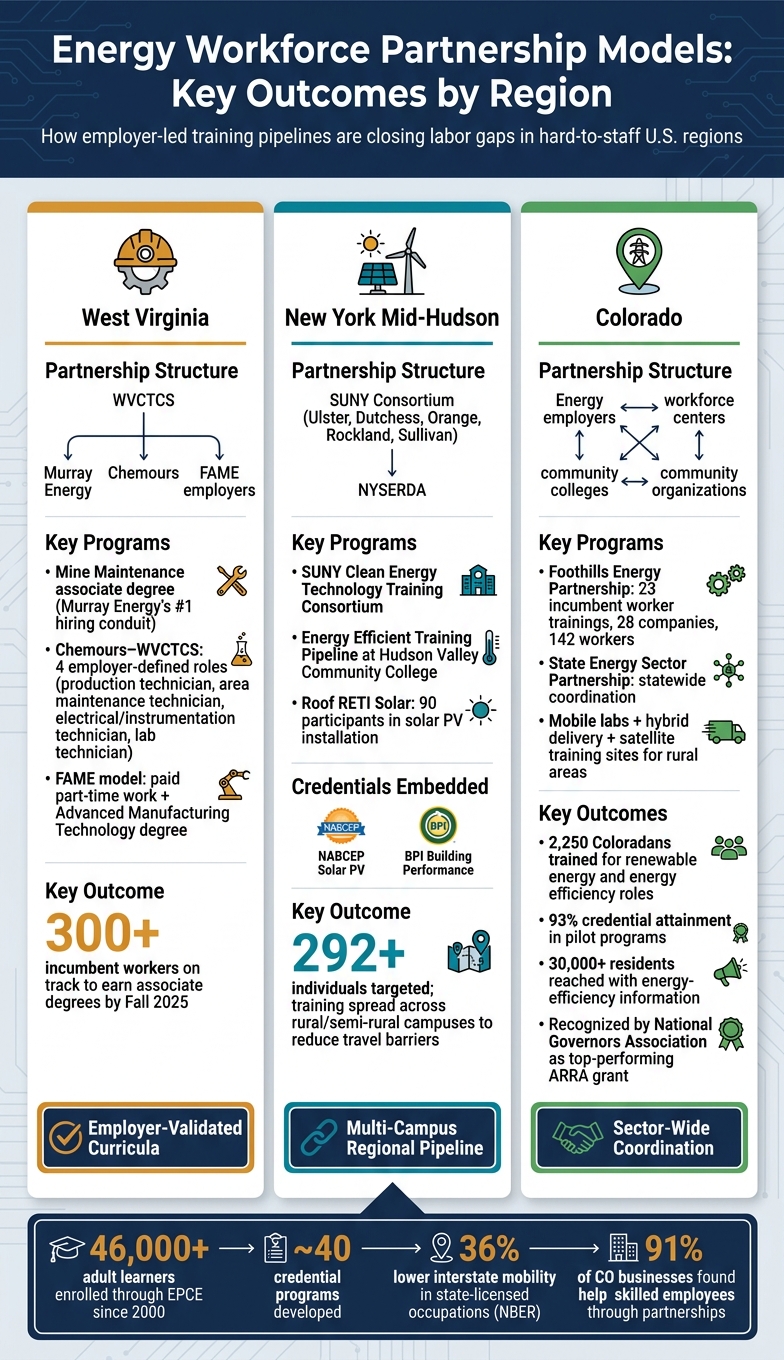
Energy Workforce Partnership Models: Key Outcomes by Region
These examples show what happens when employers, colleges, and workforce agencies stop working in silos. Training gets tied to actual hiring demand, and open roles get filled faster.
West Virginia: aligning college training with energy employer needs
In West Virginia, energy and chemical manufacturing employers were having a hard time filling maintenance technician, production operator, welder, and other technical jobs.
A RAND study found a clear mismatch. Employers wanted more hands-on technical training, better workplace readiness, and stronger soft skills. They also wanted direct input on curriculum design and equipment choices. In response, colleges compared existing courses with the skill needs named by regional employers and rebuilt programs around those gaps.
One of the strongest examples is the partnership between Murray Energy Corporation and two community colleges – Pierpont Community & Technical College and West Virginia Northern Community College. That work led to a Mine Maintenance associate degree program that Murray Energy made its "number one conduit for hiring maintenance personnel."
A similar approach took shape through the Chemours–WVCTCS partnership. The program is meant to help more than 300 incumbent workers earn associate degrees by fall 2025 in four employer-defined roles:
- production technician
- area maintenance technician
- electrical/instrumentation technician
- lab technician
The FAME (Federation for Advanced Manufacturing Education) model in BridgeValley and the Advantage Valley region takes a slightly different route. Students work in paid part-time roles with multiple manufacturing employers while finishing an Advanced Manufacturing Technology associate degree. The target is direct: the shortage of multi-skilled maintenance technicians.
That kind of alignment makes the jump from classroom to jobsite much shorter.
New York Mid-Hudson: building shared clean energy training pipelines
The Mid-Hudson region was dealing with a different problem. Clean energy project demand was growing faster than the supply of workers with the right credentials.
The SUNY Clean Energy Technology Training Consortium helped build a shared regional pipeline. It was centered at SUNY Ulster, with SUNY Dutchess, Orange, Rockland, and Sullivan delivering modules locally under common standards. NYSERDA backed the effort and helped shape the curriculum around regional project demand.
Training covered solar electric (PV), solar thermal, small wind, geothermal, green building, and energy efficiency. It also built in industry-recognized credentials, including NABCEP solar PV certifications and BPI building performance credentials. Because training was spread across several campuses, workers in rural and semi-rural parts of the Hudson Valley had less travel to deal with. The consortium also adjusted class sizes and session frequency to track projected installation and retrofit activity.
Two funded programs pushed that work further. The Energy Efficient Training Pipeline at Hudson Valley Community College targeted 292 individuals from underemployed and low-income backgrounds. It combined soft skills, job training, and college coursework for entry into building trades and energy efficiency roles. Roof RETI Solar planned to train 90 participants in solar PV installation through hands-on labs, virtual components, paid internships, and direct job placement support.
Spreading training across campuses cut travel time and made participation possible for workers outside the region’s largest population centers.
Colorado and other regions: coordinating sector partnerships for hard-to-fill regions
Colorado took a broader sector partnership route. Energy employers, workforce centers, community colleges, and community organizations worked together to identify the hardest-to-fill occupations and build a shared response.
The Foothills Energy Partnership delivered 23 incumbent worker trainings to 28 companies and 142 workers. A big part of the effort was removing travel, scheduling, and credential barriers while building clean-energy skills. At the state level, the State Energy Sector Partnership trained 2,250 Coloradans for renewable energy and energy efficiency occupations and reached more than 30,000 residents with energy-efficiency information. It was also recognized by the National Governors Association Center for Best Practices as a top-performing federal ARRA grant that exceeded all of its performance measures.
In rural and mountain communities, partners tested mobile labs, hybrid delivery, and satellite training sites so workers did not have to relocate to get sector-aligned training.
Colorado’s model worked because employer demand, training capacity, and where training happened were planned together.
| Region | Partnership Structure | Key Outcome |
|---|---|---|
| West Virginia | WVCTCS + Murray Energy, Chemours, FAME employers | Employer-validated curricula and 300+ incumbent workers on track to earn associate degrees by fall 2025 |
| New York Mid-Hudson | SUNY Consortium + NYSERDA | 292+ individuals targeted for training; NABCEP/BPI credentials embedded |
| Colorado | Sector partnerships + workforce boards + community colleges | 2,250 trained statewide; 93% credential attainment in pilot programs |
The next bottleneck is deployment: moving approved workers into open roles without delay.
How technology helps partnerships turn trained workers into filled roles
Once training wraps up, the holdup usually moves to deployment. Training programs produce workers. Technology helps get those workers into jobs.
Where ABLEMKR fits in energy workforce deployment
This is where workforce software does its best work. ABLEMKR turns program graduates into a searchable deployment pool by matching certifications, availability, and location with open roles across oil & gas, mining, utilities, and heavy infrastructure. In remote basins, mining regions, and transmission corridors, that kind of precision helps employers find workers who are qualified and ready to travel.
In May 2026, ABLEMKR established a strategic alignment with PetroEd to integrate IADC RigPass Oilfield Safety Certifications directly into its AI-powered workforce platform. The point is simple: workers can show up at job sites already verified and cleared. As ABLEMKR CEO Patrick Wallain put it:
"It’s no longer enough to simply ‘find workers.’"
For regional partnership pipelines, that changes the handoff in a big way. As soon as graduates finish a program, they can be added to a live, searchable talent pool. Employers then get a real-time view of credentialed workers based on location and availability.
How compliance tracking and payroll reduce friction for employers and workers
Even after a worker is trained, onboarding, credential tracking, and payroll can still slow things down on project-based energy jobs. ABLEMKR’s embedded compliance tracking gives employers real-time visibility into worker status – who is cleared, who has a certification expiring, and who still needs a site-specific safety acknowledgment. In high-risk settings, that matters a lot. One worker without the right credentials can lead to a stop-work order or a regulatory fine.
For workers, integrated payroll workflows and guaranteed on-time payments cut some of the uncertainty that can make travel-based assignments feel like a gamble. Colleges and workforce boards build the pipeline. Deployment software helps turn that pipeline into filled roles.
"The challenge many contractors face today is not just labor shortages. It’s onboarding delays, certification tracking, and compliance complexity." – Patrick Wallain, CEO & Founder, ABLEMKR
So the next set of numbers to watch is pretty clear: placement speed, compliance status, and payroll reliability.
What to measure and what leaders should take from these cases
Metrics that show whether a partnership is working
The key question is simple: which metrics show that a partnership is actually helping fill hard-to-staff jobs?
Because not every training program leads to hires. If you want a clear read on whether the effort is paying off, you need to track the right numbers from day one.
The most useful metrics follow a clean sequence: trainees credentialed, 90-day placement rate in target roles, time-to-fill priority vacancies, and 12-month retention. On top of that, track starting wage, wage growth at 6 and 12 months, and how pay compares with local averages.
For remote and hard-to-staff regions, one metric matters more than most: the share of remote vacancies filled through the partnership pipeline. That number gets straight to the point. It shows whether the program is fixing the geography problem, not just training people who then take jobs somewhere else.
| Metric | What It Tells You |
|---|---|
| Placement rate (90-day) | Whether training leads to actual jobs in target occupations |
| Time-to-fill | Whether the pipeline is shortening the hiring cycle |
| 12-month retention | Whether workers are staying, not just starting |
| Median starting wage ($) | Whether jobs meet quality thresholds |
| Remote roles filled via partnership | Whether the program is reaching the hardest gaps |
| Cross-state credential acceptance rate | Whether workers can move across states or sub-sectors without delay |
NYSERDA offers a good example of how this looks in practice. NYSERDA’s clean energy programs show the value of setting clear targets: they pair scale with explicit certification goals.
Conclusion: partnerships work best when mobility and deployment are built in
The clearest lesson from West Virginia, New York’s Mid-Hudson region, and Colorado is this: energy labor gaps are as much a mobility and credentialing problem as a training problem. Partnerships that treat portable credentials, relocation support, and deployment speed as core design features, not side items, are better placed to close labor gaps than programs focused only on training volume.
Colorado’s sector partnership surveys make that point hard to miss. 91% of participating businesses said they found help locating employees with the skills they needed, and 82% developed new recruitment practices as a direct result of partnership involvement. Those are not just training outputs. They’re day-to-day hiring results.
The best programs connect training to the job site through portable credentials, worker supports, and faster deployment. Measure that speed, then keep tightening the system.
FAQs
Why doesn’t training alone fill remote energy jobs?
Training builds skills. But it doesn’t fix the logistical, technical, and regulatory roadblocks that come with remote energy work.
That gap matters. Relocation can stop companies from making permanent hires, and many projects need people on site faster than a standard hiring and training cycle can deliver.
Even when workers are trained, problems can still show up, including:
- skill mismatches
- certification or documentation gaps
- site- and state-specific compliance requirements
What makes a credential truly portable across states?
A credential becomes portable when its digital record follows a common standard and can be checked on the spot across state lines.
That matters because licensing rules and safety requirements change from one state to the next. So portability isn’t just about having a card or certificate. It depends on real-time tracking through centralized, mobile-first platforms that people can use in the field.
With digital records, including QR codes and NFC, supervisors can confirm a worker’s qualifications in seconds. That makes it much easier to move pre-vetted workers across jurisdictions without slipping out of compliance.
Which metrics best show a workforce partnership is working?
Track the numbers that tell you if labor gaps are getting smaller: vacancy rates, time-to-fill for critical roles, and time-to-productivity for new hires.
It also helps to watch training completion, certification renewals, retention, overtime hours, project duration, and delays linked to labor shortages. Review these each quarter so you can fine-tune the partnership and keep workforce plans in step with project needs.


