
If I need to staff offshore crews in the U.S., I see two clear paths: use one platform to find workers fast, or use another to control rotations, certificates, travel, and pay after hiring.
Here’s the short version:
- ABLEMKR fits surge hiring and short-notice labor needs.
- Sealogic E-CMS focuses on certificate and medical expiry tracking.
- RadiantFleet stands out for 21/21, 14/14, and custom rotation planning.
- Onboard Tracker has too little public detail to rate with confidence.
- CertVault is the deepest option here for compliance, POB tracking, rotation-linked payroll, and crew status.
A few facts shape the decision fast:
- ABLEMKR says most energy job posts get matched applicants in 24 to 48 hours.
- CertVault uses a 0–100 CV-to-certificate score to check document coverage.
- CertVault also supports fixed swings like 21/21.
- Public detail for Sealogic, RadiantFleet, and Onboard Tracker is still limited in some areas.
If you want a simple rule: pick ABLEMKR for hiring speed; pick CertVault or RadiantFleet for crew control after people are hired.
smartPAL Crewing | Complete Maritime Crew Management Software for Shipping Companies ⚓
sbb-itb-aa28329
Quick Comparison
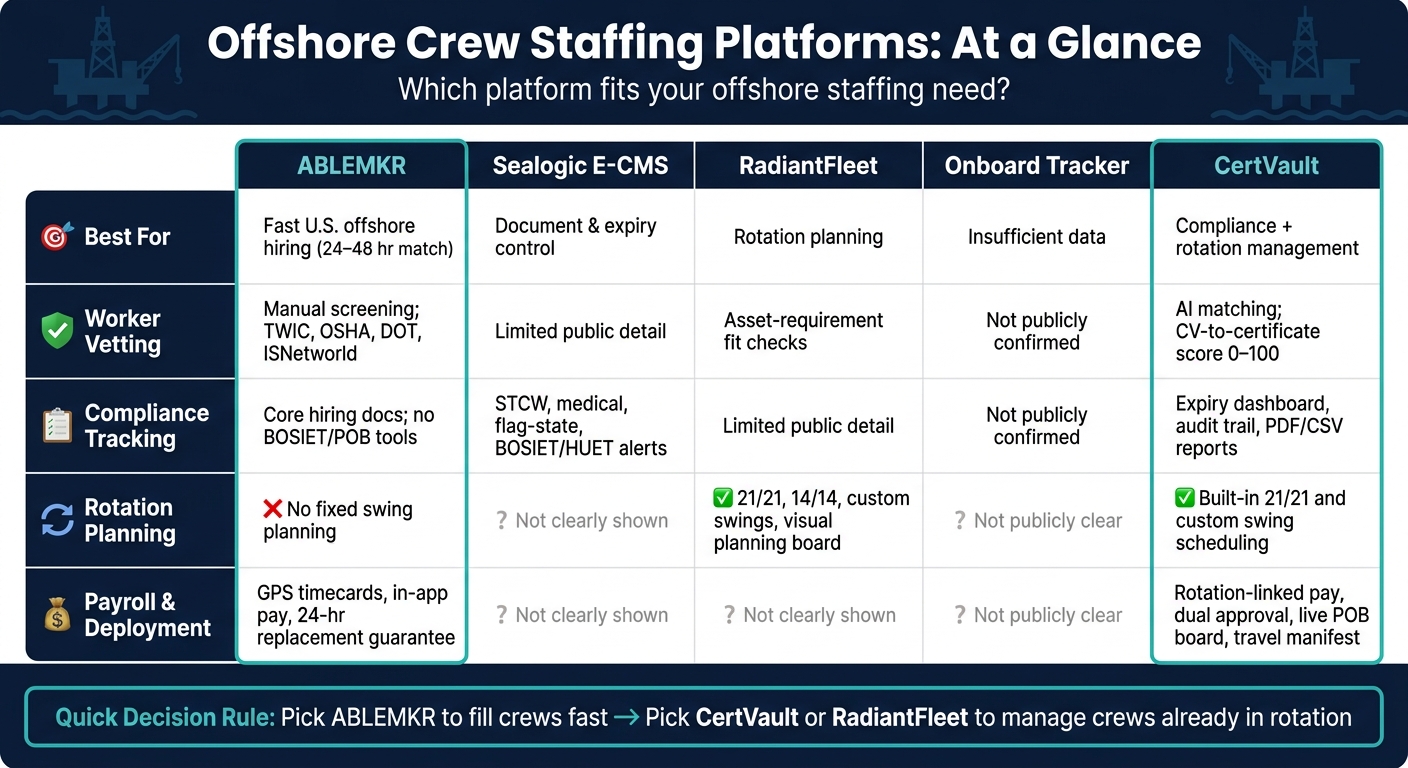
Offshore Crew Staffing Platforms Compared: ABLEMKR vs CertVault vs RadiantFleet
| Platform | Best for | Vetting | Compliance | Rotations | Payroll / Deployment |
|---|---|---|---|---|---|
| ABLEMKR | Fast U.S. offshore hiring | Manual screening, trade and safety credential checks | Covers hiring records and core documents | No fixed offshore swing planning shown | GPS timecards, in-app pay, U.S. market coverage |
| Sealogic E-CMS | Document and expiry control | Limited public detail | STCW, medical, flag-state, BOSIET/HUET alerts | Not clearly shown | Not clearly shown |
| RadiantFleet | Rotation planning | Checks fit against asset needs | Limited public detail | 21/21, 14/14, custom swings, planning board | Not clearly shown |
| Onboard Tracker | Hard to assess | Not publicly clear | Not publicly clear | Not publicly clear | Not publicly clear |
| CertVault | Crew compliance and rotation management | AI document matching, CV scoring | Audit trail, expiry dashboard, PDF/CSV reports | Built-in swing planning like 21/21 | Rotation-linked pay, dual approval, live POB, travel manifest |
For me, the choice comes down to one question: am I trying to fill open spots this week, or manage crew movement every day after that?
1. ABLEMKR
ABLEMKR is a hiring marketplace built to line up pre-vetted workers for offshore and remote energy projects. In this kind of work, speed matters – but only if certifications, location, and availability are up to date.
Worker Vetting
ABLEMKR relies on manual screening and human vetting to match workers with project needs. Its matching system filters candidates using offshore-ready credentials, including TWIC cards, ISNetworld qualifications, H2S training, OSHA 10/30, ASME/API welding credentials, and DOT drug and alcohol testing. Worker profiles also show ratings and reviews from past assignments, which gives employers more context before they hire. Most energy project postings receive matched applicants within 24 to 48 hours.
That said, this process depends on one thing: keeping those credentials current from onboarding through deployment.
Compliance Tracking
ABLEMKR’s compliance workflow is centered on hiring. During onboarding, verified profiles store certifications, safety documents, and work history. The platform also checks for site badging and DOT-compliant drug and alcohol testing.
It’s built to cover core hiring records, but offshore-specific tools like BOSIET/OPITO tracking and POB boards are not featured.
Job Matching & Rotations
The platform’s matching engine connects companies with available workers based on location, certifications, trade, and project timelines. That makes ABLEMKR a strong fit for surge staffing needs, especially for offshore maintenance, platform turnarounds, and remote shutdowns.
Fixed offshore rotation scheduling, such as 21/21 or 14/7, is not featured. So while it can help get crews in place fast, it doesn’t appear built around rotation planning.
Payroll & Location-Based Deployment
Payroll runs through the mobile app and uses GPS-verified timecards with automated payments. Employers can set pay rates directly inside job postings, which keeps the process simple. The platform also offers a 24-hour replacement guarantee if a matched worker fails to show up.
Invoicing is transparent, and coverage spans U.S. energy markets.
2. Sealogic E-CMS Maritime Crew Management System
Compliance Tracking
For offshore crews, compliance is a day-to-day job, not something you handle once during onboarding and forget about.
Sealogic E-CMS sends expiration alerts for STCW, medical, and flag-state documents. It also keeps drills and offshore certifications like BOSIET/HUET in a single crew record, so teams can stay deployment-ready.
That matters in practice. It helps keep crews cleared for rotation and mobilization, while cutting the risk of last-minute pullbacks or missed crew changes caused by expired credentials.
3. RadiantFleet Offshore Crew Management
Document control is only part of offshore staffing. You also need to put the right person on the right rotation, at the right time. RadiantFleet handles that with a Crewing Module that brings availability, certificate status, and asset requirements into one planning view. So in practice, planning matters just as much as credential checks.
Worker Vetting
RadiantFleet checks worker experience and qualifications against the vessel or asset requirements before deployment.
Compliance Tracking
Public details don’t show deeper compliance, payroll, or geo-deployment features.
Job Matching & Rotations
This is where RadiantFleet has a clear edge. It supports 21/21, 14/14, and custom swing rotations through a visual planning board. That board flags manning gaps and shows which workers are available, which makes scheduling a lot easier.
4. Onboard Tracker Energy Crew Management
There isn’t much public information on Onboard Tracker, which makes its offshore staffing features hard to judge. The company’s public profile is thin, so it’s difficult to tell how deep its support goes for energy crew management.
Worker Vetting
Public materials don’t confirm how Onboard Tracker checks licenses, medical certificates, safety training, or sea-time records.
Compliance Tracking
There’s no public proof of credential-expiration alerts, audit tools, or offshore-specific compliance tracking.
Job Matching & Rotations
Public documentation doesn’t show support for job matching, rotation scheduling, or asset-based assignments.
Payroll & Location-Based Deployment
The available material doesn’t document payroll integration or location-based deployment.
5. CertVault Workforce Compliance
CertVault takes offshore staffing past basic compliance checks and into day-to-day rotation and crew-status control. It’s built for high-compliance, rotational workforces where timing, paperwork, and crew visibility all need to line up.
Worker Vetting
CertVault checks worker documents against stated qualifications before deployment. Its CV-to-certificate scoring system compares each qualification listed on a worker’s CV with the certificates on file, then assigns a completeness score from 0 to 100.
The AI also maps equivalent site-induction credentials across jurisdictions. That means it can recognize offshore-specific credentials like BOSIET and match them with international equivalents.
Compliance Tracking
CertVault’s compliance dashboard puts every certificate, medical, visa, and license in one place, sorted by expiry date. The platform can generate timestamped, audit-ready PDF and CSV reports on demand, with a full audit trail included.
Those records don’t just sit in a file. They feed straight into scheduling and crew search, which helps teams move from checking compliance to assigning people without jumping between systems.
Job Matching & Rotations
Hiring managers can search the worker pool with plain-English queries, such as "offshore crane operator with BOSIET from Perth available now". The AI turns that request into structured filters behind the scenes.
Rotation scheduling is built in too. The system automatically works out required crew counts and schedules swing-on and swing-off dates based on the selected pattern, such as 21/21.
Payroll & Geo-Deployment
CertVault links payroll directly to rotation cycles and supports both hourly and day-rate pay through a dual-approval payroll workflow built for rotational pay.
A live Persons on Board (POB) board ties payroll, travel status, and crew records into one workflow. It shows who is on-site, in transit, or off rotation across multiple locations at the same time. The platform also includes a multi-site travel manifest with passenger-weight tracking to support crew moves to specific rigs or remote sites.
Pros and Cons
No platform works for every offshore staffing setup. The table below narrows the comparison to the points that matter most offshore: how fast you can source people, how deep the compliance tools go, how well the system handles rotations, and whether payroll ties in cleanly.
| Platform | Strengths | Limits | Best-Fit Offshore Use Case |
|---|---|---|---|
| ABLEMKR | Pre-vetted sourcing, 24–48 hour applicant turnaround, replacement guarantee, and U.S. credential support | High direct-placement cost; not built for rotation control; limited geographic focus | Surge staffing for refinery turnarounds, pipeline shutdowns, and U.S. energy projects where pre-vetted tradespeople are needed fast |
| CertVault Workforce Compliance | AI document matching, expiry alerts, live POB tracking, and rotational payroll support | Software only; no sourcing or placement service; employer plans start at A$199/month (ex GST) | Ongoing crew management on rigs or vessels with complex rotations and strict compliance requirements |
Public details for Sealogic, RadiantFleet, and Onboard Tracker are too thin to support a reliable pros-and-cons comparison.
The split is pretty clear: some platforms are built for fast hiring, while others are better at day-to-day crew control.
Conclusion
The best fit comes down to the staffing job in front of you.
ABLEMKR is a strong match for surge hiring on offshore and remote energy projects. If your main goal is fast mobilization for U.S. offshore energy work, it fits high-volume hiring and rapid deployment.
If your operation runs on complex rotations, it makes more sense to use a system built for live crew status, expiry tracking, and audit-ready compliance.
Some operators use one tool for fast sourcing and another for compliance workflows. But the right pick depends on what you need right now.
The choice is pretty simple: pick a platform to fill crews fast, or use a system to manage crews already in rotation.
FAQs
How fast can I staff an offshore crew?
Digital tools can help you staff an offshore crew much faster than older hiring methods, which often take 2 to 4 weeks. In many cases, job postings start bringing in qualified applicants within 24 to 48 hours.
That speed comes from matching your requirements with pre-vetted workers and automating steps like certification checks, safety compliance, and onboarding. When the need is urgent, deployment can happen in as little as 24 hours.
What certifications should an offshore staffing platform track?
An offshore staffing platform should track the main safety, access, and job-based credentials needed for compliance and safe operations.
That includes BOSIET/HUET/FOET, TWIC, H2S awareness, OSHA 10/30, Well Control, GWO standards, confined space permits, electrical or welding licenses, fitness-for-duty medical exams, and ISNetworld pre-qualifications.
Do I need one system for hiring and another for crew rotations?
No. An integrated platform like ABLEMKR can handle both hiring and crew rotations in one system.
You can source, vet, and onboard workers, then move them straight into rotation management, time capture, and payroll. That means less manual entry, fewer sync errors, and real-time visibility into worker status and project costs.


