
If I hire for energy work in the U.S., I can’t stop at “this person has a certificate.” I need to check two things: whether the training or certification program is on the DOE recognition path, and whether the worker’s own credential is current, role-matched, and valid for the job.
Here’s the short version:
- Program recognition and worker credentials are different.
- Recognition is role-specific, not universal.
- Employers still need to verify expiration dates, CEUs, OSHA training, and state licenses.
- Many credentials renew every 2–3 years.
- A weak screening process can lead to site-access blocks, rework, and failed inspections.
- Digital tracking with alerts at 90, 60, and 30 days before expiration helps keep crews deployable.
Some of the main credentials employers look for include:
- BPI Building Analyst Professional (BA-P) for home energy audit work
- HEP Energy Auditor for weatherization-based audit roles
- NABCEP PV Installation Professional for lead solar install work
- NABCEP PV Associate for entry-level solar roles under supervision
- AEE Certified Energy Manager (CEM) for facility energy planning and audit work
- AEE Certified Energy Auditor (CEA) for certain multifamily audit roles
A few facts stand out. For example, BPI BA-P often renews every 3 years with 30 CEUs or an exam. NABCEP PVIP also uses a 3-year cycle and often asks for 30 hours of continuing education. CEM commonly renews every 3 years with renewal credits. That means a credential that looked fine on 09/10/2026 can still become a dispatch problem if no one tracks the renewal clock.
What this all means for me is simple: recognition helps with screening, but it does not replace job-by-job compliance checks. The best use of these programs is to match credentials to defined roles, verify records before assignment, and keep everything in one digital profile so expired documents don’t slip through.
Which Credentials Count for Energy Skilled Recognition
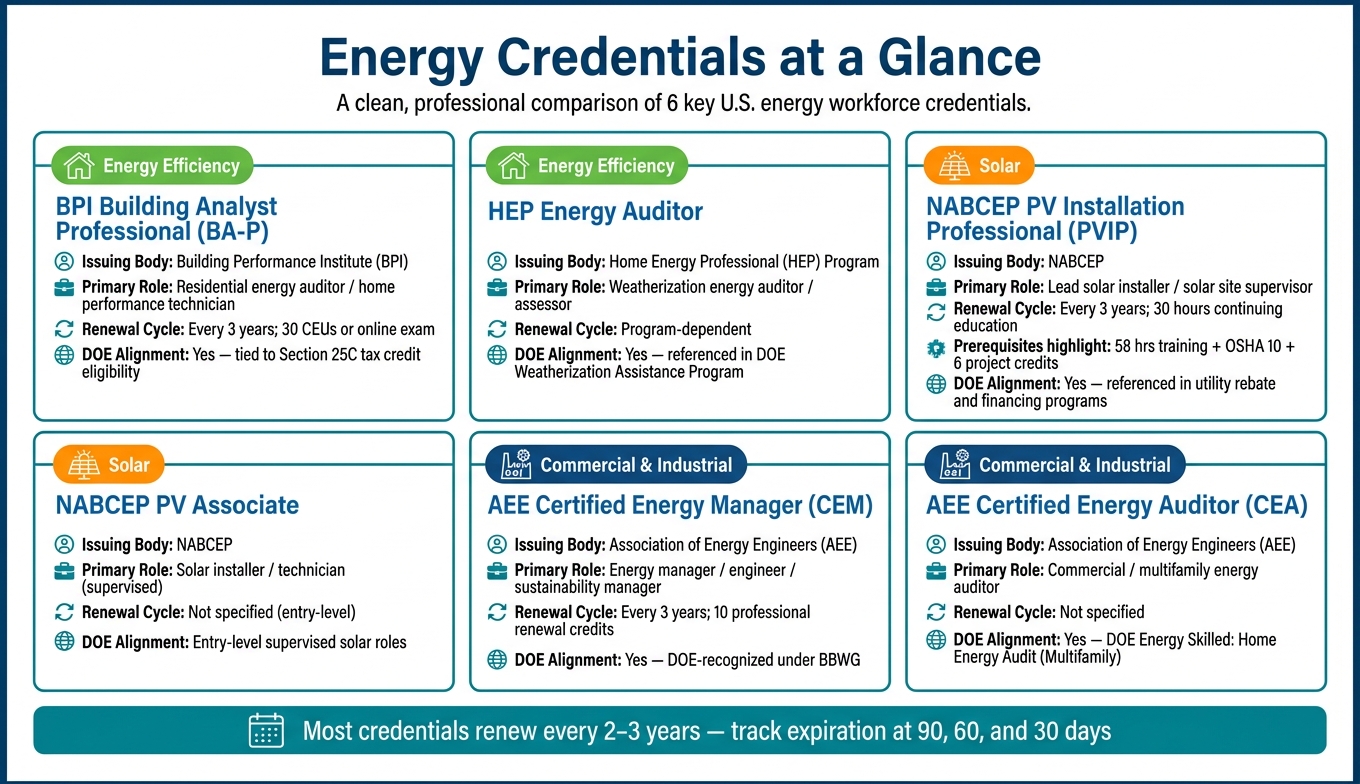
Energy Credentials Comparison: Roles, Renewal Cycles & DOE Alignment
The credential that counts depends on the job and the local compliance rules. Once that part is settled, employers still need a role-by-role shortlist of credentials they can check at hiring.
Common Credentials in Energy Efficiency and Sustainability Roles
BPI Building Analyst Professional (BA-P) is a common credential for residential energy audit work. People with this certification perform blower door testing, combustion safety checks, and whole-house diagnostics. DOE recognizes it and links it to Section 25C eligibility.
HEP Energy Auditor is used on the residential side for energy audits tied to DOE Weatherization Assistance Program standards. It supports diagnostics and quality control on low-income weatherization projects.
For solar work, NABCEP PV Installation Professional (PVIP) is common in residential and commercial solar design, code-compliant installation, and performance verification. Employers use it to check whether a worker can handle code-compliant solar installation. The NABCEP PV Associate fits entry-level installer or technician roles working under supervision.
On the commercial and industrial side, AEE Certified Energy Manager (CEM) is common for facility energy audits, measurement and verification (M&V), and energy planning across campuses, plants, and portfolios. The related AEE Certified Energy Auditor (CEA) is DOE-recognized for the Home Energy Audit – Multifamily category.
What Employers Review Beyond the Certificate
A certificate is only part of the picture. Employers also check issue and expiration dates, renewal status, CEUs, field experience, OSHA training, and any state or role-specific licenses.
For example:
- A solar installer may still need a state electrical license or to work under a licensed electrician, depending on the state.
- HVAC efficiency work may require a mechanical license.
- Residential retrofit work may fall under home improvement contractor registration rules.
The credential alone doesn’t clear all compliance boxes.
Employers that run multi-state energy programs often keep state-by-state license matrices next to their credential screening rules. Without that extra check, a worker can still end up out of compliance.
Credential Comparison Table
| Credential | Issuing Body | Primary Job Role | Typical Prerequisites | Renewal Cycle | DOE Workforce Alignment |
|---|---|---|---|---|---|
| BPI Building Analyst Professional (BA-P) | Building Performance Institute (BPI) | Residential energy auditor, home performance technician | BPI-aligned training; written and field exams | 3 years; 30 CEUs or online exam | DOE-recognized; tied to Section 25C tax credit eligibility |
| HEP Energy Auditor | Home Energy Professional (HEP) program | Weatherization energy auditor, assessor | DOE Weatherization-aligned training, field experience, and exam | Program-dependent | Referenced in DOE Weatherization Assistance Program guidelines |
| NABCEP PV Installation Professional (PVIP) | North American Board of Certified Energy Practitioners (NABCEP) | Lead solar installer, solar site supervisor | 58 hours training, OSHA 10, 6 project credits | 3 years; 30 hours of continuing education | Widely referenced in utility rebate and financing programs |
| NABCEP PV Associate | NABCEP | Solar installer, solar technician (supervised) | – | – | Entry-level, supervised solar roles |
| AEE Certified Energy Manager (CEM) | Association of Energy Engineers (AEE) | Energy manager, energy engineer, sustainability manager | Education, experience, exam | 3 years; 10 professional renewal credits | DOE-recognized under BBWG |
| AEE Certified Energy Auditor (CEA) | Association of Energy Engineers (AEE) | Commercial/multifamily energy auditor | – | – | DOE Energy Skilled – Home Energy Audit (Multifamily) |
After employers identify the right credential, the next step is checking whether it is current, renewed, and properly documented.
sbb-itb-aa28329
How Workers Earn and Keep Recognition Current
Training, Eligibility, Exams, and Field Experience
After employers identify the right credential, the next step is simple in theory: workers need to earn it and keep it active.
Most start by matching the credential to the job, then checking whether they meet the entry requirements before training begins. Earning an energy credential usually takes a few steps, not just one class and a test. Many technical and safety credentials ask for at least a high school diploma or GED. Higher-level credentials take more time because workers need documented field experience and proof that they can perform on the job. A basic safety credential might take only a few days. Qualifying for a lead role, though, usually means steady field work over a longer stretch.
Time and cost also change from one credential to another. A big reason is the amount of field experience required. Many programs test both knowledge and hands-on ability. And that matters. Credentials with a performance piece often carry more weight with employers because they show what a worker can actually do on site.
For employers, those requirements aren’t just paperwork. They help answer a practical question: Is this worker ready for this role?
Renewals, Continuing Education, and Expiration Risks
Most credentials need renewal every 2–3 years through CEUs or a retest. NABCEP also requires board-certified professionals to submit employer letters that confirm active involvement in renewable energy, along with proof of specific work such as installations, training, or leadership, to recertify. That standard shows that credentialing bodies care about on-the-job practice, not just time spent in a classroom.
Current credentials matter most at dispatch. If documentation has expired, a crew can get stopped before it even reaches the site. That can slow onboarding, restrict job assignments, and add compliance risk on active sites.
How Employers Use Recognition During Screening and Role Assignment
Role-Based Screening for Hiring and Dispatch
Recognized credentials shape which roles a worker can take on. In day-to-day hiring, employers build role profiles that spell out which credentials are required and which are preferred for each job.
Required credentials connect to legal rules, safety needs, or contract terms. Preferred credentials show deeper skill, but they aren’t always mandatory. For example, a solar PV foreman role may require a state electrician license and OSHA 10/30, while NABCEP PV Installation Professional is preferred. Those role profiles then guide dispatch decisions and determine who gets site access.
Pre-hire screening usually includes the core checks:
- certificate verification
- name match to I-9 records and government ID
- expiration review
- license and OSHA validation
For critical-infrastructure roles, employers also confirm that OSHA training is current and that the worker’s state license is in good standing. If a credential can’t be verified, the usual move is simple: assign the worker to a lower-risk role or block site access until the check is finished.
Labor Quality, Rework Reduction, and Site Readiness
Recognized credentials help improve labor quality. Fewer mistakes on complex tasks usually follow.
In solar and energy efficiency work, projects led by credentialed professionals tend to have fewer wiring non-conformities, cleaner records, and fewer inspection failures. That means less rework and fewer schedule delays. In commissioning, credentialed professionals who follow structured processes such as ASHRAE Guideline 0 are more likely to catch issues during testing instead of after occupancy, when fixes can cost much more.
That matters because rework in energy projects can set off shutdowns, re-testing, or even lost utility incentives. When employers build credential requirements straight into contracts and dispatch rules, they can avoid those costs in a measurable way. From there, the focus shifts to keeping credentials current inside a digital workflow.
Role-to-Credential Alignment Table
The table below shows how screening rules connect to access decisions. Project managers can use it to build role profiles and dispatch rules.
| Job Role | Required Credentials | Preferred Credentials | Screening Checks | Expiration Review | Site-Access Outcome |
|---|---|---|---|---|---|
| Residential Energy Auditor | BPI Building Analyst or equivalent, OSHA 10 | – | BPI locator verification; OSHA card confirmation | Block if required credentials are expired; alert 30–90 days before lapse | Approved when all required credentials are current; Blocked if BPI or OSHA has lapsed |
| Solar PV Installer (Foreman) | State electrician license, OSHA 10/30 | NABCEP PV Installation Professional | State board license check; OSHA card; NABCEP directory lookup | Block if any required credential is expired; warn before NABCEP expiration | Approved when required credentials are current; Restricted to non-foreman tasks without NABCEP |
| Commissioning Professional | CCP or ASHRAE Commissioning Process certification | PE licensure | Certification verification; PE board check | Block if required certification is expired | Approved; Restricted on complex facilities without PE licensure |
| Energy Manager | CEM | – | AEE credential verification | Alert 30–90 days before CEM expiration | Approved when current; Restricted from incentive-program work if CEM lapses |
How ABLEMKR Supports Faster, Compliant Deployment
Verified credentials only help if hiring teams can see them right when dispatch happens. ABLEMKR connects pre-vetted workers to energy and infrastructure projects by matching them to roles based on certifications, safety training, and availability. That lets employers mobilize crews without chasing paperwork by hand.
With real-time visibility into worker credential status and built-in compliance tracking, hiring teams can confirm site readiness and respond to expiration alerts before those alerts turn into access blocks.
Digital Credential Tracking and Workforce Deployment
What a Credential Management Workflow Should Include
Once employers set role-level credential rules, the next step is making sure those rules hold up during dispatch. For large crews, that means using a digital system. Spreadsheets and paper cards break down fast. A structured workflow keeps records in one place and handles checks that people often miss.
At the center of the process are centralized digital profiles for every worker. Each profile should store certifications, OSHA cards, equipment qualifications, and site-specific training, along with issue and expiration dates in standard U.S. format (MM/DD/YYYY). Those records should connect directly to dispatch, so expired credentials automatically block assignment.
Renewal alerts are required. Set them for 90, 60, and 30 days before expiration, and block assignment once a credential expires. At 30 days out, a worker’s status should move from Active to At Risk. On the expiration date, the worker moves to Non-Deployable and can’t be assigned until the credential is renewed and checked again.
The workflow also needs a clear audit trail. Log training completion and assessment evidence for every credential update. That record matters during OSHA inspections, client due diligence reviews, and insurance audits.
How ABLEMKR Supports Faster, Compliant Deployment
That same rule set gets far more useful when it connects to live workforce deployment. ABLEMKR links pre-vetted workers to energy and infrastructure projects by matching them to roles based on certifications, safety training history, availability, and geo-location – all in real time.
When a project needs fast staffing, hiring teams can see right away who is Deployable, who is At Risk, and who is Non-Compliant before anyone heads to the site. Embedded compliance tracking also flags upcoming expirations automatically, so recognition rules turn into day-to-day labor decisions.
Conclusion: What Recognition Programs Help Employers and Workers Do
After screening, recognition starts to matter on the job. In energy skilled trades, recognition programs give employers a fast way to check that a worker’s credential fits the role before dispatch. For employers, those credentials signal verified ability and help improve labor quality and site readiness.
That same verification helps workers too. A recognized credential can be job-ready across employers, projects, and regions. When workers keep credentials current and store them in a verified digital profile, those records become an active tool for getting better-paying, more dependable work.
In day-to-day use, recognition works best inside a verified workflow. It only does its job when employers combine it with current credential checks and role-based deployment rules. Used this way, recognition programs improve staffing quality for employers and open the door to better work for workers.
FAQs
What does DOE recognition mean?
In the energy sector, DOE recognition usually points to the U.S. Department of Energy’s Energy Skilled program. The program puts the spotlight on professional certifications like the Certified Energy Auditor (CEA), which confirm that a worker knows energy efficiency, conservation methods, and audit work.
These recognized credentials show that workers can handle high-level technical tasks and meet industry-specific standards and safety requirements during the energy transition.
How do I verify a worker’s credential status?
Verify a worker’s credential status through digital platforms that centralize and automate checks. On energy sites, that helps support safety and compliance without slowing teams down.
You can confirm status through:
- Real-time platform integration that checks records as they’re updated
- Digital badges and public registries that show current credential status
- Mobile on-site verification using QR codes or NFC
- Automated tracking of issue dates, expiration dates, and renewals
Which credentials matter most for my job role?
The most important credentials depend on the role. That said, most energy jobs ask for two things: basic safety training and the right trade-specific qualifications.
For many roles, OSHA 10-hour or 30-hour training is the starting point for site access. From there, employers often look for credentials tied to the work itself.
For example:
- NCCER for mechanical or electrical roles
- API for oil and gas inspectors
- NABCEP for solar and storage work
- A TWIC card for secure maritime and coastal sites
Think of OSHA as the price of entry, and the other credentials as the proof that you can handle a specific job safely and well.


