
If I had to sum it up in one line: compliance now drives the schedule, not the other way around.
I’m seeing the same pattern across U.S. energy projects: permits may move faster on paper, but court fights, grid queue delays, worker credential gaps, and shifting agency direction can still stall a project after approval. With U.S. transmission investment estimated at $760 billion to $1.4 trillion through 2050, and electricity demand climbing from data centers and AI load, even small compliance misses can turn into lost time and added cost.
Here’s the plain takeaway:
- Start permit and review work early. Don’t wait until design is fixed.
- Build regulatory dates into the main schedule. Treat filings, reviews, and approvals like hard project gates.
- Check labor and site credentials before mobilization. A missing certification can stop work fast.
- Screen interconnection risk early. Queue delays and transmission limits can block projects that look ready.
- Keep one live risk list. Each issue should have an owner, due date, and schedule or cost effect.
- Turn permit language into field instructions. Crews need plain steps, not legal wording.
A few points stand out from the article:
- Full EIS reviews often run well past one year.
- Early development work may be only 5% to 10% of total project cost, but that stage sets many of the project’s biggest risk points.
- Research cited in the article says a structured permit calendar can cut average project delays by up to 30%.
My read: this is not just a legal problem. It’s a planning, staffing, and sequencing problem. If I wait to deal with compliance after design, procurement, or mobilization, I’m inviting rework and delay. If I build it in at concept and FEED, keep records in one place, and track worker status in real time, I give the project a much better shot at staying on track.
The article below breaks that model into the main pressure points: permitting, labor and safety rules, interconnection, schedule design, field controls, and workforce tracking.
The Main Regulatory Problems Energy Project Managers Must Solve
Permitting and Environmental Reviews That Delay Project Start Dates
For major projects, a full Environmental Impact Statement (EIS) usually pushes review timelines well past one year. And even after approvals come through, court challenges can still hit. So a project can look cleared on paper and still stay exposed for months or longer.
The Supreme Court’s Seven County Infrastructure Coalition v. Eagle County decision narrowed what agencies must review under NEPA. In plain English, agencies now focus on the specific action in front of them, not every possible upstream or downstream effect. That changes the scope in a big way. But it doesn’t remove the gray area, because agencies are still rolling out policy shifts through nonbinding guidance instead of formal rulemaking.
"Permitting timelines are shortening for certain project types… but variability remains high due to litigation risk and evolving agency practices." – Ella Foley Gannon, William D. Kissinger, Kirstin E. Gibbs, and Ryan K. Lighty, Morgan Lewis
There’s also a timing problem that trips up a lot of teams. If environmental review starts only after the design is final, regulators may ask for changes that force expensive redesigns later. That’s why review needs to begin before the design is locked.
Safety, Labor, and Training Rules That Affect Who Can Work on Site
On an energy project site, every worker needs current certifications and all required credentials before mobilization starts. If a crew shows up with expired paperwork or missing credentials, that creates a compliance gap that can stop work in the middle of execution.
This isn’t something to sort out in a post-arrival audit. Credential checks need to happen during mobilization, before people are on site and the clock is running.
Site access is one risk. Interconnection is the next.
Grid, Interconnection, and Technical Compliance Requirements
Even projects that are otherwise ready can get stuck in interconnection queues or blocked by transmission limits. Part of the problem is age: much of the U.S. transmission grid was built in the 1960s and 1970s, and it hasn’t kept up with today’s generation mix or growing demand.
At the same time, interconnection queues are now dominated by renewable and storage projects. That creates a bottleneck even when generation capacity already has approval.
New federal directives add another layer. Projects on public lands now have to be judged by energy output per acre. So a design that seems workable early on can still get hit with late-stage changes if it misses those efficiency thresholds.
A smarter move is to start interconnection studies during site screening, not after designs are fixed. That helps teams catch constraints early. These issues need tracking before procurement and before interconnection filings, not after.
sbb-itb-aa28329
Energy Regulation in the U.S.: Laws, Agencies, and What Developers Must Know
How to Build Regulatory Requirements Into Project Planning
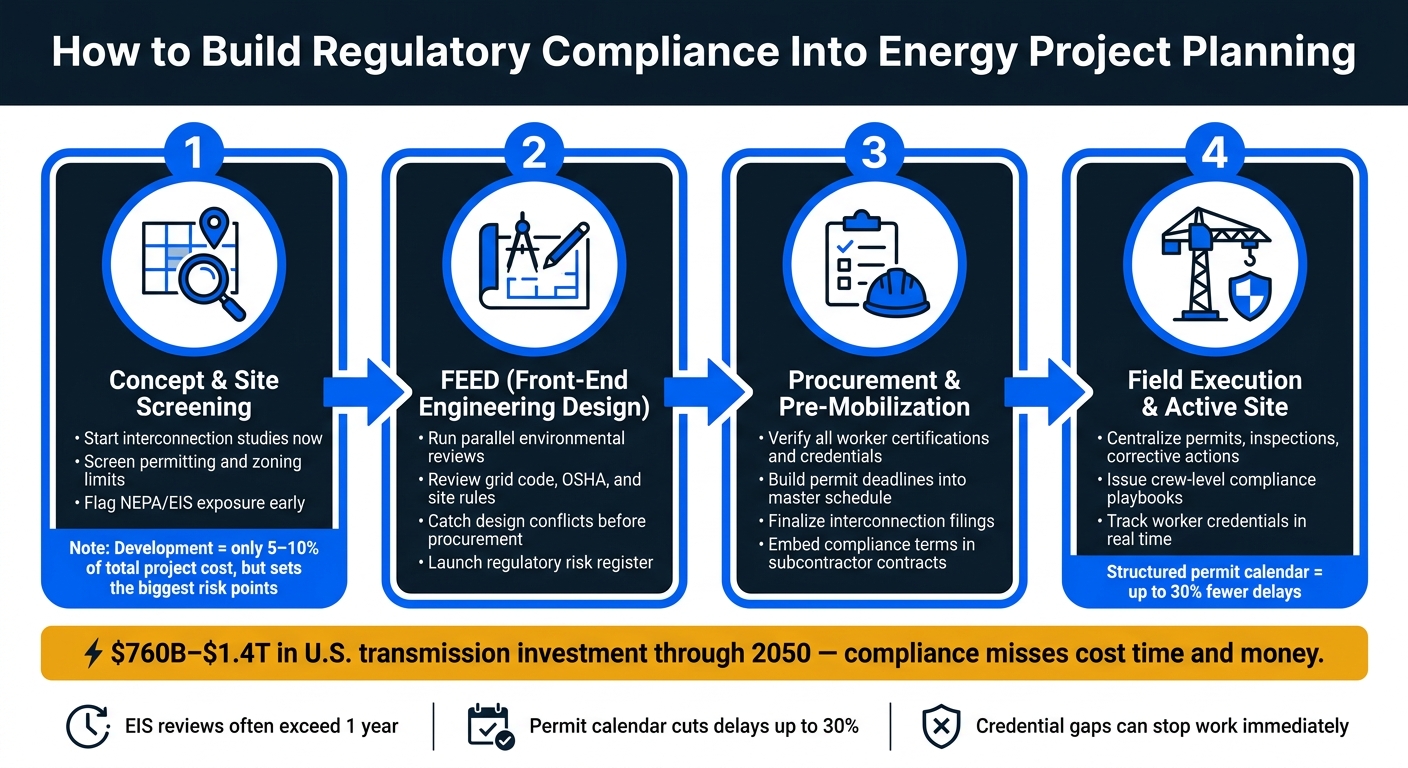
Energy Project Compliance: 4-Stage Regulatory Integration Model
Permits, site access, and interconnection are the three planning pressures that stall energy projects most often. Once you know those high-risk rules, the schedule needs to reflect them before procurement or field mobilization starts.
Use a Regulation-Integrated Schedule Instead of a Standard Construction Schedule
Most schedules put construction tasks first and deal with compliance later. That sounds fine on paper, but in practice it turns regulatory gates into nasty surprises that shove start dates back.
A regulation-integrated schedule works the other way around. Regulatory gates set the pace, and construction follows. Put every permit, filing deadline, and review window into the master schedule so the team can see what has to clear before work moves ahead.
Run Early Compliance Reviews During Concept and FEED
Most project risk is set before construction begins. That’s the window when design choices can still change without blowing up the budget.
Development expenditures typically represent only 5% to 10% of total project costs, yet these early decisions determine whether a project moves forward or stops. Running a compliance review during concept and Front-End Engineering Design (FEED) makes compliance part of the design process instead of a late check. Review grid code, zoning, OSHA rules, and site or permitting limits before the design is locked in. If one of those items conflicts with the current design path, it’s far cheaper to catch it here than after procurement starts.
Maintain a Dynamic Regulatory Risk Register
A live register helps keep those early choices aligned when rules shift. A regulatory risk register is not a one-and-done document. It has to stay active through the life of the project.
Tie each risk to a cost, schedule, or staffing effect. A missed permit renewal can lead to a stop-work order. Give each item a clear owner, a deadline, and an escalation path. That keeps the register from turning into a stale checklist nobody touches and connects it to day-to-day project control decisions.
How to Manage Compliance on Active Sites and Across Field Crews
Once field work starts, compliance turns into an execution issue, not a paperwork issue. At that point, the job isn’t just to design for compliance. It’s to make sure compliance actually happens on site. The risk usually isn’t a missing permit. It’s a permit condition no one in the field knows about, an inspection log sitting in someone’s inbox, or a crew member with an expired certification.
Centralize Permits, Inspections, and Corrective Action Records
Keep permits, inspection reports, test certificates, and corrective action records in one system with clear owners, due dates, and alerts. Every permit condition should go into a permit-condition log with an assigned owner and a deadline. Dashboards that show overdue tasks and the highest-risk sites help the team stay on the same page without constant manual follow-ups.
But a system like that isn’t enough on its own. Crews also need a way to use those rules in real time.
Give Crews Site-Specific Compliance Playbooks
Permit conditions are written for regulators. Crews need plain field instructions.
Turn permit conditions into crew directions that cover environmental controls, reporting lines, and work authorization steps tied to each crew’s scope. Daily pre-job briefings help lock in those requirements before work starts. That kind of crew-level direction turns permit language into action before the job gets held up.
Subcontractor and supplier contracts should spell out compliance terms too, including required certifications, warranties, and penalties for non-compliance.
Workers need that same level of clarity: only qualified crews should make it to the site.
Use Credential Tracking to Mobilize Qualified Workers Faster
Putting worker records into one system that tracks licenses, safety training completions, and task-specific qualifications helps keep credential checks from slowing down mobilization. If a crew needs to deploy fast, the team can see who is qualified and available without making a dozen phone calls.
ABLEMKR supports this kind of deployment. Its platform matches pre-vetted workers to job sites by certification, safety training, availability, and location, giving operators real-time visibility into worker status and compliance.
Fast credential checks help keep labor from turning into the next compliance bottleneck.
Conclusion: A Practical Compliance Model for Energy Projects
Regulatory pressure is still climbing. Permitting rules keep shifting, labor and safety standards are getting tighter, and federal policy changes continue to shape how energy projects are built and staffed. Those same pressures can slow permits and push back mobilization. But they don’t have to throw a project off track.
The difference is how teams treat compliance.
When compliance becomes part of project control, teams can manage it early instead of scrambling later. It isn’t just a legal check at the end. It’s a day-to-day control point that affects schedule, staffing, and cost. Projects move more smoothly when compliance is built into the workflow from the start, not bolted on after key decisions are already made.
The practical move is pretty straightforward: shift compliance upstream, keep it in plain sight, and give someone clear ownership at each stage. In practice, that comes down to four actions.
Key Takeaways for Project Managers and Energy Employers
- Build regulatory gates into the master schedule so deadlines shape sequencing. Research shows that a structured permit calendar can cut average project delays by up to 30%.
- Review compliance during concept and FEED to catch conflicts before design is locked. Running environmental reviews in parallel during concept and FEED can help avoid late redesigns.
- Centralize permits, inspections, and corrective actions in one system with clear owners and deadlines. A dynamic regulatory risk register, updated as rules change, helps teams track obligations and stay ahead of issues.
- Track workforce compliance. Keep certifications, safety training, and task-specific qualifications in one system so qualified workers can be mobilized faster.
Handled this way, compliance helps protect schedules, crews, and cost control.
FAQs
What is a regulation-integrated schedule?
A regulation-integrated schedule builds required regulatory milestones and compliance steps into the core project plan.
Instead of treating compliance as a separate task, it puts deadlines like environmental reviews, safety certifications, and permit approvals directly into the project schedule. That helps managers deal with outside constraints, stay audit-ready, and keep field operations compliant through the full project lifecycle.
When should compliance reviews start?
Compliance reviews should start at project conception. That way, regulatory requirements shape the schedule and design from day one instead of forcing changes later.
Map permits, grid codes, and standards early. It’s one of the simplest ways to avoid costly redesigns and cut uncertainty before it spreads across the project.
Before construction begins, set up workforce compliance frameworks and contact lists. From there, use pre-audit reviews at major milestones and quarterly audits during operations to keep compliance on track.
How can teams reduce interconnection delay risk?
Teams can cut interconnection delay risk with early planning and early coordination with regulators. Secure site control as soon as possible, target grid connection points where transmission capacity is planned or already open, and look at grid-enhancing technologies that can free up existing capacity.
It also helps to bring permitting and environmental compliance into the first round of project design instead of treating them as later steps. Run state and federal reviews in parallel where possible, and use advanced software to speed up study workflows.


