
Launching an energy apprenticeship program can address the growing demand for skilled workers in clean energy sectors like solar, wind, and energy efficiency. These programs offer hands-on training, mentorship, and nationally recognized credentials while meeting federal standards and qualifying for tax incentives under the Inflation Reduction Act (IRA). Here’s a quick overview of the key steps:
- Program Registration: Meet federal and state requirements, including creating a Standards of Apprenticeship document and registering with the U.S. Department of Labor (DOL).
- Skills and Curriculum: Identify technical and professional skills needed for energy roles and develop a curriculum with at least 2,000 hours of on-the-job training and 144 hours of related instruction annually.
- Program Structure: Define training duration, milestones, and apprentice-to-journeyworker ratios to ensure compliance and effective learning.
- Recruitment and Onboarding: Partner with workforce agencies and colleges, focus on underrepresented groups, and provide clear career paths during onboarding.
- Tracking and Compliance: Use tools like ABLEMKR to monitor progress, verify certifications, and maintain compliance with DOL and IRA requirements.
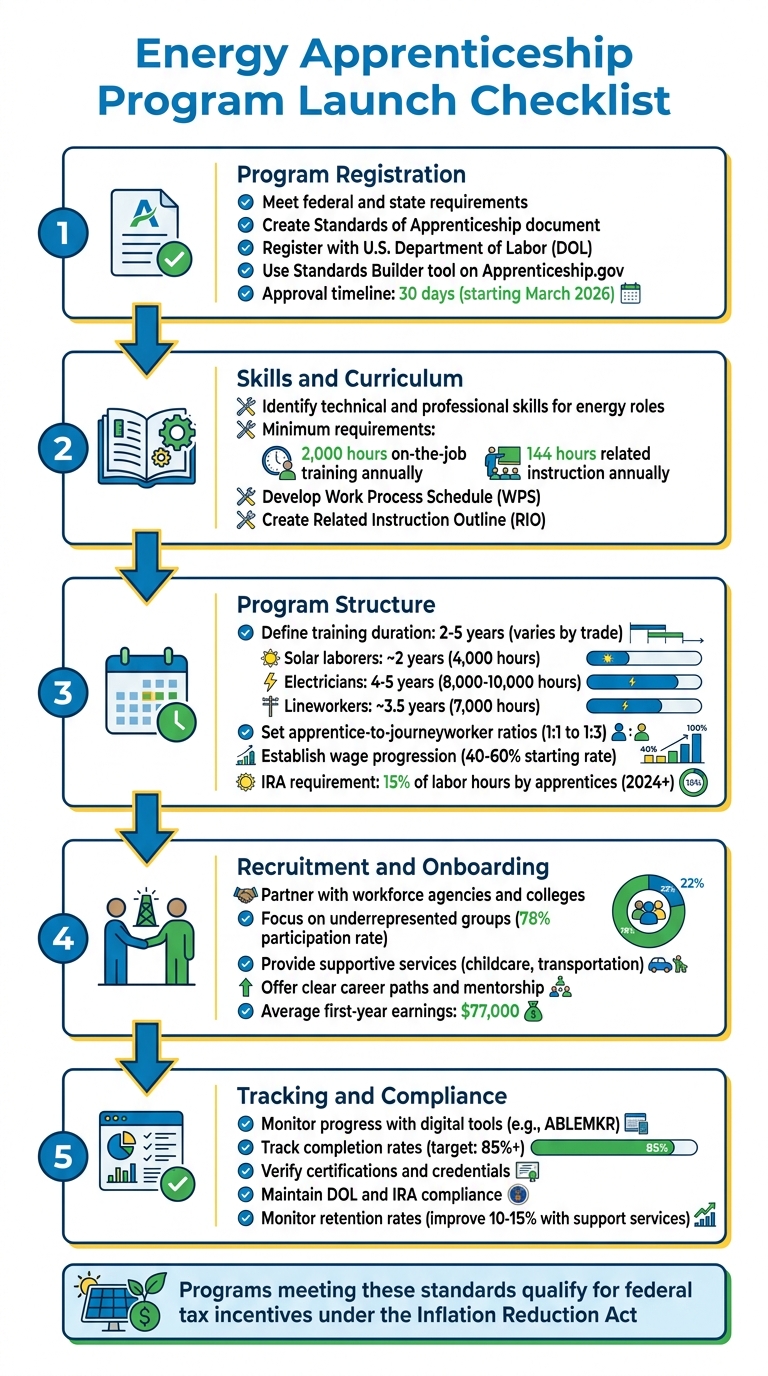
5-Step Checklist for Launching Energy Apprenticeship Programs
Program Compliance and Registration Steps
Federal and State Requirements
Apprenticeship programs operate under the oversight of either the U.S. Department of Labor (DOL) or a Recognized State Apprenticeship Agency. To determine which agency governs your area, visit Apprenticeship.gov.
To gain approval, every apprenticeship program must meet specific criteria. These include offering paid employment, structured on-the-job training, related instruction (which can be virtual or in-person), and mentorship by experienced professionals. The program must also lead to a nationally recognized credential.
A critical step is developing a formal Standards of Apprenticeship document. This outlines key elements like eligibility criteria, selection process, probationary periods, and the training approach – whether time-based, competency-based, or a hybrid model. Additionally, the program must focus on an apprenticeable occupation. To confirm this, you can use resources like the DOL Occupation Finder or O*NET Online, which list roles such as wind turbine technicians and electricians in the energy sector.
By addressing these foundational requirements, you’ll set yourself up for a smooth registration process.
How to Register Your Apprenticeship Program
The first step in registration is identifying your program sponsor. This could be a company, industry association, consortium, or a labor-management group. Once you’ve established your sponsor, use the DOL’s Standards Builder tool on Apprenticeship.gov to create your registration package. Keep in mind, you’ll need a Login.gov account to access this tool.
Engaging early with an Apprenticeship Training Representative (ATR) can significantly speed up the approval process. Starting in March 2026, the DOL has committed to issuing final registration decisions within 30 days of receiving submissions.
"We’re removing the administrative roadblocks that have prevented Registered Apprenticeship from scaling to meet demand."
- Lori Chavez-DeRemer, U.S. Secretary of Labor
Once your standards are submitted through your ATR, you’ll be scheduled for a formal registration meeting, typically within a few weeks. This streamlined process reflects the federal goal of reaching 1 million active apprentices nationwide.
sbb-itb-aa28329
Defining Skills and Curriculum for Energy Transition
Key Skills for Energy Transition Roles
Energy transition apprenticeships require a diverse set of technical abilities tailored to specific sectors. For example, in solar-plus-storage roles, apprentices need expertise in electrical installation across various settings – whether it’s interior, residential, or substation work. They also tackle tasks like mechanical installation, assembling solar systems, and weatherproofing equipment. In energy efficiency positions, the focus shifts to energy auditing, installing HVAC systems and insulation, applying weatherization techniques, and inspecting residential energy controls. Meanwhile, the wind energy sector demands skills in wind turbine technology, crane operation, rigging, and millwright tasks.
Beyond these technical requirements, apprenticeships also emphasize professional and digital skills. Competencies like computer-aided design (CAD), building information modeling (BIM), cybersecurity, project management, and technical sales are becoming standard in many programs. Safety remains a cornerstone of training, with OSHA compliance and anti-harassment programs being non-negotiable components. Physical fitness requirements vary by role; for instance, wind turbine technicians must be comfortable working at heights, while battery manufacturing roles often involve precise operation of automated machinery.
In May 2024, the U.S. Department of Energy’s Battery Workforce Initiative introduced National Guideline Standards for the Battery Machine Operator occupation. Developed with the U.S. Department of Labor, these standards provide a clear roadmap for creating Registered Apprenticeship programs tailored to advanced battery manufacturing.
This detailed skill set forms the foundation for designing a curriculum that blends practical experience with theoretical learning.
Building a Curriculum Framework
Once these essential skills are identified, the next step is to create a curriculum that translates them into actionable, measurable training. Registered Apprenticeships require a minimum of 2,000 hours of on-the-job training and at least 144 hours annually of related technical instruction. A well-rounded curriculum includes a Work Process Schedule (WPS), which outlines specific tasks and the progression of skill development, paired with a Related Instruction Outline (RIO) for classroom or online learning that supports hands-on training.
Employers often adapt existing standards, such as those for Electricians or Construction Craft Laborers, by incorporating up to 25% of additional tasks specific to solar or clean energy. This strategy not only simplifies program registration but also ensures compliance with federal labor requirements. Additionally, the curriculum should define wage steps, offering incremental pay increases as apprentices advance in their proficiency.
"Apprenticeships should prepare someone for a career, not train them for a job." – Green Workforce Connect
This approach ensures that apprenticeships not only equip individuals with job-specific skills but also lay the groundwork for long-term career growth.
Program Structure and Training Ratios
Training Duration and Milestones
Energy apprenticeships typically last between 2 and 5 years, depending on the trade. For example, solar laborers or installers often finish their program in about 2 years, completing roughly 4,000 hours of on-the-job training. In contrast, general electricians may require 4 to 5 years, accumulating approximately 8,000 to 10,000 hours. Lineworkers generally complete their training in about 3.5 years, with around 7,000 hours of hands-on experience.
The Department of Labor mandates a minimum of 2,000 hours of on-the-job training annually – equivalent to full-time work for a year – along with at least 144 hours of related technical instruction per year. Apprenticeship programs can follow one of three models:
- Time-based: Focused on completing a set number of hours.
- Competency-based: Prioritizing skill mastery over time spent.
- Hybrid: Combining minimum hour requirements with skill verification.
While traditional trades like electricians often stick to time-based models, newer clean energy roles are increasingly adopting competency-based approaches. This shift allows high-performing apprentices to progress more quickly.
Wages for apprentices typically start at 40–60% of the journeyworker rate, with annual raises tied to milestones. For instance, first-year apprentices might earn $18–$22 per hour, increasing to $32–$38 by year five, eventually reaching the full journeyworker rate of $35–$45 per hour. Programs also include a probationary period, usually covering 25% of the total training duration.
Apprentice-to-Journeyworker Ratios
Defining program duration and wage structures is just one part of the equation – ensuring proper supervision ratios is equally important. These ratios, set by apprenticeship programs and enforced by the Department of Labor, are critical for both compliance and effective training. Ratios often start at 1:1 and may extend to 1:3 as more apprentices join. However, specific requirements vary depending on the trade and program. It’s crucial to maintain these ratios daily while apprentices are on-site. If the approved ratio is exceeded, any additional apprentices must be paid the full journeyworker wage for those hours instead of the reduced apprentice rate.
For projects aiming for enhanced tax credits under the Inflation Reduction Act, at least 15% of total labor hours must be completed by qualified apprentices on clean energy projects over 1 megawatt – up from 12.5% for projects that began construction in 2023. To stay compliant, employers should:
- Monitor ratios daily with a straightforward tracking system.
- Submit written requests for apprentices at least 45 days in advance to show good faith efforts in meeting workforce needs.
- Keep detailed records for audits or when transferring tax credits.
Recruiting, Selecting, and Onboarding Apprentices
Creating a Recruitment Strategy
Getting the recruitment and onboarding process right is essential for building a steady flow of skilled workers, especially for energy transition projects.
Start by forming strategic partnerships with community colleges, workforce agencies, and labor unions. These partnerships pave the way for graduates – particularly those from underrepresented groups – through agreements that provide them with preferential access to your program.
Focus your outreach efforts on groups that have been historically underrepresented. For example, in one clean energy initiative, 78% of registered apprentices came from these populations. Tools like Green Workforce Connect can help you identify educational partners and talent in your area.
When promoting your program, emphasize the benefits of the "earn while you learn" model. Share data that shows workers who complete Registered Apprenticeship Programs earn an average of $77,000 in their first year and see a return of $1.47 for every $1 invested. A great example of this approach is Cam Solar Training, which expanded significantly between 2023 and 2025 – growing from 1 occupation with 20 apprentices to 4 approved programs, 11 employer partners, and 160 apprentices in just nine months.
"With their mentorship, we went from 1 occupation, 1 employer, and 20 apprentices to 4 approved programs, 11 employer partners, and 160 apprentices in just 9 months." – Nikki Kasper, Director of Business Strategy Consulting and Management Services, Cam Solar Training
Screening and Selecting Apprentices
Before diving into the selection process, confirm that the roles you’re targeting are officially recognized as apprenticeable occupations by the U.S. Department of Labor or a state agency. Use resources like the National Guidelines for Apprenticeship Standards to define the skills, certifications, and benchmarks needed for clean energy roles. If your project aims to qualify for Inflation Reduction Act tax credits, remember that starting in 2024, at least 15% of construction labor hours must be completed by Registered Apprentices.
When evaluating candidates, consider their readiness for physical labor and their ability to commit to a program that typically lasts 2–5 years. Use competency-based evaluations to focus on their potential and practical skills rather than just theoretical knowledge. During the onboarding phase, pairing apprentices with mentors allows for an early assessment of their hands-on abilities and their fit for the "earn while you learn" model.
These steps ensure a smoother transition into the program and set apprentices up for success.
Onboarding and Orientation
Once candidates are selected, the onboarding process should clearly map out their journey from training to career advancement. Start by introducing training and certification tracks during orientation, and highlight how wage increases are tied to skill progression. Offering supportive services like childcare, transportation assistance, mentoring, and counseling can make a big difference in retention and success rates.
To ensure the training is both recognized and scalable, align your onboarding process with Registered Apprenticeship Program standards. Keep the process employer-driven and adaptable to the specific needs of the clean energy sector. Present the apprenticeship as a clear path to a stable and rewarding career in clean energy.
"Through a customizable, employer-driven, earn-while-you-learn training model, RAs help address critical workforce challenges while creating pathways to family-sustaining clean energy careers." – Interstate Renewable Energy Council (IREC)
Tracking Progress and Program Success
Metrics to Measure Apprentice Success
To gauge how well your apprenticeship program is performing, focus on a few key metrics. Start with apprentice completion rates – a well-run program should aim for a completion rate of 85% or higher.
Another important metric is wage progression. For example, apprentices earning an average of $77,000 in their first year, compared to $52,000 for college graduates, highlights how tying pay increases to skill milestones can improve both retention and completion rates.
For solar developers specifically, tracking apprentice-to-journeyworker ratios is essential to qualify for tax incentives under the Inflation Reduction Act (IRA).
Retention rates are just as crucial as completion rates. Programs that offer supportive services like transportation assistance and childcare have seen retention improve by 10–15%. Keeping tabs on which services apprentices use can help measure their impact.
"Supportive services are not ancillary – they are foundational for both retention and employer return on investment." – Third Way
These metrics not only measure success but also provide a foundation for compliance tracking and continuous improvement.
Compliance and Continuous Improvement
Keeping your program aligned with current standards ensures it remains effective and sustainable. Start by aligning your training with Department of Labor (DOL)-approved occupations, such as the Construction Craft Laborer. This guarantees your program meets federal requirements and provides apprentices with nationally recognized credentials.
For compliance, use the National Guidelines for Registered Apprenticeship Programs. Developed by SEIA, IREC, and MREA, these guidelines offer a DOL-approved framework tailored to industry needs, ensuring your program stays federally eligible. Additionally, resources like the Apprenticeships in Clean Energy (ACE) Network can provide free technical support.
Regularly review metrics to catch potential issues early. For example, track weekly operational data like occupancy rates and monitor financial metrics such as gross margin percentage on a monthly basis. Programs should aim for a gross margin above 85% while keeping training costs under $5,000 per apprentice.
Feedback loops are another essential tool. Regular sessions between mentors and apprentices can help identify skill gaps and fine-tune training plans. This kind of ongoing dialogue ensures transparency and accountability.
"The solar and storage industry is growing by the day, and our workforce development tools and strategies must grow too." – Erika Symmonds, SEIA’s Vice President of Equity and Workforce Development
Using Technology for Workforce Deployment
ABLEMKR for Workforce Management

Managing energy apprenticeship programs involves juggling a lot of moving parts – tracking hours, verifying certifications, and ensuring compliance with federal standards. ABLEMKR’s mobile-first platform simplifies these challenges by connecting pre-vetted workers to energy projects and automating tedious administrative tasks.
The platform uses certifications, safety training, availability, and geo-location to match workers to job sites. For instance, if you need an Inside Wireman apprentice halfway through their required on-the-job training for a remote solar project, ABLEMKR helps you quickly find and deploy the right candidate. This precision becomes especially important for programs that need to monitor apprentice-to-journeyworker ratios to qualify for federal incentives under the Inflation Reduction Act.
Compliance tracking is built into the system, eliminating the need for manual spreadsheets. It keeps tabs on both on-the-job and classroom hours, ensuring apprentices meet federal certification benchmarks. Real-time updates provide a clear picture of each apprentice’s progress toward their goals. These tools not only streamline workforce management but also lay the groundwork for smoother recruitment and wage management processes.
ABLEMKR Benefits for Apprenticeship Programs
ABLEMKR goes beyond just managing workers – it also improves recruitment and payroll processes. By pre-vetting candidates, the platform ensures they meet basic qualifications, such as being at least 18 years old, having a valid driver’s license, and possessing a social security number, before they even reach the interview stage. This saves time and ensures only eligible candidates move forward.
The platform also simplifies wage progression tracking. Payments tied to skill milestones are automated, ensuring apprentices are paid on time, which helps boost retention and completion rates. This is particularly valuable for organizations scaling up apprenticeship programs during the clean energy shift.
Additionally, ABLEMKR supports what industry experts describe as a "diverse pipeline" of talent. With a strong presence in key U.S. energy regions, it allows organizations to recruit from a wider geographic area while maintaining the documentation required to secure federal incentives under the Inflation Reduction Act.
Conclusion and Key Takeaways
Checklist Summary
Launching a successful energy apprenticeship program requires careful planning and attention to essential elements. Start by identifying occupations recognized by the U.S. Department of Labor as apprenticeable and ensure your program meets federal registration standards. Develop a curriculum that combines hands-on training with classroom learning, making sure it aligns with minimum hour requirements.
To qualify for tax incentives under the Inflation Reduction Act (IRA), programs starting in 2024 must ensure that at least 15% of construction labor hours are completed by Registered Apprentices. Focus on recruiting from diverse talent pools, including individuals with transferable skills, and incorporate mentorship programs to improve safety and retention, as highlighted earlier. Use technology platforms to simplify compliance tracking, monitor apprentice progress, verify certifications, and manage wage progression.
By addressing these core steps, you can establish a solid foundation for a program that supports both workforce development and organizational growth.
Final Thoughts on Program Success
When implemented effectively, apprenticeship programs do more than just address labor shortages – they drive growth across the energy industry. Companies that invest in structured programs not only fill workforce gaps but also position themselves to take advantage of federal tax credits.
For example, between 2023 and 2024, Cam Solar Training showcased the potential of well-supported apprenticeship programs. With guidance from the ACE Network, the organization grew from offering one occupation with 20 apprentices to managing four approved programs, partnering with 11 employers, and supporting 160 apprentices – all within just nine months.
"With their mentorship, we went from 1 occupation, 1 employer, and 20 apprentices to 4 approved programs, 11 employer partners, and 160 apprentices in just 9 months." – Nikki Kasper, Director of Business Strategy Consulting and Management Services, Cam Solar Training
Want to Become a Lineman Apprentice in 2025? Watch This! Ft. Herman (Apprentice) Ep // 45
FAQs
How long does DOL registration usually take?
The U.S. Department of Labor typically requires up to 30 days to complete apprenticeship registrations. However, the exact processing time can differ based on the details of your program and whether your submission is fully complete.
What documents do I need to register a program?
To get an apprenticeship program officially registered in the U.S., you’ll need to prepare several key documents. These include a detailed program description that outlines the on-the-job training plans, related instruction components, and certification criteria. It’s also important to ensure the program complies with industry standards, incorporates proper safety training, and meets all certification requirements.
Many programs follow Department of Labor (DOL)-approved templates, such as the National Guidelines for Apprenticeship Standards (NGS). These templates provide a framework to help streamline the process.
Once your program is ready, you’ll need to submit your standards through the DOL website and ensure all regulatory requirements are met to complete the registration process.
How do I track IRA apprentice-hour compliance?
To stay compliant with IRA apprentice-hour requirements, it’s essential to meticulously document the hours worked by registered apprentices on energy projects. This includes tracking their participation and verifying their registration status.
Implement tools or systems to monitor these hours either in real-time or through periodic reporting. This ensures adherence to key regulations like the Apprentice Labor Hour Requirement, Apprentice Participation Requirement, and the Apprentice-to-Journeyworker Ratio Requirement. Keeping detailed and accurate records is critical for meeting these standards effectively.


