
Green hydrogen is reshaping the U.S. energy sector, offering a clean alternative for hard-to-decarbonize industries like steel, cement, and aviation. However, the sector faces a major challenge: a lack of skilled workers. With government funding – such as the Inflation Reduction Act’s $3/kg tax credit and $8 billion for hydrogen hubs – production must scale dramatically to meet net-zero goals by 2050. This requires a 1,000x capacity increase by 2035, yet workforce growth isn’t keeping up.
The solution? Specialized training programs. Courses like the RENAC Green Hydrogen Specialist Programme and Infocus International Mastering Clean Hydrogen Online Course are bridging the gap by equipping workers with skills in hydrogen production, safety, and infrastructure. Platforms like ABLEMKR streamline workforce deployment, matching certified workers to projects based on location, training, and availability. With hydrogen projected to account for 12% of global energy use by 2050, these efforts are critical to scaling the industry.
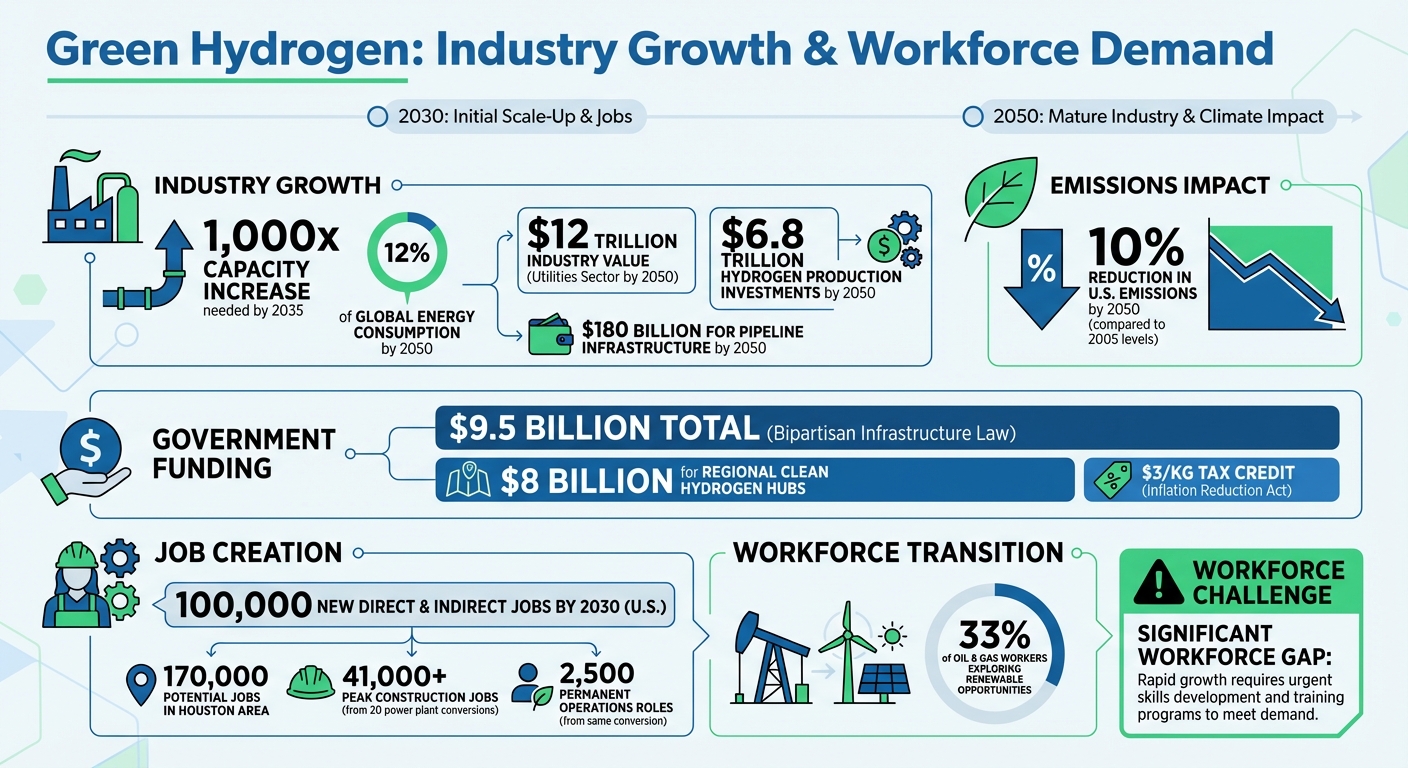
Green Hydrogen Industry Growth: Key Statistics and Projections by 2050
Course Overview: Foundations of the Hydrogen Economy
sbb-itb-aa28329
Why Green Hydrogen Matters in the U.S. Energy Sector
Green hydrogen offers a practical way to cut emissions in industries where switching to electricity isn’t feasible. Think of steel mills, cement plants, chemical facilities, shipping, and aviation – these sectors need energy-dense fuels that batteries simply can’t provide. Green hydrogen steps in to bridge that gap. As highlighted in the U.S. National Clean Hydrogen Strategy and Roadmap:
"Clean hydrogen is a key part of a comprehensive portfolio of solutions to achieve a sustainable and equitable clean energy future".
Projections show that by 2050, clean hydrogen could reduce U.S. emissions by about 10% compared to 2005 levels.
But it’s not just about cutting emissions. Green hydrogen also strengthens the energy grid by acting as a long-term energy storage solution. This is crucial for balancing renewable energy sources like solar and wind, which can fluctuate in production. Utilities are already testing ways to blend hydrogen into existing natural gas pipelines, a move that could gradually decarbonize the gas grid without requiring a complete infrastructure overhaul. Globally, the hydrogen industry is projected to reach a staggering $12 trillion in value for the utilities sector alone by 2050.
The economic potential is equally massive. The U.S. government has allocated $9.5 billion through the Bipartisan Infrastructure Law for clean hydrogen projects, including $8 billion specifically for Regional Clean Hydrogen Hubs. DNV estimates that hydrogen production will attract $6.8 trillion in investments by 2050, with an additional $180 billion earmarked for pipelines. These investments are expected to generate 100,000 new direct and indirect jobs in the U.S. by 2030. This highlights an urgent need for a skilled workforce to support the sector’s growth.
As Ivon Ivanova from Hydrogenera points out:
"Hydrogen is ready to scale, and the people who will design, build, run and govern it are the decisive factor".
For instance, converting just 20 large thermal power plants to hydrogen could create over 41,000 peak construction jobs and 2,500 permanent operations roles. However, the current workforce pipeline isn’t keeping up with demand. Specialized training programs are becoming essential to fill this gap and ensure the industry has the talent it needs to thrive.
Leading Green Hydrogen Training Programs
Specialized training programs are stepping up to address the growing need for a skilled workforce in the green hydrogen sector. These programs aim to equip professionals with the expertise required to support the expanding hydrogen economy. Among the standout options are the RENAC Green Hydrogen Specialist Programme and the Infocus International Mastering Clean Hydrogen Online Course. Both are designed to prepare individuals for the technical and economic challenges of hydrogen projects.
RENAC Green Hydrogen Specialist Programme
This 150-hour online program is tailored for engineering professionals looking to transition into the hydrogen field. The curriculum dives deep into essential production technologies like electrolysis and fuel cells, while also exploring advanced applications such as ammonia production for hydrogen storage and transport. Beyond technical knowledge, the program emphasizes economic analysis, including calculations for the Levelized Cost of Hydrogen (LCOH), which is key to assessing project feasibility. Covering the entire project lifecycle – from initial development to infrastructure planning – it equips participants with the tools they need to make meaningful contributions to hydrogen initiatives.
Infocus International Mastering Clean Hydrogen Online Course
Delivered in five virtual sessions, this course provides a comprehensive overview of various hydrogen production methods. Participants learn about processes such as electrolysis, renewable-based production, hydrocarbon conversion, and gas separation and purification techniques. The program also delves into hydrogen economics, focusing on Power-to-X (PtX) strategies, creating bankable project designs, and mitigating investment risks. This practical approach ensures that attendees are well-prepared to navigate the technical and regulatory complexities of the energy transition.
These programs play a key role in building a skilled workforce, aligning seamlessly with ABLEMKR’s efforts to place certified professionals on critical hydrogen projects.
How ABLEMKR Connects Certified Workers with Green Hydrogen Projects
As green hydrogen projects expand across the U.S., ABLEMKR’s mobile platform steps in to connect certified workers with companies driving these initiatives. The platform excels at matching pre-vetted workers to hydrogen projects by considering certifications, safety training, location, and availability – key factors when assembling teams for remote hydrogen production sites or electrolysis facilities. By streamlining this process, ABLEMKR supports the industry’s growing demand for specialized expertise in hydrogen.
ABLEMKR’s approach is particularly well-suited for the Department of Energy’s seven regional clean hydrogen hubs. These hubs create localized workforce needs, and ABLEMKR’s geographic matching system ensures crews can be deployed quickly – whether for scheduled maintenance at a hydrogen facility or urgent pipeline repairs. With real-time visibility into worker availability, location, and credentials, project managers can assemble teams efficiently, helping hydrogen facilities scale operations across the U.S.
Compliance tracking is seamlessly integrated into the platform. As the industry adopts standardized competency requirements – such as the 45 safety-focused courses developed by DNV, Enbridge, and SoCalGas covering hydrogen risks and properties – ABLEMKR ensures workers meet these standards. This alignment with initiatives like H2Skills guarantees that every worker arriving on-site adheres to consistent safety protocols. These features simplify hiring while maintaining strict safety and compliance measures.
The platform also capitalizes on transferable skills from traditional energy sectors. Workers with experience in oil and gas, utilities, or heavy infrastructure often possess skills that align with middle-skilled hydrogen roles. ABLEMKR’s algorithm identifies these transferable competencies alongside certifications and location needs, ensuring the right workers are matched to the right jobs. Integrated payroll and timely payments further enhance worker engagement.
For energy companies, ABLEMKR provides a streamlined solution to workforce deployment. By managing hiring, onboarding, and credential verification, the platform allows project teams to focus on execution instead of administrative tasks. This comprehensive approach positions ABLEMKR as an essential tool in scaling green hydrogen projects efficiently while maintaining safety and compliance standards.
How to Select the Right Green Hydrogen Training Program
Selecting the right training program for green hydrogen is a key step in advancing your career in this growing field. Start by assessing your current experience and professional goals. For entry-level positions like H₂ Instrumentation & Electrical Technicians or Pipefitters, an Associate’s degree or apprenticeship is often sufficient. On the other hand, postgraduate programs are tailored for professionals with over five years of experience, particularly in engineering or legal roles. If you’re transitioning from oil and gas, you’re not alone – about 33% of workers in that sector are actively exploring renewable energy opportunities. For these individuals, programs emphasizing transferable skills are especially beneficial.
If you’re already in a related sector, prioritize industry-specific courses. For example, professionals in the natural gas industry might consider programs like the DNV Joint Industry Project, developed in partnership with Enbridge and SoCalGas, which focuses on transitioning to hydrogen infrastructure. For broader career growth, seek training that covers the entire hydrogen value chain, including production, storage, transmission, distribution, and end-use applications. DNV, for instance, has created a comprehensive hydrogen training pathway, featuring a knowledge map with 8 work streams and 45 modules that range from foundational concepts to hands-on field applications.
Flexibility is another important factor. Many modern programs cater to working professionals by offering part-time evening courses that can last up to nine months. Additionally, some programs incorporate cutting-edge tools like augmented and virtual reality (AR/VR) to provide practical, risk-free experience with hydrogen systems. This is particularly valuable for roles where safety expertise is critical.
"A severe talent shortage in hydrogen engineering is impacting our path to net zero. These micro-credentials can bridge that gap by equipping engineers with the skills they need."
- Joel Evans, Head of Engineering Education Australia (EEA)
Before committing to a program, make sure it is accredited and recognized by the industry. Courses backed by Joint Industry Projects (JIPs) or funded by organizations like the U.S. Department of Energy are often more respected by employers. For example, the H2EDGE initiative, which received a $2 million contract in September 2020, is widely acknowledged. With DNV projecting a $6.8 trillion investment in hydrogen production by 2050, choosing a program with recognized credentials ensures your training aligns with industry needs and boosts your employability.
Conclusion
Green hydrogen training is becoming increasingly important. With DNV forecasting $6.8 trillion in hydrogen investments by 2050 and Houston potentially adding 170,000 jobs in the sector, addressing the workforce gap is critical. Initiatives like H2Skills and DNV’s Joint Industry Project are laying the groundwork by equipping workers with essential skills – such as instrumentation, pipefitting, and safety protocols – to manage hydrogen facilities effectively and safely.
Workers from the oil and gas industry, where 33% are already exploring renewable opportunities, bring valuable expertise in areas like piping, electrical systems, and facility operations. These transferable skills are key to building hydrogen infrastructure. As Peter Beard, Senior Vice President of Regional Workforce Development at Greater Houston Partnership, emphasized:
"The future growth of the hydrogen industry in Houston and the Gulf Coast provides the region with the opportunity to… rewire the talent pathways into the hydrogen sector and increase economic mobility and opportunity for residents of communities historically underserved."
To complement these training efforts, ABLEMKR offers a streamlined solution for connecting certified workers with hydrogen projects. Its mobile-first platform matches pre-vetted workers to job sites based on their certifications, safety training, availability, and location. This ensures teams can be deployed quickly for tasks like pipeline installations and facility maintenance, keeping projects on track.
For workers, stackable, safety-focused training across the hydrogen value chain is essential. Employers, on the other hand, gain significant advantages from ABLEMKR’s ability to mobilize certified talent efficiently. With hydrogen expected to account for 12% of global energy consumption by 2050, these combined efforts are paving the way for a skilled workforce to drive the industry forward.
FAQs
What jobs are most in demand in green hydrogen?
The green hydrogen industry is creating opportunities across a wide range of professions. Key roles include engineers, technicians, and specialists in areas like instrumentation, pipeline construction, process operations, and maintenance. Beyond these technical positions, there’s also a demand for project managers, safety experts, and design professionals.
As the industry evolves, safety and technical certifications are becoming increasingly important. Certifications such as H2S Alive and offshore safety credentials are often required. With workforce development programs expanding, the sector is set to support millions of jobs by 2050.
Do oil and gas skills transfer to hydrogen roles?
Many skills from oil and gas roles can transition seamlessly into hydrogen-related positions. Knowledge of safety protocols, infrastructure maintenance, and operational management is directly applicable to hydrogen production, storage, and transportation. With the help of targeted training programs, professionals can fine-tune these abilities to meet the demands of hydrogen technologies, making the shift both efficient and effective while contributing to the expansion of the hydrogen sector.
How does ABLEMKR verify training and safety credentials?
ABLEMKR uses digital credentialing platforms to check worker training and safety credentials. These platforms allow for real-time verification, streamline compliance reporting, and securely store certifications and safety training records. This ensures that workers meet the required industry standards.


