
The renewable energy sector is booming in the U.S., employing 3.5 million people and growing twice as fast as the overall job market. With the Inflation Reduction Act (IRA) introducing stricter labor requirements, certifications are becoming essential for workers to meet federal project standards and stand out in the industry.
Here’s a quick overview of three certifications shaping renewable energy careers:
- Green-e® Renewable Energy Certification: Focuses on verifying renewable electricity systems for organizations and utilities, ensuring transparency and quality in renewable energy offerings.
- Certified Renewable Energy Professional (REP): Targets individuals working on renewable system installation and optimization, covering 14 domains like solar, wind, and micro-grids. Requires specific experience or education and includes a 3-day training.
- Galileo Master Certificate (GMC): Offers modular training in solar, wind, and energy efficiency, ideal for workers transitioning into renewable energy or specializing in specific technologies.
These certifications validate technical skills, improve safety standards, and align workers with project requirements. Platforms like ABLEMKR further connect certified professionals with job opportunities, simplifying hiring and workforce placement.
| Certification | Target Audience | Key Features | Best For |
|---|---|---|---|
| Green-e® Renewable Energy | Organizations, utilities | Ensures transparency and quality of renewable energy systems | Employers verifying renewable energy offerings |
| Certified REP | Individual professionals | Covers 14 renewable energy domains; requires experience or education | Professionals seeking a recognized credential |
| Galileo Master Certificate | Individuals | Modular training in solar, wind, and efficiency systems | Transitioning workers or those specializing |
Start Your Solar Career: Training & Certification
sbb-itb-aa28329
Leading Certifications for Renewable Energy Systems Careers
As federal incentives reshape the landscape of renewable energy projects, certain certifications have become key to preparing professionals for roles in installation, design, project management, and system integration. These certifications address specific industry needs, helping to develop a skilled workforce for renewable energy systems.
Green-e® Renewable Energy Certification
The Green-e® Renewable Energy Certification ensures that professionals are equipped to verify renewable electricity systems across various technologies such as solar, wind, geothermal, and biomass. This certification emphasizes the integration of multiple energy sources into operational grids and micro-grids. It’s particularly useful for technicians and engineers working in environments that combine technologies, like solar arrays paired with battery storage or wind farms connected to grid-tied systems. By earning this credential, professionals demonstrate their ability to manage and optimize diverse renewable energy setups effectively.
Certified Renewable Energy Professional (REP)
Offered by the Association of Energy Engineers (AEE), the Certified Renewable Energy Professional (REP) program is designed for individuals involved in the installation and optimization of renewable energy systems. This certification covers 14 domains, including solar, wind, hydrogen, micro-grids, and hybrid systems. To qualify, candidates need either a 4-year degree in a related field and 2 years of experience or up to 10 years of relevant professional experience. The program includes a rigorous 3-day training session (e.g., March 23–25, 2026) and requires an initial fee of $400, with a $300 renewal fee every three years.
The REP certification goes beyond technical skills, incorporating project management and communication training to prepare professionals for large-scale renewable energy projects. It bridges the gap between policy requirements, technical execution, and financial planning, making it an essential credential for leaders in the field.
Galileo Master Certificate (GMC) from Renewable Energy Institute
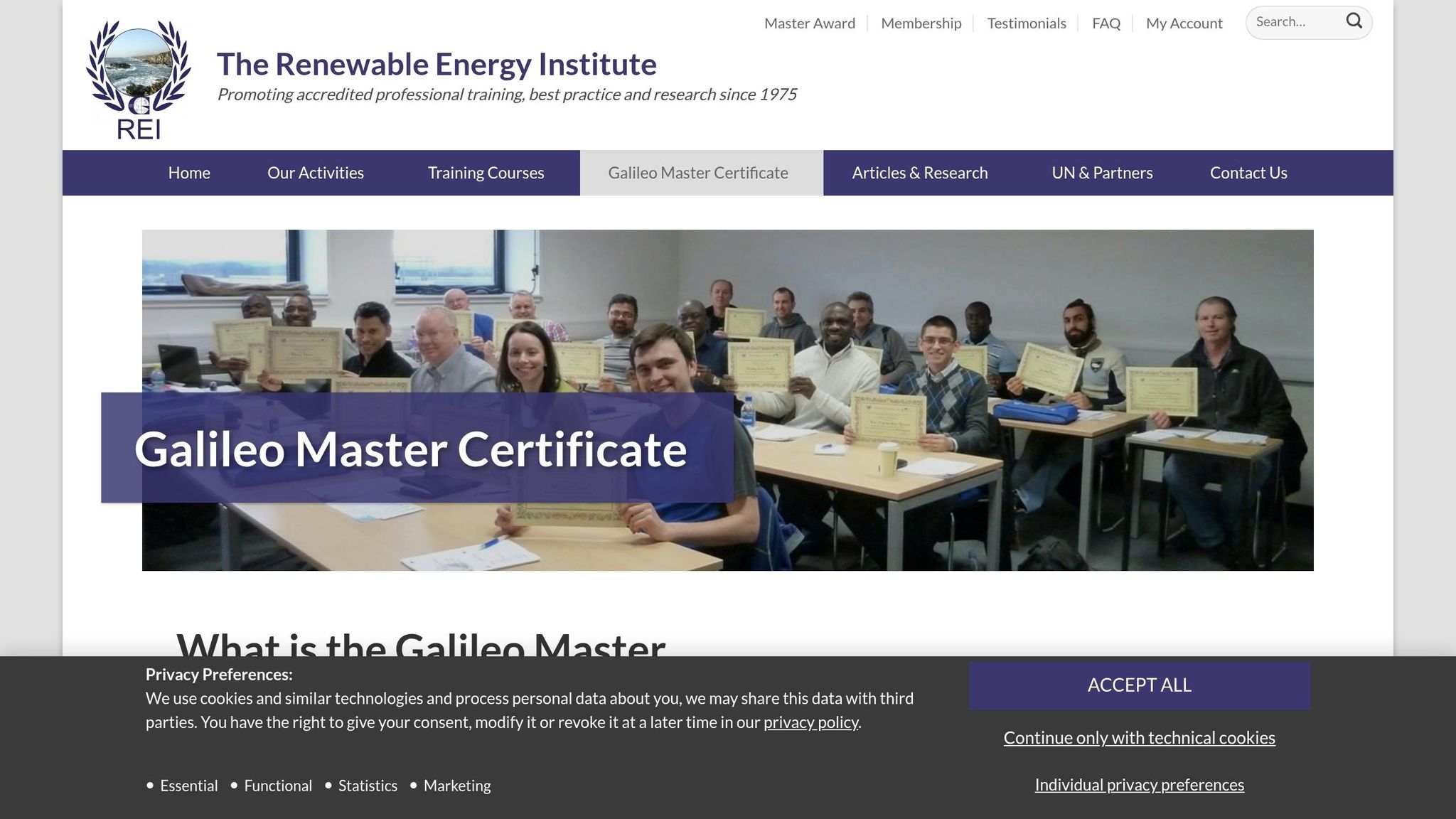
The Galileo Master Certificate (GMC) offers a modular approach to training in solar, wind, and energy efficiency systems. This structure is ideal for workers transitioning from traditional energy sectors or those seeking to specialize in specific renewable technologies before broadening their expertise. Accredited by the Interstate Renewable Energy Council (IREC), the program has certified over 100 instructors and accredited more than 200 training programs as of July 2025. This accreditation ensures the training aligns with industry standards and employer expectations.
"Students, employers, funders, and other stakeholders look for the IREC mark to find high-quality, safe training that is aligned with industry needs." – IREC
Certification Comparison: Features and Requirements
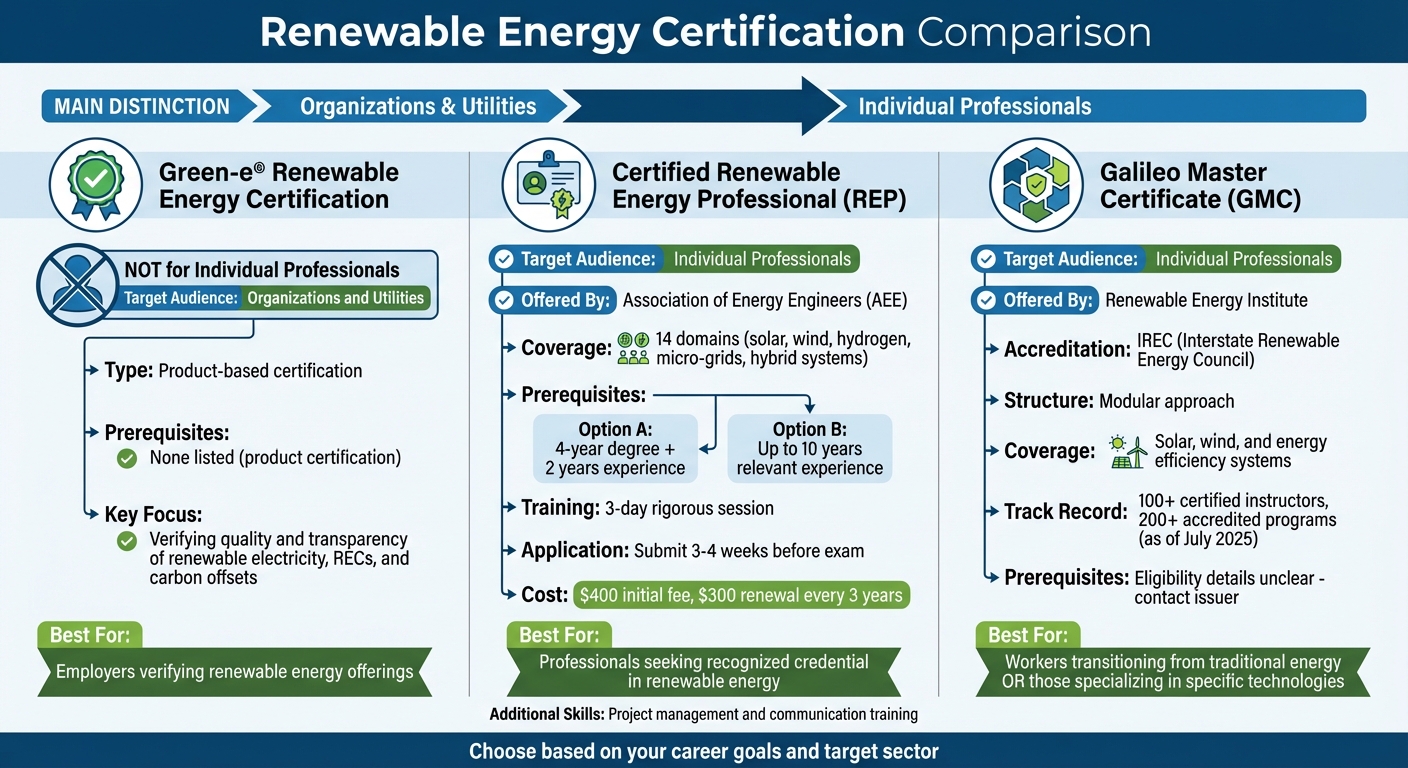
Renewable Energy Certification Comparison: Green-e, REP, and GMC Requirements
Choosing the right certification depends on your experience, career goals, and the specific renewable energy sector you aim to work in. Each certification program caters to different needs, so understanding their features and requirements is key to making an informed decision.
Green-e® Renewable Energy Certification is designed for organizations and utilities, not individuals. This certification ensures the transparency and quality of renewable electricity, renewable energy certificates (RECs), and carbon offsets. Employers and energy providers use it to demonstrate compliance and quality in their renewable energy offerings, making it a product-focused certification rather than a career credential.
For individual professionals, the Certified Renewable Energy Professional (REP) is a better fit. Candidates must submit their certification application 3–4 weeks before the exam and meet specific eligibility requirements.
Details about the Galileo Master Certificate (GMC) are less clear. To learn more about eligibility and the program structure, it’s best to contact the issuing organization directly.
Below is a summary of the key features and requirements for each certification:
Certification Comparison Table
| Certification | Target Audience | Prerequisites | Best For |
|---|---|---|---|
| Green-e® Renewable Energy | Organizations and utilities | Product-based certification; not for individuals | Employers verifying the quality and transparency of renewable energy offerings |
| Certified REP | Individual professionals | Submit application 3–4 weeks before the exam; meet eligibility criteria | Professionals seeking a recognized credential in renewable energy |
| Galileo Master Certificate (GMC) | Professionals exploring renewable energy careers | Eligibility details unclear; contact issuer | Individuals interested in a newer certification option |
Using ABLEMKR to Advance Your Renewable Energy Career
Once you’ve earned your certification, the next step is finding the right projects that align with your skills. ABLEMKR’s mobile-first platform makes this process easier by connecting certified professionals with in-demand renewable energy projects across the United States.
The platform uses automated job matching technology to pair your verified certifications – like NABCEP Energy Storage Installation Professional (ESIP), NABCEP PV Installation Professional (PVIP), or Certified Renewable Energy Professional (REP) – with specific project needs. This saves you time by ensuring you’re matched with roles that fit your expertise. It also tracks compliance requirements, so you meet all necessary safety standards before starting work. This streamlined approach helps renewable projects operate more efficiently.
ABLEMKR also provides flexible scheduling, allowing you to choose projects that fit your availability and career goals. This is especially useful if you’re juggling work with continuing education or pursuing additional certifications. You can manage your workload while staying open to last-minute opportunities in utilities, heavy infrastructure, or renewable energy installations.
The platform offers other benefits, too. Workers enjoy on-time payments and instant access to project details, including location and duration. Plus, ABLEMKR provides W2 employment with workers’ compensation coverage, eliminating the risks often associated with independent contracting in the energy sector. For employers, the platform delivers pre-vetted workers who are ready to mobilize for scheduled installations or urgent projects across key U.S. energy corridors. By combining certifications with precise job matching, ABLEMKR helps build a stronger career path in renewable energy.
Conclusion
New certifications are transforming the renewable energy workforce by creating consistent standards for technical expertise and safety. Credentials like NABCEP PVIP and ESIP validate a technician’s ability to handle every stage of a project – from design and installation to commissioning, operations, and maintenance. These programs tackle the issue of inconsistent training, ensuring that workers are ready to contribute immediately while boosting employer trust.
For those starting out in the field, certifications offer a clear advantage in securing jobs and advancing their careers. They demonstrate a commitment to quality and adherence to industry standards, which becomes increasingly important as renewable energy projects grow in scale, particularly in utilities and large infrastructure. The move toward competency-based evaluations and specialized certifications, such as those for battery energy storage systems, highlights the industry’s shifting technical needs. However, beyond earning certifications, connecting skills to job opportunities is key for long-term career success.
Taking this further, ABLEMKR bridges the gap by linking pre-vetted, certified workers to in-demand renewable energy projects. Its automated system matches certifications like NABCEP ESIP, PVIP, or REP with project needs across major U.S. energy hubs. This not only simplifies hiring for employers but also provides workers with access to well-paying roles, timely payments, and W2 employment benefits.
As renewable energy continues to grow, the combination of respected certifications and efficient workforce placement will be critical for project success. By investing in these credentials and utilizing platforms that align skills with opportunities, workers can establish thriving careers while contributing to the clean energy transition.
FAQs
Which certification should I start with for my renewable energy career?
For those new to renewable energy, the NABCEP PV Installation Professional certification is an excellent way to begin. This certification is widely recognized and focuses on solar PV system design, installation, and maintenance. It’s a solid step toward building trust and expertise in the field.
If you already have some experience and are interested in specializing, consider the NABCEP Energy Storage Installation Professional certification. This certification is perfect for diving into energy storage systems, a sector that’s rapidly gaining momentum within renewable energy.
Does the Green-e® certification help individual job seekers?
The Green-e® certification can give job seekers an edge in the renewable energy job market. It highlights their knowledge of renewable energy standards and consumer protection, signaling a strong dedication to the field. This can make them more appealing to potential employers looking for candidates with proven expertise.
How does ABLEMKR use my certifications to match me to jobs?
ABLEMKR helps connect you to jobs by checking your certifications, safety training, and credentials. It matches this information with job site requirements like location and availability, ensuring quick placement and compliance. This streamlined approach makes it easier to find opportunities that align with your skills and qualifications.


