
If power fails on an oil and gas site, production, safety, and startup plans can fall apart fast. In this field, electrical engineers handle design, field support, testing, troubleshooting, and plant reliability across upstream, midstream, and downstream assets.
Here’s the short version:
- I see three main work settings: design, field execution, and plant reliability
- I see different role types: design electrical, E&I, lead/principal/project, offshore, pipeline, refinery, and reliability engineers
- I see different phase shifts: FEED, detailed engineering, construction, commissioning, startup, and long-term plant support
- I see different reporting lines depending on phase, from project engineering teams to construction and maintenance groups
- I see license and training rules that change by task, such as PE licenses, journeyman licenses, NFPA 70E, and PHMSA OQ
- I also see why pay stays high: U.S. electrical engineers in oil and gas extraction average about $155,660 per year, while job growth is projected at 7% from 2024 to 2034
If you want the plain answer, it’s this: electrical engineers keep power systems safe, stable, and ready to run, whether they’re sizing equipment in an office, checking relay settings in the field, or finding the cause of motor and switchgear failures after startup.
Oil & Gas Career for Electrical Engineers
sbb-itb-aa28329
Quick Comparison
| Area | What I’d focus on |
|---|---|
| Upstream | Generators, drilling loads, VFDs, UPS, hazardous-area gear |
| Midstream | Substations, pump/compressor stations, SCADA-linked power systems, cathodic protection |
| Downstream | Heavy motor loads, switchgear, MCCs, arc-flash control, refinery tie-ins |
| Design phase | SLDs, load lists, studies, specs, layouts |
| Construction/commissioning | Walkdowns, cable checks, testing, energization, redlines |
| Operations/reliability | RCA, maintenance support, relay issues, turnaround planning |
That’s the full picture in simple terms: the role changes by asset, by phase, and by who owns the work on site.
Core Electrical Engineer Roles and Job Scopes
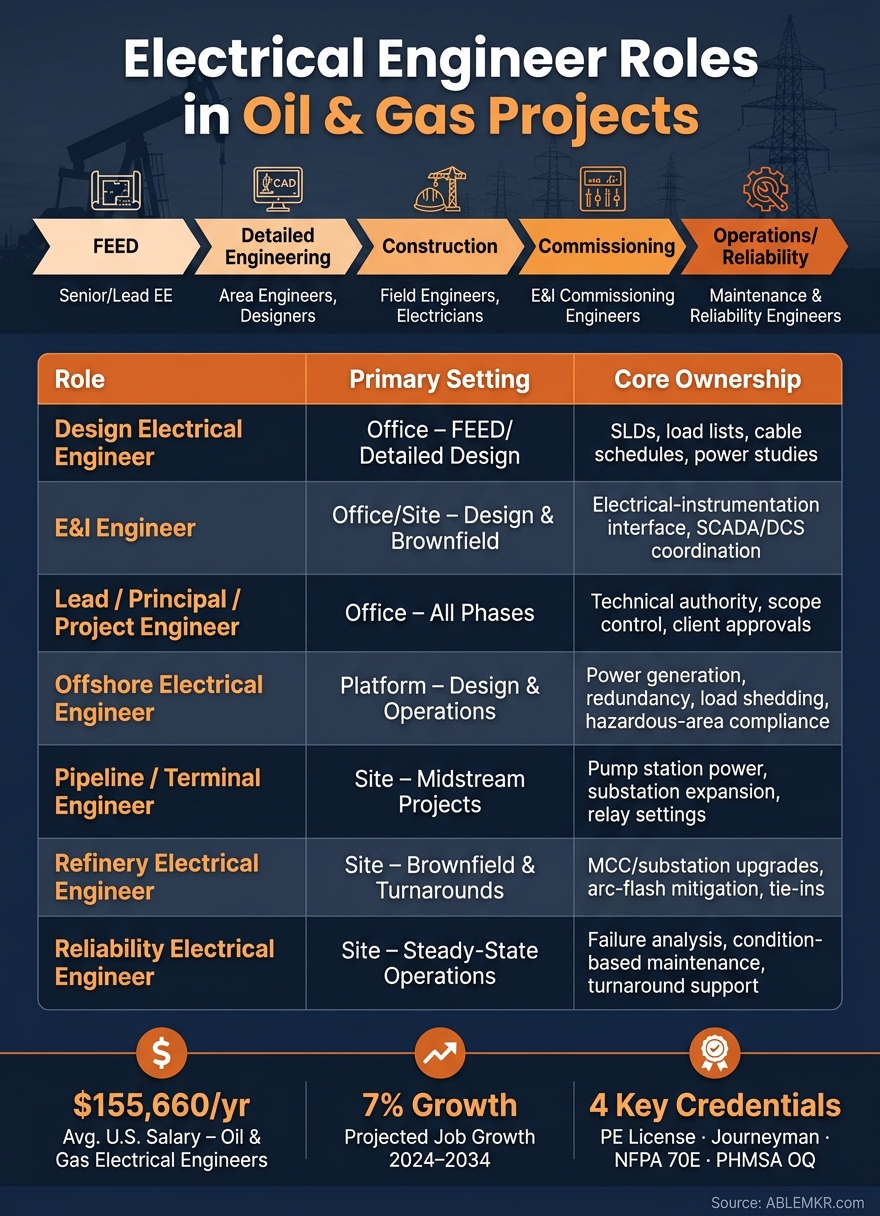
Electrical Engineer Roles in Oil & Gas: Role, Phase & Reporting Line at a Glance
Oil and gas projects split electrical work across design, construction, commissioning, and operations. That split matters. When each phase has clear ownership, teams avoid gaps, duplicate work, and late fixes. It also makes it clear who owns each deliverable as the project moves from one phase to the next.
Design Electrical Engineers and E&I Engineers
The design electrical engineer owns the electrical basis of design and the detailed electrical deliverables during FEED and detailed design. In plain terms, this role is responsible for core documents like single-line diagrams, load lists, cable schedules, MCC interfaces, equipment selection support, and power system studies for short-circuit, load flow, protection coordination, and arc flash. In detailed design, the scope usually grows to include grounding and lightning protection, cable tray and conduit routing, electrical room layouts, and lighting designs.
The E&I engineer sits where power and control meet. This role coordinates instrument power supplies, shutdown logic, interlock wiring, SCADA and DCS integration, and field device needs alongside the electrical scope. You’ll see E&I engineers a lot on brownfield projects, compressor stations, processing plants, and offshore facilities, where electrical, instrumentation, and control work are tightly connected. Some companies split electrical and instrumentation into separate jobs. Others roll them into one discipline with shared deliverables.
The line between the two is simple: design electrical engineers own the electrical system, while E&I engineers own the electrical-control interface. That separation keeps deliverables clean and helps teams staff the work the right way.
Lead, Principal, and Project Electrical Engineers
These roles carry technical authority, scope control, and project-facing duties. A lead electrical engineer coordinates the team’s output. A principal electrical engineer acts as the senior technical authority and steps in on tough design issues. A project electrical engineer works across technical execution, schedule, budget, and client communication through the life of the project.
All three roles report to the Project Engineering Manager or Project Manager. Their work is less about producing drawings by themselves and more about steering decisions. That usually means review comments, bid tab evaluations, vendor data approvals, and design change decisions. Titles can blur from company to company, so it’s smarter to define these roles by deliverables, decision rights, and interfaces instead of title alone.
Offshore, Pipeline, Refinery, and Reliability Roles
Some roles change shape based on the asset. Offshore electrical engineers focus on platform power generation and distribution, paralleling, load shedding, and MV/LV systems in tight, hazardous-area settings. Since offshore access is limited and failures can hit hard, this role leans more toward reliability than pure design, with a strong focus on operability and maintainability.
Pipeline and terminal electrical engineers handle pump station power, MV switchgear, VFDs for large motors, substation expansion, relay settings, and area classification surveys at midstream facilities. Refinery electrical engineers deal with substation and MCC upgrades, arc-flash mitigation programs, motor protection relay replacements, and unit tie-ins during turnarounds. Reliability electrical engineers usually sit in operations, where they investigate repeat failures, support turnarounds, and improve asset availability through condition-based maintenance for HV/LV switchgear, protection relays, and emergency generators.
| Role | Primary Setting | Core Ownership |
|---|---|---|
| Design Electrical Engineer | Office – FEED/Detailed Design | SLDs, load lists, cable schedules, power studies |
| E&I Engineer | Office/Site – Design & Brownfield | Electrical-instrumentation interface, SCADA/DCS coordination |
| Lead / Principal / Project Engineer | Office – All Phases | Technical authority, scope control, client approvals |
| Offshore Electrical Engineer | Platform – Design & Operations | Power generation, redundancy, load shedding, hazardous-area compliance |
| Pipeline / Terminal Engineer | Site – Midstream Projects | Pump station power, substation expansion, relay settings |
| Refinery Electrical Engineer | Site – Brownfield & Turnarounds | MCC/substation upgrades, arc-flash mitigation, tie-ins |
| Reliability Electrical Engineer | Site – Steady-State Operations | Failure analysis, condition-based maintenance, turnaround support |
These boundaries shape reporting lines and the staffing mix used in each phase of a project.
Site Duties, Safety, and Daily Field Responsibilities
During construction, electrical engineers move from design review into field execution. At that point, they become the technical authority on site. The work gets very hands-on, and day-to-day calls in the field can affect safety, schedule, and final handover. They stay in close contact with electricians, instrument techs, contractors, and OEM representatives so installation and startup work keeps moving safely and on time.
Construction, Installation, and Commissioning Work
Field work usually begins with walkdowns. Engineers check equipment placement, clearances, classified-area plans, cable routing, enclosure ratings, grounding, bonding, and terminations against the drawings.
Before energization, they oversee pre-commissioning tests such as insulation resistance (megger) tests, continuity checks, transformer ratio and vector group verification, current and voltage transformer polarity checks, and protection relay setting confirmation. They also prepare energization philosophies, define system boundaries, verify interlocks, and support loop checks and functional tests for motors, MCCs, switchgear, and drives.
The pre-energization check is where safety discipline has to be rock solid. Engineers confirm that lockout/tagout is applied the right way, arc-flash boundaries are in place, and NFPA 70 and NFPA 70E rules for PPE and approach distances are being followed. After that, they manage punch-list closeout, update redlines, keep test records current, and make sure as-built documents match actual field conditions before handover to operations.
After energization, the job changes. The goal is no longer just proving the system works. It becomes keeping the system stable.
Operations, Troubleshooting, and Turnaround Support
In steady-state operations, electrical engineers monitor SCADA or DCS data, review alarm and trip reports, and approve electrical maintenance work on MCCs, transformers, and switchgear. They work with operations, maintenance, and QA/QC to plan electrical work in a way that limits production impact and stays within code and site procedures. They also take part in management of change (MOC) when electrical modifications are proposed.
Some of the most common issues they investigate include motor trips caused by insulation breakdown or supply problems, relay misoperations tied to wrong settings or worn hardware, and nuisance trips driven by harmonics or protection coordination gaps.
A good root cause analysis (RCA) process doesn’t start with guesswork. It pulls together relay event records, DCS trends, breaker operation counters, and operator interviews before anyone touches the equipment. That helps engineers find both the technical fault and the process failure behind it.
For turnarounds, electrical engineers define the outage scope, plan relay injection tests, coordinate load shedding and re-energization, and fix problems like damaged bus bars or failed insulation before restart. When a plant is racing toward startup, those details matter a lot.
Field authority also comes with strict safety expectations.
Safety Standards and Role Comparison
In the U.S., electrical work in oil and gas is governed by OSHA 29 CFR 1910 Subpart S and 1926 Subpart K, lockout/tagout under 29 CFR 1910.147, NFPA 70 (National Electrical Code), and NFPA 70E. NFPA 70E lays out practices meant to reduce shock, electrocution, arc flash, and arc blast risk.
On site, that means:
- Job safety analyses before electrical work begins
- Strict LOTO verification before exposed energized parts are approached
- Maintaining limited and restricted approach boundaries
- Using arc-rated PPE, plus tools and test instruments rated for the job based on incident energy calculations
Hazardous-location rules also shape equipment selection. That includes explosion-proof, purged, or intrinsically safe equipment used to control ignition sources in classified zones. Electrical engineers are expected to set the tone on safety, review and approve safe work procedures, and join incident investigations when standards are missed.
| Role / Phase | Work Environment | Typical Daily Activities | Key Safety Standards | Main Stakeholders |
|---|---|---|---|---|
| Construction & Commissioning EE | Field, construction areas, substations | Walkdowns, cable checks, inspections, energization | OSHA 1926, NFPA 70, LOTO, arc-flash controls | Construction mgr, craft leads, QA/QC |
| Operations & Troubleshooting EE | Control rooms, substations, plant areas | Alarm review, fault investigation, MOC, maintenance support | OSHA 1910, NFPA 70E, arc-flash, LOTO | Ops mgr, maintenance, HSE, QA/QC |
| Reliability & Turnaround EE | Plant-wide during outage, planning offices | Outage scope, test plans, RCA, improvements | OSHA 1910/1926, NFPA 70/70E, simultaneous operations procedures | Reliability team, turnaround planners, senior mgmt |
Reporting Lines, Staffing Plans, and Hiring by Project Phase
After role scope, the next piece is the chain of command: who owns design, who runs field execution, and who manages staffing as the project moves from one phase to the next.
Typical Reporting Structure in Projects and Operations
Electrical reporting lines change with the phase of work. On a large EPC project, the usual structure runs from Project Director → Project Manager → Project Engineering Manager (PEM) → Lead Electrical Engineer → discipline electrical engineers and designers. The Lead Electrical Engineer owns the electrical deliverables and works across disciplines to keep things lined up.
On the owner/operator side, an Engineering Manager or Technical Authority usually works with the EPC lead through a Project Manager or Owner’s Engineer. In plain terms, the owner holds technical authority and signs off on changes. The EPC team runs the day-to-day design work.
When work moves into the field, that structure shifts to the site. A common construction setup looks like Construction Manager → Electrical Superintendent → Electrical Supervisor/Foreman → journeymen electricians, apprentices, and helpers. An Electrical Field Engineer often supports the crew by handling RFIs, redlines, and technical clarifications.
In steady-state operations, electrical engineers usually report to a Maintenance Manager, Reliability Manager, or Asset Manager. They also work closely with I&E technicians, planners, and operations supervisors. So the reporting line doesn’t stay fixed. It changes as the work moves from design into construction and then into plant support.
How Staffing Changes from FEED to Startup to Reliability
Staffing changes a lot across the project life cycle. FEED teams are usually small and led by senior people. Detailed engineering adds more engineers and designers. Construction shifts the center of gravity to field engineers and craft labor. Commissioning pulls E&I teams back in for loop checks and turnover. Once the asset is running, the team gets narrower and focuses on troubleshooting, maintenance, and reliability.
There are also differences by sector. Upstream projects are often leaner and more integrated. Midstream work may be spread across many sites. Downstream facilities tend to have more management layers.
| Project Phase | Active Electrical Roles | Main Deliverables | Typical Reporting Line |
|---|---|---|---|
| FEED | Lead Electrical Engineer, Senior Engineers | Single-line diagrams, load lists, equipment specs | Project Engineering Manager |
| Detailed Engineering | Lead EE, Area Engineers, Designers | Cable schedules, protection studies, IFC packages | Lead EE → Project Engineering Manager |
| Construction | Field Engineers, Superintendents, Electricians | Installation sign-offs, redlines, test records | Construction Manager |
| Commissioning | E&I Commissioning Engineers, System Leads | Loop checks, energization packages, turnover dossiers | Commissioning Manager |
| Operations/Reliability | Maintenance Engineers, Reliability Engineers | Root-cause analyses, preventive maintenance plans, arc-flash updates, capital scopes | Maintenance/Reliability Manager |
Using ABLEMKR to Source and Deploy Field Labor

Once the staffing map is clear, the next job is filling those roles fast. On fast-moving projects, labor deployment often becomes the bottleneck.
U.S. energy projects still have a hard time filling qualified electrical and I&E roles. ABLEMKR matches pre-vetted electricians, I&E technicians, and supervisors to jobs based on certifications, safety training, availability, and location across major U.S. energy corridors.
For employers, that means compliance tracking, payroll workflow support, and worker status visibility. For workers, it means access to well-paid jobs and tracked payroll.
Licenses, Certifications, and Key Takeaways
U.S. Licenses and Certifications That Matter
Once you know the role and the project phase, credentials decide who can sign, supervise, and do the work. In practice, they split into two lanes: engineering authority and craft work.
If an engineer is signing or sealing electrical drawings or studies, they need a state PE license. On EPC projects, owners often want a PE in Lead and Principal roles. That said, reliability engineering inside one operator’s own assets may not call for it.
For field work, state and local journeyman electrician licenses set the rules. Some jurisdictions also add industrial or maintenance classifications. In refineries and terminals, contractors often want a current journeyman license for construction, commissioning, and turnaround work.
| Credential | Who Needs It | Notes |
|---|---|---|
| OSHA 10-Hour / 30-Hour | Field staff, construction crews, site engineers | Required entry credential for energy and construction sites |
| NFPA 70E | Anyone working on or near energized equipment | Electrical safety training; retraining at intervals not exceeding 3 years |
| Hazardous-area qualification (NEC Class/Division, Zone concepts, API/IEC guidance) | Offshore, refinery, gas plant, and classified-area personnel | Required for work in classified zones |
| PHMSA Operator Qualification (OQ) | Pipeline and midstream I&E technicians performing covered tasks | Task-specific qualification and requalification under site OQ programs |
Key Takeaways for Project Managers and Workers
The rule is pretty simple: match the credential to the phase and the task. A PE covers design sign-off. Journeyman licenses cover field work. OQ covers pipeline tasks.
For project managers, it helps to build credential requirements into job profiles from day one. Verify PE status for any engineer who will sign deliverables. Make sure state journeyman licenses match the project jurisdiction. Check that NFPA 70E training is current, since the standard requires retraining at intervals not exceeding 3 years. And for pipeline work, confirm OQ task codes match the covered tasks at that site before the crew shows up.
For workers, staying current on the credentials that control site access is one of the clearest ways to get more project options. NFPA 70E, hazardous-area qualification, and an active journeyman license can help open doors across upstream, midstream, and downstream work.
For operators, credential tracking is one of the best ways to avoid mobilization delays. ABLEMKR builds credential tracking into worker profiles, so certifications, license numbers, and expiration dates are visible before dispatch.
FAQs
Which electrical engineer role fits each project phase?
Electrical work changes as a project moves from planning to day-to-day operation.
- Engineering and design: electrical engineers and grid interconnection specialists
- Construction: licensed journeyman and apprentice electricians
- Commissioning and maintenance: I&E technicians and SCADA specialists
Together, these roles handle the full arc of the job: design, installation, system calibration, troubleshooting, and long-term system performance.
Do electrical engineers in oil and gas need a PE license?
It depends on the project scope and the role’s seniority. A PE license is often required for senior roles or work that carries legal responsibility, such as project approvals, regulatory compliance, or oversight tied to public safety.
In those cases, a PE license shows technical skill and the legal authority to sign off on engineering designs. The best move is to check the job requirements for the specific project.
How do electrical duties differ in upstream, midstream, and downstream?
Electrical work changes a lot depending on where you are in the oil and gas chain.
In upstream, technicians keep an eye on wellhead pressure and pipeline flow. They also troubleshoot control systems, often in remote field locations or offshore environments where the job can get tough fast.
In midstream, engineers spend more time on pipeline integrity, leak detection, and regulatory compliance. The focus here is keeping product moving safely while meeting strict rules.
In downstream, refinery jobs revolve around process safety, instrument calibration, and control system maintenance. These roles are often tied closely to day-to-day plant uptime and safe operations.
No matter the sector, workers need the right safety credentials and site-specific authorizations before they can get on the job.


