
Worker status is judged by facts, not labels. Under the U.S. Department of Labor’s rule in effect since March 11, 2024, I look at six factors together to decide whether someone is an employee or an independent contractor under the FLSA.
Here’s the short version:
- No single factor decides it
- The main question is whether the worker depends on the company for income
- The six factors focus on:
- profit or loss
- investment
- permanence
- control
- integral work
- skill and initiative
- In construction and energy, a mistake can mean:
- minimum wage and overtime claims
- 2 to 3 years of back pay
- double damages in some cases
- payroll tax exposure
- workers’ compensation and unemployment issues
If I had to boil the whole test down even more, I’d say this: a skilled worker is not automatically a contractor, and a signed contractor agreement does not settle anything. What matters is how the job works day to day.
A few facts stand out:
- Workers in one city were estimated to lose about $6,000 per year in missed overtime
- One state enforcement action reached $6.3 million
- In long-shift fields like construction, utilities, oil and gas, and mining, overtime risk can grow fast
My takeaway: if the company sets the schedule, directs the work, supplies the main gear, and keeps the worker from project to project, the facts often point to employee status. If the worker bids jobs, carries business risk, brings major equipment, works for more than one client, and runs the job like a separate business, that points more toward independent contractor status.
| Factor | More like employee | More like contractor |
|---|---|---|
| Profit or loss | Paid by the hour or shift | Can make or lose money through pricing, staffing, and cost control |
| Investment | Uses company gear | Puts money into trucks, rigs, equipment, insurance, and business capacity |
| Permanence | Open-ended relationship | Set project with a clear end |
| Control | Company sets time, tasks, and methods | Worker controls how the job gets done |
| Integral work | Work is central to the business | Work is outside the main line of business |
| Skill and initiative | Uses skill under company direction | Uses skill to run and market a separate business |
So before I classify anyone, I’d document the scope, pay setup, equipment, supervision, project length, and whether the work sits at the center of the business. That gives me a cleaner record if pay, tax, or labor questions come up later.
Webinar preview: Differentiating Between Employees and Independent Contractors
sbb-itb-aa28329
The Six Economic Realities Test Factors Explained
Taken together, these factors get at three practical questions: Who takes the risk? Who controls the work? And who is operating like a business?
Profit or Loss, Investments, and Permanence
These factors focus on who carries the business risk.
Profit or loss looks at whether a worker can change the money they make through business decisions, not just by putting in more hours. A concrete finisher earning $28/hour doesn’t control pricing, hiring, or profit margins. A subcontractor who bids lump-sum work, brings tools and a crew, and eats the cost of overruns does.
Investment works much the same way. Employees usually rely on tools, vehicles, and systems that the employer supplies. A genuine independent contractor puts money into assets that increase capacity or cut costs – excavators, service trucks, welding rigs, and commercial general liability insurance. The DOL is comparing business-level investments, not basic personal tools.
Permanence asks whether the work relationship has a clear endpoint. An open-ended arrangement leans toward employee status. A project-based contract with a defined end date leans toward contractor status. That same pattern shows up in the other factors below too.
Control and Whether the Work Is Central to the Business
Control goes beyond direct supervision. The DOL looks at who sets the schedule, who decides the pay rate, and whether the worker can take jobs from others. On a U.S. construction or energy job site, signs that point toward employee status include:
- Set schedules
- Assigned tasks
- Fixed pay
- GPS check-ins
- Limits on outside work
One point the 2024 DOL rule cleared up: safety and health requirements required by OSHA or other rules do not automatically count as employer control. If a general contractor requires hard hats and fall protection on-site, that may simply mean the company is following the law – not directing every worker at an employment level.
Integral work leans toward employee status when the labor is at the heart of what the company sells. Ironworkers building a bridge for a general contractor, production crews running oil wells for an operator, and lineworkers maintaining a utility’s transmission system are all doing the main work of those businesses. A third-party environmental auditor, by contrast, is farther from the core operation.
Skill and Business Initiative
Specialized skill is common in construction, utilities, oil and gas, and mining. But skill by itself doesn’t settle contractor status.
The key issue is whether the worker uses that skill as part of an independent business. A certified welder working fixed hours for one contractor is an employee. That same welder starts to look like an independent contractor when they bid jobs, market services, carry insurance, and hire helpers.
The signs of independent business activity are concrete: marketing services under a business name, negotiating contract fees, buying commercial insurance, managing helpers or subcontractors, and choosing which projects to take or turn down. A controls technician who works only for one operator, on a fixed schedule, using company software and tools, does not meet that standard – even if the role is highly specialized.
How to Apply the Test on Job Sites
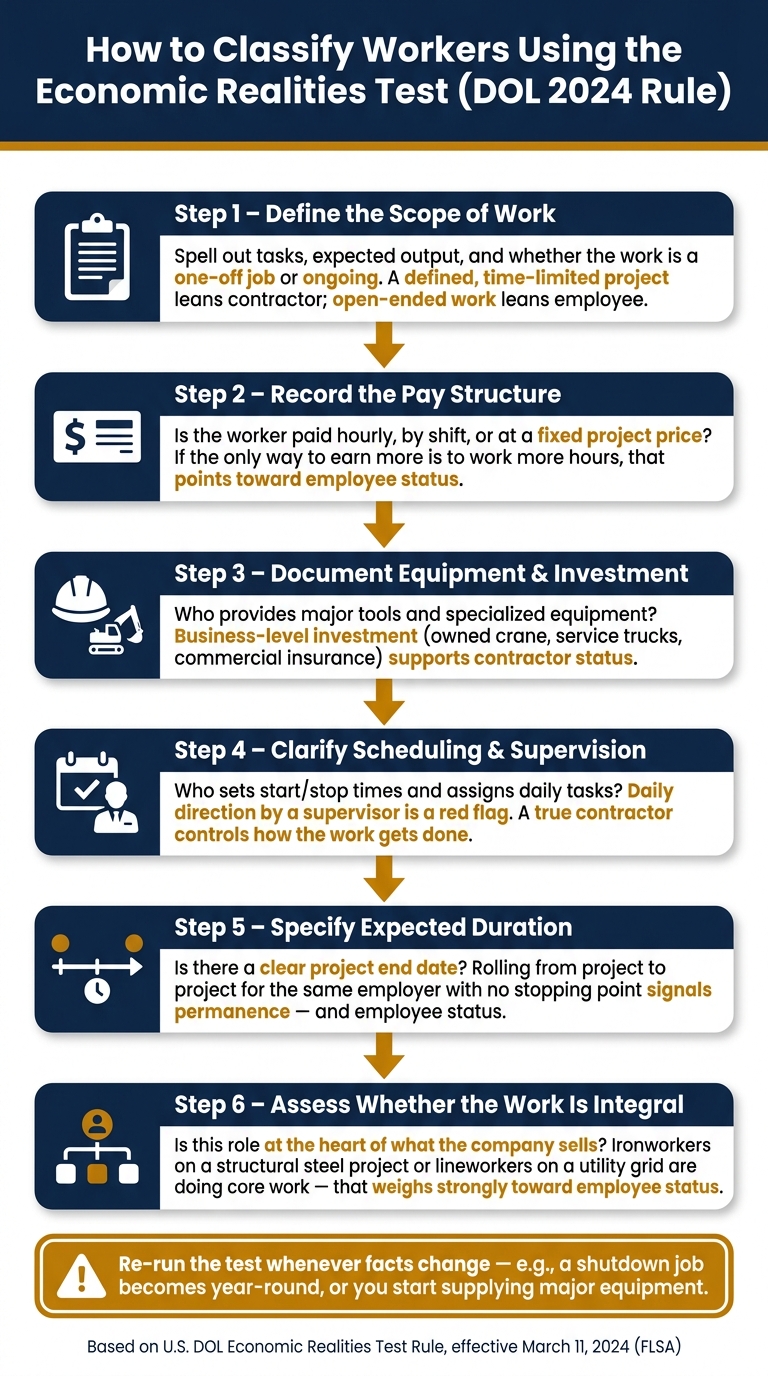
Economic Realities Test: 6-Step Worker Classification Process
Use the Economic Realities Test based on what actually happens on the job site, not just what the contract says. The six factors are meant to check the real working relationship on site, not the paperwork.
A Step-by-Step Process for Classifying Workers
Before a worker ever shows up on site, write down the facts that drive the classification call. Go through these six areas in order and keep the details in a written classification file.
- Define the scope of work
Spell out the tasks, the expected output, and whether the work is a one-off job or something that may continue into another project. A pipeline weld repair during a scheduled outage is not the same as integrity maintenance that keeps going with no clear end.
- Record the pay structure
Note whether the worker is paid by the hour, by shift, per day, or at a fixed project price. The main issue is whether they can increase earnings through business choices, like pricing the work, setting crew size, or controlling costs, or whether the only way to earn more is to work more hours on your jobs. That second setup points toward employee status.
- Document equipment and investment
Record who provides major tools and specialized equipment. The test looks for business-side investment that supports an independent operation, such as an owned excavator, a fleet of service trucks, or commercial insurance.
- Clarify scheduling and supervision
Pin down who sets start and stop times, who decides task order, and who deals with performance problems. If your supervisor is handing daily assignments to a supposed contractor the same way they direct employees, that’s a red flag. A real contractor setup is about the result, not day-to-day methods.
- Specify the expected duration
Write down the project end date and whether the worker is likely to move straight into another assignment with your company. If someone rolls from project to project for the same employer, especially with no clear stopping point, the relationship starts to look permanent. That leans toward employee status.
- Assess whether the work is integral
Ask whether the role sits at the center of the business. Ironworkers on a structural steel project and lineworkers maintaining a utility grid are doing work that is core to the operation. That weighs strongly toward employee status.
Run the test again when the facts change. For example, that could happen when a shutdown job turns into year-round work or when you begin supplying major equipment.
Employee Status vs. Independent Contractor Status: Comparison Table
Use this table to compare the facts for each role. In plain English, it helps you match the role to what is happening on site.
| Factor | Signals Employee Status | Signals Independent Contractor Status | Construction/Energy Example |
|---|---|---|---|
| Profit or Loss | Paid hourly or by shift; earns more only by working more hours | Bids lump-sum work; absorbs cost overruns; controls pricing and crew size | A refinery turnaround rigger paid hourly vs. a rigging firm that bids the scope and manages its own crew |
| Investment | Uses company-owned tools, vehicles, and equipment | Owns specialized equipment (e.g., crane, welding rig); carries commercial insurance; invests in business capacity | A company-supplied crane operator vs. a contractor who owns and mobilizes their own crane |
| Permanence | Open-ended relationship; rolls from project to project for the same employer | Defined project scope with a clear end date; works for multiple clients | A heavy equipment operator on back-to-back jobs for one civil contractor vs. a blast engineer hired for a single mine development project |
| Control | Follows daily instructions on methods, schedule, and task sequence | Controls how and when work is performed; can hire helpers; routes performance issues through their own management | A welder assigned to specific crews by a foreman vs. a welding subcontractor who manages their own team and schedule |
| Integral Work | Performs core production or service tasks central to the employer’s business | Provides specialized, occasional, non-core services | Lineworkers maintaining a utility’s transmission system vs. a drone inspection vendor hired for a one-time gas plant survey |
| Skill and Initiative | Uses specialized skills under the employer’s direction; works for one company | Markets services independently; negotiates fees; chooses which projects to take; operates under a business name | A skilled technician working exclusively for one operator on a fixed schedule vs. a pipeline integrity consultant who bids work across multiple operators |
If most of the facts for a role land in the "Signals Employee Status" column, the working arrangement needs to match that classification, no matter what the contract says. If you want a contractor setup, the conditions on site need to line up that way before the job begins.
Compliance Risks and Workforce Systems That Support Proper Classification
Once the factors are clear, the next risk is simple: not documenting them well.
What Misclassification Can Cost Employers and Workers
Misclassification can get expensive fast.
Under the FLSA, employers found liable may owe back wages for up to two or three years, depending on whether the violation is willful, plus liquidated damages that can double back pay.
If workers are mislabeled as independent contractors, employers can also end up owing unpaid FICA, FUTA, and state unemployment taxes, along with interest and penalties. In one California enforcement action, a single assessment hit $6.3 million for misclassification and wage theft.
For workers, the loss goes well beyond overtime. Misclassification can block access to workers’ compensation on high-risk job sites, unemployment insurance during project shutdowns, and, in prevailing-wage settings, the wage rates and fringe benefits they are legally owed. In Philadelphia, individual workers lost an estimated $6,000 per year from lost overtime alone.
And when an audit or lawsuit shows up in the middle of a project, the damage doesn’t stay on paper. Companies may have to reclassify workers and change staffing models on the fly. That can slow schedules, trigger liquidated damages under owner contracts, and pull HR and legal teams away from project work.
How ABLEMKR Helps Manage Classification and Compliance

This is where workforce systems come in. They turn day-to-day job-site activity into records a compliance team can actually use.
Misclassification often starts with gaps in the paper trail. Fragmented timekeeping, informal task assignments, and paper-based onboarding make it hard to piece together who directed the work, how long someone was on site, and whether pay was handled the right way.
ABLEMKR builds compliance documentation into the daily workflow. It keeps verified worker profiles tied to employment status, certifications, safety training, and job assignments. Every task assignment, approved timesheet, and crew roster entry creates a record that supports the control, permanence, and integral work factors regulators review under the Economic Realities Test.
Its payroll workflows also connect scheduling, timekeeping, and payroll so hours, overtime, and pay rates stay consistent. On top of that, compliance teams can spot risk patterns early, like a worker marked as a contractor but scheduled and supervised like a crew member, and then produce audit-ready reports before an inquiry begins.
For fast-moving construction and energy projects, that record trail matters just as much as the staffing itself. It gives employers a clear view of the workforce while keeping classification, timekeeping, and payroll in sync.
Conclusion: The Factors Work Together, Not in Isolation
The Economic Realities Test comes down to one practical question: is the worker economically dependent on the company, or are they in business for themselves? Job titles and contract labels don’t settle that question. The answer comes from the six factors discussed above.
No single factor controls the outcome. You have to weigh all six together to see whether the worker depends on the company for their livelihood. In construction and energy, that means looking at what happens on the jobsite, not just what the paperwork says.
These industries often involve project-based work, rotating crews, and changing locations. That can make classification harder, but it doesn’t change the legal standard. A worker who moves from project to project for the same operator over time may still be an employee if the relationship shows permanence and economic dependence. That’s why a steady review process matters.
Employers should document how each factor applies, review classifications when roles or contracts change, and make sure scheduling, timekeeping, and payroll match the actual working relationship. ABLEMKR helps support that work with embedded compliance tracking and integrated payroll workflows. Clear records make classification decisions easier to defend.
Handled well, this approach cuts risk and makes worker status easier to sort out.
FAQs
How do I know which factor matters most?
Under the U.S. Department of Labor’s current framework, no single factor decides a worker’s status.
You have to look at the totality of the circumstances and weigh all six economic reality factors together. In plain English, that means looking at the full picture, not just one piece of it.
So you can’t lean on a single factor and call it done. To classify a worker the right way, evaluate the entire relationship as a whole.
Can a long-term project contractor still be independent?
Yes. A long-term project contractor can still be an independent contractor.
The length of the relationship is only one part of the Economic Realities Test. If the work goes on for a long time, or doesn’t have a clear end date, that can point toward employee status.
But that fact alone doesn’t settle it.
What matters is the full relationship, including:
- how much control the business has over the person’s work
- whether the person has a chance to make a profit or take a loss
- whether the person invests in their own tools or equipment
So even if someone works with a company for a long stretch, they may still qualify as an independent contractor if the rest of the facts line up that way.
When should a worker’s classification be reviewed?
Worker classification needs regular review to help keep you in line with compliance rules. Why? Because agencies look at the actual working relationship – not just the job title or whatever the contract says on paper.
It also needs a second look any time the work setup changes. If supervision shifts, day-to-day work starts to look different, or the scope of the engagement changes, the worker may no longer fit the same classification. And when that happens, misclassification risk goes up.


