
If you need refinery and plant workers fast, local hiring is usually the first pick. But when the job needs rare skills or a turnaround adds 1,500 to 2,000 extra workers, you may need to hire beyond the local market.
I’d sum it up like this: local hiring is often lower-cost, simpler, and faster to put on-site, while global hiring helps fill hard-to-find technical and leadership roles when local supply falls short. In downstream oil and gas, that choice affects cost, safety checks, mobilization time, compliance work, and outage results.
Here’s the short version:
- Local hiring fits steady plant work, routine maintenance, and repeat staffing
- Global hiring fits niche roles, commissioning, shutdowns, and turnarounds
- A single turnaround can need 1,500–2,000 contractor workers
- More than 80% of downstream project and maintenance leaders said qualified labor was their top near-term issue
- One Gulf Coast estimate pointed to a shortage of about 37,400 craftsmen in one year
- In Texas, 74% of contractors said they struggled to fill hourly craft jobs
- The best approach is usually role by role, not one rule for every job
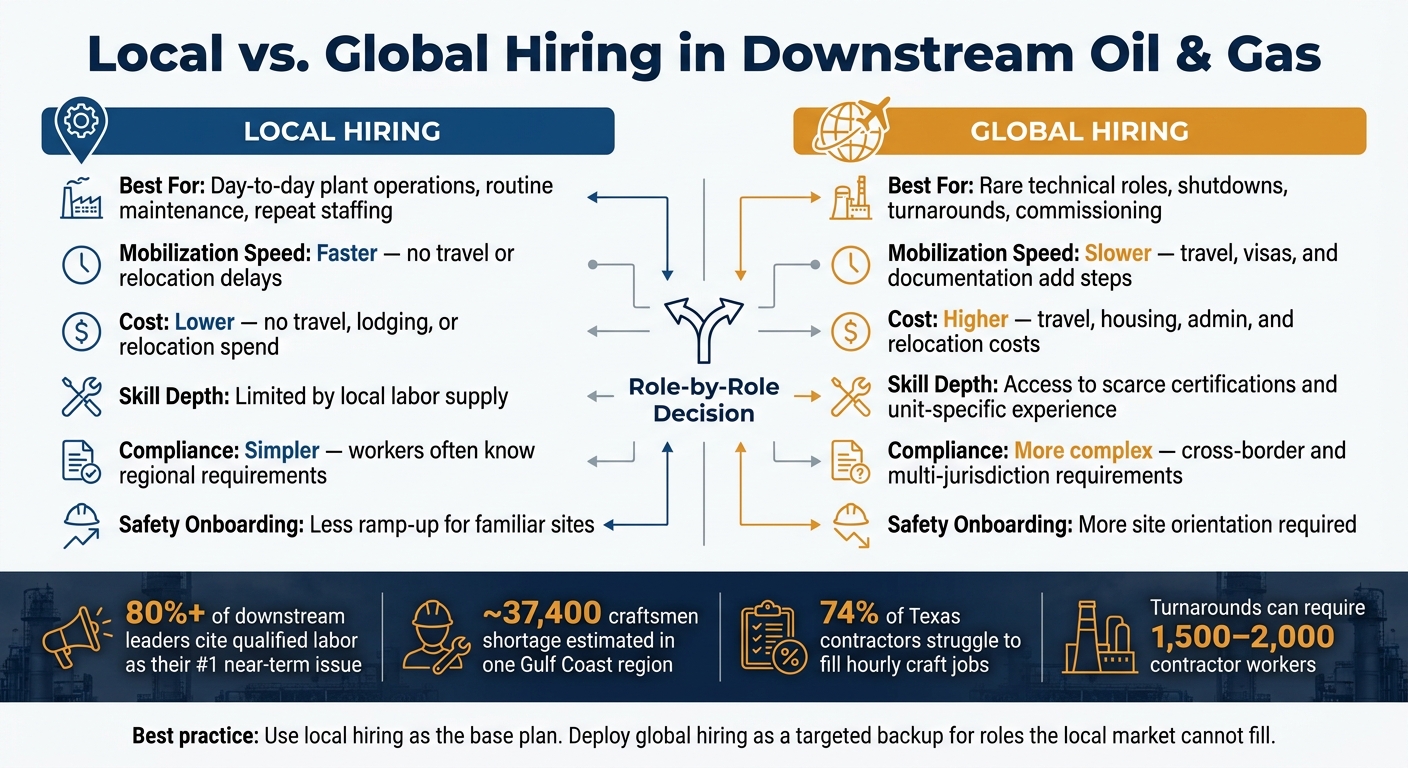
Local vs. Global Hiring in Downstream Oil & Gas: Key Differences at a Glance
Quick Comparison
| Area | Local hiring | Global hiring |
|---|---|---|
| Best fit | Day-to-day plant work and long-term maintenance | Rare technical roles, shutdowns, turnarounds, commissioning |
| Mobilization | Often faster if workers are nearby | Often slower due to travel and paperwork |
| Cost | Lower travel, lodging, and relocation spend | Higher travel, housing, and admin spend |
| Skill depth | Limited by local labor supply | Better for scarce skills and past unit-specific experience |
| Compliance work | Usually simpler | Usually more involved |
| Safety onboarding | Less ramp-up if workers know similar sites | More site orientation may be needed |
If I were making the call, I’d keep local hiring as the base plan and use global hiring as a targeted backup for roles the local market can’t cover.
2. Local hiring: strengths and limitations
Local hiring means bringing in workers from the site area or the nearby labor market. For downstream facilities, that’s usually the first place staffing starts – especially for steady operations, routine maintenance, craft labor, and roles with heavy compliance demands. In plain terms, it’s the default option for day-to-day operations.
What local labor does well for downstream sites
For steady operations and long-term maintenance, local hiring is often the right fit. People who live nearby can get on-site faster because you don’t have to deal with relocation timelines or travel planning. That alone can save a lot of hassle.
There’s another plus: local workers often already know the regional work culture, nearby contractor networks, and the site, state, and regional rules that shape the job. In compliance-sensitive settings like refineries and fuel terminals, that kind of familiarity matters. It cuts down on ramp-up time and helps teams get moving with fewer surprises.
Cost also works in local hiring’s favor. If you’re not paying for flights, hotel rooms, or relocation packages, your per-worker spend usually drops in a noticeable way. And for jobs that come back season after season – routine inspections, preventive maintenance, and equipment checks – local workers tend to build site knowledge over time. A crew that already knows the facility layout, safety protocols, and site-specific conditions will usually work faster and more safely than a team starting from zero.
Downstream facilities also tend to have a clear local presence. Hiring from the area supports regional employment and can help with permitting, community relations, and license-to-operate concerns. That said, this model starts to strain when demand for specialized labor grows past what the local market can supply.
Where local hiring falls short for specialized roles
The weak spots show up fast when labor demand jumps or a role calls for a niche certification. Local labor markets have limits. During major turnarounds, the nearby workforce often can’t provide enough qualified workers unless employers pay more in wages or lean harder on overtime.
Specialized roles make the problem tougher. If a job needs a certain welding certification, advanced instrumentation skills, or past experience with a specific process unit, the local market may offer only a small number of qualified people – or none at all. Being close to the site doesn’t fix a skill gap.
The tradeoff is simple: local hiring cuts friction, but it does not produce scarce skills.
| Local hiring factor | Main advantage | Main drawback |
|---|---|---|
| Time to mobilize | Workers can often start faster because travel and relocation are limited | Speed depends on whether qualified local workers are actually available |
| Cost | Lower spending on travel, lodging, and relocation | Scarce local skills can still drive up wages or overtime |
| Compliance | Workers may already know site, state, and regional requirements | Local familiarity does not remove the need for site-specific verification |
| Safety readiness | Local workers may have relevant plant or contractor experience nearby | Required certifications may still be limited for specialized work |
| Workforce continuity | Better fit for long-term maintenance and repeat staffing needs | Smaller labor pools can weaken coverage during peak demand |
| Community relations | Supports local employment and can strengthen community ties | Community preference alone may not solve technical labor shortages |
3. Global hiring: when it makes sense for downstream operations
Global hiring means looking beyond the local market for technical and leadership talent, including candidates from other countries. In downstream oil and gas, it’s usually not the first move. But when local talent dries up, it can widen the search in a big way.
That’s why global hiring tends to work best as a backup for specialized roles, not as the main staffing model.
What global hiring adds
During commissioning, shutdowns, and turnarounds, labor demand can spike fast. In those moments, global hiring gives operators access to engineering leaders and technical experts who’ve worked directly with specific plant technologies.
That matters when the gap isn’t just headcount. It’s experience, certifications, and hands-on knowledge that the local market may not have. For short-term work, this route can bring in the right people without taking on long-term payroll overhead.
Risks and added complexity with global hiring
The upside comes with a price. Global hiring often costs more and takes more coordination. Travel, housing, relocation, and admin costs can pile up fast.
And even when a hire is fully qualified, they still need site-specific safety training. They also need time to get used to the site’s workflow, team habits, and operating pace. That can slow mobilization and put more pressure on the safety review window when the schedule is fixed.
These tradeoffs hit hardest when the work is time-bound and there’s little room for delays.
| Global hiring factor | Main advantage | Main drawback |
|---|---|---|
| Talent access | Expands the pool of specialized technical and leadership talent | Can take more effort to source and mobilize |
| Specialized roles | Helps fill niche certification and experience gaps | Often requires additional site-specific orientation |
| Project flexibility | Useful for commissioning, shutdowns, and turnarounds | Short-term work can still be costly to mobilize |
| Cost | Can be justified when skill shortages are severe | Higher travel, housing, relocation, and administration costs |
| Compliance | Helps address labor shortages when managed well | Adds compliance and onboarding complexity |
| Integration | Brings outside experience to the site | May slow ramp-up if teams are unfamiliar with one another |
That tradeoff leads straight into the comparison with local hiring on speed, cost, compliance, and fit.
sbb-itb-aa28329
4. Local vs. global hiring: a direct comparison
Local hiring usually wins on speed and simplicity. Global hiring wins when you need a deeper bench for hard-to-fill roles.
In day-to-day terms, the gap comes down to speed, cost, compliance, and mobilization. If a crew needs to get on-site fast, those factors matter a lot.
| Comparison area | Local hiring | Global hiring |
|---|---|---|
| Talent availability | Strong for common local roles | Better access to scarce technical and engineering roles |
| Time to mobilize | Usually faster for nearby workers; slower when travel and documentation are required | Often slower because travel and documentation add steps |
| Cost structure | Lower travel and housing costs | Higher mobilization and admin costs |
| Compliance burden | Simpler in familiar labor markets | More complex across borders |
| Safety and onboarding | Faster for familiar workers; more orientation and site checks | May require more onboarding and readiness checks |
| Flexibility during outages or peak demand | Can be constrained if local supply is tight | Broader reach fills surge demand when local supply falls short |
The right choice also depends on the kind of work. Steady operations tend to lean local. Outage work often needs a larger talent pool.
Which model fits steady operations vs. shutdowns
For routine plant operations and long-term maintenance, local hiring is usually the better fit. Workers are close by, know similar sites, and are often easier to keep around. That means less overhead and fewer last-minute issues.
For shutdowns, turnarounds, and commissioning work, the math changes. These jobs are time-compressed and technically demanding. If the local market can’t cover the full scope – especially when you need niche certifications or experience with specific equipment – regional or global sourcing becomes a practical move, not just a nice option. The smart play is to build that pipeline before the outage window opens, not scramble after it starts.
How labor technology can support either approach
Whether a downstream operator stays local or looks farther out, the core problem is the same: getting the right worker into the right job, fast. And that only works if you can see certifications, safety training status, and availability in one place.
ABLEMKR matches pre-vetted workers by certification, safety training, availability, and geo-location, giving downstream teams faster visibility into who can mobilize – supporting either hiring model without adding administrative drag.
5. Choosing the right hiring approach: a practical framework
After you compare speed, cost, and compliance, the next step is simple: choose the sourcing model role by role. There’s no one-size-fits-all answer here. Pick the hiring approach based on the job itself, not on a blanket policy.
Key decision criteria for downstream hiring teams
Before you choose a sourcing path, run every open role through six filters: role criticality, skill scarcity, urgency, distance to site, budget, and regulatory constraints. In most cases, that order matters. Criticality and scarcity come first. If a role is safety-sensitive and calls for hard-to-find credentials, access to qualified workers matters more than location.
A simple scoring matrix helps make this repeatable instead of relying on gut feel every time. Rate each role from 1 to 5 across factors such as urgency, certification requirements, mobilization time, labor availability, total cost, safety exposure, and expected assignment length. Roles with high urgency and heavy certification needs usually lean toward the fastest source of verified labor. More stable maintenance roles often make more sense as local hires.
Compliance should sit at the front of the process, not at the end. Right-to-work documentation, site-specific safety training, and state licensing are nonnegotiable gates. If a candidate fails compliance, they do not move forward, no matter how strong the rest of the score looks.
Start workforce planning at least six months before a scheduled shutdown. That runway gives teams time for visa or permit processing when needed, helps avoid the premium costs that come with last-minute sourcing, and creates space to pre-vet workers and build a backup roster for no-shows or scope changes.
Once the role is scored, the staffing model usually becomes much easier to see.
Conclusion: most downstream operations need both approaches
In practice, local hiring works well for steady roles, while global hiring helps fill shortage gaps. Broader-regional or global hiring can close the talent gap when local markets can’t supply enough qualified workers, especially during turnarounds, commissioning events, or periods of deferred maintenance catch-up.
The strongest downstream staffing plans don’t choose one side and stick with it. They use a consistent, role-specific framework to decide which model fits each job. They also use labor tech like ABLEMKR to make that blended approach practical, with pre-vetted workers searchable by certification, location, and availability across both local and broader talent pools. Downstream staffing works best when strategy follows the role, not the other way around.
FAQs
How do I decide local vs. global for each role?
Balance project needs, logistics, and compliance. Use local hiring for standard roles when lower housing costs, faster availability, and local rule familiarity matter most. Use global or non-local hiring when you need specialized expertise to fill hard skill gaps.
For each role, look at niche skills, timeline, and any local hiring or prevailing wage rules. Tools like ABLEMKR can help you compare verified certifications, safety training, and real-time availability.
When should a turnaround hiring plan start?
A turnaround hiring plan should start in the early planning stages – not when the project begins.
Starting early gives companies time to document critical skills, line up replacements, map team skills, and work certification and safety training into the timeline and budget so crews are ready on day one.
What are the biggest risks in global hiring?
Global hiring in downstream oil and gas can create major logistical, financial, and regulatory challenges. Teams often face higher logistics costs, complicated visa and permit compliance, and the messy job of handling taxes and immigration rules across multiple jurisdictions.
Manual tracking makes things worse. A missed expiration date can trigger delays, penalties, or even shutdowns. And without standardized, pre-vetted verification, remote hires can bring added safety risks and gaps in critical on-site qualifications.


