
If you hire directional drilling staff the same way you hire general field workers, you will miss people, lose time, and add safety risk. This guide comes down to five steps: plan headcount by well schedule, define each role clearly, use the right sourcing channels, screen for field fit and certs, and get people cleared for site before day one.
Here’s the short version:
- Start with the well plan, not job ads. Map each well by basin, timeline, and rotation so you know how many people you need and when.
- Budget the full cost. Include pay, overtime, per diem, lodging, travel, cert renewals, and medical checks in U.S. dollars ($).
- Hire by role, not by generic title. A directional driller, MWD/LWD specialist, drilling engineer, and drilling supervisor each need different skills and field history.
- Check deployability early. If certs, medical status, or site access do not line up with the hitch, the worker is not ready to go.
- Screen for proof, not claims. Look for basin history, tool knowledge, well type fit, and track record such as lower NPT, better well placement, or less slide time.
- Use the same interview scorecard every time. That makes hiring decisions easier across rigs, basins, and managers.
- Treat onboarding like field prep. Payroll, I-9, W-4, travel, lodging, PPE, and site orientation should be done before the worker reaches location.
- Retention is often simple. Clear schedules, correct pay, written terms, and a visible path to the next role keep more people on crew.
A few numbers show why this matters:
- The U.S. drilling workforce hit 303,533 workers in 2023.
- That total fell 7.2% over five years.
- Oil and gas well drilling had about 43,696 direct jobs in 2024, down from 98,208 in 2014.
- IADC data shows the highest accident risk is among workers with less than six months on the job.
- Drilling contractors had a fatality rate of 44.6 per 100,000 workers.
Bottom line: if I want a hiring process that works in directional drilling, I need one system for planning, sourcing, screening, and mobilizing people – not a last-minute scramble each time a hitch opens.
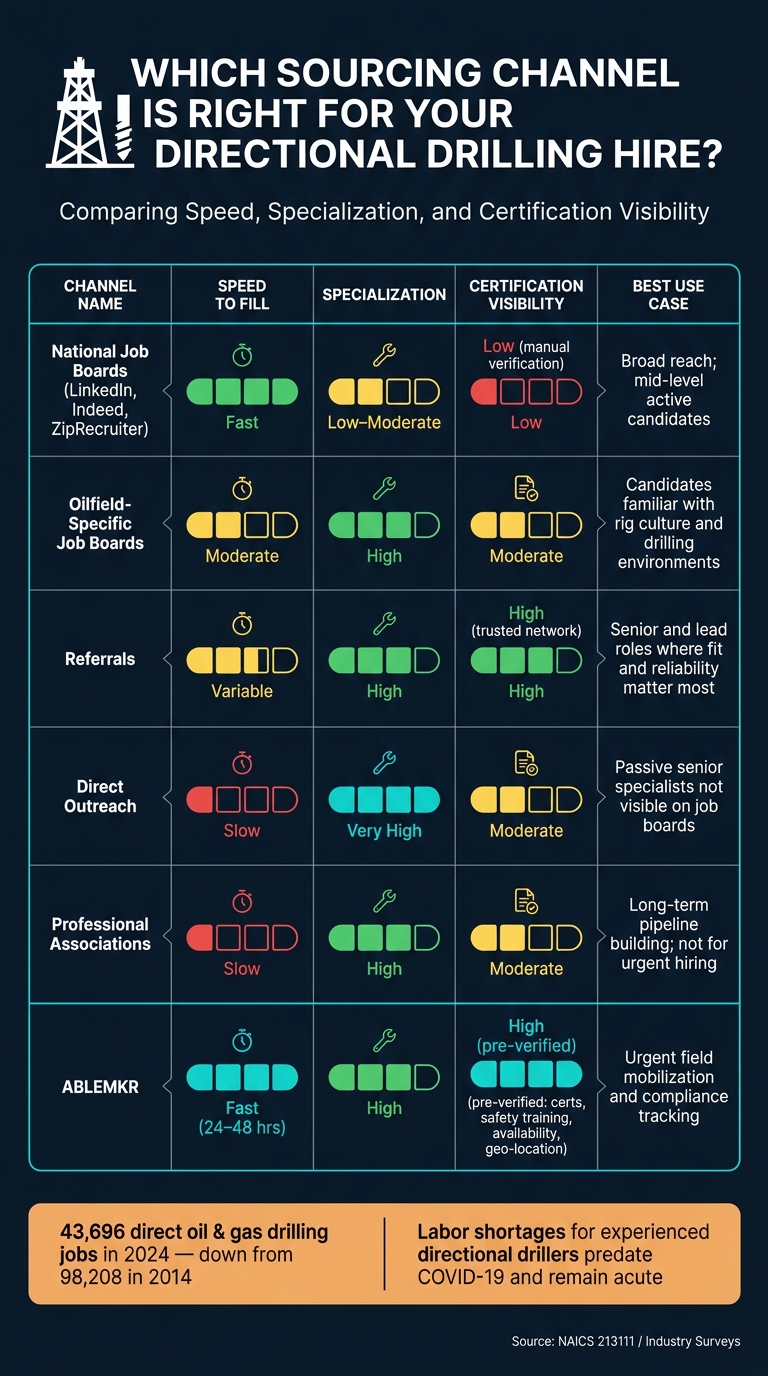
Directional Drilling Sourcing Channels: Speed, Specialization & Certification Visibility
1. Plan Directional Drilling Headcount, Rotations, and Budget
Start with the well schedule, not a stack of open roles. For each planned well, map the basin, the well type, and the spud-to-TD timeline in days. That gives you the clearest view of how long directional crews will stay tied to each rig and when rotations will hit. From there, you can set headcount based on field demand instead of guesswork.
A practical plan should track wells across places like the Permian, Bakken, and Eagle Ford, along with whether each one is a development well, exploration well, workover, or extended-reach horizontal. Once that demand is laid out, you can define the crew needed to cover it.
Assess Staffing Demand by Basin, Well Program, and Rotation Schedule
Map each well by basin, well type, TD date, and expected duration. Rotation length has a direct effect on headcount. A 14/14 schedule needs more backup for travel days, time off, and training. A 21/21 or 28/28 pattern cuts down on handovers, but it changes crew volume in other ways.
Build a staffing chart that shows mobilization and demobilization dates for each role. Add time for domestic travel, fit-for-duty checks, and site orientations. Then run a monthly look-ahead with drilling engineers, operations managers, and HR well ahead of each spud date. That number becomes the base for your labor budget.
Define Role Mix and Total Labor Cost in USD
A typical U.S. land rig directional crew usually includes:
- 1–2 directional drillers
- 1–2 MWD/LWD specialists
- shared drilling engineer support
- a company man or drilling supervisor overseeing services
For offshore work or more complex unconventional campaigns, you may also need a senior directional coordinator and remote operations center support.
Once the role mix is clear, build a fully loaded cost model. Directional driller pay and supervisor pay can vary a lot, so budget by role, not just by title.
| Cost Element | What to Include |
|---|---|
| Base pay | Hourly, salary, or day rate depending on role |
| Overtime | 1.5x base rate after 40 hours/week for W-2 employees |
| Per diem | Meals and incidental expenses by basin |
| Lodging | Hotel or camp rate per night, plus taxes |
| Travel | Airfare, mileage reimbursement, and ground transport |
| Certification renewals | Well control and H2S recertification, plus site orientation |
| Medical exams | Fit-for-duty assessments before mobilization |
Many operators use a hybrid staffing setup. They keep 1–2 senior basin roles on staff for program continuity, then scale contracted directional drillers and MWD/LWD field crews up or down based on well count. That approach can work well, but only if you compare the full cost of a staff hire, including wages, benefits, and idle time between rigs, against the contractor day rate on a per-well basis. Post roles only after those costs are nailed down and the workers can be sent to the field legally.
Check Compliance Requirements and Talent Availability Before Posting Jobs
Treat certifications as deployment gates, not paperwork. Common requirements include valid well control certification through IADC or IWCF, H2S awareness, BOP competency, medical clearance, and operator-specific site orientations such as ISNetworld-aligned safety programs. If the certs, medical status, or site access do not line up with campaign dates, the worker is not deployable.
Before posting jobs, check your workforce database against the compliance rules for each basin and operator. The goal is simple: find out how many people are actually available, with credentials that stay valid through the planned campaign. For new hires, spell out required certifications and expiration windows in the job description from the start.
ABLEMKR centralizes worker profiles, certification records, medical clearance, and location data so you can view deployable capacity before opening requisitions. Once deployable headcount is confirmed, you can define the roles and start sourcing.
sbb-itb-aa28329
2. Define Roles and Source Qualified Candidates
Once headcount and compliance are in place, the next step is simple: define each role well and source against that profile. A clear role profile does more than describe the job. It also helps you pick the sourcing channel most likely to fill that seat fast.
Write Clear Role Profiles for Directional Driller, MWD/LWD, Drilling Engineer, and Supervisor
One of the biggest hiring mistakes is using the same generic job description for four different positions. That usually falls flat. These roles may sit close to each other in the field, but their technical scope is not the same, and candidates know it right away.
A Directional Driller profile should spell out the well type, operating environment, tool stack, level of autonomy, and the outcomes that matter on the job. That means items like RSS, motor steering, trajectory control, placement accuracy, and NPT reduction.
For an MWD/LWD Specialist, get specific about required tool families, data quality, signal integrity, troubleshooting, and support for geosteering. If the role depends on clean data under pressure, say so.
A Drilling Engineer profile should cover planning scope, trajectory design, BHA, torque-and-drag, fluids, and cross-functional coordination. This is where vague wording can cause problems fast. If the role leans more toward planning than field execution, make that clear.
A Drilling Supervisor profile should define rig count, decision authority, HSE leadership, and rotation oversight. People stepping into supervisor roles want to know exactly how much ownership comes with the position.
Across all four roles, separate junior, mid-level, senior, and lead tiers by autonomy, well complexity, and mentoring responsibility rather than years of experience alone. That shift matters. As seniority goes up, the profile should move from day-to-day execution to independent judgment on more complex wells.
Source Candidates Through Active, Passive, and Referral Channels in U.S. Energy Markets
Directional drilling is a tight labor market, so sourcing channels matter more than most teams expect. The U.S. had about 43,696 direct jobs in oil and gas well drilling (NAICS 213111) in 2024, down from 98,208 in 2014. That long swing in the labor market helps explain why efficient sourcing is such a big deal. Industry surveys also show that labor shortages for experienced directional and HDD workers started before COVID-19 and are still sharp, with contractors reporting multi-year trouble finding qualified drillers despite training programs, bonuses, and technical school partnerships.
That means you can’t rely on one source and hope for the best.
Use:
- broad job boards for active applicants
- referrals when fit matters most
- direct outreach for senior passive talent
- basin-specific postings when local reach is the priority
It also helps to localize every posting to the basin where the work will happen. A candidate in the Permian does not look at a job the same way as someone weighing a move into the Bakken, Eagle Ford, or Marcellus. Rotation terms, housing conditions, and travel expectations often matter just as much as base pay. Put schedule, rotation, housing, per diem, and travel terms in the posting up front. It saves time for both sides.
Compare Sourcing Channels by Speed, Specialization, and Certification Visibility
No single sourcing channel works for every hire. Some are built for speed. Others are better for niche talent or certification checks. The table below makes the tradeoff easier to see.
| Sourcing Channel | Speed to Fill | Specialization | Certification Visibility | Best Use Case |
|---|---|---|---|---|
| National Job Boards (LinkedIn, Indeed, ZipRecruiter) | Fast | Low–Moderate | Low; manual verification required | Broad reach for active candidates; works best for mid-level roles |
| Oilfield-Specific Job Boards | Moderate | High | Moderate | Targeting candidates familiar with drilling environments and rig culture |
| Referrals | Variable | High | High; trusted network validation | Senior and lead roles where fit and reliability matter most |
| Direct Outreach | Slow | Very High | Moderate | Passive senior specialists not visible on job boards |
| Professional Associations | Slow | High | Moderate | Experienced specialists; better for long-term pipeline than urgent hiring |
| ABLEMKR | Fast (24–48 hours) | High | High; pre-verified profiles with certifications, safety training, availability, and geo-location | Urgent field mobilization, pre-vetted workers, and compliance tracking |
For urgent mobilization, ABLEMKR can filter candidates by certifications, safety training, availability, and geo-location.
Once the sourcing pool is built, move candidates into technical screening and compliance checks.
3. Screen for Technical Fit, Safety Readiness, and Field Reliability
Directional drilling screening needs to be tighter than general field hiring. The stakes are high: drilling contractors have a fatality rate of 44.6 per 100,000 workers. That’s why pre-mobilization screening isn’t optional. Screen each candidate against the basin, well type, and rotation already set in the role profile.
Pre-Screen Resumes for Well and Basin Experience and Measured Outcomes
A resume that says “experienced in drilling operations” doesn’t tell you much. You need specifics.
Look for details like rig type, basin or play name, measured depth (MD) and true vertical depth (TVD) ranges, lateral lengths, dogleg severity management, and the tools and software the candidate has used, such as MWD/LWD systems, rotary steerable tools, or directional software.
Strong candidates go beyond task lists. They show what happened because of their work. For example, they may explain how they reduced NPT, corrected trajectory deviation, or handled stuck-pipe and lost-circulation events. That matters because long-lateral shale work is a very different job from vertical conventional drilling.
Move only the candidates with matching well history and measured results to credential checks.
Verify Certifications, Run Structured Technical Interviews, and Score Candidates Consistently
Once a resume passes the first review, verify anything that could stop mobilization for the role or site. Well control certifications from IADC WellSharp or IWCF require a passing score set by the certifying body and must be renewed every two years. Also confirm site-access items like TWIC status or ISNetworld approval before mobilization.
For interviews, use the same core questions for every candidate. This keeps comparisons fair and gives you cleaner hiring data. Scenario-based prompts work best because they show how a person thinks when things start going sideways.
Ask how they would respond if:
- build rate drops without warning
- survey data shows the well moving off target
- torque and drag point to a stuck-pipe risk
Score each answer with a simple three-part rubric: technical skill, safety behavior, and team fit. A 1-to-5 scale with defined scoring anchors makes side-by-side comparison much easier.
Complete Background, Drug, Medical, and Reference Checks Before Mobilization
After the interview, clear the admin and medical gates that decide whether the candidate can actually mobilize. These steps are not box-checking. Directional drilling is physically demanding and safety-sensitive, and sending someone to a remote site before clearing these items adds risk you don’t need.
| Screening Step | Purpose | Common Documents Required | Typical Timeline |
|---|---|---|---|
| Employment Verification | Confirm job titles, dates, and wells or environments worked | Employment records; employer contact | Before mobilization |
| Supervisor Reference Check | Validate field reliability, shift discipline, and response under pressure | Reference contact list | Before mobilization |
| Background Check | Identify records that could affect site access or safety readiness | Candidate authorization | Before mobilization |
| Drug & Alcohol Testing | Meet company, DOT, and site-specific safety requirements | Lab results | Before mobilization |
| Medical / Fitness-for-Duty | Confirm candidate can perform field duties including long shifts, PPE use, and travel | Medical clearance | Before mobilization |
Reference calls deserve more than a quick once-over. Talk to supervisors directly and ask whether the candidate showed up ready for shift changes, flagged risks early, and stayed steady during an off-plan event or sudden schedule change. Those answers usually tell you more about field reliability than a polished resume ever will.
Clear all checks before travel, then move the hire into onboarding.
4. Onboard Fast and Retain Directional Drilling Specialists
After screening removes technical and compliance risk, onboarding has one job: clear the last obstacles before mobilization. Once screening is done and a start date is locked in, onboarding becomes the final gate. And every day between offer acceptance and the first hitch increases the chance of losing the hire.
Build a Field-Ready Onboarding Flow for U.S. Drilling Operations
Treat onboarding like an operations workflow, not an HR paperwork exercise. Payroll setup, W-4 and I-9 forms, travel, lodging, and equipment handoff should all be finished before the worker gets to the site gate. It also helps to assign one point of contact for the first hitch, so the new hire gets fast answers and steady feedback instead of mixed messages.
Site-specific safety orientation needs to happen before the worker enters any active area. That should cover H2S exposure zones, emergency assembly points, alarm systems, stop-work authority, PPE requirements, the well plan, and the safety and delivery standards tied to the job. General company onboarding and site-specific induction are not the same thing. Even an experienced directional driller may still need orientation on local weather risks, operator-specific permit-to-work rules, or pad traffic rules.
Once the worker is on pad, retention comes down to a few basic things: predictable scheduling, accurate pay, and fast issue resolution.
Use Scheduling, Pay Transparency, and Career Paths to Improve Retention
Publish rotation schedules early. Confirm pay and per diem in writing. Hold a 30-day check-in after the first hitch. Those steps sound simple, but they do a lot of heavy lifting in the field.
Track certification expiration dates ahead of time so workers aren’t caught off guard by a lapse that takes them off a job. Late rotation changes, late or incorrect pay, and no clear next step are the most common reasons experienced workers leave.
Spell out the path from MWD trainee to MWD specialist to directional driller to supervisor, along with the certifications and performance milestones tied to each role. When workers can see where the road leads, they’re more likely to stay on it.
Use deployment software to keep those basics visible across multiple rigs and basins.
Support Onboarding and Retention with Workforce Deployment Technology
Manual onboarding tracking falls apart fast when crews are moving across multiple basins or when parallel well programs are running at the same time. ABLEMKR puts credential status, onboarding completion, and payroll workflows in one place, which helps operators move fast when a hitch opens up or a last-minute replacement is needed.
GPS-enabled timecards feed straight into payroll, which cuts down on manual corrections and the pay disputes that push field workers out. Employers get real-time visibility into worker status and compliance. Workers get on-time pay and clear assignment details in one place.
That kind of visibility gives supervisors a better handle on compliance, payroll, and last-minute changes across active rigs.
Conclusion: The Core Steps of a Strong Directional Drilling Recruitment System
Taken together, these steps form a repeatable hiring system. Directional drilling recruitment only works when each part happens the same way each time: plan headcount, define roles, source certified talent, screen with a clear process, and treat onboarding like an operational handoff.
In many U.S. basins, labor shortages now limit execution more than rig availability. When hiring is slow or uneven, the risk moves straight into field operations.
In day-to-day terms, a structured system fills seats faster, cuts NPT, lowers early-assignment safety risk, and makes successful hiring repeatable across basins.
Key Takeaways for Employers
Plan headcount around the well program and rotation schedule. Budget the full labor cost in USD, including day rates, overtime, per diems, travel, and compliance costs. Verify certifications before offers so only compliant candidates move ahead. Use the same scorecards across every basin and hiring manager. When all of that data lives in one system, supervisors can mobilize replacements fast, spot compliance gaps early, and cut retention risk before it turns into a vacancy.
That kind of consistency turns directional drilling recruiting from a scramble into a dependable operating process.
FAQs
How many directional drilling hires do I need per well program?
It depends on the project phase, scope, and day-to-day needs. Rather than pick a fixed headcount, split the well program into work packages, such as drilling, completions, or maintenance, and assign roles based on what each part of the job calls for.
Use past project data and the timeline to estimate staffing. It also helps to add buffer personnel for remote sites or periods of peak demand. ABLEMKR can help operators post exact role needs and scale teams up or down as project demands shift.
Which certifications should I verify before making an offer?
Before making an offer, check every project-specific safety and technical credential first. It’s a simple step, but it helps you confirm compliance and make sure the person is ready to work on-site from day one.
Common requirements include OSHA 10 or 30, H2S Awareness, and Confined Space Entry. For offshore roles, look for BOSIET, HUET, and a TWIC card. For more specialized positions, confirm IWCF or IADC Well Control, the right API certifications, any required PE license, and current heavy equipment operator credentials.
How can I retain directional drilling specialists after onboarding?
Keep directional drilling specialists on your team with good pay, steady work, set schedules, and a safety-first culture people can count on. Clear rotation plans and early job updates make a big difference. They help workers handle family plans, appointments, and day-to-day life without last-minute stress, which can cut down on burnout.
Career growth matters too. Mentorship, upskilling, and cross-training give workers a path forward instead of making the job feel stuck in place. Digital tools like ABLEMKR can also ease admin headaches by helping with on-time pay and giving workers a clear view of job details, certifications, and compliance status.


