
If I had to sum it up in one line, it would be this: share repeatable factory tasks, but keep licensed work with the right trade.
That’s the main point. In offsite construction, crews can share skills like drawing review, tolerance checks, basic rigging awareness, digital reporting, and assembly sequencing. But they still can’t cross into regulated work like electrical terminations, gas connections, pressure tests, or structural welding unless they hold the right license or qualification.
Here’s the short version:
- Specialist-dominant teams keep each trade in its own lane.
- Multiskilled teams train workers across several non-licensed tasks.
- Hybrid teams mix both, so shared tasks move across the crew while licensed steps stay with specialists.
The tradeoff is simple:
- More specialization usually means more control, but less staffing flexibility.
- More cross-training can cut delays and handoffs, but it can also increase compliance risk if task limits are not clear.
- A hybrid setup often gives factories a middle path: shared prep and support work, with licensed trades handling code-bound steps.
A few numbers stand out:
- Factory work can be up to 3x as productive as onsite work.
- In one bathroom-pod study, cross-trained staffing cut makespan by up to 41% and labor cost by about 17%.
- A digital-twin reassignment system reported a 62% drop in idle time, a 40% drop in total production duration, and a 25% drop in total production cost.
- One industry study linked multiskilling to about 5% total labor cost savings and a 35% drop in required project workforce.
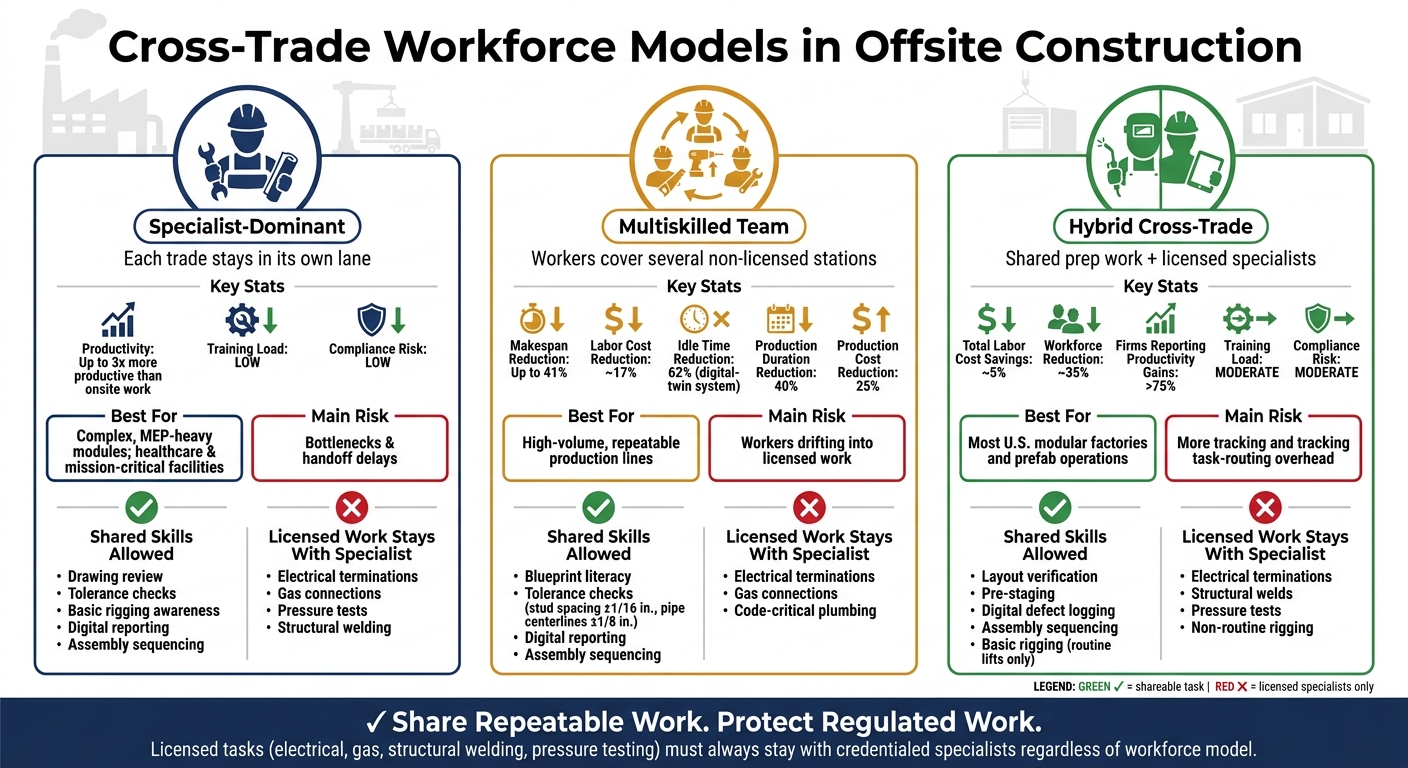
Cross-Trade Workforce Models in Offsite Construction: A Side-by-Side Comparison
Takt Planning for Trade Partners: How Lean Construction Works in the Field
sbb-itb-aa28329
Quick Comparison
| Model | Main Idea | Best Use | Main Risk | Training Load |
|---|---|---|---|---|
| Specialist-Dominant | Each trade handles its own work | Complex, MEP-heavy modules | Bottlenecks and handoff delays | Low |
| Multiskilled Team | Workers cover several non-licensed stations | High-volume, repeatable production | Workers drifting into licensed work | High |
| Hybrid Cross-Trade | Shared tasks across crew, licensed tasks stay with specialists | Most modular factory lines | More tracking and task-routing rules | Moderate |
So if you’re deciding how to staff an offsite factory, I’d look at one question first: Which tasks can be shared safely, and which ones must stay inside a licensed scope? That answer usually tells you which workforce model fits.
1. Specialist-Dominant Trade Model
In this model, each worker stays in one trade: carpenters, electricians, plumbers, HVAC technicians, and welders. The floor is set up as trade stations. Framing and sheathing come first, then electrical, then plumbing and HVAC, followed by finishing and quality control. Modules move from framing to MEP installation to finishing, with each trade in charge of its own station.
This is the most controlled setup. It also serves as the baseline for the cross-training models that come next.
Shared Skill Overlap
In a specialist-dominant line, shared skills help teams coordinate. They do not mean workers swap core trade tasks. The model uses shared know-how to keep work moving while regulated tasks stay inside each trade.
Specialists still read drawings, shop drawings, or digital models to check routing, clearances, and sequence. Carpenters review panel squareness. Plumbers check pipe alignment. Electricians confirm conduit placement. Teams may also share basic rigging awareness and digital reporting.
Compliance and Handoff Ownership
Core technical work stays inside trade boundaries. Electrical terminations, gas-line pressure testing, and structural welding remain with licensed specialists. In California, construction work over $500 requires a CSLB license, including C-10 electrical, C-36 plumbing, and C-20 HVAC. If someone works outside that scope, the legal risk goes up. That can lead to insurance denials and disqualification from bonded projects.
Standard work instructions back this up by naming the trade responsible for each production step. On paper, that sounds clean. On the floor, the trouble often shows up at the handoff between trades, especially around penetrations, seals, and tie-ins.
Each trade also gets safety training tied to its own hazards, such as:
- lockout/tagout for electricians
- pressure-testing protocols for plumbers
- fall protection for framing carpenters
Factory Workflow Impact
Repeatable specialist stations can support higher throughput in factory work. KPMG has found that factory work can be up to three times more productive than onsite labor. The reason is simple: workers repeat the same task in the same sequence, shift after shift.
But there’s a catch. Because each station is tied to one trade, cross-cover is limited. When one station falls behind, nearby workers usually can’t step in and fill the gap. So the line gets stability, but it gives up flexibility. That rigidity is the main tradeoff when the workflow later moves toward multiskilled production teams.
2. Multiskilled Production Team Model
In the specialist-dominant model, one worker usually sticks to one trade. The multiskilled production team model works differently. Workers are trained to handle several stations across the production line.
That cross-training usually starts with blueprint literacy, tolerance checks, safety, and task modules on the factory floor. The point isn’t to replace licensed trades. It’s to move people where the line gets stuck. Put simply: this model gives up some specialization to gain staffing flexibility.
Shared Skill Overlap
This setup spreads the same core skills across more of the team. Workers along the line learn to read the same production drawings, use the same tolerance matrix for checks like stud spacing at ±1/16 in., window rough openings at ±1/16 in., and pipe centerlines at ±1/8 in., and log quality checks and defect codes in the same digital reporting system. They also follow standardized assembly plans so panels, modules, and MEP skids move through the line in the right order.
When everyone is working from the same reference points, handoffs between framing, envelope, and interior fit-out cells usually create less rework. That’s the big win here. Fewer mismatches. Fewer stop-and-fix moments.
Role Boundary Control
Using shared tools doesn’t mean license limits disappear. Electrical terminations, gas connections, and code-critical plumbing still stay with licensed specialists.
To keep those lines clear, multiskilled teams often use color-coded or role-coded digital work orders that flag licensed tasks. They also use mandatory supervisor sign-offs before any task near a trade boundary begins. For example, a cross-trained worker may place conduit and junction boxes, but energizing circuits still belongs to a licensed electrician.
Safety and Compliance Fit
If multiskilling is handled badly, safety risk goes up fast. Overloaded job scopes, weak retraining, and the loss of separate error-checking are direct causes of safety incidents.
Because of that, all workers complete baseline OSHA-aligned training that covers hazard communication, PPE, lockout/tagout awareness, fall protection, and material handling. After that, they add role-specific modules for work such as crane signal communication, machine guarding, or hot work.
Each worker’s certifications, completed training, and refresher dates are tracked in a digital system, and assignments are matched to that worker profile. ABLEMKR can match workers to assignments by verified certifications and safety training, which helps keep cross-trained workers within the tasks they are cleared to perform.
Factory Workflow Impact
This model matters most when one station becomes the bottleneck. That’s where staffing flexibility can change the pace of the whole line.
In a bathroom-pod line study, a cross-trained workforce strategy cut makespan by up to 41% and labor cost by about 17% compared with a single-skilled staffing approach. Another system, based on digital-twin reassignment, reported a 62% drop in idle time, a 40% drop in total production duration, and a 25% drop in total production cost when real-time production data guided worker reallocation.
So when one station starts slipping, a cross-trained worker from a lighter station can step in instead of everyone waiting on a specialist who may not be available.
3. Hybrid Cross-Trade Model
The hybrid model keeps licensed work with specialists and shares only low-risk production tasks across the crew. Unlike full multiskilling, hybrid crews cross-train only the tasks that can move safely across trades.
Shared Skill Overlap
In a hybrid setup, shared tasks are picked with care. They’re usually repeatable jobs that don’t call for a license, such as verifying dimensions against tolerance requirements, logging defect codes in a digital system, pre-staging kitted materials, or confirming assembly sequence before a specialist steps in.
These tasks can be shared because the process is standardized. SOPs, visual instructions, and color-coded jigs make each step clear, so a carpenter and a plumber can follow the same workflow when handling the same shared task. Some workers also learn nearby prep or troubleshooting work, but final connections and inspections still stay with licensed specialists. That limited overlap gives the model room to flex without wiping out trade lines.
Role Boundary Control
Shared skills let more workers help with more steps, but they do not change the licensing line. Electrical terminations, load-bearing structural welds, and pressure tests still belong to licensed specialists.
To keep that line clear day to day, hybrid factories often use role-based assignment in the scheduling system. That way, restricted operations can only go to workers whose credentials match the task. Color-coded documentation and role-specific work orders also flag the steps that need specialist sign-off before the next step can begin.
A cross-trained worker may prep materials or pre-stage assemblies, but the final connection or sign-off still sits with the licensed specialist. That separation is the key difference between hybrid crews and fully multiskilled teams.
Safety and Compliance Fit
Shared skills only work safely when training is structured and tracked. Every worker on a hybrid team completes baseline safety training before taking on any shared production task. That training covers fall protection, lockout/tagout awareness, and PPE requirements.
Rigging follows the same logic. Routine lifts can be shared, but non-routine lifts stay with specialists. After passing written and practical assessments, cross-trained workers can handle:
- Basic rigging
- Pallet moving
- Standard crane signals on routine lifts
Advanced or non-routine lifts still stay with rigging specialists or supervisory personnel. Certification expiration dates are tracked in a live registry, and assignments are filtered automatically so no one gets scheduled for work their credentials do not cover.
Factory Workflow Impact
The main upside of the hybrid model is flexibility. If a specialist station gets ahead of schedule, cross-trained workers can pre-stage the next phase. If that station falls behind, those same workers can pick up support tasks so the specialist spends time only on the work that calls for a license.
In practice, hybrid planning keeps specialists focused on licensed work while cross-trained workers take care of prep and staging. That cuts idle time without requiring full-line cross-training.
The Construction Industry Institute found that well-implemented multiskilling strategies produce roughly 5% total project labor cost savings and about a 35% reduction in required project workforce, with more than 75% of surveyed firms reporting productivity improvements. Those results show what can happen when specialist depth and shared flexibility are built to work together, not pull in opposite directions.
Benefits and Tradeoffs of Each Cross-Trade Skill Approach
Choosing the wrong model leads to rework, compliance risk, and idle time. The main differences come down to where each model gives up speed, flexibility, or control – and how far it extends five shared skills: blueprint use, tolerance checks, rigging basics, digital reporting, and assembly planning.
The specialist-dominant model keeps those shared skills inside a single trade lane. Licensed specialists bring high precision to code-critical work, which helps keep inspection outcomes accurate. Shared skills still help teams coordinate, but the core trade stays in one lane. The downside is slower flow. If one licensed trade falls behind, modules sit idle. And with more handoffs, coordination risk goes up.
That extra control helps accuracy, but it also makes it harder to recover when demand shifts.
The multiskilled production team model spreads blueprint reading, tolerance checks, and assembly planning across more workers. The big upside is fewer handoffs and shorter cycle time, especially on high-volume, standardized work. But there’s a catch: without tight scope control, crews can drift into licensed work and trigger stop-work orders or insurance problems. That compliance exposure is the main tradeoff.
The hybrid model keeps much of that flow while putting task boundaries back in place.
The hybrid model aims for a middle ground between speed and compliance. Shared skills cover layout, staging, and reporting, while licensed work stays with specialists. The tradeoff is more training, more routing, and more compliance overhead. That push and pull between speed, control, and flexibility is what shapes the best-fit model for each factory.
The differences stand out most when you line them up side by side.
| Model | Productivity Impact | Safety/Compliance Risk | Training Intensity | Suitability for Modular Factories |
|---|---|---|---|---|
| Specialist-Dominant | Fast on individual tasks; bottlenecks when licensed trades are constrained | Low – licensed execution aligns with NEC, IPC, and state codes; coordination gaps still need oversight | Low – workers arrive with existing credentials; factory onboarding is narrow | Strong for complex, MEP-dense assemblies; less ideal for high-volume standardized lines |
| Multiskilled Team | High throughput on repetitive work; fewer handoffs | High – crews crossing into licensed work is a real risk without strict controls | High – broad skill expectations require continuous cross-training | Strong for non-regulated assembly tasks; limited where MEP licensing is required |
| Hybrid Cross-Trade | Balanced – specialists handle licensed work while multiskilled crews cover standardized steps | Moderate – lower risk with clear scopes and digital task controls | Moderate – deep specialist pathways plus tiered upskilling for non-licensed workers | Highest overall fit for most modular factories seeking lean flow and code compliance |
Conclusion
The comparison above comes down to one simple rule: share repeatable work, protect regulated work.
Each model handles that tradeoff in its own way. Specialist-dominant models keep craft depth and code compliance front and center, which makes them a strong fit for complex assemblies and high-risk projects like healthcare buildings or mission-critical facilities. Multiskilled production teams can move standardized, non-licensed work through the factory faster, but they also bring clear compliance risk if guardrails aren’t tight. The hybrid model tends to fit most U.S. modular factories and prefab operations best because it keeps the speed gains of cross-training while preserving the accountability that licensed trades bring.
The practical path is simple: sort work scopes into licensed, shared, and general production categories, then build training and sign-off rules around those lines. That setup helps protect cycle time, inspection readiness, and worker safety. Expand shared skills where risk is low. Keep specialist boundaries in place where it isn’t.
FAQs
How do I decide which tasks can be shared across trades?
Start by grouping work based on the tasks people do, not job titles or union affiliations. The goal is to spot shared skills across teams, like blueprint reading, digital tools, safety compliance, and coordination.
In practice, some tasks are much easier to share than others. Work with clear, repeatable procedures – like quality checks, basic rigging, digital reporting, or assembly planning – usually moves across roles with less friction.
At the same time, keep role boundaries in place when the work depends on specialized expertise, required certifications, or system-specific technical knowledge.
What controls help prevent cross-trained workers from drifting into licensed work?
Key controls include role-based access and editing limits, so only licensed engineers can change sensitive technical documents. They also include automated credential management to track required licenses, OSHA safety credentials, and certification expiration dates.
If documentation is missing or expired, systems flag it right away. That keeps workers from being scheduled for regulated tasks until their credentials are current. Mobile verification, audit trails, and real-time compliance reporting help support inspections and cut stop-work risk.
Which offsite projects are best suited for a hybrid crew model?
Hybrid crew models are often the best fit for offsite construction projects that involve specialized work or big seasonal shifts. The idea is simple: keep a permanent core team in place, then bring in gig workers when demand spikes or project needs change.
That mix gives firms a steady base while making it much easier to scale crews up or down without a lot of friction.
This matters even more in high-demand, high-risk sectors like energy and infrastructure. In those settings, the ability to deploy pre-vetted, compliant labor fast can cut downtime and help teams handle short-term or urgent jobs without scrambling.


