
Cross-functional teams are essential in high-stakes industries like construction, energy, and mining, where collaboration across departments ensures safety, efficiency, and problem-solving. However, these teams often face major hurdles, including conflicting priorities, communication breakdowns, and compliance challenges. Nearly 75% of such teams fail to meet key success metrics like staying on budget or meeting deadlines.
The solution? Technology. Tools like real-time communication apps, workforce deployment platforms, and compliance tracking systems are transforming how these teams operate. By streamlining processes, improving coordination, and ensuring up-to-date certifications, these tools reduce delays, improve safety, and minimize costly downtime.
Key takeaways:
- Challenges: Misaligned goals, poor communication, and logistical issues.
- Solutions: Platforms like ABLEMKR simplify workforce deployment, automate compliance, and provide real-time updates.
- Impact: Faster mobilization, improved safety, and reduced financial losses.
In industries where every second counts, leveraging these tools is critical for success.
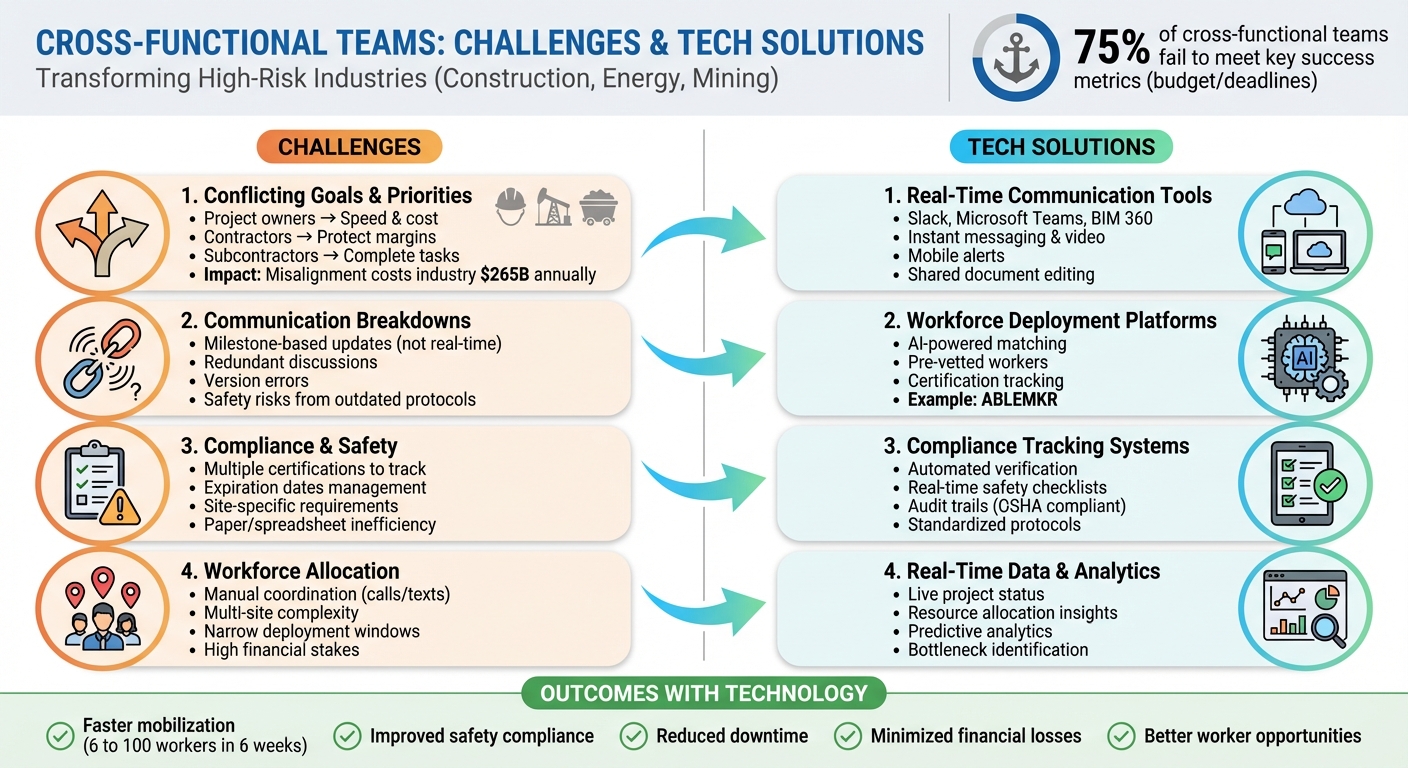
Cross-Functional Team Challenges vs Technology Solutions in High-Risk Industries
Mastering Cross-Functional Collaboration: Proven Strategies for Team Success
sbb-itb-aa28329
Common Challenges in Cross-Functional Team Management
Bringing together engineers, safety officers, operators, and managers is no small feat. It involves juggling schedules, aligning objectives, and addressing conflicting priorities. These hurdles aren’t just abstract – they’re often the reason projects exceed budgets, miss deadlines, or encounter safety incidents.
Conflicting Goals and Priorities
At the heart of the issue lies a basic reality: different departments are driven by different outcomes. For instance, project owners prioritize finishing on time and staying within budget. General contractors, on the other hand, need to protect their margins while meeting project specifications. Subcontractors? Their focus is on completing their specific tasks, often avoiding accountability for delays outside their control. McKinsey aptly describes this dynamic as "adversarial power dynamics", where owners push for speed and cost-efficiency, and contractors struggle to meet demanding expectations.
The financial implications of resolving these conflicts are staggering. If the construction industry can embrace digital collaboration and better alignment, profit margins for general contractors could almost double, unlocking a $265 billion annual profit pool. However, there’s a catch: many contractors resist new tools, fearing they’ll add administrative headaches instead of simplifying processes. To complicate matters further, digital maturity varies widely across subcontractors. Some use advanced tracking systems, while others still rely on paper forms and phone calls.
This lack of alignment can lead to unrealistic expectations. For example, project owners without real-time updates might misinterpret delays – like staffing shortages or material delivery issues – as poor performance. As McKinsey highlights, "Digital tools create value not by reinforcing old mechanisms, where the project owner exerts control and contractors struggle to deliver, but by serving as catalysts to a joint understanding, joint truths, and joint success".
And when objectives are out of sync, communication often suffers.
Communication Breakdowns
Conflicting priorities naturally set the stage for communication breakdowns, which can amplify risks and slow problem-solving. When teams rely on milestone-based updates instead of real-time insights, small issues can snowball into major setbacks. Imagine a workforce shortage that could have been resolved with a few calls early in the week turning into a critical bottleneck by the weekend. Add redundant discussions and version errors to the mix, and delays pile up.
In high-risk industries, poor communication can also jeopardize safety. For instance, if a safety officer updates a confined space entry procedure but the crew supervisor doesn’t get the memo, workers might unknowingly follow outdated protocols. Similarly, a disconnect between equipment operators and project managers can lead to constructability issues that only come to light during execution, wasting time and resources.
Compliance and Safety Requirements
Industries like construction, energy, and mining operate under strict safety regulations and require up-to-date certifications. Keeping track of credentials, expiration dates, and site-specific requirements is a logistical headache, especially when coordinating across multiple teams and contractors.
This challenge becomes even more urgent during rapid team mobilizations. Relying on outdated systems like paper files or spreadsheets in these fast-moving environments can lead to compliance violations – or worse, serious safety risks.
Workforce Allocation and Resource Management
In high-risk sectors, managing resources with precision is non-negotiable. Picture this: You need a welder with pipeline experience who can mobilize quickly to a remote site. At the same time, you’re trying to coordinate electricians with high-voltage expertise and operators for critical equipment – all during a narrow shutdown window.
These decisions often come with high stakes. Delays in infrastructure projects can result in hefty financial losses, and unplanned downtime in high-risk industries can be devastating. Yet, many companies still rely on informal methods – calls, texts, and personal networks – to manage workforce deployment. When working across multiple sites with cross-functional teams, such an approach quickly proves inadequate, leading to inefficiencies and missed opportunities.
Technology Solutions for Cross-Functional Team Challenges
In high-risk industries, technology is stepping in to tackle the challenges of cross-functional collaboration. Modern platforms are designed to address common hurdles, such as communication breakdowns and compliance issues, with tools that keep teams connected and operations on track. These tools are essential for enabling quick, coordinated responses across departments.
Real-Time Communication and Collaboration Tools
When critical updates need to be shared, real-time communication tools are a game-changer. Platforms like Slack, Microsoft Teams, and BIM 360 offer instant messaging, video conferencing, and shared document editing, making it easier for teams to collaborate seamlessly, whether they’re in the office or on-site. These tools also provide mobile alerts, ensuring supervisors receive urgent updates without delay. According to the Lean Construction Institute, such platforms not only support hybrid working environments but also encourage innovation by incorporating early feedback from various disciplines. On construction sites with multiple subcontractors, real-time tracking helps bridge information gaps, reducing the risk of costly errors .
Workforce Deployment and Management Platforms
Matching the right workers to the right projects is critical, and workforce deployment platforms make this process more efficient. These systems pair pre-vetted workers with job sites based on factors like certifications, safety training, availability, and location. For example, ABLEMKR serves industries like construction and energy by offering real-time visibility into worker status and speeding up crew mobilization. Whether it’s an emergency shutdown, a remote pipeline repair, or a scheduled mining project, these platforms ensure crews are deployed quickly. Workers also benefit from flexible access to well-paying opportunities, with guaranteed timely payments.
Compliance and Safety Tracking Systems
Relying on outdated methods like paper files and spreadsheets can’t keep up with today’s regulatory demands. Compliance systems automate the verification of certifications, provide real-time safety checklists, and maintain audit trails to meet OSHA standards and other regulations. By standardizing safety protocols across teams, these systems reduce the risk of miscommunication and improve hazard awareness. When paired with platforms like ABLEMKR, compliance tracking ensures that only certified workers are assigned to tasks, eliminating last-minute credential checks during critical situations.
Real-Time Data and Analytics
Data analytics play a crucial role in streamlining resource management. Real-time dashboards provide insights into project status, workforce use, and resource allocation, helping managers spot bottlenecks and reassign labor before issues escalate. Tools like Kanban boards enhance transparency and keep team priorities aligned. For example, in construction, real-time monitoring can identify resource imbalances early, while in energy and mining, predictive analytics can forecast potential delays or shortages, allowing for proactive adjustments that reduce downtime and costs.
Real-World Applications of Technology
ABLEMKR in Construction: Streamlining Workforce Deployment
In the construction world, scaling up a workforce quickly can feel like an uphill battle. Patrick Wallian, President and CEO of ABLEMKR, paints a vivid picture:
"Companies have a really hard time going from six workers on site to 100 in six weeks."
Traditional hiring methods just can’t keep up. That’s where ABLEMKR steps in. Using AI-powered automation, the platform simplifies the process by pulling project requirements and automatically creating and distributing job postings across a network of publishers. This not only matches certified workers to job sites but also handles compliance checks, ensuring crews are ready to hit the ground running. As Wallian puts it:
"The future of recruitment, the future of project-based staffing, I think, lies there [in AI and automation]."
This tech-driven approach enables construction companies to scale their teams quickly, even in high-pressure situations.
Energy Sector: Rapid Team Deployment for Emergency Repairs
The energy sector faces similar challenges, especially during emergencies. When a pipeline bursts or an unexpected shutdown occurs, the clock starts ticking. Companies need to deploy certified teams immediately, but navigating state-specific certifications can slow things down.
ABLEMKR’s platform tackles this by offering real-time updates on worker availability and qualifications. For example, during a pipeline repair crisis, managers can instantly locate trained workers who meet safety requirements and send them to remote sites without delay. The platform also tracks compliance, ensuring only certified personnel are assigned, eliminating common last-minute obstacles. By centralizing workforce data, it bridges the gaps between IT, operations, and finance departments, enabling swift, coordinated responses. This not only minimizes downtime but also helps prevent costly disruptions.
These examples showcase how technology can turn traditionally slow and fragmented processes into efficient, well-coordinated solutions.
Conclusion
Managing cross-functional teams in high-risk industries comes with its fair share of challenges. These hurdles can delay projects and drive up costs, making efficiency a constant struggle.
To tackle these issues, companies need reliable digital tools. ABLEMKR simplifies workforce deployment, keeps real-time tabs on certifications, and connects skilled labor to critical projects. By speeding up crew mobilization, companies not only improve safety but also cut down on costly downtime.
The right digital tools don’t just streamline operations – they also create better opportunities for workers, offering flexibility and competitive pay. Meanwhile, employers benefit from real-time updates on compliance and workforce status, reducing the friction that often plagues labor deployment.
In today’s fast-paced, high-risk industries, technology is no longer optional – it’s a necessity. Platforms that combine workforce management, compliance tracking, and real-time coordination into one system are key to staying ahead of the curve.
For companies navigating these demanding environments, adopting integrated solutions like ABLEMKR isn’t just smart – it’s essential for maintaining safety, efficiency, and a competitive edge.
FAQs
How can real-time communication tools improve cross-functional team collaboration?
Real-time communication tools make teamwork effortless by connecting everyone – engineers, safety officers, schedulers, and field crews – on platforms that update instantly. These tools ensure that critical updates like schedule adjustments, safety alerts, or technical instructions are shared without delay. By cutting out the lag of emails or phone calls, they save time, reduce mistakes, and help meet essential certifications and training requirements, especially in high-risk industries like construction, oil and gas, and mining.
Push notifications take this a step further by sending urgent alerts directly to the right workers based on their specific skills, certifications, and location. This targeted system speeds up shift coverage, lowers no-show rates, and ensures smooth handoffs between tasks, keeping projects on schedule. On top of that, real-time data dashboards offer immediate insights into labor costs and resource usage, helping teams make smart decisions that avoid expensive delays and improve project outcomes.
What are the benefits of using workforce deployment platforms in high-risk industries?
Workforce deployment platforms simplify operations in industries like construction, oil and gas, and mining – sectors where risk and complexity often go hand in hand. By centralizing labor data into mobile-friendly systems, these platforms help businesses cut down on overtime, idle time, and overstaffing. The payoff? Fewer project delays, improved productivity, and labor cost savings of up to 15%.
These tools also make it easier to match pre-qualified workers to job sites based on factors like certifications, safety training, and proximity. This speeds up crew mobilization for critical jobs such as shutdowns or remote repairs. Additional features like automated payroll, real-time compliance tracking, and geofencing add another layer of efficiency. They reduce administrative burdens, improve safety, and ensure workers are paid on time – leading to a more predictable work environment, lower costs, and greater employee satisfaction.
How do compliance tracking systems enhance safety and prevent downtime on job sites?
Compliance tracking systems play a critical role in workplace safety by ensuring every worker’s certifications, safety training, and medical clearances are current and stored in one accessible digital record. When a credential expires, the system doesn’t just sit idly – it flags the issue or even restricts site access entirely. This ensures unqualified personnel are kept out of hazardous areas. Supervisors can also tap into real-time data to track who’s on-site, confirm what equipment workers are authorized to use, and address any overdue safety requirements before they lead to problems.
These systems go a step further by incorporating technologies like IoT sensors and geofencing. For example, they can send alerts if someone enters a restricted area without the necessary permits or safety gear, allowing for immediate action. By automating tasks such as audit preparation and regulatory reporting, these tools cut down on human error, save time, and reduce downtime caused by safety investigations or potential fines. ABLEMKR’s platform ties all these features together, helping create safer job sites while ensuring projects stay on schedule.


