
Managing worker certifications is critical for safety and compliance in industries like construction, energy, and mining. Companies must choose between manual tracking methods or automated credential systems to handle certifications efficiently. Here’s what you need to know:
- Manual Tracking: Relies on spreadsheets, paper files, and calendar reminders. Prone to human error, delays, and compliance risks.
- Credential Integration Systems: Use digital platforms for real-time tracking, automated alerts, and instant field verification. Reduces errors and improves efficiency.
Key Takeaways:
- Manual tracking is time-consuming and error-prone, leading to potential safety risks and OSHA fines.
- Automated systems streamline processes, ensure compliance, and save time by automating tasks like tracking expiration dates and verifying credentials on-site.
- Industries with high safety standards benefit significantly from moving to automated solutions.
Quick Comparison:
| Feature/Metric | Manual Tracking | Credential Integration |
|---|---|---|
| Data Accuracy | High risk of errors | Real-time updates ensure accuracy |
| Access Control | Manual checks | Automated lockouts for expired credentials |
| Administrative Burden | High | Low |
| Compliance Risk | High | Low |
| Reactivation Speed | Slow | Instant |
Switching to automated systems not only improves safety and compliance but also helps organizations save time and avoid costly disruptions. Let’s dive deeper into how these systems work and why they outperform manual methods.
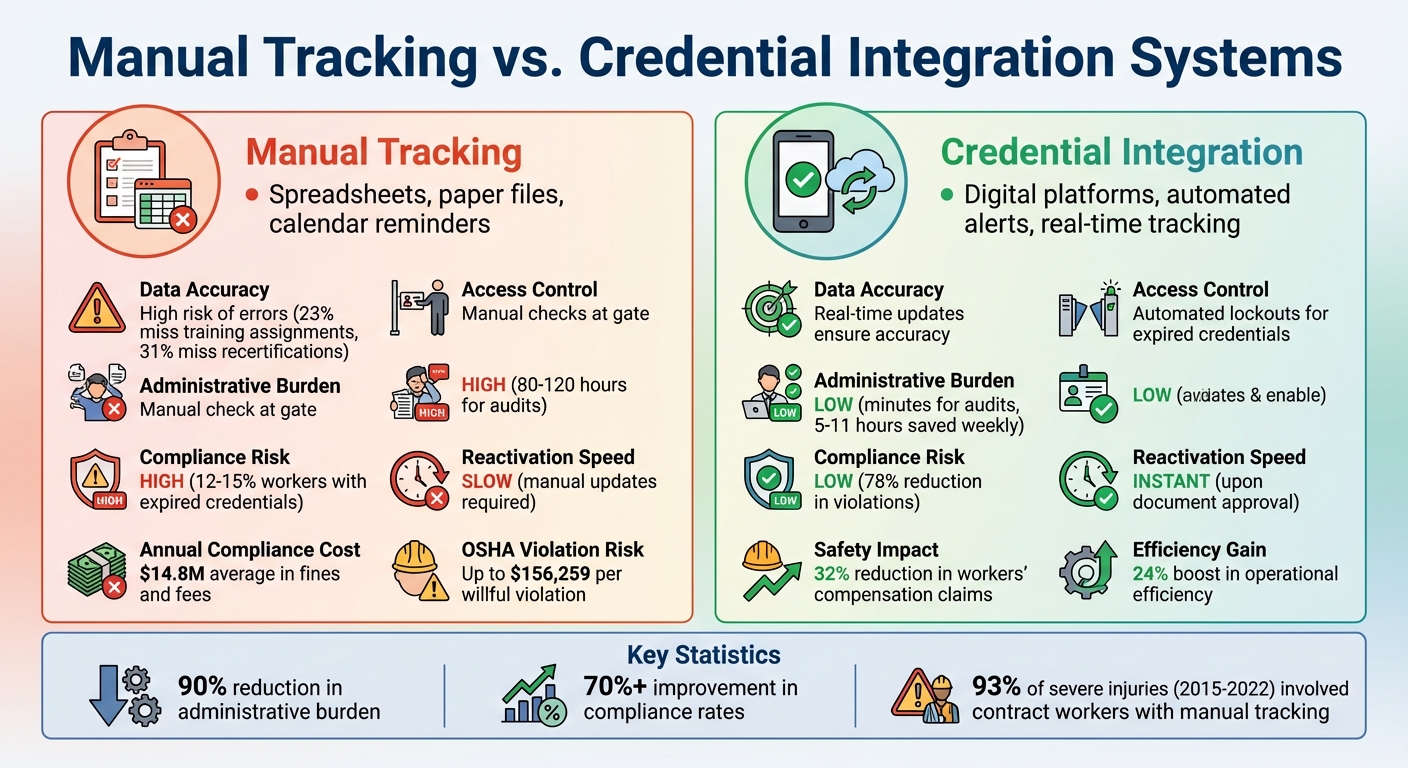
Manual Tracking vs Credential Integration Systems Comparison
Manual Tracking: How It Works and Where It Falls Short
Process Overview
In industries like construction, energy, and mining, tracking worker credentials often relies on a patchwork of spreadsheets, paper files, digital documents, and calendar reminders. HR staff manually input certification details, store physical copies, and set up calendar alerts to manage renewals. When a worker completes new training, someone has to update the records by hand. Similarly, when a credential expires, it’s up to a person to remember and follow up. This system, entirely dependent on human effort, lacks automated checks to catch errors or missed deadlines – a setup that’s not only time-consuming but also prone to significant issues.
Common Problems
Manual tracking is a breeding ground for human error. Typos in expiration dates and missed updates are all too common. As Spivac explains:
"Human error is a significant risk when manually entering data – whether it’s a typo in a certification expiration date or simply forgetting to update records".
Inconsistent naming conventions add another layer of complexity. David Finkelstein, President of Credential Verification Service, highlights the issue:
"If you are looking for an assistant foreman with a specific qualification, but foremen’s job titles are spelled differently, you may not find the person you’re looking for".
For instance, one spreadsheet might list "Asst Foreman", while another spells it out as "Assistant Foreman." This inconsistency can cause searches for qualified workers to fail, even when the right people are available.
Accessing records in the field is another major hurdle. Paper files are often locked away in office cabinets, and spreadsheets are usually stored on desktop computers. This disconnect means supervisors at jobsites can’t quickly verify whether a worker’s OSHA certification is still valid before assigning them to operate heavy machinery. The stakes are high – OSHA fines for allowing unqualified workers to handle hazardous equipment can run into thousands of dollars per violation. Worse, failing to prove compliance during an audit can lead to an immediate halt in operations.
Communication gaps further complicate matters. HR might know about an expired certification, but if that information doesn’t reach the project manager in time, an unqualified worker could be assigned to a high-risk task. With data scattered across emails, filing cabinets, and disconnected spreadsheets, maintaining a reliable, centralized record becomes nearly impossible. These challenges highlight the pressing need for a more streamlined and automated solution.
Credential Integration Systems: Automated and Real-Time
How Integration Systems Work
Credential integration systems take the hassle out of managing certifications by replacing outdated spreadsheets and filing cabinets with a centralized digital platform. These systems gather data from multiple sources – such as Student Information Systems (SIS), Learning Management Systems (LMS), and Human Resources Management Systems (HRMS) – to create a single, reliable repository for tracking worker certifications. Instead of manually logging expiration dates into a spreadsheet, workers can simply upload certificate images through a mobile app. This makes it easy to automatically track OSHA training, equipment licenses, and job site approvals.
One standout feature is real-time field verification. Supervisors can instantly check a worker’s credentials on-site using their smartphones, cutting out the need for phone calls or digging through paperwork. Automated alerts ensure that workers and HR teams are notified when certifications are about to expire. If a certification lapses, some platforms take it a step further by implementing auto lockouts – disabling the worker’s digital badge to prevent site access until a valid certificate is uploaded. Once HR approves the updated document, the badge is reactivated immediately, keeping operations smooth and minimizing downtime. These real-time features bring efficiency and precision to the forefront.
Main Benefits
Switching from manual processes to integrated credential systems delivers a host of advantages. Accuracy improves significantly as digital workflows standardize data entry, reducing errors like typos or mismatched job titles. Highlighting the importance of such systems, the Credential As You Go initiative states:
"The integration of credential information across different systems is not simply a technical challenge but a critical measure for creating a more efficient and supportive educational framework".
Time savings are another major win. HR teams no longer spend hours updating spreadsheets or chasing down expired certifications. Tasks like generating compliance reports, verifying worker qualifications, and managing renewals, which used to take days, are now fully automated. For businesses experiencing growth, scaling becomes seamless – adding new workers doesn’t mean drowning in manual data management. Most importantly, automated systems ensure that only qualified workers are on the job, reducing the risk of costly OSHA violations.
Take ABLEMKR, for example. This platform uses mobile-driven, real-time updates to keep worker credentials and compliance statuses up to date, making workforce management more efficient in industries where safety and precision are critical.
Side-by-Side Comparison: Manual Tracking vs. Credential Integration
Let’s break down how manual tracking measures up against automated credential integration. This comparison sheds light on how each approach impacts day-to-day operations and long-term efficiency.
Manual tracking leans heavily on human oversight to manage expiration dates, update records, and verify worker credentials at job sites. This process is not only time-consuming but also leaves room for errors and delays. On the other hand, credential integration automates these tasks, using real-time data to maintain compliance without constant administrative intervention.
Take Access Control, for example. Manual tracking relies on gate supervisors to check paper-based credentials, which increases the chances of oversight. In contrast, automated systems immediately disable a worker’s digital badge when a certification expires, blocking site access until updated credentials are approved.
The reactivation process also highlights the benefits of automation. With manual systems, reactivating access requires updating records – a process that can take time. Automated systems, however, restore access instantly once HR approves the necessary documents, allowing workers to get back to their tasks without unnecessary delays.
Comparison Table
| Feature/Metric | Manual Tracking | Credential Integration |
|---|---|---|
| Data Accuracy | High risk of missed expiration dates in paperwork | Real-time updates ensure accuracy |
| Access Control | Manual checks at the gate | Automated lockouts for expired certifications |
| Administrative Burden | High; requires constant manual effort | Low; managed via a mobile app |
| Compliance Risk | High; expired credentials may go unnoticed | Low; alerts notify before expiration |
| Reactivation Speed | Slow; manual updates required | Instant; access restored upon document approval |
For companies managing large teams across multiple sites, scalability becomes a key consideration. Expanding a manual system means juggling more files, credentials, and expiration dates – an administrative nightmare. In contrast, mobile-first credential integration handles growth effortlessly. It tracks certifications, sends renewal alerts, and ensures real-time compliance, regardless of how quickly your workforce expands.
These differences aren’t just about convenience – they directly impact safety, compliance, and project timelines, paving the way for a closer look at how these systems influence overall operations.
Impact on Safety and Compliance
The way an organization tracks worker credentials has a direct and measurable effect on both safety and compliance.
How credentials are tracked determines whether workers are performing tasks within their qualifications. Relying on manual methods like spreadsheets and paper records leaves dangerous gaps. Research shows that 23% of required employees miss training assignments, and 31% of recertifications go unnoticed in these systems. Even more concerning, 12-15% of workers in manually tracked setups have expired credentials, significantly increasing the risk of safety incidents. These lapses don’t just slow down operations – they put lives at risk.
Take the oil and gas industry as an example: from 2015 to 2022, 93% of severe injuries involved contract workers, many of whom were managed using less robust manual tracking systems. Without real-time verification, supervisors might unknowingly assign high-risk tasks – like operating heavy machinery or working with hazardous materials – to workers whose certifications have expired. As mentioned earlier, proper training is the foundation of workplace safety.
Automated credential tracking systems solve these challenges by using features like real-time access control and proactive alerts for expiring certifications. Mobile-first platforms let supervisors instantly confirm a worker’s qualifications before assigning tasks, ensuring that only certified individuals handle specific jobs. This level of automation significantly reduces risks. In fact, organizations using automated compliance tools report a 78% drop in compliance violations and a 32% reduction in workers’ compensation claims.
Beyond improving safety, staying compliant has a major financial impact. Compliance failures cost organizations an average of $14.8 million annually in fines, legal fees, and reputational damage. A single willful OSHA violation can lead to penalties as high as $156,259. Manual audits, which can take 80 to 120 hours to complete, are another drain on resources. In contrast, automated systems compile the necessary data in seconds. This isn’t just about saving time – it’s about ensuring continuous compliance, which protects workers and keeps projects on track without costly disruptions.
For industries like energy, mining, and heavy infrastructure – where safety standards are non-negotiable – the decision to move from manual tracking to automated systems directly impacts operational integrity. These systems do more than lighten the administrative load; they act as a safeguard, catching expired credentials before they lead to accidents, ensuring that every worker on-site is qualified for the tasks they perform.
sbb-itb-aa28329
Effects on Operations and Project Timelines
How fast an organization can verify credentials has a direct impact on how smoothly and quickly projects progress. Relying on manual methods, like spreadsheets and paper files, often creates roadblocks that slow down operations at every stage – from hiring and workforce mobilization to daily task assignments. Imagine a supervisor spending hours combing through documents just to confirm if a worker is certified for a specific task. This kind of delay piles up fast.
These bottlenecks can grind operations to a halt. Assigning tasks to uncertified workers not only disrupts workflows but can also result in hefty OSHA penalties that run into the thousands. On top of that, the scramble to find qualified replacements can stretch project timelines by days or even weeks. Manual systems also tend to cause communication breakdowns between HR and field managers, leading to errors in verifying credentials.
Automated systems solve these challenges with instant verification and smooth integration. Credential platforms like ABLEMKR provide real-time updates, allowing supervisors to check qualifications on their mobile devices before assigning tasks. This ensures that only certified workers are scheduled for high-risk jobs, avoiding last-minute chaos and keeping projects on track. By digitizing these administrative processes, organizations can save 5–11 hours every week, speeding up project timelines significantly.
This kind of efficiency is particularly crucial for industries like energy, mining, and utilities. Automated platforms can quickly match pre-vetted workers to job sites based on their certifications, availability, and location. Whether it’s an emergency pipeline repair, a planned shutdown, or infrastructure development, these systems enable rapid workforce mobilization. Unlike manual tracking, which takes time, automated tools instantly identify qualified personnel and kick off deployment.
Integration with payroll and project management systems ensures workers are compensated accurately and on time, while also keeping projects aligned with their schedules. This seamless data exchange between office and field teams minimizes errors and avoids costly delays caused by miscommunication. Together, these efficiencies help keep projects moving forward and budgets under control.
Choosing the Right Approach for Your Organization
When weighing manual tracking against real-time credential integration, the decision hinges on factors like organization size, regulatory demands, and budget. One key concept to consider is the 1-10-100 Rule: getting credential verification right the first time costs $1, fixing errors later costs $10, and addressing compliance failures can exceed $100. These escalating expenses make automation a smart choice for industries with strict compliance needs.
For high-risk sectors, integrated platforms take credential management to the next level by performing Primary Source Verification (PSV). They directly check credentials with state boards and federal databases, providing the documentation regulators require.
Take ABLEMKR’s mobile-first platform, for example. It’s tailored for industries like construction, energy, and extractives, where quick deployment of certified workers to job sites is essential. This system enables rapid, location-based worker allocation, which is particularly valuable during shutdowns, repairs, or development projects. Avoiding delays in these scenarios not only saves money but also ensures operational efficiency.
While automated platforms come with an upfront investment, the long-term benefits are hard to ignore. They significantly reduce administrative workload, cutting audit response times from days to just minutes. This frees up HR teams to focus on more strategic initiatives.
To get started, clearly define what you need to track – such as licenses, certifications, safety training, or insurance documents. Look for platforms that seamlessly integrate with your existing systems, like HRIS, payroll, or scheduling tools, via APIs . If you’re hesitant to go all-in, consider starting small by automating credential verification for high-risk roles and then scaling up gradually.
Conclusion: Why Credential Integration Wins
Relying on manual credential tracking just doesn’t cut it for industries where safety and compliance are critical. Automated systems ease the administrative burden by a staggering 90% while boosting compliance rates by over 70%.
These systems do more than just store data – they actively monitor expiring certifications and filter workers based on current qualifications, ensuring only properly certified individuals are scheduled for jobs. This is especially crucial for safety-sensitive fields like construction, energy, and extractive industries, where mistakes can have serious consequences.
Take ABLEMKR’s platform as an example. It matches pre-vetted workers to job sites by factoring in certifications, safety training, and even geo-location. This enables quick crew deployment in urgent situations, like emergency shutdowns or remote pipeline repairs. With built-in compliance tracking and real-time updates on worker statuses, employers gain the confidence to send teams into action across key U.S. energy corridors without hesitation.
But the benefits don’t stop at compliance. These tools elevate overall operations. Real-time reporting not only simplifies audits but also empowers better decision-making. In fact, companies using such systems experience a 24% boost in operational efficiency. Plus, audits become far less stressful thanks to streamlined reporting features.
For organizations still stuck with manual credential tracking, switching to automated systems delivers immediate improvements, especially for roles where safety and compliance are non-negotiable.
FAQs
What are the benefits of using credential integration systems instead of manual tracking?
Credential integration systems offer an automated, hassle-free way to handle certifications, safety training, and work authorizations – leaving behind the inefficiencies of manual tracking.
With these systems, efficiency and accuracy take a big leap forward. Forget about tedious data entry and the errors that often come with it. Automated processes streamline administrative work, speed up job assignments, and cut down on payroll mistakes.
On top of that, they improve compliance and risk management. Certifications are automatically verified, expiration dates are tracked, and non-compliant workers are flagged before they even set foot on a job site. This proactive approach helps businesses avoid fines, reduce liability risks, and dodge audit headaches.
Another major perk is real-time visibility into worker qualifications and availability. This means crews can be mobilized faster, cutting down on idle time and overtime expenses. Companies that switch from manual tracking to these integrated systems often see noticeable savings in both time and money.
How do automated credential systems enhance compliance and safety in high-risk industries?
Automated credential systems make it easier to track and verify workers’ certifications by keeping information updated in real time. This not only removes the risk of manual errors but also ensures compliance with regulatory standards while offering instant access to worker qualifications.
Take platforms like ABLEMKR, for example. They use automation to simplify compliance tracking in industries like construction and energy. By matching workers to projects based on their certifications, safety training, and availability, these systems help lower risks, enhance safety, and ensure that critical projects stay on schedule.
What should organizations consider when choosing between manual tracking and automated credential systems?
When choosing between manual tracking and automated credential systems, organizations should weigh factors like accuracy, efficiency, and scalability. Manual tracking often results in errors, delays, and higher administrative expenses. On the other hand, automated systems simplify workflows, minimize mistakes, and ensure compliance through real-time updates.
These automated platforms can integrate seamlessly with payroll and HR tools, eliminating duplicate data entry and saving both time and money. Features such as mobile access, geofencing, and automated alerts help ensure certifications stay current and compliance remains on track. In contrast, manual methods demand more staff time, are harder to scale, and come with a greater risk of costly errors or overruns.
In the end, automation provides quicker processing, improved accuracy, and reduced long-term costs, making it a practical solution for organizations aiming to boost efficiency and meet evolving workforce needs.


