
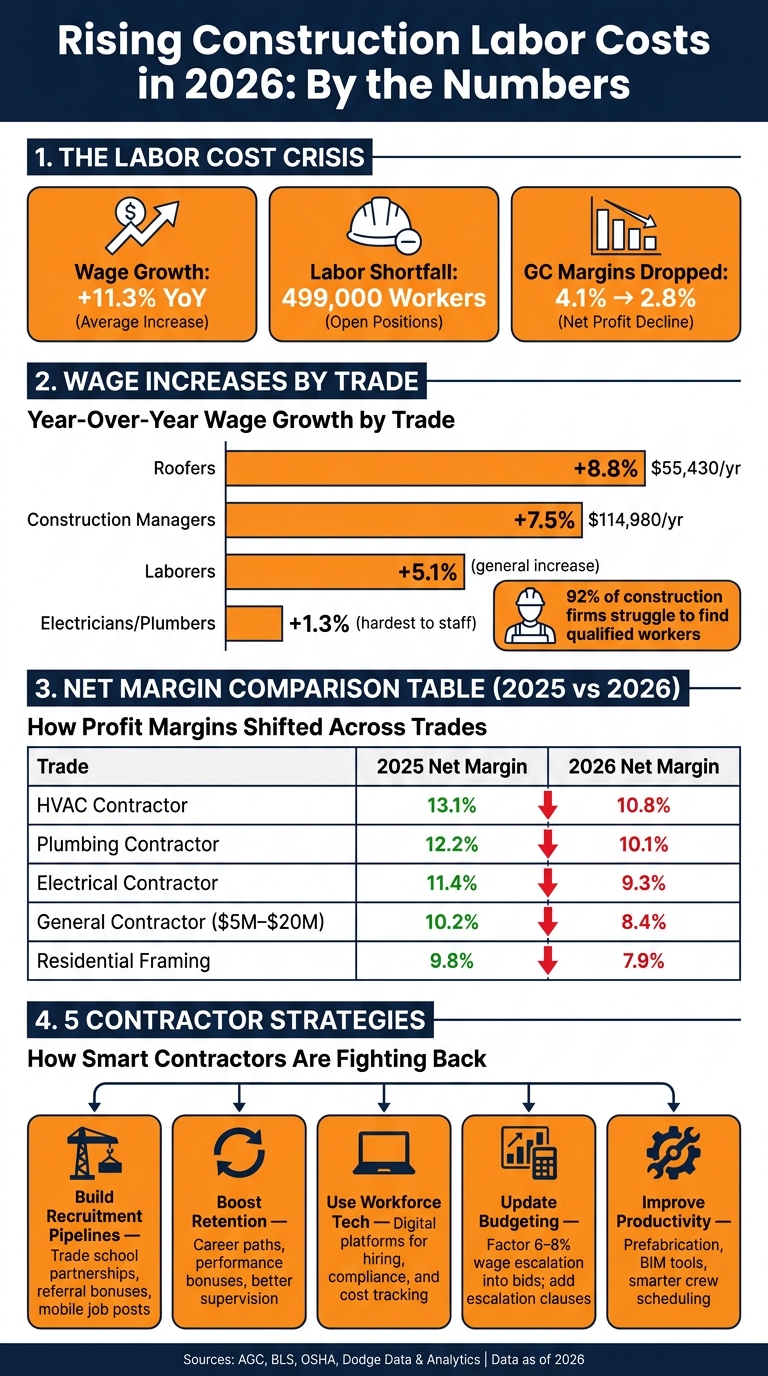
Labor costs in construction are surging, and contractors are feeling the pressure. Wages for skilled trades have jumped significantly – up 11.3% year-over-year as of May 2026 – while profits are shrinking. General contractor margins have dropped from 4.1% in 2024 to just 2.8% in 2026. With a labor shortfall of up to 499,000 workers this year and rising costs for benefits, insurance, and compliance, managing projects has become increasingly challenging.
Here’s how contractors are tackling these issues:
- Recruitment Strategies: Building continuous hiring pipelines through trade school partnerships, referral bonuses, and mobile-friendly job postings.
- Retention Tactics: Offering clear career paths, performance bonuses, and better supervision to reduce turnover costs.
- Workforce Management Tools: Using platforms like ABLEMKR to streamline hiring, compliance tracking, and labor cost monitoring.
- Updated Budgeting: Factoring in rising wages during project estimates and including labor escalation clauses in contracts.
- Boosting Productivity: Leveraging prefabrication, BIM tools, and smarter crew scheduling to offset higher hourly rates.
The key takeaway? Contractors must rethink hiring, budgeting, and workforce strategies to stay competitive amid rising labor expenses.
Construction Labor Costs 2026: Key Stats & Contractor Strategies
The Core Problems Contractors Face With Rising Labor Costs
Higher Wages and Tighter Competition for Skilled Workers
The construction industry is no longer grappling with material costs as its primary challenge – labor costs have taken center stage. While prices for materials like lumber and steel have settled, wages continue to climb, and the demand for skilled workers has become fiercer than ever.
Wage increases vary widely depending on the trade. For example, roofers experienced an 8.8% year-over-year increase, reaching a median annual pay of $55,430. Construction managers saw a 7.5% increase, bringing their median salary to $114,980. Meanwhile, roles like electricians and plumbers – despite being some of the hardest to staff – only saw 1.3% wage growth. This uneven growth highlights how scarcity premiums are being applied selectively to certain trades rather than across the board.
The competition for skilled labor is also coming from unexpected places. Data center and semiconductor projects are luring electricians away from general construction by offering higher pay and more predictable schedules. Kenneth Simonson, Chief Economist at the Associated General Contractors of America, explained:
"Electricians are the hardest positions to fill as data center projects are competing for thousands of them per site and often paying enough to draw workers away from less-urgent projects."
With 92% of construction firms struggling to find qualified workers, contractors are caught in a tough spot. They’re hesitant to expand their workforce due to rising costs but are also unwilling to lose the employees they already have. And wages are just the tip of the iceberg – hidden costs are adding even more pressure to already tight budgets.
Growing Costs for Benefits, Insurance, and Compliance
Employee benefits have become a significant expense in construction, now accounting for 30.3% of total compensation. This averages out to an additional $15.45 per hour on top of base wages, increasing 3.4% year-over-year – outpacing the 2.0% growth in median wages during the same timeframe. Workers’ compensation insurance only adds to the financial strain. For instance, roofers face rates ranging from $22.00 to $45.00 per $100 of payroll, far higher than the $4.00 to $9.00 rates for electricians. In unionized metro areas, total compensation – including health insurance and pensions – can soar to $80–$100 per hour.
Compliance costs are another growing burden. In 2024, the federal government recovered $33 million in misclassified wages affecting 17,000 construction workers, signaling stricter enforcement measures. OSHA fines for serious violations can reach $16,131 per incident, and emerging state-level regulations – such as AI hiring laws in Illinois and Colorado – are adding layers of administrative complexity that smaller contractors are often unprepared to handle.
As the Wiss Team aptly noted:
"The construction labor shortage is a financial planning problem that requires CFO-level analysis, not just an HR problem that operations has to solve."
These mounting expenses are creating a ripple effect, leading to increased risks at the project level.
Project Risks From Labor Shortages
Labor shortages have immediate and far-reaching consequences on construction projects. 45% of construction firms report that these shortages are directly causing delays, either on their own job sites or through subcontractors. These delays often translate into higher interest costs on project lines of credit, which are used to finance extended timelines.
Even when workers are available, many lack the necessary skills or certifications. In fact, 57% of firms say that the candidates they can find don’t meet the technical requirements for the job. This creates challenges during the bidding process, as contractors struggle to accurately price the risks associated with an underqualified workforce.
Safety concerns are another significant issue. Inexperienced workers in high-risk environments increase the likelihood of accidents, which can lead to OSHA investigations, insurance claims, or even project shutdowns. Terrapin Construction Group summed it up well:
"Most 2026 bid overruns that get blamed on ‘inflation’ are really labor – the scarcity premium, the overtime padding, the bench-depth insurance every honest GC has to carry just to hold schedule."
To tackle these challenges, contractors need to address the root causes – wage competition, rising overhead costs, and workforce shortages – before they can implement effective strategies for hiring, budgeting, and workforce management.
How to Improve Hiring and Workforce Management
Building a Stronger Recruitment Pipeline
With 88% of U.S. construction firms struggling to fill craft positions, waiting until the last minute to hire workers can be an expensive misstep. Treating recruitment as a continuous process, rather than a rushed reaction, helps contractors fill roles faster and avoid the high costs of emergency hires.
A winning strategy combines online efforts with local partnerships. Start with a mobile-friendly careers page that clearly outlines pay, project details, and locations. Since many field workers rely on their phones to job hunt, quick and clear information is key. Adding geo-targeted job board ads and short social media videos showcasing active job sites can also build trust with potential candidates who might otherwise ignore generic postings.
For long-term success, partnering with local trade schools and apprenticeship programs is a game-changer. Only about one-third of high school students know about lucrative construction careers, so engaging in classroom presentations and career fairs can help contractors connect with untapped talent. Additionally, offering referral bonuses – paid out after a new hire completes 90 days – encourages current employees to bring in reliable candidates while promoting team loyalty. A well-maintained recruitment pipeline not only fills roles efficiently but also helps control turnover costs.
Keeping Workers Longer and Cutting Turnover Costs
Replacing a skilled worker can cost anywhere from 20–50% of their annual salary when you factor in recruiting, onboarding, and lost productivity. For in-demand trades, these costs can climb even higher. Retention isn’t just an HR issue – it’s a direct hit to your bottom line.
While competitive pay is a must, workers are more likely to stay when they see opportunities for growth. Clear advancement paths tied to certifications, skills, and tenure encourage employees to invest in their future with the company. Performance bonuses for safety, quality work, and attendance are another smart way to reward employees without permanently increasing base wages.
Beyond pay, small changes can make a big difference. Predictable schedules and organized, well-equipped job sites create a more stable work environment. Interestingly, poor supervision – not low wages – is often the main driver of turnover. Training frontline managers to lead effectively can significantly improve worker satisfaction and retention.
Using Workforce Management Technology to Cut Overhead
Once recruitment and retention are under control, workforce management tools can help streamline operations even further. Contractors using digital tools report labor cost overruns dropping by 10–15% thanks to better crew allocation and reduced downtime. Cloud-based platforms can also slash the time spent on manual scheduling and timesheet management by 30–50%.
When speed is critical – whether it’s for a project launch, a sudden shutdown, or emergency repairs – platforms like ABLEMKR simplify the process. ABLEMKR connects contractors with pre-vetted, skilled laborers who are ready to work. The platform matches workers to job sites based on certifications, safety training, availability, and location, eliminating the need to restart the vetting process every time a new hire is needed.
It also tracks compliance documentation, such as OSHA training records and trade licenses, in one place. This minimizes the risk of sending unqualified workers to the site and makes audits far less stressful. Features like GPS timecards, automated payroll, and real-time worker updates ensure staffing decisions are fast and data-driven, keeping projects on track and within budget.
How to Estimate Construction Labor Costs – (Complete Guide)
Budgeting and Cost Control When Labor Costs Are Rising
When labor costs are climbing, contractors must rethink their budgeting strategies to account for both current wage trends and future increases.
Updating Labor Cost Assumptions in Your Estimates
One of the biggest mistakes in construction estimating is relying on outdated wage data. With labor costs expected to rise by 6–8% in 2026, this translates to about 0.34% growth per month.
"The mistake most estimators make is using last year’s labor rates on this year’s bids. By the time a project mobilizes… those rates are already outdated." – Construction Back Office
To avoid this, estimate labor costs based on the project start date, not the bid date. For projects beginning six months from now, factor in at least half of the projected annual increase. For longer timelines, spread the full escalation across the project’s duration. Additionally, use trade-specific rates instead of general industry averages. For instance, laborers experienced a 5.1% year-over-year wage increase, while operating engineers saw only 3.2%. Combining these averages can obscure critical differences in costs.
Take a moment to compare the actual hourly rates from your last three jobs to what you initially bid. If the difference is more than 5%, it’s time to update your bid templates.
Once you’ve incorporated updated wage data, it’s equally important to adjust contingencies to protect against unexpected cost jumps.
Scenario-Based Estimating and Contingency Planning
Flat contingency percentages, like a blanket 5%, don’t cut it in today’s unpredictable labor market. For example, trades like electricians and roofers are seeing wage increases of 4.8% and 4.9% year-over-year, respectively. A better strategy is to create tiered contingencies by trade, considering how scarce and volatile certain labor categories are in your area.
In cities like Phoenix or Dallas, where skilled-trade wages are climbing 7–11%, the stakes are even higher. For a $2 million labor budget, a 0.34% monthly escalation adds roughly $6,800 per month, which could total between $81,600 and $122,400 over a 12–18 month project.
"Most 2026 bid overruns that get blamed on ‘inflation’ are really labor – the scarcity premium, the overtime padding, the bench-depth insurance every honest GC has to carry just to hold schedule." – William Goodin, Terrapin Construction Group
However, contingencies only work if your baseline numbers are accurate. As Construction Back Office emphasizes, "A labor escalation factor applied to an inaccurate labor hour count doesn’t protect you… your baseline numbers have to be right." Double-check your takeoffs before applying escalation rates.
With solid estimates and trade-specific contingencies in place, tracking costs in real-time becomes the next critical step.
Tracking Labor Costs Against Budgets in Real Time
Having a budget is one thing; staying on top of it during the project is another. Real-time labor cost tracking allows you to catch overruns early, giving you time to adjust crew sizes, shift schedules, or even renegotiate the project scope.
Modern workforce management tools can help by incorporating up-to-date 2026 labor rates and regional labor data into your estimates and schedules. Features like GPS timecards and automated payroll workflows provide real-time insights into labor spending versus your budget.
For example, ABLEMKR’s mobile-first platform offers tools that track worker status, streamline payroll, and ensure compliance. Requiring named crew commitments in scheduling – where specific foremen and their team locations are identified – helps ensure your labor budget reflects actual crew availability, not optimistic assumptions. This is particularly vital in a market where 439,000 commercial construction positions remained unfilled in Q1 2026.
sbb-itb-aa28329
Getting More Output From Your Workforce to Offset Higher Hourly Rates
To counter rising hourly wages, improving workforce productivity is one of the most practical strategies contractors can use. It’s about working smarter, not harder, to keep costs in check.
Improving Productivity With Better Methods and Tools
Did you know that up to 70% of time on construction sites can be unproductive? Workers often face delays due to waiting for materials, navigating the site, or redoing tasks. Prefabrication offers a solution by cutting on-site hours, reducing delays, and increasing profit margins. For example, if a $50/hour crew boosts their productive time from 55% to 65%, it can save thousands of dollars weekly on a mid-size project. This also helps with more accurate labor budgeting, which is crucial when dealing with inflation-driven costs.
A Dodge Data & Analytics survey highlighted that 66% of contractors using prefabrication reported better productivity, and 65% saw improved schedule performance. In high-wage areas, where every hour costs more, shifting even 10–20% of labor to a shop can significantly improve profit margins.
Digital tools amplify these benefits. Contractors using advanced BIM (Building Information Modeling) reported 25% improvements in labor productivity and 25% less rework. Pairing BIM with mobile field management apps – such as those for time-tracking, plan access, and issue logging – streamlines operations. These tools cut down administrative tasks and give managers real-time insights into where labor hours are going. Start small by implementing one or two mobile workflows that integrate seamlessly with job-cost reporting.
Once productivity improves, the next step is fine-tuning crew scheduling for maximum efficiency.
Smarter Crew Scheduling and Deployment
Even the best schedules need flexibility to handle unexpected changes in the field. That’s where rolling look-ahead planning – which focuses on the next three to six weeks – comes into play. This approach allows project managers to adjust crew sizes proactively, preventing minor issues from snowballing into costly overtime.
Platforms like ABLEMKR make crew redeployment more agile. Using AI-assisted matching, ABLEMKR connects pre-vetted workers to job sites based on their certifications, training, availability, and location. For example, if a concrete pour gets moved up or a shutdown is rescheduled, contractors can shift workers across projects seamlessly. The platform’s Subscription Hiring Partner model starts at $2,000/month and includes workforce intake, AI-driven matching, and coordination support. This approach reduces worker-related costs compared to traditional on-demand hiring.
Using Safety and Compliance Tracking to Avoid Costly Incidents
Boosting productivity and optimizing schedules is only part of the equation – safety must remain a top priority. Strong safety programs don’t just protect workers; they also save money. OSHA estimates that effective safety measures can cut injury and illness costs by 20–40%, while companies with robust safety cultures report incident rates 70% lower than the industry average. This translates to fewer lost workdays and less disruption.
To achieve this, regular job hazard analyses (JHAs), toolbox talks, and certification tracking are essential. Ensuring workers have up-to-date credentials – such as OSHA 10/30 training or equipment operation licenses – avoids costly compliance issues. For high-risk tasks in industries like energy, industrial, or heavy civil work, even one uncredentialed worker can halt an entire project.
Platforms like ABLEMKR simplify this process by embedding safety and compliance tracking into hiring and onboarding workflows. This ensures that only properly certified workers are deployed to job sites. By integrating safety tracking with workforce management, contractors can control budgets more effectively and avoid unexpected labor cost spikes.
Project Mix and Contract Adjustments to Manage Inflation Risk
With rising labor costs cutting into profits, contractors need to rethink how they choose projects and structure contracts to maintain financial health.
Prioritizing Projects With Predictable Labor Needs and Higher Margins
Not all projects are worth pursuing when labor costs are climbing. In 2026, average contractor profit margins fell from 12% to 9.8% – an 18% drop year-over-year – while labor costs surged by 23% across the industry. This makes it crucial to evaluate which projects are still profitable.
Specialty trades like HVAC, plumbing, and electrical work tend to deliver better margins compared to general contracting. For instance, gross margins in specialty trades range between 25–40%, while general contractors average closer to 15–25%. The following table highlights how net margins shifted across various trades in 2026:
| Trade Specialty | 2025 Avg Net Margin | 2026 Avg Net Margin |
|---|---|---|
| HVAC Contractor | 13.1% | 10.8% |
| Plumbing Contractor | 12.2% | 10.1% |
| Electrical Contractor | 11.4% | 9.3% |
| General Contractor ($5M–$20M) | 10.2% | 8.4% |
| Residential Framing | 9.8% | 7.9% |
To stay competitive, contractors should analyze margins at the job level and avoid consistently unprofitable projects, even if it means a temporary revenue dip. Sectors like industrial, infrastructure, and data center construction often offer better pricing power.
"Taking on work without the workforce to deliver it reliably can cause schedule failures, financial losses, and reputational damage. Contractors must choose work they can staff successfully." – Builder Outlook
Beyond project selection, adjusting contract terms is another key step to protect profitability.
Including Labor Escalation Clauses in Contracts
Labor costs can escalate significantly during long-term projects. For example, a $2 million labor budget could see an added $122,400 in costs over an 18-month project due to a 4.1% annual wage increase, if rates are locked at the bid date. To address this, labor escalation clauses have become more common. By 2026, 67% of construction contracts over six months included these clauses, compared to less than 40% three years earlier.
The most effective clauses tie adjustments to a reliable index, such as the Bureau of Labor Statistics (BLS) Construction Employment Cost Index, ensuring transparency. A typical structure includes a buffer – no adjustments for the first 2% of inflation – with a cap around 8% annually. This balances risk between contractors and project owners.
"If you’re not putting escalation language in your contracts, you’re one of the remaining 33% who are absorbing all of that risk in their contingency line – or eating it out of margin." – Mike Callahan, 20-Year General Contractor
In today’s environment, where skilled-trade wages rose 5.8% year-over-year through early 2026, quarterly adjustments are often more practical than annual ones. Reviewing contracts with legal counsel before signing multi-year agreements is essential for protecting margins.
While contract terms are critical, ensuring flexibility within your workforce is equally important.
Expanding Crew Flexibility Through Training and Cross-Training
Flexible crews can help mitigate labor cost issues. Workers who are trained to handle multiple roles reduce reliance on costly outside labor, which is becoming harder to secure.
Between 2025 and 2026, 42% of construction firms increased spending on training and professional development to strengthen internal labor reliability. For example, cross-training a carpenter to assist with formwork or an equipment operator to handle basic rigging can improve scheduling adaptability. Treating training as a necessary overhead cost rather than an optional expense helps contractors self-perform critical tasks, manage their own schedules, and avoid delays caused by overbooked subcontractors.
Conclusion: What Contractors Should Do Now About Rising Labor Costs
Labor costs are climbing, and with construction unemployment increasing in 44 states, contractors who hesitate to act could find themselves grappling with even steeper expenses.
The strategies outlined here create a strong game plan for tackling rising labor costs. By building better recruitment pipelines, contractors can reduce reliance on expensive, last-minute hires. Updating estimates with escalation clauses helps safeguard profit margins before a project even begins. And cross-training crews allows for more flexible scheduling, cutting down on the need for higher-cost external labor.
Technology can also provide quick solutions. Platforms like ABLEMKR simplify workforce management by combining payroll, workers’ compensation, onboarding, and compliance into one system. This allows contractors to set accurate hourly rates tied to skills and budgets, giving them full transparency over labor costs.
The contractors who thrive in today’s market will be those who adopt smarter systems for hiring, budgeting, and crew management – well before the next wave of cost increases hits. Start implementing these strategies now to build a more resilient operation and stay ahead of rising expenses.
FAQs
How do I budget for wage increases on a project that starts months from now?
Plan carefully by factoring in the loaded labor rate in your projections – not just base wages. This means including overtime, payroll taxes, benefits, and paid time off to create a realistic cost model. To stay on top of changes, use real-time labor cost tracking to adjust budgets within 24–48 hours when wages or hours shift. Tools like ABLEMKR make this easier by providing wage calculations, certified payroll reporting, and real-time insights into worker hours and status.
What should a labor escalation clause include to protect my margins?
A labor escalation clause is essential for managing wage volatility, particularly since skilled labor wages are currently about 18% higher than private-sector averages. Such a clause should enable real-time budget adjustments based on documented increases in hourly rates. Additionally, incorporating variance analysis can help identify inefficiencies early on. This approach ensures that project budgets stay aligned with actual labor costs, reducing the risks tied to fixed-price estimates in an unpredictable market.
How can I cut labor overruns without adding headcount?
To keep labor costs in check without hiring more employees, the key is making the most of your current team. One effective approach is a hybrid crew model. By combining specialized workers with versatile generalists, you can cut costs by 5–20%.
Efficiency can also get a boost – up to 15–25% – with tools like look-ahead scheduling. This method helps balance workloads by planning ahead and avoiding bottlenecks.
For even better results, consider predictive analytics and tools like ABLEMKR. These can automate scheduling, minimize overtime, and give you real-time insights into costs. With this data, you can quickly tackle any variances and allocate resources more strategically.


