
To start construction welding, I’d check local job requirements before paying for training. Your main options are employer training, technical school – often 6–18 months – or a paid apprenticeship, typically 3–5 years.
I’d compare those paths by total cost, hands-on practice, and access to entry-level work – not the number of certificates offered. Safety training and welding qualifications serve different purposes, and an employer may still require a weld test.
Here’s what I’d focus on:
- Getting hired: Entry requirements, application documents, and helper or apprentice openings.
- Preparing for the site: Welding processes, tools, PPE, and task-specific safety rules.
- Choosing a path: Union and non-union training, wages, benefits, and work schedules.
- Planning ahead: Qualification records, local versus travel work, and first-year goals.
My rule for comparing offers: <u>check the full pay package</u>, including travel costs and unpaid gaps – not just the hourly rate.
Training Paths and Welding Credentials
Technical School, Employer Training, and Apprenticeships
Choose training that matches local jobs – not the longest certificate list. Check nearby openings for the welding processes employers want. Then ask schools and sponsors which skills, tests, and costs their programs cover. AWS SENSE or NCCER alignment helps you compare courses, but it doesn’t guarantee employer acceptance.
Pick the route that prepares you for a first job you can realistically get. Compare cost, time, and hands-on access against the jobs you’re targeting.
| Route | Cost and paid experience | Instruction and equipment | Likely first work and limits |
|---|---|---|---|
| Technical school | Upfront tuition; classroom and lab time generally unpaid | Structured lessons and access to school welding equipment | Entry-level work; graduation doesn’t guarantee placement |
| Employer training | A paycheck while learning; confirm fees or repayment terms | Supervised work; ask whether dedicated practice time and testing are included | Helper work first; training may focus on one employer’s needs |
| Registered apprenticeship | Usually no tuition; fees and dues may apply | Classroom instruction plus supervised work; confirm tool and testing coverage | Structured advancement; admission and steady assignments aren’t guaranteed |
Tools, tests, and retests can change the total price. Before enrolling, request the full out-of-pocket cost, including tools, consumables, practice time, tests, and retests. Use Apprenticeship.gov to find registered programs, then contact sponsors about current openings.
Union and Non-Union Career Paths
Union status and training route are separate choices. Non-union employers can offer apprenticeships, too. Contact local Ironworkers programs for structural work, Boilermakers for boiler and vessel work, and United Association pipe-trade programs for piping. Contractors, fabrication shops, and industrial employers offer other ways to get started.
Your terms depend on local programs, agreements, and projects – not the union label.
| Compare | Union path | Non-union path |
|---|---|---|
| Applications and training | Apply through the local Joint Apprenticeship and Training Committee (JATC); selection windows and entry tests vary | Apply directly to employers or staffing platforms; instruction varies |
| Wage progression | Scheduled increases under the applicable agreement and apprenticeship rules | Employer pay scales, performance reviews, or apprenticeship schedules |
| Benefits | Check health coverage, pension or annuity contributions, and eligibility rules | Check health coverage, retirement contributions, and eligibility rules |
| Hiring and dispatch | Local referral or dispatch procedures may apply | Assignments follow employer or platform rules |
| Mobility and specialties | Travel, transfer, and recognition of prior training depend on local rules | New employers may require different skills, records, or tests |
Before accepting, compare the written wage schedule, benefits, fees, dispatch rules, and expected work hours. Keep records of your welding processes and work hours. Another employer or union program may review those records when assessing your prior experience. Then check which credentials your target employers and projects require.
Welding Qualifications, Safety Training, and Licenses
| Requirement | Who sets it | When it applies |
|---|---|---|
| Welding performance qualification | Applicable code, project specs, and qualification program | Proves skill for one code, procedure, and position – not every job |
| OSHA Outreach courses | OSHA defines course content; states and sites may require completion | General construction safety awareness, not welding qualification |
| Task-specific safety training | Employer under applicable safety requirements | Before assigned work involving hazards that require specific training |
| Employer weld test | Contractor or project owner | Hiring or project assignment, even with an existing credential |
| State or local license | Relevant licensing authority | Where the jurisdiction requires a license for the trade or work |
Requirements vary by location, trade, and project. Confirm the proof each site assignment requires rather than relying on one general credential.
AWS SENSE is a school-focused training framework that includes written tests. AWS Certified Welder is performance-only, with testing at an AWS Accredited Test Facility. It requires no course, minimum experience, or written exam. Before paying, confirm the process, position, material, and qualification range. Renew every six months using the required maintenance form.
OSHA 10- and 30-Hour Construction courses provide safety training, not welding certification. Some states or sites require them. Check local licensing rules and site-specific safety requirements separately; no single checklist fits every construction welder.
sbb-itb-aa28329
Welding Processes, Tools, and Site Safety
Common Construction Welding Processes
Once you’re qualified, match the welding process to the jobsite. Follow the approved WPS, and check that your qualification covers the assigned process, material, thickness, and position. A 6G pipe test holds the pipe at a 45-degree angle and commonly qualifies welders for all positions within that procedure’s range.
SMAW (stick) uses flux-coated electrodes without external shielding gas, making it a good fit for outdoor construction. FCAW-S uses self-shielded flux-cored wire and works well on structural steel in windy field conditions. FCAW-G, by contrast, needs external shielding gas.
GMAW (MIG) uses solid wire and external shielding gas, so wind protection matters. GTAW (TIG) uses a non-consumable tungsten electrode, typically with a separate filler rod, for precise heat control on thin stainless steel or aluminum. Your process determines which tools and PPE you’ll need on site.
Personal Tools, PPE, and Employer Equipment
Before your first assignment, check the employer’s written tool list and PPE rules – not just its credential requirements. You may need to bring hand tools such as a chipping hammer and clamps. Employers typically supply welding machines, leads, electrodes, wire, shielding gas, and grinders. Inspect holders, cables, and ground clamps before use, and remove damaged equipment from service. Your tools and working conditions also determine which site controls apply.
Wear safety glasses beneath a welding helmet with the proper shade, along with dry leather gloves, flame-resistant clothing, leather boots, and hearing protection. Use approved respiratory protection when ventilation cannot keep exposure below limits.
Site Hazards, Controls, and Work Permits
Safety rules vary by site and task. Before each assignment, review the hazards, controls, and required approvals below.
| Hazard | Controls to verify | Training or authorization |
|---|---|---|
| Fumes and gases | Keep your head out of the plume; use ventilation or local exhaust. | Use approved respiratory protection when ventilation cannot keep exposure below limits. |
| Fire and explosion | Remove or protect combustibles; follow required combustible-clearance rules. | Obtain required hot-work approval; provide a fire watch during and after work as required. |
| Electrical shock | Inspect leads and holders; keep cables dry; never change electrodes while standing in water or wrap cables around your body. | Follow site electrical-safety procedures. |
| Compressed-gas cylinders | Secure upright, keep away from heat, and use valve caps when required for storage or transport. | Follow handling procedures; inspect hoses before use. |
| Grinding and arc radiation | Use task-appropriate eye and face protection and welding screens for nearby workers. | Follow site orientation and shielding rules. |
| Heights | Use safety netting, guardrails, or a personal fall arrest system as required. | Verify fall-protection and lift requirements. |
| Confined spaces | Verify atmospheric testing, ventilation, and an attendant as required. | Permit-required entry needs an entry permit and trained, authorized personnel – not just an OSHA Outreach card. |
Career Growth, Pay, and Job Search
From Helper to Welder and Crew Lead
With your records and site qualifications up to date, you can pursue work with more responsibility. An apprenticeship or trainee role is a next step from helper or laborer, giving you supervised experience in fit-up, layout, reading welding symbols, welding in every position, and specific welding processes. Structural welding often comes first, while pipe welding follows a separate path. Documented weld quality and a strong work history help you move forward.
Keep your qualification, continuity, training, and work records. AWS certifications, for example, require maintenance every six months, so check the rules for your credential. To pursue a lead role, build crew-coordination and planning skills alongside your welding ability. Check journeyman and OSHA 30 requirements, too. Inspection is a separate career path with its own certification requirements.
Welding Pay and Job Offer Comparisons
When you qualify for better roles, compare the full pay package – not just the hourly rate. Confirm whether each offer classifies you as an apprentice or journeyman.
Check the BLS welders, cutters, solderers, and brazers profile for current wage, education, training, and job outlook figures. Note the reference period for each figure. Then compare offers by region, industry, required qualifications, and union scale or prevailing-wage agreements.
| Offer component | What to verify before accepting |
|---|---|
| Base pay | Hourly wage versus total compensation; apprentice or journeyman classification |
| Overtime eligibility | Overtime rate and when it starts |
| Expected hours and unpaid gaps | Scheduled and guaranteed hours; unpaid gaps between assignments and downtime between project phases |
| Benefits | Health coverage start date, employee premiums, retirement contributions, and vesting |
| Per diem | Eligibility, qualifying days, attendance conditions, and tax treatment |
| Travel reimbursement | Mobilization, return travel, mileage, and reimbursement timing |
| Project length | Expected start and end dates; whether extensions are confirmed |
| Deductions | Union dues, initiation fees, and any other disclosed charges |
Finding Local Jobs and Travel Work
Use your pay and travel checklist to screen openings before applying. Look through apprenticeship sponsors, contractor career pages, union hiring halls or local training centers, and state workforce centers.
Use accurate résumé terms such as “welding helper,” “trainee,” “SMAW,” and “pipe welder,” backed by your records. Ask about application windows and weld testing: which positions and processes the test covers, and whether testing is paid.
Before leaving home for a travel assignment, verify its duration, schedule, per diem, tools, PPE, and return-travel terms. Travel work doesn’t guarantee better take-home pay.
ABLEMKR matches pre-vetted workers to U.S. projects based on certification, safety training, availability, and location.
Keep your profile accurate, complete onboarding and compliance checks, and confirm the schedule and assignment terms before mobilizing. Registration and credentials don’t guarantee placement or higher pay; most employers still require hands-on retesting.
How to Become a Welder (Step-By-Step Guide)
Conclusion: Your 12-Month Career Plan
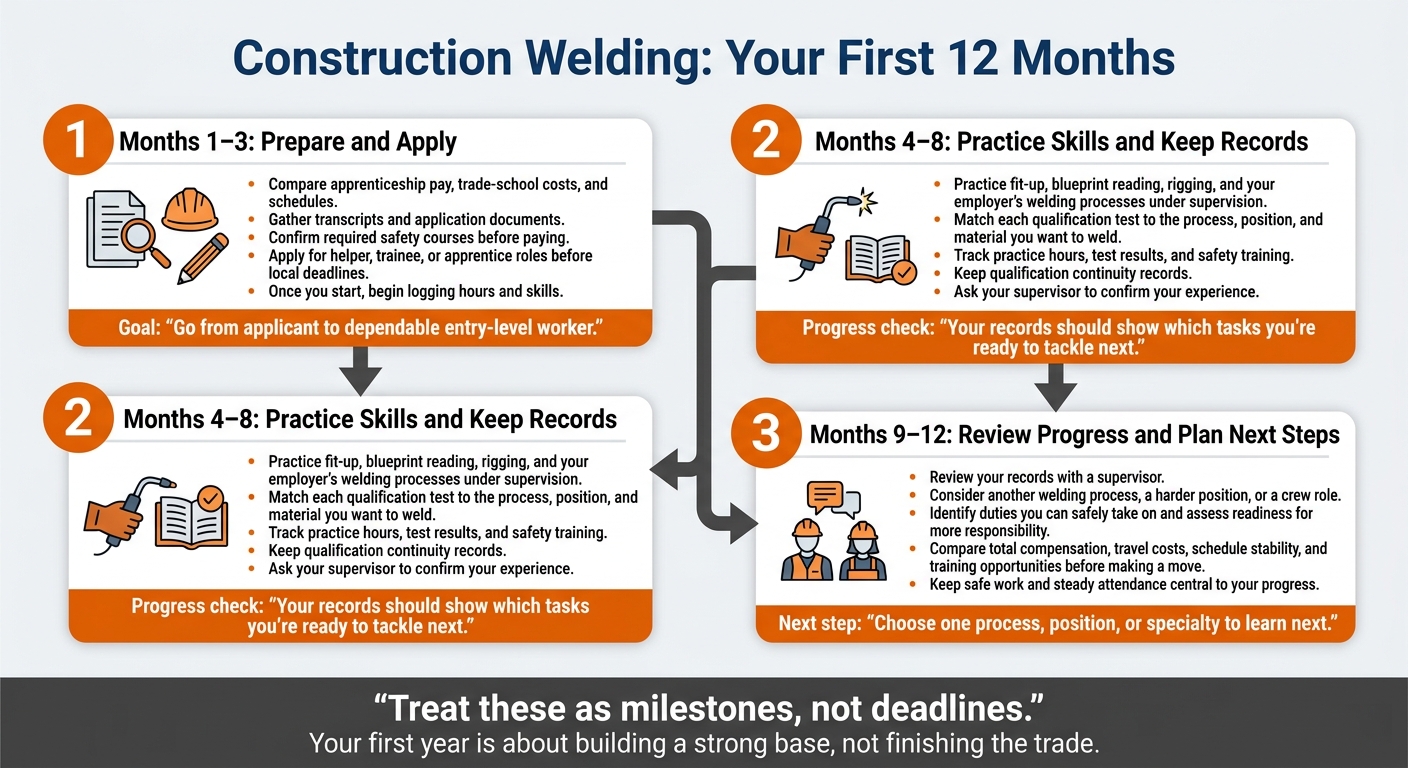
Construction Welding: Your First 12 Months
Months 1–3: Prepare and Apply
Your first goal: go from applicant to dependable entry-level worker. Compare apprenticeship pay, trade-school costs, and schedules. Gather your transcripts and application documents, confirm required safety courses before paying, and apply for helper, trainee, or apprentice roles before local deadlines. Once you start, shift your focus from applications to logging hours and skills.
Months 4–8: Practice Skills and Keep Records
Practice fit-up, blueprint reading, rigging, and your employer’s welding processes under supervision. Match each qualification test to the process, position, and material you want to weld. Track practice hours, test results, and safety training. Keep qualification continuity records, and ask your supervisor to confirm your experience. By the end of this phase, your records should show which tasks you’re ready to tackle next.
Months 9–12: Review Progress and Plan Next Steps
Review your records with a supervisor to decide what comes next: another welding process, a harder position, or a crew role. Identify duties you can safely take on and whether you’re ready for a welding role with more responsibility – not just more training.
Before making a move, compare total compensation, travel costs, schedule stability, and training opportunities. Choose one process, position, or specialty to learn next, while keeping safe work and steady attendance at the center of your progress.
Treat these as milestones, not deadlines. Your first year is about building a strong base, not finishing the trade.
FAQs
Can I transfer welding qualifications between employers?
Welding qualifications generally don’t transfer between employers or union locals. An AWS Certified Welder credential provides portable proof of skill, but it isn’t a universal license. Most employers and locals still require hands-on weld tests using their own coupons.
If you’re changing union locals, check your status with the new local. Apprenticeship credits and journeyman recognition don’t transfer automatically.
How do I know I’m ready for a welding job?
You’re ready when you can consistently pass hands-on weld tests, document your welding experience, and meet the site’s performance requirements. You’ll also need current OSHA 10 or 30 certification, the required personal protective equipment (PPE), and a solid grasp of safety practices.
For union work, you’ll need a high school diploma or GED, a valid driver’s license, and physical stamina. Be prepared to pass math and mechanical reasoning tests, too.
Which welding skills can increase my pay?
Focus on specialized certifications and in-demand skills, such as AWS certifications for structural steel (D1.1) or stainless steel (D1.6), along with pipe welding skills. Specializing in pipeline or underwater welding can also help you earn more.
OSHA safety training and industry-recognized credentials can help you qualify for higher-paying roles. ABLEMKR can connect you with projects that need your specialized skills, while union benefits can add to your total compensation.


