
If you need to staff remote jobs, the main problem changes by sector: construction usually struggles with movement and timing, while energy struggles with clearance and shift coverage.
I’d sum it up like this: both sectors need the right worker, in the right place, with the right training. But construction crews often get slowed by changing sites, local rules, trade licensing, and moving schedules. Energy crews are more likely to get blocked by gate approval, permit-to-work steps, H2S or LOTO training, camp travel, and 24/7 staffing needs.
A few numbers make the gap clear:
- 45% of U.S. construction firms reported project delays tied to labor shortages in 2025
- 76% of contractors in energy-type settings said clearance-to-work delays had pushed back a planned start at least once
- 45% said their most recent delay lasted 3 days or more
- Energy sites must cover 8,760 hours per year before leave, training, and fatigue limits are added
If you’re comparing the two, here’s what matters most:
- Site access: construction gates are often handled by the GC; energy entry usually needs multi-team approval
- Safety rules: construction follows mobile jobsite rules; energy adds process safety, PTW, and hazardous energy control
- Credentials: construction leans on OSHA cards and trade licenses; energy adds site induction, H2S, LOTO, and sometimes MSHA
- Travel: construction often means regional driving; energy often means flights, long drives, and employer-set lodging
- Scheduling: construction deals with staggered trades and weather; energy deals with no-gap rotation coverage and outage staffing
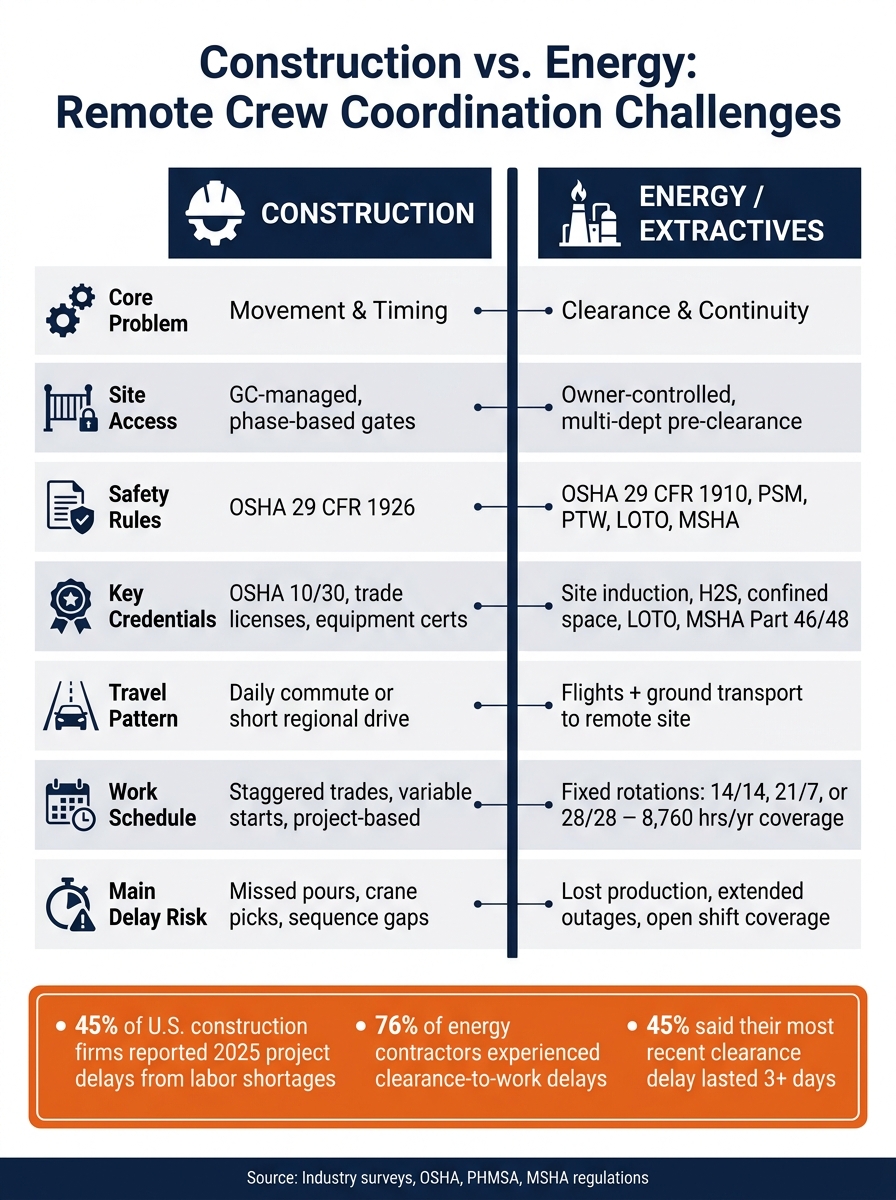
Construction vs. Energy: Remote Crew Coordination Challenges at a Glance
Quick Comparison
| Area | Construction | Energy / Extractives |
|---|---|---|
| Main coordination issue | Moving people as the job shifts | Clearing people to enter and keeping every shift filled |
| Site access | GC-managed, phase-based | Owner-controlled, pre-cleared entry |
| Safety focus | OSHA 29 CFR 1926 | OSHA 29 CFR 1910, PSM, PTW, LOTO, MSHA where needed |
| Common credentials | OSHA 10/30, trade cards, equipment certs | Site orientation, H2S, confined space, LOTO, MSHA Part 46/48 |
| Travel pattern | Commute or short regional drive | Flight + ground transport to remote site |
| Work pattern | Project-based, variable starts | Fixed rotations like 14/14, 21/7, or 28/28 |
| Main delay risk | Missed pours, picks, or sequence changes | Lost production, longer outages, open coverage gaps |
Bottom line: if I’m staffing construction, I’m watching location, license rules, and daily schedule changes. If I’m staffing energy, I’m watching clearance, training status, travel setup, and round-the-clock coverage. That split is the core of the article below.
sbb-itb-aa28329
Site Access and Safety Rules: Where Coordination Diverges
Construction sites: shifting locations and contractor-managed access
Construction site access changes all the time. The general contractor (GC) runs the gate and manages the worker roster, but those rules often shift as the project moves from one phase to the next. Local permits and municipal rules also decide when crews can enter the site and start work. When permits get held up, the schedule usually slips with them.
If a worker gets stopped at the gate, the fix is often pretty direct. A GC superintendent or safety manager can step in, issue a temporary badge, run a short orientation, or add the worker to the sign-in list.
Energy sites: controlled entry and process safety requirements
Energy sites work very differently. Entry is tightly controlled. No one gets in without written clearance, and that clearance usually involves security, operations, the control room, and HSE.
Before a remote crew enters an active process unit, a permit-to-work (PTW) has to be submitted, reviewed, and approved. If the job involves hot work, confined space entry, or line breaking, the crew also needs current lockout/tagout (LOTO) records under OSHA 29 CFR 1910.147. That rule requires each authorized worker to apply a lock or tag to each energy-isolating device before servicing starts. So even one missing training module or an expired badge can hold up an entire crew while several departments check compliance.
That slowdown shows up in the data. A survey of contractors in these settings found that 76% had dealt with clearance-to-work delays that pushed back their planned start date at least once, and 45% said their most recent delay lasted three days or more. Another 94% said most delays came from process-related problems, such as approvals, portal issues, or missing paperwork, not from the safety rules themselves.
Those clearance steps shape what workers need to prove before day one. That’s why certifications and pre-access checks become the next choke point.
OSHA construction rules vs. energy and process safety compliance
OSHA 29 CFR 1926 applies to construction hazards that move with the job. OSHA 29 CFR 1910 and PSM apply to fixed energy facilities. MSHA applies to mining and extractives.
The table below shows the main differences:
| Factor | Construction | Energy / Extractives |
|---|---|---|
| Site type | Moving job sites: highways, bridges, data centers, industrial expansions | Fixed assets: refineries, pipelines, wind/solar farms, mine sites |
| Access control | GC or construction manager; contractor-run gates | Owner-operator; security, operations, and HSE approval required |
| Approval chain | Short: superintendent, safety manager, owner’s rep | Multi-department: security, control room, HSE, operations management |
| Primary safety rules | OSHA 29 CFR 1926 (falls, excavation, equipment) | OSHA 29 CFR 1910 / PSM, with MSHA for mining and extractives (process integrity, LOTO, PTW) |
| Impact of access delays | Schedule slippage, missed pours or crane picks, liquidated damages | Lost production and longer outages |
Once access rules are set, the next bottleneck is simpler to spot: what each worker has to bring to the gate.
In construction, a delayed crew might miss a pour or crane pick. In energy, that same kind of delay can stretch an outage and leave production sitting idle.
Certifications and Travel: What Workers Need Before Day One
Construction credentials: trade cards, OSHA training, and local requirements
In construction, crews usually need OSHA 10 or 30 along with the license or certification tied to the job. That might mean a journeyman electrician card, an NCCER credential, or a crane operator certification. Federal OSHA doesn’t require workers to carry those cards, but owners and general contractors often make them a condition of access. Many jobs also require site orientation and badge approval before anyone can start.
The catch is that requirements can change from one project to the next and from state to state. A trade license may need reciprocity or a temporary permit in another state. Equipment training can also change by site. The most common pre-mobilization slowdowns in construction come from expired OSHA cards, out-of-state trade licenses, missing equipment-specific qualifications, and incomplete onboarding paperwork.
Once those credentials are set, travel rules often become the next gatekeeper.
Energy credentials: site orientations, specialized safety training, and pre-access checks
Energy work adds one more layer. Process-safety rules sit on top of the usual credential checks. Workers typically need site orientation, plus task-based training such as H2S, confined space, LOTO, hot work, and permit-to-work clearance before they can begin.
Mining and extractive work add still more. MSHA requires 40 hours of training for new underground miners and 24 hours for new surface miners, followed by annual refresher training. During shutdowns and turnarounds, all of that onboarding gets squeezed into a short window. There’s almost no margin for error. An expired MSHA card or an incomplete site induction can send a worker home at the gate.
How travel, per diem, and rotation schedules affect worker retention
Construction workers usually commute each day or drive a short distance to regional projects. Per diem often starts when a site is far enough from a worker’s tax home that daily commuting no longer makes sense. Workers often line up their own housing. That makes things simpler for the employer, but it can also make commute times and fatigue harder to predict.
Energy work runs on a different setup. Remote sites often mean flights to a regional hub, then long drives to the facility. Employer-managed camps or designated hotels are common when the nearest town is hours away. Offshore and remote rotations often use 14/14 schedules – 14 straight 12-hour shifts, then 14 days off – though 21/7 and 28/28 patterns also show up. Mid-tour shift changes cause the most circadian disruption, while fixed day or night tours are easier to handle. If travel time isn’t paid, lodging isn’t locked in, or per diem is too low, retention can fall fast.
ABLEMKR matches pre-vetted workers to jobs by certification, training, availability, and location. That helps cut gate rejects and wasted travel.
That credential-and-travel load leads straight into the next issue: keeping daily schedules visible and lined up.
| Factor | Construction | Energy / Extractives |
|---|---|---|
| Common credentials | OSHA 10/30 Construction, trade licenses, equipment certs | OSHA 10/30 General Industry, site induction, H2S, LOTO, MSHA Part 46/48 |
| Verification method | Physical cards, GC onboarding review | Contractor management systems, digital profiles, gate checks |
| Typical travel pattern | Daily commute or short regional drive | Long-distance flights + ground transport to remote sites |
| Per diem trigger | Site far enough from tax home to make daily commuting impractical | Employer-booked travel and lodging common |
| Rotation model | Standard weekday shifts, occasional 4x10s or 5x10s | 14/14, 21/7, or 28/28 with 12-hour shifts |
| Primary fatigue driver | Extended overtime weeks | Long consecutive shifts + travel days + mid-tour schedule changes |
Shift Planning and Workforce Visibility: Daily Scheduling vs. 24/7 Coverage
Once crews are cleared and travel is locked in, the next job is simple to describe and hard to pull off: keep every shift filled.
Construction scheduling: staggered trades, moving crews, and variable start times
Construction schedules can change by the day. Electricians might start at 5:00 a.m., mechanical crews at 7:00 a.m., and finishers later, all while staying out of each other’s work zones. When those teams overlap, safety risk goes up and production can slow down.
Weather can throw the whole sequence off. Multi-site crews may also bounce from one job to the next, each with different badges, start times, and supervisors. By the time the day begins, office teams are often looking at stale data.
Energy scheduling: fixed rotations, outage staffing, and continuous operations
Energy scheduling works a bit differently. The main issue isn’t moving crews through project phases. It’s making sure there are no coverage gaps.
Energy sites need nonstop staffing. Refineries, power plants, and pipeline control rooms have to cover every shift, every day. That adds up to 8,760 coverage hours a year before leave, training, or fatigue controls even enter the picture. To handle that load, operators use set rotation patterns like DuPont (4-4-4), Panama (2-2-3), and 7-on/7-off to divide day and night shifts across crews.
During outages and turnarounds, headcount can jump fast. Sites may bring in hundreds of contractors working 10- to 12-hour shifts for weeks at a time. In that setting, one empty key role can stretch downtime and increase losses far more than a missed day on a construction project. As PHMSA notes, in regular cyclic 24/7 operations, the number of crews should exceed the number of shifts per day so that at least one crew is off each day.
That’s where manual coordination starts to crack. Spreadsheets, group texts, and paper timesheets can only carry so much weight. Schedulers may not know:
- who is close to maximum hours
- which workers are already cleared for a certain area
- where the next coverage gap is about to open
And by the time they spot the issue, it can be almost too late to fix.
How ABLEMKR supports remote crew deployment

This is where mobile workforce tools make a big difference.
ABLEMKR matches pre-vetted workers to open shifts based on certification, safety training, availability, and location. That gives coordinators a clearer view of who is on-site, in transit, or ready for the next rotation window. For a last-minute shutdown, a remote pipeline repair, or a planned mine development job, crews can be matched and mobilized without the back-and-forth that slows manual methods.
Conclusion: Key Coordination Gaps Between Construction and Energy
Construction and energy both depend on remote crews, but the weak spots aren’t the same. Construction is a mobility problem. Energy is a control and continuity problem.
Here’s where that split shows up most clearly:
| Area | Construction | Energy |
|---|---|---|
| Site access | GC-managed, phase-based | Controlled entry, pre-clearance |
| Safety focus | OSHA 29 CFR 1926 | PSM, PTW, hazardous energy control |
| Certifications | OSHA 10/30, trade/local cards | Site induction, H2S, confined space, operator credentials |
| Travel/rotation | Regional, project-based | Long-distance, structured rotations |
| Scheduling | Staggered trades, variable starts | 24/7 coverage, outage staffing |
Those differences lead to different breakdowns. In construction, the trouble usually starts with timing. A worker may be available, but not in the right place at the right moment. In energy, the bigger risk is clearance and coverage. If one piece is missing – site access, training, permit alignment, or shift coverage – the job can stall fast.
This matters even more now that the lines between these sectors are starting to blur. Renewables, EV infrastructure, and grid upgrades mix construction mobility with energy-grade safety. That means crews often need both: the flexibility to move like construction labor and the pre-clearance expected on energy sites. As that overlap grows, coordination gets harder for both sides.
That’s why deployment tools matter. By matching pre-vetted workers to open roles based on certification, safety training, availability, and location, ABLEMKR helps coordinators move crews into place faster – closing the gap between scheduling and actual day-one readiness before mobilization.
FAQs
Why are energy crew delays often worse than construction delays?
Energy crew delays tend to hit harder. Remote sites are high-risk, tightly regulated, and much harder to manage in the moment.
A few common problems can knock a whole crew off schedule fast: poor connectivity, safety incidents, equipment trouble, or missing certifications. And because these jobs need specialized workers who are harder to replace, delays usually last longer and cost more money.
Which credentials matter most before remote workers arrive on-site?
Before remote workers arrive on-site, make sure all certifications, safety training, and site-specific credentials are up to date.
This usually means checking key documents like a government-issued photo ID, work authorization, and training records such as OSHA 10/30, TWIC cards, welding qualifications, and site-specific safety orientations.
Doing this vetting ahead of time helps prevent delays, keeps unqualified workers off-site, and supports compliance from day one.
How can companies reduce clearance and coverage gaps?
Companies can cut clearance and coverage gaps by moving from manual, paper-based tracking to integrated digital workforce management platforms.
These systems automate certification tracking, flag expiring credentials, keep verified worker profiles in one place, and support geo-location matching and mobile onboarding. That helps managers assign workers with the right qualifications, get people on-site faster, and keep compliance records current and ready for audits.


