
If you work in construction or energy, remote communication is not the same problem. In construction, the main risk is missed updates that cause rework, delays, and extra cost. In energy, the main risk is a bad handoff that can lead to injury, outages, or rule violations.
Here’s the short version:
- Construction runs on moving crews, changing sites, and many subcontractors.
- Energy runs on fixed or remote assets, 24/7 shifts, and strict work controls.
- Construction teams lean on phones, texts, radios, and cloud plan-sharing.
- Energy teams lean on control rooms, radios, satellite links, shift logs, PTW, and LOTO records.
- Construction problems often come from version control, crew turnover, noise, and language gaps.
- Energy problems often come from weak signal, alarm overload, shift handovers, and permit confusion.
- In both fields, the best setup comes down to 3 things: clear reporting, worker verification, and set escalation rules.
A missed drawing update can cost hours or days. A missed isolation update can cost far more. That’s why I see construction as a coordination-heavy job and energy as a control-heavy job.
Quick Comparison
| Criteria | Construction | Energy |
|---|---|---|
| Work setup | Project-based | Asset-based |
| Site type | Temporary, changing | Fixed or remote |
| Schedule | Project cycle | 24/7 |
| Main communication style | Fast, spread across many parties | Formal, rule-driven |
| Main tools | Texts, smartphones, radios, cloud platforms | Radios, SCADA, shift logs, satellite, PTW systems |
| Main risk of poor communication | Rework, delays, cost overruns | Safety events, outages, rule issues |
| Staffing need | Fast onboarding and crew changes | Checked credentials and shift continuity |
| Best control focus | Plan updates and crew alignment | Handover quality and work authorization |
If you want remote teams to work well, you can’t use one communication model for both. You need one system for fast-moving job sites and another for high-risk, always-on assets.
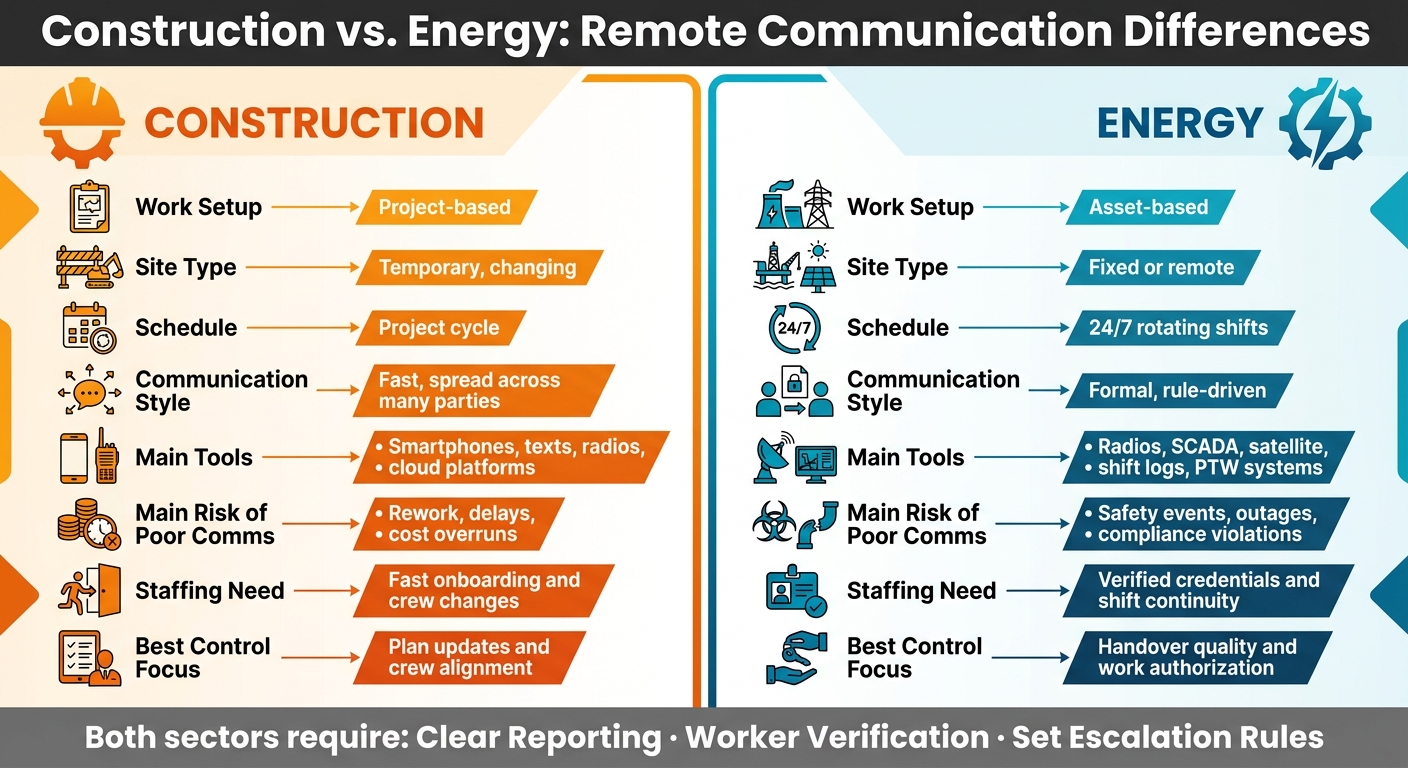
Construction vs. Energy Remote Communication: Key Differences at a Glance
Construction Remote Communication: Coordinating Fast-Moving Crews Across Job Sites
Construction communication has to move fast across crews, trades, and job sites. And because work is spread out, the pressure shows up most on active sites, where people are moving, plans shift, and delays can snowball fast.
How Construction Teams Communicate Day to Day
Most days start with toolbox talks, pre-task planning meetings, and job hazard analyses. That’s where foremen cover hazards, work sequence, and any changes before crews get going. On a busy site, that sets a simple chain of communication: the foreman gets the update first, then passes it to the crew.
The office sends updated drawings, RFIs, approvals, and schedule changes. The field sends back daily logs, inspection notes, and jobsite updates. In the middle of all that, foremen turn office direction into short, clear instructions people can act on right away.
Most crews now check current plans and task updates through cloud project platforms. That matters more than it may seem. If someone works from an old drawing, rework and delays usually follow.
Common Communication Problems in Construction
The biggest headache is fragmented information across subcontractors. Each crew may have its own supervisor, its own habits, and its own way of passing things along. So when a schedule changes or a safety notice goes out, getting that message to everyone fast – and making sure they all got the same message – can be tough.
Document version control is right behind it. When a drawing is revised, every foreman and subcontractor needs the new file before work keeps moving. If even one crew misses it, the whole job can drift off course.
Language barriers add another layer. Plain-language messages, translated safety material, and visual alerts help fill the gap. Then there’s the jobsite itself: noise, motion, and heavy activity. In that setting, phone calls and radios don’t always work well for information that has to be understood correctly the first time.
Tools and Workforce Systems Used on Construction Projects
To cut down on those breakdowns, teams use mobile tools that keep the field and office aligned.
- Smartphones and text alerts usually reach field workers the fastest.
- Radios still matter in spots with weak cell coverage or where hands-free communication is safer.
- Cloud platforms keep drawings, RFIs, safety forms, and daily logs in one place so the office and field work from the same version.
Digital daily reports and field logs give project managers real-time visibility into progress, worker status, and safety events without waiting for end-of-day paperwork. That direct line of sight helps with schedule control and cost tracking.
For companies managing distributed labor across multiple U.S. job sites, ABLEMKR adds another layer of coordination. By matching pre-vetted workers by certification, safety training, availability, and location, ABLEMKR gives employers real-time worker status, compliance tracking, and faster crew mobilization.
sbb-itb-aa28329
Energy Remote Communication: Coordinating High-Risk and Remote Operations
Energy sites never sleep. They run 24/7, which means communication has to be fast, traceable, and tied directly to safety. If communication slips, the result isn’t just a slow day on the job. It can lead to equipment damage, compliance issues, or serious incidents.
How Energy Teams Communicate Across Assets and Shifts
Energy work revolves around assets, so the control room sits at the center of day-to-day communication. Operators watch SCADA systems that pull live data from substations, compressor stations, turbines, and field sensors. When something looks wrong, a pressure issue on a pipeline segment, an inverter trip at a solar farm, or an abnormal sensor reading at a refinery unit, the control room sends out a technician and follows the response as it happens. In plain terms, technician dispatch isn’t separate from communication. It is part of the system.
Shift handovers matter just as much. Incoming operators need a full picture of active alarms, isolations, and open work orders because weak handovers push incident risk higher. Many utilities and oil & gas operators use structured electronic shift logs with required fields for open work orders, temporary bypasses, and safety system status. After that, they back it up with a verbal handover and a standard checklist.
Planned shutdowns and outages add even more moving parts. Outage control centers may be coordinating many crews and contractors at the same time, running daily coordination meetings, and watching critical-path tasks on centralized dashboards. If the scope changes or the schedule moves, that update has to go out through set channels so teams don’t end up working against each other or crossing safe system boundaries.
Common Communication Problems in Energy Operations
The same controls that keep energy work organized can also create risk when teams are spread out across remote sites, hazardous areas, and rotating shifts. A lot of U.S. energy locations are far from towns or major roads, and cell service can be weak or missing altogether.
Permit-to-work (PTW) and lockout/tagout (LOTO) procedures make communication even more sensitive. These steps are tied directly to worker safety. The permit issuer has to spell out the work scope, isolation points, hazards, and required controls to every person involved. If there’s confusion about which equipment is de-energized, the outcome can be fatal. And when that message is being passed over a radio in a remote area, the room for error gets even tighter.
Incident escalation brings a different kind of pressure. During a major equipment failure, severe weather event, or process upset, control rooms can get slammed with alarms. Without clear escalation thresholds and set notification paths, the most urgent information can disappear into the noise. High-reliability operators deal with this by deciding ahead of time which alarm combinations trigger automatic alerts to supervisors, safety teams, and executives. They also run drills so people can practice communication under pressure instead of figuring it out in the moment.
Tools and Workforce Systems Used in Energy Operations
That’s why energy teams don’t rely on just one app or device. They build backup channels into the job. Two-way radios are still the backbone of field communication in energy, especially where cellular coverage is weak. In hazardous areas such as refineries, gas processing plants, and some mining settings, workers use intrinsically safe radios and smartphones rated for use around flammable gases or dust. These hazardous-location-rated devices are also helping teams move away from paper-based PTW processes toward digital forms, checklists, and live messaging.
Satellite phones and terminals cover the jobs that are far off the grid, offshore platforms, remote pipeline stretches, and mine exploration camps where no ground network reaches. Most operators also build in redundancy with a setup like this:
- A primary radio channel
- A cellular backup
- Satellite as the last resort
- Set check-in intervals for crews entering known dead zones
On the operations side, electronic logbooks and alarm management systems help connect the dots. On the workforce side, compliance-linked systems track contractor certifications, safety training, and medical fitness before anyone steps onto a regulated site. When an unplanned shutdown hits or a pipeline repair has to move fast, operators don’t have time to manually check every contractor’s credentials. ABLEMKR tackles that problem by matching pre-vetted workers to energy sites based on certification, safety training, availability, and location, helping teams mobilize fast without giving up compliance.
Construction vs. Energy: Key Communication Differences That Affect Staffing and Safety
After looking at each sector on its own, the big split comes down to one thing: how much weight the communication system has to carry.
Where Both Sectors Share the Same Communication Needs
Both sectors rely on mobile, auditable updates to keep crews on the same page when schedules, conditions, or equipment shift. If a crane delivery shows up late or a compressor trips, people need fast, clear notice right away.
So yes, the need is similar. The way each sector operates is not.
Where Construction and Energy Require Different Communication Models
The biggest difference is structure.
Construction communication is flexible by design. Crews change. Subcontractors come and go. Site layouts shift as the job moves from one phase to the next.
Energy communication is formal by necessity. It sits around fixed assets, 24/7 operations, and regulatory rules that leave little room to wing it.
| Dimension | Construction | Energy |
|---|---|---|
| Work environment | Temporary, changing sites with shifting hazards and access routes | Fixed or remote assets with stable layouts and harsh conditions |
| Crew structure | Layered subcontracting with a general contractor, multiple trades, and specialized subcontractors that grow or shrink by phase | Fixed operational teams plus contractors for turnarounds or outages |
| Connectivity | Relies on commercial cellular service, temporary Wi-Fi, and radios; dead zones are common | Assumes limited or no cell coverage and uses two-way radios, satellite, microwave links, or hardwired communication tied to control systems |
| Documentation | RFIs, change orders, daily reports, punch lists, and inspection records | Operating logs, permit-to-work records, lockout/tagout documentation, and regulatory safety and environmental reports |
| Safety procedures | Site orientations, daily safety meetings, task hazard analyses, and enforcement of PPE and fall protection | Formal work-control systems, hot/cold work permits, confined space permits, and formal lines of authority |
| Shift patterns | Standard day shifts with occasional nights and weekends | 24/7 rotating shifts, often in 8-, 10-, or 12-hour blocks |
| Emergency communication | Site evacuations, severe weather, equipment incidents, and medical emergencies managed by on-site supervisors | Process upsets, leaks, fires, and grid events managed through pre-defined incident command structures and control rooms |
These differences hit staffing in a direct way.
In construction, project managers need communication tools that can handle fast onboarding and daily crew turnover. In energy, operations supervisors need systems built for formal shift handovers, documented authority, and auditable records.
That same structure helps explain why pipeline operators depend on documented handovers, communication rules, and alarm-response procedures.
Communication Barriers and How Each Sector Addresses Them
You can see those structural gaps most clearly when communication starts to fail. In practice, the barriers usually fall into four buckets:
| Barrier | Construction Response | Energy Response |
|---|---|---|
| Noise and physical interference | Spotters use hand signals and radios; safety stops are called verbally and backed by signage | Intrinsically safe radios and rated devices are used in hazardous areas; PA systems supplement radio in loud process areas |
| Poor or unreliable signal | Temporary cellular boosters or Wi-Fi on large sites, with radio as the primary backup | Layered redundancy with primary radio, cellular backup, and satellite as a last resort, plus set check-in intervals for dead zones |
| Language and literacy differences | Multilingual safety signage, translated toolbox talks, and bilingual safety leads | Structured checklists and visual permit-to-work forms reduce reliance on verbal communication, supported by training for contractor crews |
| Escalation complexity | On-site supervisors and safety leads manage incident response; the general contractor coordinates with the owner and emergency services | Pre-defined alarm thresholds trigger alerts to supervisors, safety teams, and executives; regular drills reinforce escalation paths |
In construction, these barriers are usually operational problems. In energy, the same breakdowns can turn into safety and compliance risks fast.
That gap shapes the kind of communication system employers need to put in place.
How to Build Better Remote Communication Systems in Construction and Energy
What Employers Should Focus On
Communication systems break down when they don’t fit the jobsite. The answer isn’t sending more messages. It’s setting clear rules for what gets sent, who sends it, and which channel they use.
Start with standard reporting, then support it with backup channels like cellular, radio, and satellite when sites are remote. Set the same rules for what gets reported, who sends it, and when it needs to go out. Poor communication can consume a large share of project time. In construction, crews change fast, so field updates need to be fast and repeatable. In energy, communication has to be tied to control and safety systems, with records that hold up across shifts. Different settings, same core need: tight reporting discipline.
Once the reporting channel is steady, the next weak spot is worker verification. Digital onboarding and certification tracking are communication controls, not just HR work. If a dispatcher can check in real time whether a worker has an active OSHA 30, H2S certification, or TWIC card, that cuts delays and helps avoid compliance gaps before mobilization. ABLEMKR matches pre-vetted workers by certification, safety training, availability, and location, with compliance tracking built into deployment.
After worker status comes the last major control: escalation. Set rules for who gets notified, through which channel, and within what time window for each event type, such as a schedule conflict, equipment issue, safety incident, or permit delay. Without that setup, escalation turns into a scramble, where the first person to answer the phone ends up driving the response instead of one clear chain with set response times.
Those three controls – reporting, verification, and escalation – separate a system people can use from one that falls apart under pressure. For multi-site construction work or energy assets spread across regions, use the same status codes, report format, and escalation chain at every location. That kind of consistency helps office teams compare sites and spot trouble early.
Key Takeaways
Construction communication is project-driven and fragmented by nature. Crews shift, subcontractors rotate, and site conditions can change in a hurry. Energy communication is asset-centered and procedure-heavy, built around fixed infrastructure, 24/7 shifts, and records that need to be auditable. Employers that close the gap fastest treat standard channels, reporting fields, and escalation rules as one connected system, not three separate issues.
FAQs
Why can’t construction and energy use the same communication model?
Construction and energy need different communication models because the job itself looks different in each field, and the risks are high.
Construction runs on fast, mobile-first coordination. Site conditions can shift day by day, sometimes hour by hour, so teams need to communicate on the spot and keep work moving.
Energy teams face a different problem. They often work in remote areas with weak or unreliable service, which makes offline access a must. They also need automated compliance tracking to help keep records straight without adding extra manual work.
Both fields share a few core needs that standard messaging tools just don’t handle well:
- Safety verification
- Labor matching
- Real-time workforce visibility
That’s the gap. Basic chat apps may help people send messages, but they weren’t built for high-risk job sites where timing, safety, and crew status matter every day.
What communication tools work best on remote construction and energy sites?
The best tools blend real-time and async communication in mobile-first platforms made for field work.
That matters because generic apps often miss what crews need on the job: offline access, geo-location safety tracking, and compliance support. On paper, a standard chat or video app can look fine. Out in the field, it can fall short fast.
Useful options include:
- Video conferencing for safety huddles and visual inspections
- Integrated messaging for fast field-to-office updates
- Shared dashboards and cloud-based documents for schedules, progress, and safety protocols
- Mobile-first workforce platforms like ABLEMKR for hiring, compliance tracking, and worker matching
How can employers reduce communication failures across crews and shifts?
Employers can cut communication failures by moving away from scattered, manual workflows and using centralized, mobile-first platforms instead. That gives teams one place to check messages, updates, and job details, without chasing texts, paper notes, or missed calls.
It also helps to set clear rules for communication. Urgent safety alerts shouldn’t look or sound the same as routine updates. When everything comes through the same way, people can miss what matters most.
For more complex situations, video calls can make a big difference. They’re useful for repair walkthroughs, detailed handoffs, and safety briefings where a quick text just won’t do the job.
At the same time, real-time cloud systems, archived shift logs, and offline-capable tools help crews stay on the same page. They make it easier to share the same information, track unresolved issues, and keep people connected even in remote locations.


