
Understanding NAICS codes is essential for businesses in construction and energy sectors. These codes classify industries based on their activities, impacting compliance, labor regulations, and access to federal contracts. Construction falls under Sector 23, covering building projects, while energy-related activities span Sector 21 (Mining, Quarrying, Oil, and Gas Extraction) and Sector 22 (Utilities). Misclassification can result in lost opportunities or regulatory issues.
Key Points:
- Sector 23 (Construction): Includes residential, commercial, and infrastructure projects.
- Sector 21 (Energy – Mining, Quarrying, Oil, Gas): Covers resource extraction and related activities.
- Sector 22 (Utilities): Involves energy production and distribution.
- Federal contracts and SBA size standards depend on accurate classification.
- Misclassification risks include incorrect wages, ineligible bids, and compliance penalties.
Quick Comparison
Here’s a breakdown of key NAICS codes for construction and energy projects:
| NAICS Code | Industry Title | Scope | Examples | 2026 Revenue/Stats |
|---|---|---|---|---|
| 236210 | Industrial Building Construction | General industrial facilities | Warehouses, non-petrochemical plants | 294,755 businesses |
| 237120 | Oil/Gas Pipeline Construction | Oil/gas infrastructure | Refineries, pipelines | $48.9B revenue |
| 237130 | Power/Communication Line Construction | Power transmission/distribution projects | Power plants, substations | 2,508 businesses |
| 238210 | Electrical Contractors | Building electrical systems | Wiring, fiber optics | Specialty trade focus |
Accurate NAICS classification ensures compliance, proper workforce planning, and maximized contract opportunities. Missteps can lead to penalties or missed bids, so precision matters. Platforms like ABLEMKR help businesses align projects with the correct codes, ensuring compliance and better workforce management.
Construction NAICS Codes
sbb-itb-aa28329
NAICS Codes for Construction (Sector 23)
Sector 23 organizes businesses based on the type of construction they perform, ranging from residential buildings to large-scale infrastructure projects. The U.S. Bureau of Labor Statistics defines this sector as establishments "primarily engaged in the construction of buildings or engineering projects (e.g., highways and utility systems)". As of early 2026, there are approximately 1,406,173 construction businesses operating in the U.S.. These businesses employ around 8.3 million workers, with average hourly earnings of $40.55. The sector is further broken down into specific categories, which are explained below.
Main Construction Categories
The construction sector is divided into three main subsectors, each focusing on distinct activities:
- NAICS 236 (Construction of Buildings): This includes both residential projects, such as single-family homes, and nonresidential structures, like office buildings. Approximately 471,059 businesses specialize in residential construction, while 61,135 focus on nonresidential projects.
- NAICS 237 (Heavy and Civil Engineering Construction): This category handles large-scale infrastructure projects, including highways (2373) and utility systems (2371). As of January 2026, this subsector employed 1,195,800 people, with average hourly earnings of $42.06 and an average workweek of 43.2 hours. However, this area also comes with higher risks, as evidenced by 186 fatalities reported in 2024.
- NAICS 238 (Specialty Trade Contractors): This subsector includes subcontractors who focus on specific tasks like electrical work (238210) or plumbing and HVAC systems (238220). According to the U.S. Census Bureau, these businesses are "primarily engaged in specialized construction activities, such as plumbing, painting, and electrical work". It’s a vast category, with 111,721 electrical contractors and 177,781 plumbing/HVAC contractors registered.
Utility System Construction and Energy Overlap
NAICS 2371 (Utility System Construction) bridges construction and energy, focusing on projects like oil and gas pipelines (237120) and power transmission lines (237130). This subsector also includes infrastructure such as pumping stations and substations. Around 20,950 businesses operate in this field, with 2,393 specializing in oil and gas pipelines and 2,508 in power and communication lines.
A crucial distinction exists here: an independent contractor building a natural gas pipeline is classified under 237120, while construction done by a utility’s in-house team (known as force account construction) is categorized based on the utility’s primary sector. This detailed classification ensures that labor data and regulatory measures accurately reflect the specific nature of the work being performed.
NAICS Codes for Energy Projects
Energy projects have a unique classification system because they often combine construction and operational aspects. The applicable NAICS codes depend on whether the focus is on building infrastructure (Sector 23) or operating it (Sector 22). For example, companies constructing pipelines, power lines, or industrial facilities fall under Sector 23 (Construction). On the other hand, entities that manage and operate these systems for energy production or distribution are classified under Sector 22 (Utilities). To put this into perspective, the U.S. has about 48,626 utility entities, compared to over 1.5 million construction companies, highlighting the specialized nature of energy operations.
Energy Industry Codes
NAICS 237120 (Oil and Gas Pipeline and Related Structures Construction) focuses on building oil and gas pipelines, refineries, storage tanks, and pumping stations. It includes new construction, repairs, and reconstructions. This industry is expected to generate $48.9 billion in revenue by 2026, with modest growth of 0.11%, partly due to policy changes like the lifting of the raw crude oil export ban. Currently, around 2,393 businesses operate in this sector.
NAICS 237130 (Power and Communication Line and Related Structures Construction) applies to constructing electric power transmission lines, towers, substations, and power plants (excluding hydroelectric facilities, which are categorized under 237990). Approximately 2,508 businesses are engaged in this type of work. Specific tasks like tree and brush trimming for overhead lines fall under a different code: 561730.
NAICS 236210 (Industrial Building Construction) pertains to the construction of manufacturing and industrial buildings, such as chemical plants. However, petrochemical plants are classified under 237120. These distinctions are essential for accurate compliance and reporting.
Energy vs. Utility Classifications
The classification of a business depends on its primary function. For example, if you’re building a natural gas pipeline as a contractor, you fall under 237120. But if you’re a utility company operating that pipeline to distribute gas, you belong to Sector 22 (Utilities), specifically NAICS 2212 (Natural Gas Distribution). Similarly, constructing a power plant is classified under 237130, while generating and distributing electricity from that plant falls under NAICS 2211 (Electric Power Generation).
A unique case is force account construction, where a utility company builds its own infrastructure. This work is generally classified under the utility’s primary sector (Sector 22) unless handled by a separate construction-focused establishment. For example, electrical contractors working inside buildings use code 238210, while those constructing power transmission lines are classified under 237130. Proper classification ensures compliance and efficient workforce management, aligning with industry standards.
Construction vs. Energy: Direct Comparison
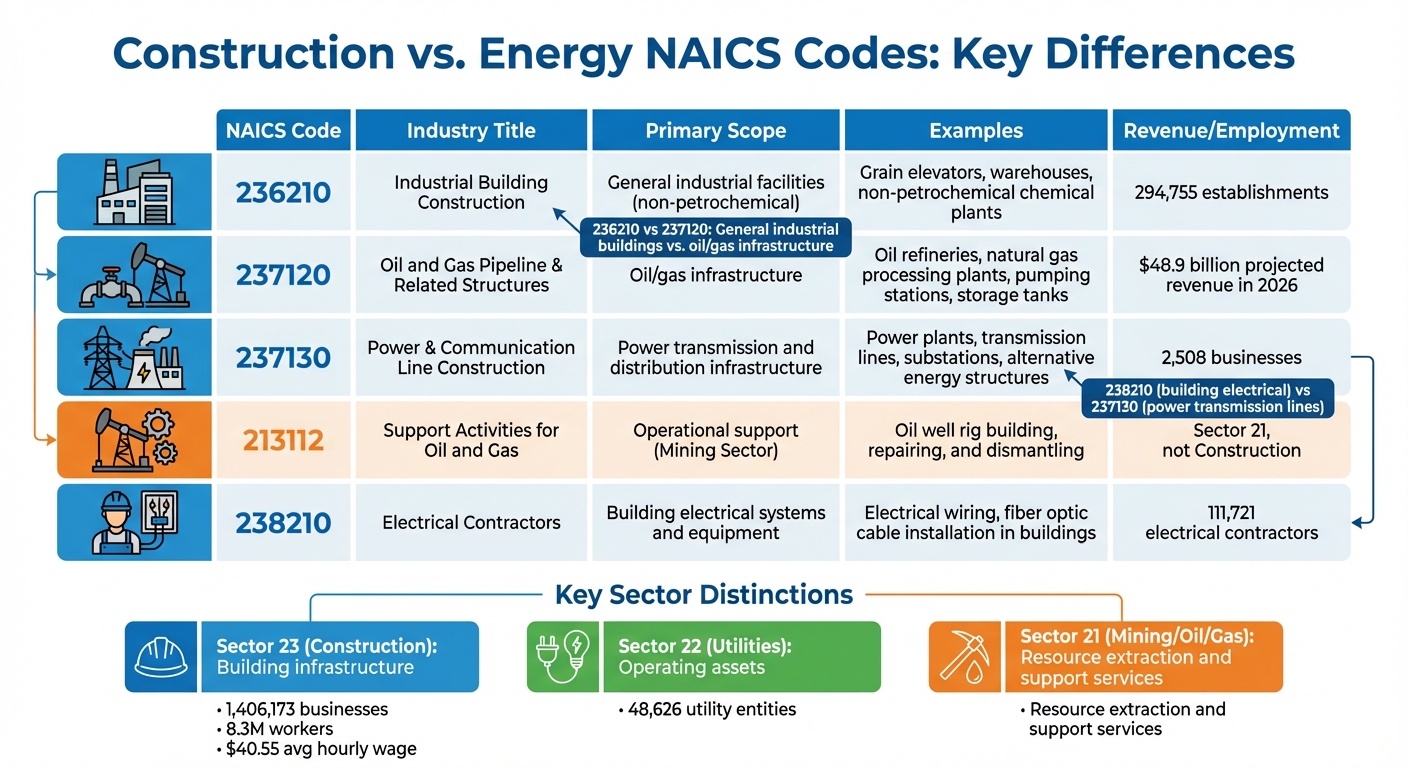
Construction vs Energy NAICS Codes Comparison Chart
Understanding NAICS codes requires focusing on their core functions: building infrastructure (Sector 23), operating assets (Sector 22), or providing support services (Sector 21).
Construction activities fall under Sector 23, which is divided into three main subsectors: 236 (Construction of Buildings), 237 (Heavy and Civil Engineering Construction), and 238 (Specialty Trade Contractors). Energy-related construction often overlaps with utility system projects, while operations and maintenance are categorized under different codes.
The workforce numbers show just how different these sectors are in scale. For instance, as of January 2026, the Construction of Buildings subsector employed roughly 1,855,400 people, while Heavy and Civil Engineering Construction had a workforce of 1,195,800. When it comes to businesses, there are approximately 294,755 private establishments in building construction, compared to 59,396 in heavy and civil engineering construction.
The table below provides a side-by-side comparison of key NAICS codes, their scopes, examples, and economic metrics.
Comparison Table
| NAICS Code | Industry Title | Primary Scope | Examples | Revenue/Employment |
|---|---|---|---|---|
| 236210 | Industrial Building Construction | General industrial facilities (non-petrochemical) | Grain elevators, warehouses, non-petrochemical chemical plants | 294,755 establishments |
| 237120 | Oil and Gas Pipeline & Related Structures | Oil/gas infrastructure | Oil refineries, natural gas processing plants, pumping stations, storage tanks | $48.9 billion projected revenue in 2026 |
| 237130 | Power & Communication Line Construction | Power transmission and distribution infrastructure | Power plants, transmission lines, substations, alternative energy structures | – |
| 213112 | Support Activities for Oil and Gas | Operational support (Mining Sector) | Oil well rig building, repairing, and dismantling | Sector 21, not Construction |
| 238210 | Electrical Contractors | Building electrical systems and equipment | Electrical wiring, fiber optic cable installation in buildings | Part of Specialty Trade Contractors |
A closer look at 236210 versus 237120 reveals an important distinction. Both deal with industrial construction, but 236210 focuses on general industrial buildings, such as warehouses and non-petrochemical chemical plants. In contrast, 237120 is specific to oil and gas infrastructure, including refineries and petrochemical plants. Similarly, while 238210 includes electrical work within buildings, projects like power transmission line construction fall under 237130.
These differences are crucial for compliance and understanding the economic and operational scope of each sector.
Compliance and Workforce Management
Getting NAICS classification right isn’t just a technicality – it’s the backbone of staying compliant with regulations and managing your workforce effectively.
Regulatory Requirements by Sector
NAICS codes play a key role in determining Small Business Administration (SBA) size standards, eligibility for federal contracts, and safety requirements. For construction firms, size thresholds vary, typically between $16.5 million and $45 million in average annual receipts, depending on the specific subsector. For example, a contractor earning $25 million annually qualifies as a "small business" under General Building Construction (NAICS 236220, with a $45 million limit) but is considered "other-than-small" under Electrical Contracting (NAICS 238210, with a $19 million limit).
"Your small business status is evaluated per NAICS code, not globally. You qualify as small under codes with thresholds above your three-year average receipts and as other-than-small under codes with lower thresholds." – ConstructionBids.ai
Safety data also highlight sector-specific risks. In 2024, Heavy and Civil Engineering Construction (NAICS 237) reported 1.8 injury and illness cases per 100 full-time workers, compared to 1.2 cases in Mining, Quarrying, and Oil and Gas Extraction. These differences have direct implications for workers’ compensation costs, insurance premiums, and required certifications. Since SAM.gov registration requires a primary NAICS code, misclassification can lead to penalties for false certification and disqualification from set-aside contracts.
The importance of accurate classification is clear. Missteps can result in severe consequences, as seen in a Bureau of Labor Statistics report from January 2021. Narrowly defining the oil and gas industry to four specific 6-digit codes (Sector 21) yielded an employment figure of 471,772. However, broadening the scope to include supply chain and output-related activities – such as NAICS 237120 (oil and gas pipeline construction) and NAICS 221210 (natural gas distribution) – brought the total to 2,006,970 workers, a difference of over 1.5 million.
How ABLEMKR Supports Proper Classification
ABLEMKR takes the guesswork out of compliance by aligning worker deployment with NAICS-specific regulations. The platform ensures workers are matched to projects based on their certifications, safety training, and location. For example, if a company posts a job for pipeline repair under NAICS 237120, ABLEMKR filters for workers qualified in oil and gas infrastructure rather than general construction labor. This approach reflects the NAICS principle of classifying establishments by their specific production processes.
The platform also includes compliance tracking to ensure workers in sectors like Heavy and Civil Engineering meet prevailing wage standards, with average hourly earnings in December 2025 at $42.06. Real-time visibility into worker status helps contractors avoid common errors, such as misclassifying personnel services under a parent company’s industry instead of the specific service provided. For federal contractors, this level of precision matters – those registered with five or more NAICS codes receive three times more automated bid alerts compared to those with just one code.
Conclusion
Grasping the difference between construction and energy NAICS codes is more than just a bureaucratic task – it directly affects profitability, compliance, and access to business opportunities. Construction activities generally fall under Sector 23, while energy extraction is categorized under Sector 21. Things get more complex with utility system construction, where projects like pipeline and power line work often overlap.
The numbers highlight the importance of getting these classifications right. For example, adding the construction of oil and gas infrastructure to the energy sector’s supply chain expands its workforce from around 472,000 to over 2 million workers. This illustrates the massive scale and impact of proper classification in these industries.
Why does accurate classification matter so much? It determines eligibility for small business set-asides and federal bid notifications, ensuring compliance while maximizing access to tailored federal opportunities. Misclassification can mean missing out on these chances or, worse, running into regulatory issues.
Platforms like ABLEMKR simplify this process by aligning workforce matching with precise NAICS requirements. For instance, when a company posts a pipeline repair job under NAICS 237120, the system filters for workers with the right oil and gas infrastructure credentials. This ensures compliance with wage standards – such as the $50.10 average hourly rate in Oil and Gas Extraction compared to $42.06 in Heavy and Civil Engineering as of December 2025 – and reduces the risk of costly misclassification errors.
Whether you’re assembling crews for a pipeline repair or staffing a utility infrastructure project, accurate NAICS classification is your key to staying compliant, competitive, and connected to the right opportunities. It’s far more than just paperwork – the stakes are too high to overlook.
FAQs
How do I choose the right NAICS code for a specific job?
To pick the right NAICS code, start by identifying the main activity that defines your business. For construction-related work, look at Sector 23 codes. For instance, 23611 applies to residential building construction, while 236210 covers industrial projects. Select the code that aligns with your primary source of revenue. Choosing the most precise code helps ensure accurate classification, maintain compliance, and qualify for relevant contracts.
When is a project Sector 23 vs. Sector 22?
A project falls under Sector 23 (Construction) if it involves activities like building, repairing, renovating, or land development. This includes work on structures such as highways, power plants, or pipelines.
On the other hand, Sector 22 (Energy) is dedicated to energy-related operations. This sector covers areas such as oil and gas extraction, utility services, and manufacturing processes directly tied to energy production.
To put it simply: Sector 23 is all about construction, while Sector 22 revolves around energy production and distribution.
What happens if I pick the wrong NAICS code?
Choosing the wrong NAICS code can lead to major headaches. Misclassifying your industry might cause compliance issues, financial penalties, or even legal trouble – especially in tightly regulated fields like construction and energy. Beyond that, it can mess up contracts, affect marketing strategies, and disrupt workforce planning. Getting the right code isn’t just about ticking a box; it’s about staying compliant, reporting accurately, and keeping operations running smoothly. It’s a small step that can save you from expensive mistakes down the line.


