
Construction doesn’t just have a hiring problem. It has a retention problem that hits skilled and unskilled workers in different ways. With 8.3 million people in the U.S. construction workforce and demand for about 499,000 more workers in 2026, many contractors are not losing people to other industries. They are losing them to other construction firms.
If I had to boil the article down, I’d say this:
- Entry-level turnover is often tied to pay, schedule swings, safety concerns, and weak onboarding.
- Skilled-trade turnover is more often tied to poaching, travel, overtime, project uncertainty, and admin problems.
- Skilled workers cost more to replace because licensing, training, and apprenticeship pipelines take years.
- Project delays are common when crews are short, with 45% of firms reporting delays tied to worker shortages in 2025.
- Retention needs to match the role: general labor needs clear pay, stable hours, and a path forward; skilled trades need assignment visibility, certification support, and fewer payroll or paperwork issues.
The bottom line: if you treat all construction turnover the same, you miss the root cause. A laborer leaving and an electrician leaving may both count as turnover, but the reason, cost, and jobsite impact are not the same.
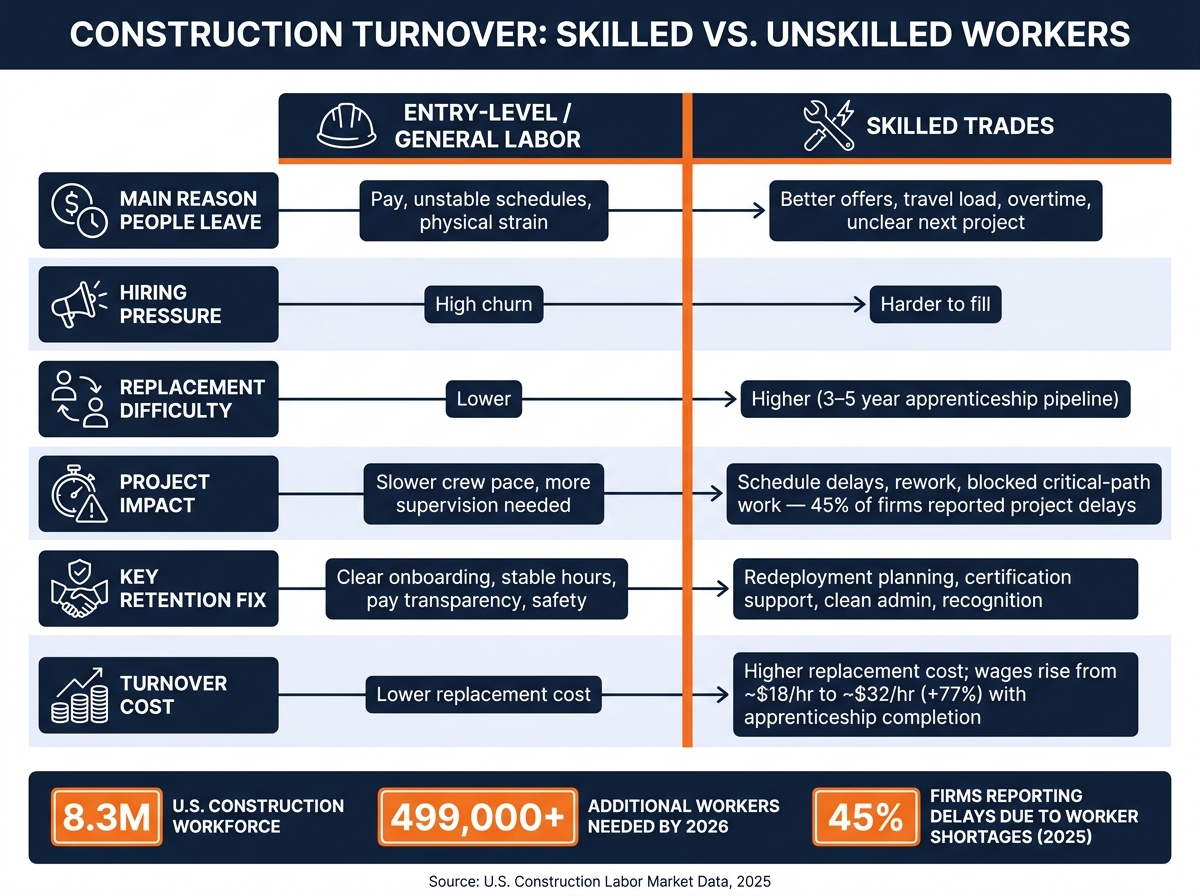
Skilled vs Unskilled Construction Worker Turnover: Key Differences
Keep Your Best Workers: How to Reduce Employee Turnover in Construction
sbb-itb-aa28329
Quick Comparison
| Area | Entry-Level / General Labor | Skilled Trades |
|---|---|---|
| Main reason people leave | Pay, unstable schedules, physical strain | Better offers, travel load, overtime, unclear next project |
| Hiring pressure | High churn | Harder to fill |
| Replacement difficulty | Lower | Higher |
| Project impact | Slower crew pace, more supervision | Delays, rework, blocked critical-path work |
| Best retention focus | Clear onboarding, steady hours, safety, pay clarity | Redeployment planning, training support, clean admin, recognition |
I see the main takeaway as simple: the right retention fix depends on the role, not just the headcount.
Turnover Signals by Skill Level in U.S. Construction
Overall Construction Turnover and Separation Patterns
In August 2025, construction job openings fell while quits moved up. That doesn’t point to workers leaving construction altogether. It points to workers changing employers inside the same industry.
Put simply, this is job-to-job movement within construction. In a tight labor market, workers use that leverage to chase better pay, steadier hours, or better day-to-day conditions. The big issue isn’t just labor tightness on its own. It’s which jobs lose people the fastest.
Skilled Trades vs. General Labor: Turnover Benchmarks
You can see that split most clearly when you compare entry-level labor with skilled trades. General labor tends to be more sensitive to pay. Skilled-trade turnover is more tied to poaching between firms. Electricians, pipefitters, and equipment operators are often pulled by other employers, while entry-level workers are more likely to move for higher wages and better schedule flexibility.
| Role Type | Skill Category | Turnover/Demand Pressure | Common work arrangement | Main turnover pattern |
|---|---|---|---|---|
| General Laborer | Entry-Level | High churn; 21% wage growth since 2021 | Project-based / W-2 | Voluntary quit |
| Skilled Trades (Electricians, Plumbers) | Skilled / Journeyman | High replacement pressure; hardest to fill | Long-term / Permanent W-2 | Job-to-job switch |
| Heavy Equipment Operators | Skilled | Acute shortage | Project-based / Specialized | Voluntary quit (pay-driven) |
Those gaps shape both why people leave and what employers have to deal with when they try to replace them.
What Drives Turnover in Skilled and Unskilled Roles
Turnover doesn’t come from one cause. It shifts by role. What makes a general laborer walk away is often not the same thing that pulls a licensed tradesperson to another employer. The gap becomes a lot easier to see when you separate general labor from licensed trades.
Why Entry-Level Workers Leave
Entry-level workers usually leave for a pretty direct set of reasons: better pay, steadier schedules, less wear on the body, and a clearer shot at moving up.
Safety matters here in a very practical way. It’s not just about compliance paperwork. It’s about whether people feel okay coming back tomorrow. Weak fall protection pushes people out of an industry that accounts for 21% of U.S. workplace fatalities, with falls making up 38.5% of construction deaths.
A dead-end job also speeds up exits. If workers can’t see a path into an apprenticeship or some kind of advancement, many won’t stick around.
Why Skilled Trade Workers Leave
Skilled tradespeople can move. And they know it. Demand for electricians, welders, and other trades climbs around megaprojects and federally backed construction, especially in Texas, Arizona, and Florida.
But the pull isn’t only about headline pay. A lot of the time, it’s steadier local work, more predictable schedules, and less time on the road. Relocation, heavy overtime, and erratic schedules wear people down. That’s what pushes many skilled workers to switch employers, even when the hourly rate looks close on paper.
The table below shows where the split shows up most clearly.
| Turnover Driver | Entry-Level / General Labor | Skilled Trades |
|---|---|---|
| Wage Sensitivity | High – seeking immediate gains | High – driven by premium rates on megaprojects |
| Safety Concerns | Very high | Moderate |
| Career Progression | High – often lack a clear path | Moderate – focused on leadership or specialization |
| Schedule Predictability | High influence | High influence |
| Market Mobility | High – local competition | Very high – regional and national movement |
| Burnout / Physical Toll | Very high | Moderate – driven by travel and overtime |
Registered apprenticeships lift pay from about $18 to $32 per hour – a 77% increase – which gives workers a plain reason to stay. And that’s the heart of the split: mobility works differently across these roles. When skilled workers leave, projects feel it more sharply, and replacement costs climb faster. Those same exit patterns also show up later in the form of higher backfill costs and jobsite delays.
Project and Cost Impacts of Turnover by Role Type
Turnover hits from a few directions at once: recruiting, onboarding, lost output, and rework. In construction, that pain isn’t spread evenly. General labor turnover tends to show up in extra supervision, weaker crew pace, and more day-to-day inefficiency. Skilled-trade turnover is a different animal. It can stall work that sits right on the critical path.
Why Replacing Skilled Workers Costs More
Skilled roles are harder to refill because the process starts before a worker even arrives on-site. Many of these jobs need pre-mobilization recruiting, and apprentices often need 3–5 years to reach journeyman status. That means a backfill is rarely a simple swap.
The labor market makes this worse. Shortages in electrical and heavy equipment work are especially sharp in places like Arizona and Ohio, where semiconductor and infrastructure megaprojects are pulling from the same labor pool. When several big jobs chase the same people, costs climb fast.
There’s also paperwork and compliance time that firms can’t skip. State licensing, certification checks, and OSHA 10/30 confirmation all add lost labor time to each backfill. On paper, that may sound administrative. On the ground, it slows everything down.
Basu says labor shortages raise labor costs, limit feasible work, and reduce output.
That last point is the one that sticks. When skilled workers leave, the issue isn’t just higher cost. A firm may have to pass on jobs or scale back what it can take on.
How Turnover Affects the Jobsite
Once a role stays open, the problem moves past payroll and lands on the schedule. On the jobsite, turnover shows up as delays, rework, safety risk, and heavier supervision. That’s why workforce strategy is now tied closely to risk management, especially in heavy civil infrastructure work where missed dates can lead to contract penalties.
| Role Category | Turnover Cost Drivers | Primary Project Impacts | Documented Quantitative Relationships |
|---|---|---|---|
| General Labor / Entry-Level | High-volume recruiting, basic safety orientation (OSHA 10), and 21% wage growth since 2021 | Increased supervisory burden, lower crew efficiency, and safety risks | – |
| Skilled Trades (Electricians, Pipefitters, HVAC) | 3–5 year apprenticeship pipeline, state licensing, certification verification, and higher wages | Schedule delays, technical rework, quality risk on precision tasks, and reduced bidding capacity | 45% of firms reported project delays tied to worker shortages, and 78% had at least one delayed project in the past year |
| Equipment Operators | Safety-sensitive role requiring certification and ramp-up time | Schedule disruption, struck-by incident risk, and possible equipment damage | Median annual wage of $55,110; unfilled roles delay mobilization |
Those ramp-up costs help explain why retention matters so much in the next part.
Retention Strategies Backed by Research
Retention takes different moves for different roles. Entry-level churn usually comes down to clarity and stability. Skilled-trade churn is more about continuity, mobility, and admin follow-through. That split shapes which levers work and which ones fall flat.
Retention Levers for Entry-Level and General Labor
Early churn spikes in the first few weeks. In many cases, people leave when pay timing, supervisor expectations, or reporting details aren’t clear.
Realistic job previews can lower those early exits. When new hires see the physical strain, weather exposure, and normal day-to-day routine before day one, there’s less surprise and less shock-based quitting. Fast onboarding helps too: same-day paperwork, plain hourly rates, clear overtime rules, and early intros to supervisors all send the same message – this job is organized. Firms with structured onboarding programs have seen up to 30% lower turnover.
Schedule stability matters almost as much as pay. Weekly schedules posted ahead of time, with fewer last-minute cancellations, give workers the predictability they need. Safety habits matter too. Toolbox talks, PPE compliance, and near-miss reporting show workers that safety is taken seriously and that people aren’t treated like disposable labor. Better safety and health programs can cut turnover by up to 35% in some construction settings.
Skilled-trade retention works a little differently.
Retention Levers for Skilled Trades
Skilled workers often leave when the next assignment is fuzzy or when small admin problems keep stacking up.
Redeployment planning is one of the biggest levers here. If a worker doesn’t know where they’re going after a project ends, they’ll often start scanning for the next job before the current one wraps. Contractors that keep a skills inventory, map future labor needs, and share upcoming assignments early tend to hold onto more of their experienced crew. Certification support matters too. Paid training time and reimbursement for journeyman upgrades, OSHA 30, or specialty credentials show that the employer sees skilled trades as a long-term part of the business. Finishing a registered apprenticeship is linked to an average wage increase of 77%, from about $18/hour at entry to $32/hour at completion.
Recognition also carries weight. Structured programs that call out quality work, safety leadership, and mentoring are linked to about a 31% drop in voluntary turnover. And then there’s the plain day-to-day stuff: repeated pay mistakes or slow reimbursements can push skilled workers out the door faster than many leaders expect.
| Retention Lever | Entry-Level & General Labor | Skilled Trades |
|---|---|---|
| Pay & Benefits | On-time payroll, clear rates, transparent overtime | Wages tied to certifications, performance bonuses, health and retirement |
| Scheduling | Stable weekly hours, advance notice | Redeployment planning, project pipeline visibility |
| Safety | Toolbox talks, PPE modeling, open reporting | Advanced training, safety planning involvement, stop-work authority |
| Onboarding | Same-day paperwork, clear pay procedures, supervisor introductions | Role clarity, project context, advancement pathways |
| Training & Career Path | OSHA 10, visible pathway into apprenticeships | OSHA 30, apprenticeship support, certification reimbursement |
| Recognition & Culture | Respectful supervision, early check-ins, mentor pairing | Formal recognition, peer acknowledgment, performance-based rewards |
Those same controls help cut deployment friction too. ABLEMKR supports these levers with certification verification, compliance tracking, and payroll workflows that reduce admin drag.
Key Takeaways
The practical point is simple: match the fix to the role.
Construction turnover is high, but it doesn’t hit every role the same way. Entry-level and general labor jobs tend to see the most instability, often tied to shaky pay predictability, weak onboarding, and uneven scheduling. Skilled trades face a different problem. Replacing them costs more, and departures are more often tied to career path, project continuity, and whether the admin side of the job runs smoothly.
For entry-level workers, fast and transparent onboarding plus stable scheduling do the heavy lifting. For skilled trades, redeployment planning, certification support, recognition, and dependable admin processes matter more. Match the retention plan to the role, and crews are more likely to stay intact.
FAQs
Why do skilled workers leave for other construction firms more often?
Skilled workers often leave because a tight labor market gives them more leverage to look for better pay, stronger benefits, or better working conditions.
There’s also a long-running shortage of qualified tradespeople, which fuels aggressive recruiting. And because construction work is often tied to projects, some workers move to other employers in search of steadier, longer-term jobs.
Which type of turnover hurts project timelines most?
Skilled-role turnover tends to hit project timelines the hardest. When experienced workers leave, they take hard-won know-how with them. That creates bottlenecks fast, especially when the role depends on specialized tasks, strict safety rules, and complex workflows.
New hires usually need time to get up to speed. During that handoff, work quality can slip, rework can grow, and schedules can start to drift.
Unskilled labor shortages can also slow a project down and push costs higher. But in most cases, losing skilled workers is more disruptive because it affects productivity and key project milestones almost right away.
How can contractors reduce early turnover in entry-level roles?
Contractors can cut early turnover by giving new hires clear career paths, solid pay, and a structured onboarding process. Mentorship helps too. It gives people a go-to person, helps them build skills, and makes them feel part of the team faster.
Retention also tends to improve when companies offer benefits people care about, such as health insurance, retirement plans, flexible scheduling, regular recognition, and steady communication. Data-driven hiring can help as well by identifying candidates who are more likely to stay for the long haul, not just fill an immediate opening.


