
A bad pre-mobilization check sends the wrong people to the job, slows work, and adds safety risk. I’d boil this checklist down to four pass/fail checks: verify credentials, review safety history and hazard clearance, confirm the crew can do the planned work, and make sure each person can travel and start on time.
Here’s the short version:
- Check licenses, cards, and training records first. If a cert is expired, missing, or not valid in the state, that worker should not be assigned to that task.
- Review recent safety records. Look at incidents, near misses, rule violations, and any retraining from the last 6 to 12 months.
- Match site hazards to training. Falls, trenching, confined spaces, energized work, hot work, rigging, silica, and traffic hazards each need proof of training.
- Confirm crew fit. Make sure the trade mix, skill level, and backup coverage match the work plan for each phase.
- Clear travel and start-date issues. Check availability, lodging, shift limits, drug screens, fit tests, and site orientation before dispatch.
- Document everything. Keep one readiness packet that shows what was checked, who checked it, and the date of sign-off.
A few numbers make the risk clear. In AGC’s 2026 Workforce Survey, 50% of firms said candidates lacked the right skills or license/certification, and 42% said worker shortages delayed projects. That’s why I’d treat this review as a hard gate before anyone mobilizes.
| Check area | What I’d confirm | Common stop issue |
|---|---|---|
| Credentials | OSHA training, trade certs, state licenses, medical clearance | Expired or missing proof |
| Safety | Incident history, near misses, corrective training | Pattern of unsafe work |
| Site hazards | Hazard-specific training for the upcoming job | No documented clearance |
| Crew fit | Trade mix, headcount, role coverage | Missing key role |
| Logistics | Availability, travel, shifts, start date | Worker not ready to deploy |
If you want a simple way to read the article, think of it like this: no paperwork gaps, no hazard gaps, no crew gaps, and no travel gaps.
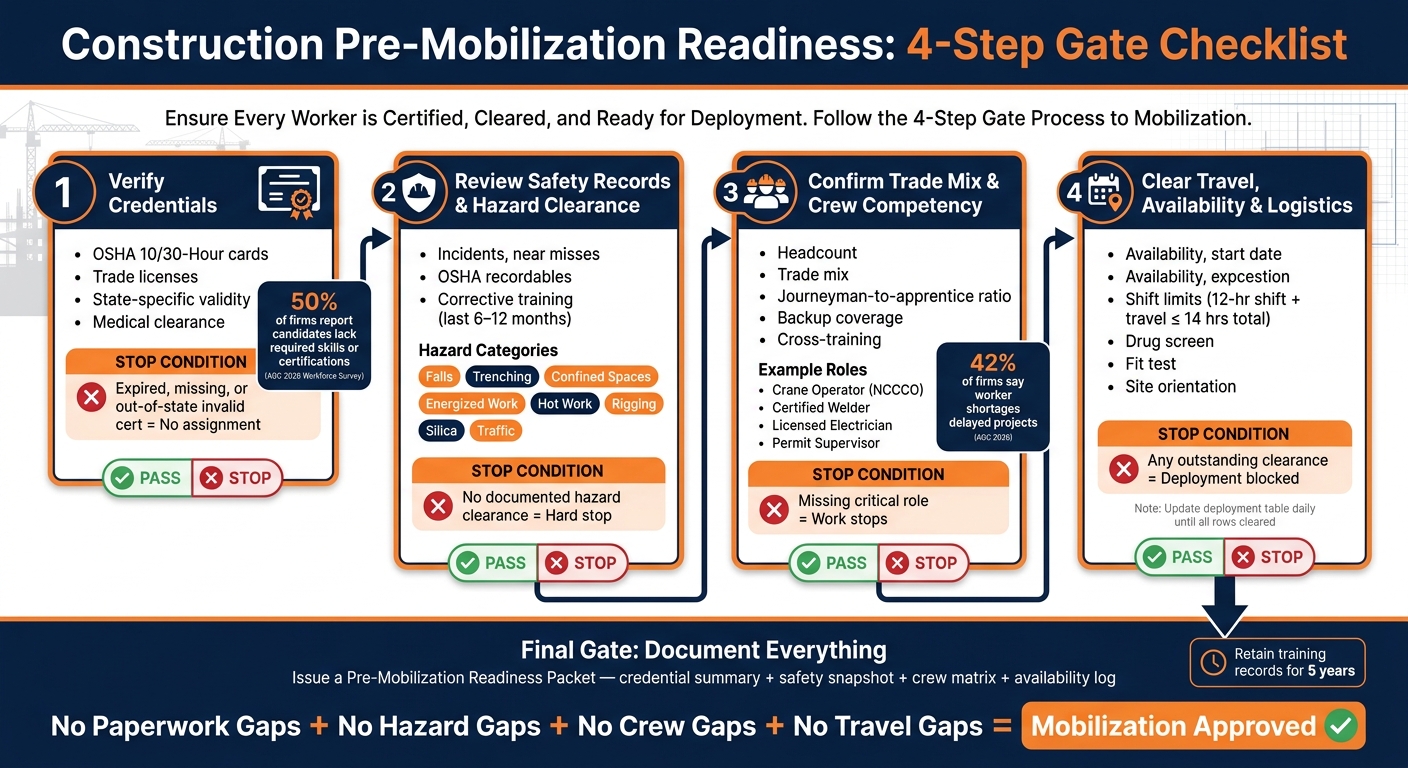
Construction Pre-Mobilization Checklist: 4-Step Readiness Gate
How to Do a Training Needs Analysis: The Ultimate Guide 📈
Step 1: Verify Certifications, Licenses, and Required Training
Before you assign anyone to a job, check that they have the right credentials for the task, scope, and site. That means confirming identity, issuer, course title, and license details. Document the review, then mark each person’s readiness.
Build a Role-Based Skills and Credential List
Start with the project’s work breakdown structure. Look at the main work packages – structural steel, concrete forming and pouring, electrical rough-in, and pipeline tie-in – and match each one to the roles doing that work. From there, assign the required credentials to each role-task pair.
Common credentials by role in U.S. construction include:
- General Laborer: OSHA 10-Hour Construction, fall protection, PPE training, site orientation
- Heavy Equipment Operator: OSHA 10 or 30-Hour Construction, equipment-specific operator training, earthwork and trenching safety (OSHA Subpart P)
- Crane Operator: NCCCO certification, rigging and signalperson qualification, OSHA 30-Hour Construction
- Journeyman Electrician: State journeyman license, NFPA 70E electrical safety, lockout/tagout, OSHA 10 or 30-Hour Construction
- Foreman/Supervisor: OSHA 30-Hour Construction, supervisory safety leadership, incident reporting, Job Hazard Analysis (JHA) training
If the project spans more than one state, add a Valid in States field. Then check reciprocity before mobilization. A license that works in one state may not carry over to the next. That small detail can turn into a big delay.
Use a Certification Tracking Table
After you build the role-based list, log every worker’s credentials in a tracking table. The table should show the credential type, who holds it, what proof is needed, the expiration date, current status, and what must happen before mobilization. Use MM/DD/YYYY formatting so everyone on the project team reads dates the same way.
| Credential Type | Role/Worker | Proof Required | Expiration Date | Status | Action Before Mobilization |
|---|---|---|---|---|---|
| OSHA 10-Hour Construction | General Laborer | Digital card (PDF) | N/A (check site rules) | Current | Confirm site accepts digital proof |
| NCCCO Crane Operator | Crane Operator | NCCCO certificate + photo ID | 11/02/2026 | Expiring | Schedule recertification by 10/01/2026 |
| State Journeyman Electrician License | Journeyman Electrician | Copy of license + license number | 07/30/2028 | Current | Verify state board listing |
| Confined Space Training | Pipefitters (Crew A) | Training roster + sign-in sheets | 01/10/2026 | Lapsed | Arrange refresher before mobilization |
| Forklift Authorization | Equipment Operator | Competency evaluation record | 03/15/2027 | Current | Conduct site-specific evaluation |
| Fall Protection | Workers at Heights | Signed training record | 12/01/2026 | Current | Confirm refresher if last training >2 years ago |
| Medical Clearance | Respirator Users | Physician’s written note | 09/20/2026 | Expiring | Schedule physical exam before deployment |
If you spot a gap – an expired crane certification, a lapsed confined space record, or missing hot work training – don’t place that worker on that task. Simple as that. Set up the required training early enough to avoid a scramble, or hand the work to someone who is already qualified.
A good rule: verify all documentation at least two weeks before mobilization.
Once credentials are current, move to incident history and hazard readiness. Next, check safety records and site-specific hazards before assignment.
Step 2: Review Safety Records and Site Hazard Clearance
Credentials show that someone is qualified. Safety records show how they actually work once boots hit the ground.
Before mobilization, review each worker’s record from the last 6 to 12 months. The goal isn’t to overreact to a single mistake. It’s to spot patterns.
Check Incident History, Near Misses, and Corrective Training
Look at recent incidents, near misses, OSHA recordables if available, safety-rule violations, disciplinary actions, and any past corrective coaching tied to unsafe behavior. If a worker had a recent fall-related near miss, that may call for refresher training, tighter supervision during start-up, or temporary removal from high-risk tasks.
A blank near-miss log is not always good news. In many cases, it points to weak reporting, not strong safety performance. If a crew’s near-miss log is empty, dig deeper into how that crew reports risk before dispatch.
When you find a gap, tie the fix to the actual hazard. A struck-by incident should lead to a review of spotter protocols and exclusion zones, not a generic retraining session. Record the reviewer, the evidence reviewed, the action taken, and the return-to-work date.
After that, line those risks up against the hazards on the upcoming site.
Match Site Hazards to Required Training
A clean safety record does not clear a worker for hazards they haven’t been trained to handle. OSHA’s Fatal Four – falls, struck-by, caught-in/between, and electrocution – account for nearly two-thirds of construction fatalities each year. That’s why each site hazard needs to be matched to the training each worker holds before dispatch.
| Hazard Category | Required Training | Verification Method | Refresher Timing |
|---|---|---|---|
| Work at Heights | Fall Protection Training | Certificate + supervisor sign-off | Before mobilization; after any incident |
| Excavation & Trenching | Competent Person Training | Certification + experience log | Project-specific; before excavation begins |
| Confined Spaces | Permit-Required Entry & Rescue | Signed training logs + drill record | Annual or before entry |
| Energized Systems | Lockout/Tagout (LOTO) | Written program records + training log | Periodic; before each new phase |
| Hot Work | Fire Prevention & Equipment Operations | Specialty certifications | Per project scope |
| Lifting & Rigging | Crane/Rigging Operator Certification | Accredited program certs + competency eval | Monthly or annual, as required |
| Silica & Dust Exposure | Exposure Control Plan Training | Training records + fit test | Annual refresher |
| Vehicle & Equipment Traffic | Work Zone / Traffic Control Safety | Flagger cert + site orientation sign-off | Before nighttime or high-traffic operations |
If a worker’s training does not cover a hazard on the upcoming site, that’s a hard stop. Prior experience is not enough on its own. Check documented records. And if the gap is tied to role fit rather than knowledge, reassignment makes more sense than a rushed refresher.
ABLEMKR can keep safety records and hazard-specific clearances in one view, which helps teams make mobilization decisions faster. Once safety clearance is confirmed, move to trade mix and crew capability.
sbb-itb-aa28329
Step 3: Confirm Trade Mix, Crew Competency, and Site Demands
Certifications get workers onto the site. Trade mix and crew competency decide whether the job can get done. After you verify credentials and hazard training, the next step is simple: make sure the crew can actually perform the work.
Compare Planned Work to Current Crew Capabilities
Each phase of a project has a minimum crew need. Check headcount, trade mix, skill level, and backup coverage.
Concrete placement needs journeyman finishers and a certified pump operator. Steel erection calls for experienced ironworkers, certified welders, and a qualified signalperson or rigger. MEP rough-in depends on licensed electricians and plumbers in the right journeyman-to-apprentice ratio. If even one of those roles is missing or thinly staffed, the work slows down – or stops altogether.
Labor gaps delay work and add cost. That’s why cross-trained workers matter. They help cover absences and keep the job from getting jammed up.
A few common examples:
- A carpenter cross-trained on a powered industrial truck can keep materials moving when the main operator is tied up.
- An ironworker who is also qualified as a rigger can cut wait time during lifts.
- A bilingual lead supervisor can help reduce miscommunication during safety-critical tasks.
Use a Crew Readiness Matrix Before Assignment
Put the matchup on paper with a Crew Readiness Matrix. It helps you catch missing roles before the crew is sent out.
| Planned Task | Trades Required | Minimum Competency Required | Crew Status | Action Needed |
|---|---|---|---|---|
| Concrete Placement | Carpenters, Finishers | 1 foreman, 3 journeyman finishers, certified pump operator | Foreman + 2 journeymen; missing certified pump operator | Add certified pump operator |
| Steel Erection | Ironworkers, Welders | 1 lead erector, 4 journeyman ironworkers, 2 certified welders, qualified signalperson/rigger | 1 lead, 3 ironworkers, 1 welder | 1 additional certified welder; rigging refresher for crew |
| MEP Rough-in | Electricians, Plumbers | 1 licensed electrician, 1 licensed plumber, 2 helpers each | Electrician verified; plumber is apprentice-only | Assign licensed plumber for first 2 weeks |
| Confined Space Work | Multi-trade | Permit supervisor, rescue-trained personnel | No permit supervisor assigned | Assign and document Competent Person before entry |
| Heavy Civil / Excavation | Equipment Operators | Competent Person (trenching), equipment certifications | 2 of 3 operators certified; 1 cert expired | Recertify or reassign before work starts |
Treat every shortfall as a hard stop. Assign an owner. Set a due date. Then track it until it’s fixed.
If the matrix shows a gap you can’t fill in-house – like a shortage of certified welders during a refinery shutdown or a missing NCCCO-certified crane operator – ABLEMKR can surface pre-vetted workers who already hold the required certifications and safety training. That makes a staffing gap a role you can fill.
Next, confirm who is actually available to travel and start on time.
Step 4: Check Travel Status, Availability, and Mobilization Logistics
Once crew fit is confirmed, the last question is simple: can this person actually deploy on time? This step clears the final mobilization blockers: availability, travel, and start date.
Verify Availability and Start Dates
Pull current assignment data, then confirm details with both workers and supervisors. You need to know who’s free now, who’s wrapping up another job, and who’s still blocked.
This is where scheduling can get messy fast. Night shifts, rotation cycles, and long travel all add risk. For 12-hour shifts, total shift time, including travel, should not exceed 14 hours. If someone arrives after a long trip, they need rest before taking on high-risk work. On rotational jobs with a 14/14 cycle, start dates need to line up with rotation breaks so you don’t run into fatigue issues or double-book someone.
Weekend mobilizations need extra planning too. Site access, supervisor coverage, and lodging check-in all need to be lined up ahead of time.
Also, flag any clearance issue that stops mobilization, like a fit test or drug screen. One missing item can hold up the whole start.
Track Deployment Constraints in One Table
Use the table below as a simple go/no-go view for each worker.
| Worker / Role | Availability Status | Travel and Shift Constraints | Outstanding Training / Clearance | Ready Date |
|---|---|---|---|---|
| Lead Carpenter | Fully available | No constraints; night shifts OK | None | Sep 16, 2026 |
| Crane Operator | Committed until Sep 20 | Local only; no overtime | Annual competency evaluation due | Sep 21, 2026 |
| General Laborer | Ready to report | Requires 24-hr notice for remote sites | OSHA 10 cert upload pending | Sep 18, 2026 |
| Welder (Sub) | Available for rotation | Out-of-state travel OK | Site-specific safety orientation needed | Sep 17, 2026 |
| Safety Coord. | Fully available | Weekend starts OK | Medical clearance (respirator fit) | Sep 19, 2026 |
Update this table every day until each row is cleared.
ABLEMKR puts worker availability, location, certifications, and compliance status in one place, which helps coordinators issue mobilization orders faster.
Conclusion: Document the Review and Keep the Checklist Current
Once Step 4 confirms availability, finish the process with a written record. Put the review into a pre-mobilization readiness packet that shows what was checked, who checked it, and when. Include a credential summary, a safety snapshot, the crew readiness matrix, and the availability log. That packet shows each gate was cleared in the right order: certifications, safety, crew fit, then deployment. Add a timestamp and note who signed off on each section.
If you cannot produce training records during an inspection, the training does not count. Keep training records current and retain them for five years to support audits and repeat-violation reviews.
Treat the packet as the control record for any change. Update it if the scope shifts, a new JHA hazard shows up, a crew member gets replaced, or a certification moves into its 30- to 60-day renewal window.
Create a Repeatable Pre-Mobilization Process
The goal is simple: make the checklist work the same way for every mobilization. Use one template, assign each role clearly, and set up a digital workflow that stops mobilization until every step is done. The safety manager owns hazard training sign-off. The operations manager owns trade mix. The labor coordinator owns availability and travel.
ABLEMKR puts worker profiles, certifications, safety history, and availability in one place, so coordinators can match qualified workers by location, cut mobilization delays, and keep one audit-ready record for each deployment.
FAQs
Who should own each mobilization check?
Assign each check based on role and know-how. Project managers should handle contract documents, while safety coordinators should oversee OSHA records and safety compliance. A lead audit coordinator can manage communication and keep documentation on schedule.
For day-to-day work, supervisors can use ABLEMKR at the job site to verify worker certifications and compliance status in real time.
What should be included in a readiness packet?
A readiness packet should include verified documents for each worker and for the job site.
For workers, that means current trade licenses, equipment certifications, required safety training records, First Aid/CPR cards, drug test results, Form I-9, and updated contact information.
For the project, include the Site-Specific Safety Plan, active permits, insurance certificates, and performance bonds.
Keep all of it in a centralized digital system so teams can access records in real time and stay ready for audits.
When should this checklist be updated?
Update the checklist on a set schedule so your team stays ready and your site stays in line with rules. Review it annually, and also any time the project scope changes, site conditions shift, or a safety incident points to a need for updates.
On active job sites, review it weekly or monthly so it keeps pace with changing requirements, project milestones, and seasonal changes. It also helps to track worker certifications and safety credentials with an automated system, so you can spot lapses as they happen.


