
Construction robots help with three main jobs: scan the site, move dirt or material, and take on risky work. In the U.S., that matters because contractors still face more than 600,000 open jobs, and some robot deployments have cut hazardous task time by 72%, improved accuracy by 55%, and reduced layout labor by 68%.
If I had to boil this guide down, I’d say this:
- Drones map large sites, inspect roofs, and measure stockpiles
- Ground robots scan interiors, corridors, and tunnels
- Autonomous equipment handles grading, hauling, trenching, and site prep
- Robotic arms do repeat tasks like bricklaying, drilling, welding, and shop work
- Remote demolition robots break concrete and work in tight, dangerous areas while the operator stands back
What matters most is simple: match the robot to the task. These machines work best on jobs that are repetitive, dangerous, or tied to tight tolerances. But they still need skilled people for setup, checks, repairs, and safe coordination with other trades.
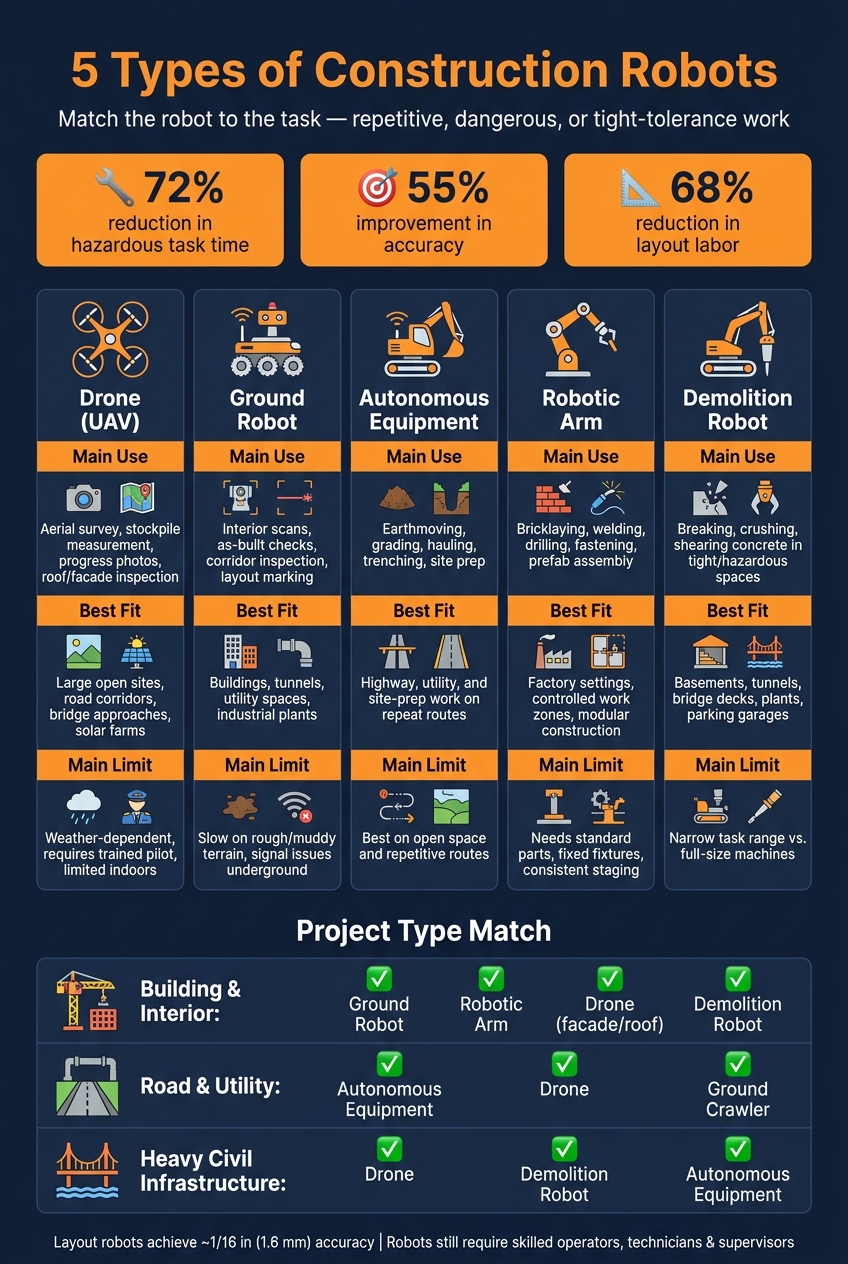
Construction Robots Compared: Types, Uses & Best Fit
Quick Comparison
| Robot Type | Main Use | Best Fit | Main Limit |
|---|---|---|---|
| Drone | Aerial survey, photos, inspection | Large open sites, roofs, corridors | Weather, flight time, pilot rules |
| Ground robot | Interior scans, as-builts, inspections | Buildings, tunnels, utility spaces | Rough terrain, clutter, weak signal |
| Autonomous equipment | Earthmoving, grading, hauling | Road, utility, and site-prep work | Best on repeat routes and open space |
| Robotic arm | Bricklaying, welding, drilling, shop assembly | Factory settings or controlled work zones | Needs standard parts and steady setup |
| Demolition robot | Breaking, crushing, shearing | Basements, tunnels, plants, bridge decks | Narrow task range compared with full-size machines |
Bottom line: I’d use robots where they remove people from danger, cut layout and grading errors, or keep repeat work on track without extra passes and rework.
sbb-itb-aa28329
Main Types of Construction Robots
Construction robots usually fit into a few practical buckets: data-capture tools, heavy equipment, and machines built for risky tasks. Put another way, they tend to do one of three things: sense the site, move material, or take on hazardous work. That grouping is based on what they do, not who makes them or how big they are.
Ground Robots and Drones
Ground robots are wheeled or tracked platforms with cameras, LiDAR, and laser scanners. They scan floors, corridors, and outdoor surfaces at close range. That makes them a good fit for indoor work like tracking mechanical, electrical, and plumbing installs, photographing apartment units, or scanning tunnels and utility corridors where GPS doesn’t work well. Of course, they have limits. Basements, tunnels, and heavily reinforced structures can disrupt connectivity, and mud, rubble, or steep slopes can stop a wheeled platform cold.
Drones handle the view from above. With high-resolution cameras, RTK GNSS receivers, and sometimes LiDAR, they create site maps and terrain models, take aerial progress photos, inspect roofs and facades, and measure stockpiles across large project areas. Most drones stay in the air for about 20 to 40 minutes, and U.S. rules often require the pilot to keep the aircraft in sight unless a waiver is in place. Teams usually deal with those limits by flying early in the day or on weekends and by planning flight paths ahead of time during look-ahead meetings.
These robots collect site data. The next set uses that data to do the physical work.
Autonomous Equipment and Robotic Arms
Autonomous and semi-autonomous equipment includes excavators, dozers, graders, compactors, and haul trucks. These machines take on earthmoving, grading, trenching, and material hauling. A machine-controlled dozer, for example, can use GNSS guidance and automatic blade control to follow a digital design surface without stakes or constant manual checks. That means fewer passes, less rework, and lower fuel use.
Robotic arms are built for repeatable tasks, not for moving around the site. On building projects, bricklaying robots place units and apply mortar based on a digital design. Other robotic arms used for drilling and fastening can pre-drill holes in steel or wood, place anchors, or install screws in set patterns. In industrial and tunnel jobs, they also handle welding, torch cutting, and concrete spraying, or shotcrete. With controlled nozzle movement, shotcrete work can reduce rebound and improve coverage. Off-site, robotic arms cut, weld, and assemble wall panels, bathroom pods, and structural steel in modular construction factories with high throughput. Before production starts, engineers and technicians build tool paths from BIM or CAD files and set up the fixtures.
This is where robotics moves from mapping to execution: earthmoving, fabrication, and repeat install work.
Remote-Controlled Demolition Robots
When the work is dangerous rather than repetitive, demolition robots step in.
Remote-controlled demolition robots are compact tracked machines equipped with hydraulic breakers, crushers, or shears. An operator controls them wirelessly from a safe distance outside the immediate hazard zone. Their small footprint and low ground pressure let them work on weak floors or pass through narrow access routes. That’s why they fit places like parking garages, basements, bridge decks, tunnels, cement plants, and steel mills, where dust, falling debris, vibration, noise, or chemical exposure are constant concerns.
What Each Robot Does on a Jobsite
Now that the robot categories are clear, here’s the work each one handles on site.
Surveying, Inspection, Layout, and Progress Tracking
Drones handle aerial survey, stockpile measurement, and progress photos. Ground robots handle interior scans and as-built checks. The payoff is pretty simple: crews can verify progress, spot clashes early, and document work faster. Both also help keep people out of steep slopes, active traffic, and confined spaces.
Layout robots push this a step further. A layout robot reads the BIM file and marks the slab with the building layout at about 1/16 in (1.6 mm) accuracy. That cuts layout mistakes and reduces rework caused by misplaced walls, anchor points, or penetrations.
| Robot Type | Main Task | Best Use Case | Main Limitation |
|---|---|---|---|
| Drone (UAV) | Aerial survey, stockpile measurement, progress tracking | Large open sites, road corridors, bridge approaches, solar farms | Weather-dependent, requires trained pilot, limited indoors or in dense vegetation |
| Ground Robot | Interior layout, corridor inspection, detailed as-built capture | Complex building interiors, utility tunnels, industrial plants | Slower coverage than drones, may struggle on muddy or cluttered terrain |
Earthmoving, Hauling, Demolition, and Site Prep
Autonomous equipment makes the most sense on long, repetitive runs. On highway cut-and-fill jobs, autonomous haul trucks and dozers follow preset routes between borrow pits and embankment areas. That helps keep cycle times steady, while human operators take over for tougher cuts near structures or utilities.
Semi-autonomous graders and compactors follow digital design surfaces on bridge approaches to hit exact slopes and densities. That means less rework and smoother ride quality.
Demolition robots do a different kind of job. On substation work, compact remote-controlled machines break and remove heavy concrete equipment pads in tight spaces where a normal excavator’s swing radius or vibration would cause trouble. The operator runs the machine from outside the hazard zone. That’s the whole point: the robot goes into the hazard zone, and the operator stays out of it.
Masonry, Welding, Drilling, and Prefabrication
Robotic arms are a good fit for repetitive work that needs tight tolerances, like bricklaying, welding, drilling, and fastening. A bricklaying robot places units at a set height, pattern, and mortar thickness along long, straight facade runs. Welding robots produce steady fillet and seam welds on beams and plate assemblies, which helps cut defect rates on high-volume parts.
Drilling robots punch exact hole patterns into steel plates or curtain wall frames, then fasteners go in at controlled torque. But there’s a catch. These systems work best when the job is predictable. They need standard parts, fixed fixtures, and consistent staging.
Those tasks look a little different on buildings, roads, and heavy civil sites.
Where Each Robot Fits by Project Type
Building and Interior Construction
Indoor jobs usually lean on ground robots, drones, robotic arms, and demolition robots. Autonomous heavy equipment tends to be a poor match for cramped interior spaces.
Ground robots are used for layout checks, LiDAR scans, and progress tracking across open floors and corridors. That data feeds BIM and digital-twin updates. Robotic arms take on masonry, drilling, welding, and prefabricated installs in controlled zones. Drones work best on facades, atriums, and roofs, though indoor flying is limited by tight clearances and safety rules.
The big issue here is sequencing. Robots need to move fast between work windows, so teams often schedule them during low-traffic periods, like early rough-in or night shifts. On long, open corridors and areas outside the building envelope, the mix starts to shift toward machine control and site mapping.
Road and Utility Projects
Linear projects are a strong fit for autonomous heavy equipment. On highway grading, pipeline trenching, and solar farm site prep, autonomous dozers, graders, compactors, and haul trucks follow GNSS-guided paths and digital grade models across miles of corridor. The goal is simple: hold target elevations and cross slopes with steady accuracy.
Drones support these jobs from end to end. They map alignments, measure stockpiles, track progress, and inspect overhead transmission lines or utility routes. Ground crawlers inspect pipes and vaults for welds, corrosion, and obstructions before turnover. Autonomous compactors make even passes and log compaction data for GIS and asset systems.
When access gets tighter and the job gets riskier, the robot mix shifts away from production and toward inspection and demolition.
Heavy Civil Infrastructure
The toughest jobs often call for the most remote operation. Bridges, tunnels, dams, ports, and rail corridors include some of the most hazardous and hard-to-reach conditions in U.S. construction. That’s where inspection drones, demolition robots, and autonomous earthmoving equipment tend to matter most.
Drones inspect bridge girders, dam spillways, and quay walls where access is costly or unsafe. Demolition robots remove bridge deck and pier concrete while operators stay out of collapse zones and away from live traffic. In tunnels, compact remote-controlled machines break rock and remove lining where ventilation limits, water, and weak GNSS make human access risky. Some inspection programs now use drone-and-ground-robot systems: a drone covers the upper half of a tunnel, while a ground robot covers the lower half for full 360° defect detection.
Choosing the Right Robot for the Task
Once you know which robot fits the project, the next step is figuring out whether it fits your site and your crew.
Questions to Ask Before You Invest or Rent
Start with a simple test: does the robot fix a real jobsite problem? The best use cases are tasks that are repetitive, standardized, labor-heavy, or hazardous.
Then look at site constraints. Check:
- available space
- power access
- connectivity
- terrain
- after-hours supervision
Those factors can make or break a deployment.
Usage rate matters too. If expected use stays below 40% to 60% of workdays over 6 to 12 months, renting or using RaaS usually makes more sense. If use is above 60% to 65%, buying or leasing is often the better call.
It also helps to ask how much field experience the vendor has. If they’ve completed fewer than 20 similar deployments, move carefully.
Why Robots Still Depend on Skilled Workers
Even a very good robot still needs skilled people around it to keep work moving and keep the site safe. Each deployment needs operators to load work instructions and set geofences, technicians to handle calibration and repairs, survey staff to confirm the output meets tolerances, and supervisors to keep the workflow moving safely alongside other trades.
That people side has a direct effect on cost and results. A study of ten construction robots found that repetitive and ergonomically hard work dropped by an average of 72%, and accuracy improved by about 55%. But total costs went down in only 6 out of 10 cases. In plain English: the robot may do the task well, but staffing still shapes whether the numbers work.
That’s why workforce planning matters just as much as equipment selection. ABLEMKR supports robot-enabled projects by matching pre-vetted workers to job sites based on certification, safety training, availability, and location.
Conclusion: Match the Robot to the Job
The right robot depends on the project type, how often the task repeats, site conditions, and risk. When the fit is good and the crew is trained, robots can improve productivity, quality, and safety. Match the robot to the job, not the hype.
FAQs
Which construction robot should I start with?
A common place to start is with roles like robotics technician or robot operator. These jobs let you build on the mechanical skills and hands-on trade experience you already have, while picking up new digital tools along the way.
From there, you can spot any skill gaps in areas like programming, electronics, or CAD and work on them through certifications or online training. Some companies take a similar path by starting with pilot programs or hybrid roles, so teams can build know-how step by step.
Should I rent or buy a construction robot?
It comes down to project size and your budget plan.
Buying often means a big upfront bill – sometimes hundreds of thousands of dollars. For a lot of firms, that’s a tough pill to swallow. So renting, leasing, or financing can be easier to handle and easier to fit into day-to-day cash flow.
A pilot project is often the smartest place to start. It lets you test the tech, see how it performs on the ground, and estimate ROI before you make a bigger commitment.
Government grants, tax incentives, and support from ABLEMKR can also help lower the barrier to getting started.
Do construction robots replace skilled workers?
No. Construction robots mostly handle repetitive or physically tough jobs. Skilled workers still take care of safety-critical work, planning, monitoring, setup, and troubleshooting.
What’s changing is the team structure. Construction is moving toward hybrid teams, where trained operators and robotics technicians run, manage, and maintain these systems. Instead of being pushed out, workers are shifting into more digital, robot-assisted roles.


