
Getting certified for confined space entry doesn’t have to take weeks. Here’s a quick breakdown:
- Why It Matters: OSHA requires training for jobs involving confined spaces like tanks, silos, or manholes, which carry risks like toxic gases or low oxygen. Certification ensures you’re prepared to work safely.
- Fast Options: Online courses let you complete training in as little as 2–8 hours. You can study anytime, anywhere, and print your certificate immediately after passing.
- Steps:
- Choose the right course for your industry (General Industry or Construction).
- Complete the training and pass the exam.
- Submit your certificate to your employer for final approval.
- Staying Current: OSHA mandates retraining when job conditions change or annually for rescue roles. Platforms like ABLEMKR can help track and manage certifications.
Online training is the fastest way to meet OSHA requirements, avoid job delays, and start working right away.
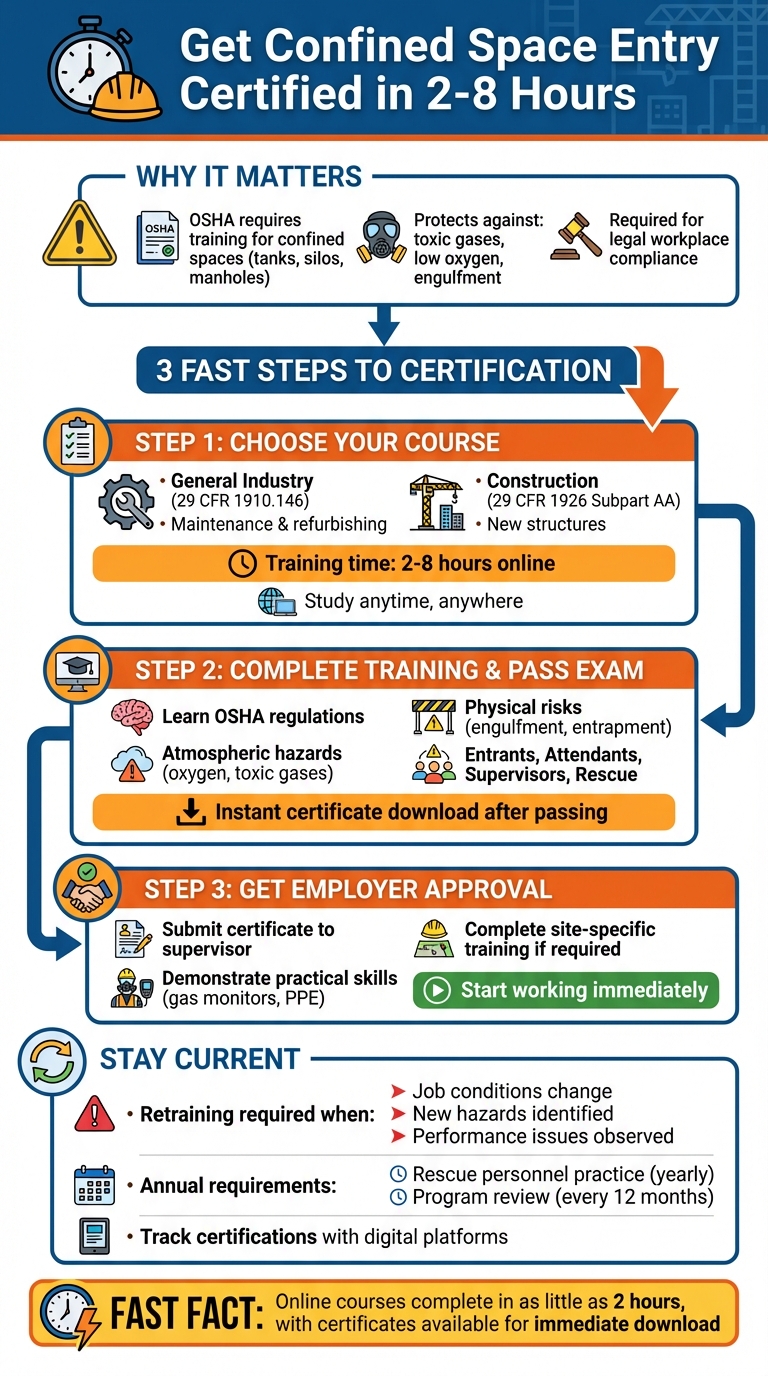
3-Step Guide to Getting Confined Space Entry Certified Fast
Free OSHA Confined Space Training Tutorial – Identifying Confined Spaces in Construction
sbb-itb-aa28329
What Is Confined Space Entry Certification?
Confined space entry certification confirms that you’ve completed OSHA-compliant training to safely work in restricted spaces. According to OSHA, a confined space is defined by three key criteria: it must be large enough for someone to enter and perform work, have limited or restricted entry or exit points, and not be designed for continuous occupancy by workers. Only spaces with additional hazards require a permit. A permit-required confined space includes risks such as hazardous atmospheres (oxygen levels below 19.5% or above 23.5%), materials that could engulf a person, structural dangers that may trap or suffocate, or any other serious safety or health hazards.
"There is no such thing as becoming ‘confined space certified’ because OSHA does not issue official certifications." – Compliance Training Online
Certification involves completing training and passing an exam to earn a certificate of completion. However, your employer holds the legal responsibility for ensuring you’re adequately trained and authorized for specific roles. Whether you’re an entrant (working inside the space), an attendant (monitoring from the outside), a supervisor (managing the permit system), or part of a rescue team, OSHA’s requirements ensure you’re prepared for the job.
OSHA Requirements for Confined Spaces
OSHA has distinct regulations based on the type of industry. General industry operations follow the guidelines in 29 CFR 1910.146, which apply to tasks like maintaining existing facilities or refurbishing equipment. Construction activities, on the other hand, are governed by 29 CFR 1926 Subpart AA, which applies to building new structures or reconfiguring existing spaces. The Construction standard uniquely requires a "competent person" to assess the workspace, a stipulation not found in the General Industry standard.
Employers are obligated to identify all permit spaces in the workplace, notify employees of their presence (often with signs reading "DANGER – PERMIT-REQUIRED CONFINED SPACE, DO NOT ENTER"), and establish a written permit space program if entry is necessary. This program must be reviewed annually. OSHA also specifies a testing sequence for atmospheric hazards: first, test for oxygen levels, then check for flammable gases or vapors, and finally, test for toxic contaminants.
What Certification Includes
The certification process combines theoretical knowledge with hands-on training. You’ll learn OSHA regulations, how to recognize atmospheric hazards (like oxygen deficiency or toxic gases), and how to address physical risks (such as engulfment). The practical portion includes using personal protective equipment, calibrating gas monitors, and practicing safe entry and exit procedures.
To earn your certificate, you’ll need to pass both a written exam and a practical evaluation. However, even after completing these steps, your employer must assess whether you’re competent to handle the specific confined spaces at their site. Only after this evaluation can you be formally authorized for your role. This employer approval is essential, as OSHA holds employers accountable for ensuring workers are prepared for the hazards they may encounter.
| Feature | Confined Space | Permit-Required Confined Space |
|---|---|---|
| Bodily Entry Possible | Yes | Yes |
| Limited Entry/Exit | Yes | Yes |
| Continuous Occupancy | No | No |
| Atmospheric Hazard | No | Yes (or potential for) |
| Engulfment Risk | No | Yes |
| Entrapment Risk | No | Yes (due to internal configuration) |
| Other Serious Hazards | No | Yes |
Steps to Get Certified Quickly
Select a Fast Online Training Course
One of the quickest ways to get certified is by opting for self-paced online courses that are available around the clock. Many providers allow you to move through the material at your own speed, skipping over sections you already know. For example, online confined space training can be wrapped up in as little as 2 hours, while General Industry courses typically require about 8 hours of study time.
When picking a course, make sure it aligns with OSHA requirements for your industry. If you’re working on maintaining or refurbishing existing equipment, you’ll need General Industry training (29 CFR 1910.146). For tasks like building new structures or reconfiguring spaces, Construction training (29 CFR 1926 Subpart AA) is the right choice. Platforms that are mobile-friendly can be a game-changer, letting you study on your smartphone or tablet during breaks, commutes, or other downtime.
| Provider | Course Length | Price | Key Feature |
|---|---|---|---|
| Compliance Training Online | 2+ Hours | Varies by volume | Quickest completion; mobile-friendly |
| OSHA.com (360training) | 8 Hours | $159.00 | Interactive elements; highly mobile-compatible |
"Online training is the most convenient way to take OSHA-authorized training. Enroll online, complete the training at your own pace, and receive your certificates and cards online or in the mail." – OSHA.com
Once you’ve chosen your course, the next step is to complete the training and pass the required exam.
Complete Your Training and Pass the Exam
After enrolling, you’ll dive into key topics such as OSHA regulations, atmospheric hazards (like oxygen deficiency and toxic gases), physical risks (such as engulfment or entrapment), and the four key roles in confined space safety: entrants, attendants, supervisors, and rescue personnel. Interactive features like games and clickable exercises can help you absorb these concepts more effectively than text-based modules alone.
Final exams are typically completed in one sitting. Many courses provide immediate feedback on quiz questions you miss, allowing you to quickly identify and address any weak areas. Once you pass the exam, you can instantly download and print your certificate.
"This option is great for anyone with a busy work life and home life. As a mom the ease of being able to log in to the course after work… was amazing!" – Cierra Kirby, Verified User
With your certificate in hand, the final step is to get your employer’s approval.
Get Employer Approval
Your digital certificate serves as proof that you’ve met the educational requirements. Submit it to your supervisor as soon as possible. In most cases, you’ll also need to demonstrate practical skills, such as using gas monitors or SCBAs, to finalize the approval process.
To avoid delays, coordinate with your employer before signing up for a course to confirm you’re selecting the right training. If your company uses a Learning Management System (LMS), link your training to their account for automatic tracking. Additionally, be ready for any site-specific training your workplace might require for unique hazards or procedures.
How to Keep Your Certification Current
Take Refresher Courses on Schedule
OSHA has clear guidelines for retraining. It’s required whenever there are changes in workplace hazards, entry procedures, or job duties, or if performance shows a lack of proficiency. On top of that, OSHA mandates that rescue personnel practice their rescue techniques at least once a year, and employers must review their permit-required confined space program every 12 months.
"OSHA requires confined space training to be conducted initially and whenever there is a change in operations, job duties, or when deviations from safety procedures are observed." – Compliance Training Online
Safety experts also recommend annual refreshers to stay up-to-date with protocols. For instance, California enforces retraining at least once a year under Title 8 CCR. Setting reminders or coordinating with your employer can help you avoid missing these critical updates. Regular refresher courses not only keep your skills sharp but also ensure you remain compliant with changing regulations.
Track Certifications with ABLEMKR

Keeping track of multiple certification deadlines can be overwhelming, but ABLEMKR simplifies this process. The platform helps you manage your certifications by maintaining accurate training records and keeping tabs on expiration dates. Once you upload your certificate to your ABLEMKR profile, it tracks renewals and ensures your credentials align with the requirements of your job – whether you’re working on a pipeline in Texas or a mining project in Wyoming.
For employers, ABLEMKR provides real-time updates on workers’ certifications and integrates compliance tracking directly into its system. Supervisors can quickly confirm that every worker on a permit-required confined space job has valid credentials before they begin work. Its mobile-friendly design ensures instant access to certificates, making it easy to reprint or share proof of training with a new employer on the spot. By centralizing and automating certification tracking, ABLEMKR helps you stay prepared and compliant in high-risk work environments.
Conclusion
You can complete confined space entry certification online in just 2–8 hours and get certified right away. Choose an OSHA-approved course tailored to your role – whether you’re an entrant, attendant, supervisor, or part of a rescue team.
Once certified, staying up to date is key. OSHA requires retraining under certain conditions, but even without specific timelines for all roles, annual training is a smart way to reinforce safety practices and reduce the risk of workplace accidents.
After certification, managing renewals becomes just as important. For industries with higher risks, ABLEMKR simplifies this process with digital recordkeeping and automatic renewal reminders. Employers can also use the platform to track worker credentials in real time, ensuring that only certified individuals are assigned to confined space tasks. This system helps both workers and employers stay organized and compliant.
On top of that, ABLEMKR speeds up workforce deployment by connecting pre-vetted, certified workers to job sites quickly. Its integrated W-2 system takes care of payroll taxes, workers’ comp, and insurance, allowing employers to focus on their projects while workers enjoy timely, competitive pay. This efficient setup ensures compliance while keeping critical operations on track.
FAQs
Do I need General Industry or Construction confined space training?
The kind of confined space training you require depends entirely on your workplace. If your job involves working in areas like tanks, storage bins, or pipelines, General Industry training is the right choice. On the other hand, if your work involves construction activities in confined spaces, you’ll need Construction training, as specified by OSHA’s Construction Standard (29 CFR 1926 Subpart AA). Make sure to pick the training that aligns with your specific tasks and work environment.
What hands-on skills will my employer still require after online training?
After finishing online confined space entry training, you’ll need to show your employer that you can apply those skills in practice. This includes operating calibrated safety equipment, carrying out atmospheric testing, and executing rescue procedures. These abilities are essential for maintaining safety in actual confined space situations.
When do I need retraining to stay OSHA-compliant?
To meet OSHA requirements, workers must undergo retraining for confined space entry on a regular basis. OSHA suggests annual refresher training to keep employees informed about the latest safety procedures and regulations. However, the specific frequency of retraining might also depend on your company’s safety program or the unique demands of a particular job. These refresher courses play a crucial role in maintaining both compliance and workplace safety standards.


