
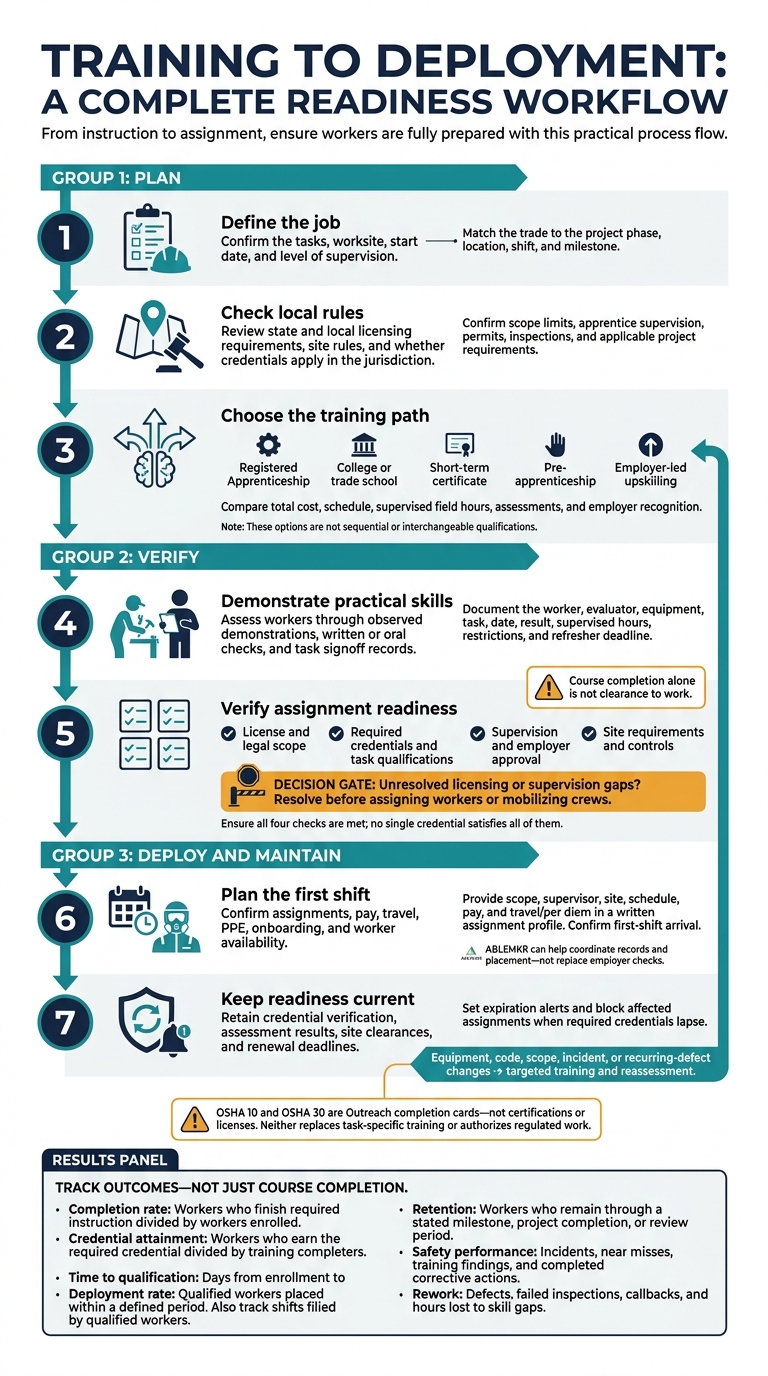
I start clean energy workforce training with the job – not the course. Before enrolling anyone, I check the tasks, state licensing rules, safety needs, and supervised practice required. An OSHA 10- or 30-hour card records safety training; it does not grant permission to perform regulated work.
For solar, wind, battery, grid, and energy-efficiency roles, I use this checklist:
- Choose the training path: Compare apprenticeships, schools, short courses, pre-apprenticeships, and employer training by cost, schedule, hands-on hours, and hiring connections.
- Check readiness: Verify licenses, credentials, practical skills, supervision, and site approval. <u>Course completion alone is not clearance to work.</u>
- Plan the first shift: Confirm assignments, pay, travel, PPE, onboarding, and worker availability. Tools such as ABLEMKR can help coordinate records and placement – not replace employer checks.
- Track results: Review qualification time, placements, retention, safety, rework, renewals, and advancement.
My goal is simple: match each worker to work they can perform safely and legally, then keep their training and records current.
Clean Energy Workforce Training: From Job Requirements to Deployment
Clean Energy Trades and Training Paths
Match Trades to Project Tasks
Once you’ve defined the role, match it to a trade and training path that can staff the work. The goal: a worker who can be scheduled, supervised, and deployed without delay.
Build a role-to-task matrix from the project schedule. For each assignment, record the trade, skills, supervisor, location, shift, and milestone. Group tasks by project phase – not just by solar, wind, or storage technology.
- Site preparation: Laborers, survey crews, equipment operators, environmental technicians, and civil construction workers handle grading, access roads, trenching, foundations, erosion control, and material movement. Match equipment assignments to documented operator qualifications.
- Structural and mechanical installation: Solar installers assemble racking, modules, and trackers. Ironworkers and welders build or connect supports. Millwrights install and align mechanical equipment.
- Electrical installation: Electricians and apprentices install raceways, wiring, grounding, inverters, and switchgear. Apprentice assignments must meet applicable supervision rules and apprentice-to-journey-level worker ratios.
- Commissioning: Electricians, controls technicians, battery technicians, utility technicians, quality personnel, and safety staff test systems, check documentation, correct deficiencies, and support grid interconnection.
- Maintenance: Wind technicians inspect and repair turbine systems. Battery and utility technicians troubleshoot storage and grid assets. HVAC technicians install and service heat pumps, refrigeration equipment, and building controls.
Across every phase, safety and quality staff support hazard reviews, inspections, work procedures, and documentation.
Support roles do not authorize regulated trade work. Helpers may stage materials, document inspections, perform approved support tasks, or observe work. Define each worker’s allowed tasks, supervision, and advancement criteria. Then check assignments against engineering documents, equipment manuals, utility requirements, and licensing rules.
Compare Training Paths
Match training to the target job’s requirements: reading drawings, using tools, testing, troubleshooting, and documented field practice. The timelines below are estimates. Occupation, prior experience, program design, and licensing rules can change how long training takes.
Before enrolling, confirm the cost, schedule, and access to employers.
| Training path | Estimated duration | Entry requirements | Classroom and on-the-job learning | Result | Typical roles |
|---|---|---|---|---|---|
| Registered Apprenticeship | Commonly about 1–5 years | Sponsor selection; education, aptitude, or other requirements vary | Paid on-the-job learning plus related instruction | Portable, nationally recognized completion credential | Electricians, lineworkers, HVAC technicians, industrial maintenance, and utility occupations |
| College or trade school | Several months to 2 years or more | School-specific admission requirements | Classes, labs, shops; internships vary | Certificate, diploma, or associate degree | Electrical technology, controls, HVAC, and energy technicians |
| Short-term certificate | Several days to several months | Limited or course-specific prerequisites | Focused instruction; field practice may be limited | Course certificate or credential preparation | Solar fundamentals, battery safety, equipment-specific skills |
| Pre-apprenticeship | Several weeks to several months | Provider-specific; often designed for beginners | Math, tools, safety, and supervised or simulated practice | Readiness certificate or documented competencies | Preparation for construction and utility apprenticeships |
| Employer-led upskilling | Often days to several months, with continuing refresher training | Employment or role-specific selection | Vendor instruction and coached field practice | Employer authorization, vendor certificate, task qualification, or continuing education record | Maintenance, storage, commissioning, and cross-trained crews |
Ask the sponsor about classroom schedules and any expenses learners must pay. Pre-apprenticeship does not guarantee admission or employment. Confirm any referral arrangement with the sponsor.
Check Training Costs and Hiring Connections
Request a written total-cost breakdown that covers tuition, books, tools, PPE, exams, retesting, transportation, parking, child care, lodging, and lost work time.
Check schedules, supervised field hours, and instructor experience. Also ask whether your target employers recognize the training. Which employers sponsor apprenticeships, interview graduates, or host work-based learning?
American Job Centers, workforce boards, colleges, unions, and employers may offer funding. Confirm eligibility and available support before counting on that help.
For solar roles, check NABCEP’s current eligibility rules and candidate handbook. The Education Pathway requires qualifying coursework through an Associate Registered Training Provider; the Experience Pathway requires at least six months of full-time equivalent relevant experience. Applicants must meet pathway rules, agree to the code of ethics, pay current fees, and pass the exam. The Associate credential shows foundational knowledge, but it does not replace a state license or proof of installation competency.
sbb-itb-aa28329
CEJA – Clean Energy Workforce Training
Hands-On Training, Credentials, and State Rules
Once you’ve chosen a training path, verify that workers can perform their assigned tasks safely under actual site conditions.
Practice Under Qualified Supervision
Supervised practice comes before deployment. Use qualified instructors and controlled practice:
Electrical labs for voltage testing and terminations; mock solar arrays for racking, wiring, and commissioning; inverter and battery drills for startup, shutdown, fault isolation, and thermal-event response; wind climbing and rescue; rigging; HVAC diagnostics; and lockout/tagout.
Assess workers through observed demonstrations, written or oral checks, and task signoff records. Document the worker, evaluator, equipment, task, date, result, supervised hours, restrictions, and refresher deadline.
Match safety practice to each assignment. Cover fall protection and rescue, shock and arc-flash hazards, stored energy, battery thermal-runaway warning signs, and emergency notification. Include drills for communication, evacuation, first aid/CPR response, and site emergency procedures.
Passing a lab does not authorize hazardous work on an operating site. Workers still need the right qualifications, supervision, employer approval, and site controls.
Verify Safety Training and Technical Credentials
OSHA 10 and OSHA 30 are Outreach completion cards – not certifications or licenses. The 10-hour course covers worker hazard awareness. The 30-hour course provides broader training for supervisors and workers with safety responsibilities.
Neither course replaces task-specific training or acts as a universal federal hiring requirement. However, project owners, contractors, unions, or state and local rules may require a card for site access. Separately verify first aid/CPR, aerial-lift, confined-space, equipment, electrical-safety, and manufacturer training. Qualification on one machine or battery system does not automatically carry over to another.
NABCEP’s PV Installation Professional certification requires defined eligibility, training, experience, an application, and an exam. Course attendance alone isn’t enough. Check the current handbook and the worker’s certification status.
For each qualification, record the issuer, scope, equipment, issue date, current status, renewal deadline, assessment result, and supporting records. Keep cards, practical evaluations, supervised-hour logs, and employer sign-offs. When possible, verify them with the issuer or original provider. OSHA does not maintain individual Outreach training records.
Distinguish Licenses, Credentials, and Site Requirements
| Requirement | Who sets it | What it establishes | When to verify | Evidence to retain |
|---|---|---|---|---|
| Professional credential | Independent issuer, trade organization, or manufacturer | Completion of issuer-defined education, experience, exam, or practical requirements | During hiring and before assignment | Certificate, credential number, issuer verification, renewal record |
| State or local license | State board, municipality, or authorized agency | Legal authority for regulated work within a defined jurisdiction and scope | Before bidding, supervision, installation, inspection, or mobilization | License number, status, classification, jurisdiction, restrictions, renewal date |
| Site requirement | Owner, utility, general contractor, or project specification | Compliance with access, safety, orientation, or project conditions | Before site access and when requirements change | Orientation record, access approval, task authorization, project checklist |
| Employer preference | Employer, labor agreement, or hiring policy | Alignment with internal hiring or deployment standards | During recruiting and role assignment | Resume, internal assessment, references, training matrix, supervisor approval |
Before mobilization, check the state licensing board, local building department, utility interconnection rules, and project specifications for the exact location and scope of work.
Determine whether licensing applies to the worker, supervising licensee, contracting business, or more than one. Confirm electrical and HVAC scope limits, apprentice supervision, permits, inspections, and adopted code editions. Resolve any licensing or supervision gaps before assigning workers or mobilizing crews, and use the verified qualifications to build role-based hiring and deployment plans.
Connect Training to Hiring and Deployment
Build a Training and Hiring Plan by Role
Verify credentials and site rules, then plan backward from each project milestone. Build a skills matrix that covers trade, project phase, location, shift, start date, experience, required qualifications, supervisor, pay rate, and advancement level.
Keep requirements for site access, unsupervised work, and advancement separate. Internal job levels don’t override licensing or supervision rules. Match training-provider capacity, assessments, and make-up sessions to installation, commissioning, and maintenance dates. Allow time for document checks, travel, orientation, and supervised practice.
Check prevailing-wage and registered-apprenticeship obligations separately from licensing and safety duties. Where federal clean-energy apprenticeship requirements apply, projects beginning construction in 2024 or later generally require 15% apprentice labor hours, plus applicable participation and ratio rules.
Before mobilization, give each worker a written assignment profile covering scope, supervisor, site, schedule, pay, travel/per diem, and PPE. Make clear which terms are guaranteed and which hours are estimates.
Use ABLEMKR to Coordinate Worker Deployment
With the role matrix in place, match qualified workers to open assignments. ABLEMKR matches pre-vetted workers to energy projects based on certification, safety training, availability, and location. Employers can also view worker status, track compliance, and manage payroll workflows. Use these records to flag missing requirements before confirming an assignment.
Matching does not replace training, readiness checks, or approval. Confirm availability and pay terms, complete onboarding, assign a supervisor, and define the permitted scope of work. Then confirm first-shift arrival. Keep unresolved items visible – a course-completion email alone doesn’t clear someone for deployment.
Track Worker Readiness, Retention, and Advancement
Once deployment starts, track whether the training pipeline produces qualified workers who stay and advance. Review results by role, provider, project, and cohort.
Name one owner for credential renewals and another for closing training gaps. Set expiration alerts and block affected assignments when required credentials lapse. Update training when equipment changes, codes are updated, work scope expands, incidents reveal a gap, or recurring defects point to a skills issue.
Publish advancement criteria tied to demonstrated skills, assessment results, supervisor approval, and pay steps. For workers who fall short, schedule targeted supervised practice and reassessment.
- Completion rate: Workers who finish required instruction divided by workers enrolled.
- Credential attainment: Workers who earn the required credential divided by training completers.
- Time to qualification: Days from enrollment to verified readiness for the assigned scope.
- Deployment rate: Qualified workers placed within a defined period. Also track shifts filled by qualified workers.
- Retention: Workers who remain through a stated milestone, project completion, or review period.
- Safety performance: Incidents, near misses, training findings, and completed corrective actions.
- Rework: Defects, failed inspections, callbacks, and hours lost to skill gaps.
Conclusion: Training-to-Hiring Checklist
Use this checklist to turn training decisions into a safe plan for hiring and placing workers.
- Define the job: Confirm the tasks, worksite, start date, and level of supervision.
- Check local rules: Review state and local licensing requirements, site rules, and whether credentials apply in the jurisdiction.
- Check the training’s value: Find out which employers recognize the program, whether it includes supervised practice and assessment, and what the total cost is.
- Require hands-on skills: Verify skills through supervised task demonstrations with clear pass/fail criteria. Attendance alone isn’t enough.
- Keep records current: Retain credential verification, assessment results, site clearances, and renewal deadlines.
- Plan time before the first shift: Allow for testing, retesting, onboarding, and site orientation. State offer conditions upfront.
Use ABLEMKR to track worker records, availability, and deployment. It does not replace training, licensing, skills assessment, or employer oversight.
FAQs
Can my construction experience shorten clean energy training?
Yes. Construction experience can shorten clean energy training. Skills in electrical work, mechanical assembly, and equipment operation carry over to many clean energy jobs.
Focus on filling skill gaps – not starting from scratch. Industry certifications or modular training can cover specific topics, such as photovoltaic systems or DC electrical safety, without requiring a full, multi-year apprenticeship.
Will my clean energy credentials transfer across states?
Many clean energy credentials travel with you across the country. Apprenticeships that follow national guidelines lead to nationally recognized credentials. Employers also widely value certifications that meet national standards.
Electrical licensing works differently. Requirements vary by state and jurisdiction. ABLEMKR helps you track credentials and license status for compliance, but you’re still responsible for making sure your licenses meet local requirements.
How can I spot a training program with weak job prospects?
Be cautious of programs that ask for a lot of time and money upfront but offer no clear path to employment. Look for employer partnerships, job placement support, and networking opportunities. If graduates have to handle the job search entirely on their own, the program may have weak industry connections.
Check that the curriculum matches industry needs and prepares students for recognized credentials, such as OSHA, NABCEP, or GWO certifications.


