
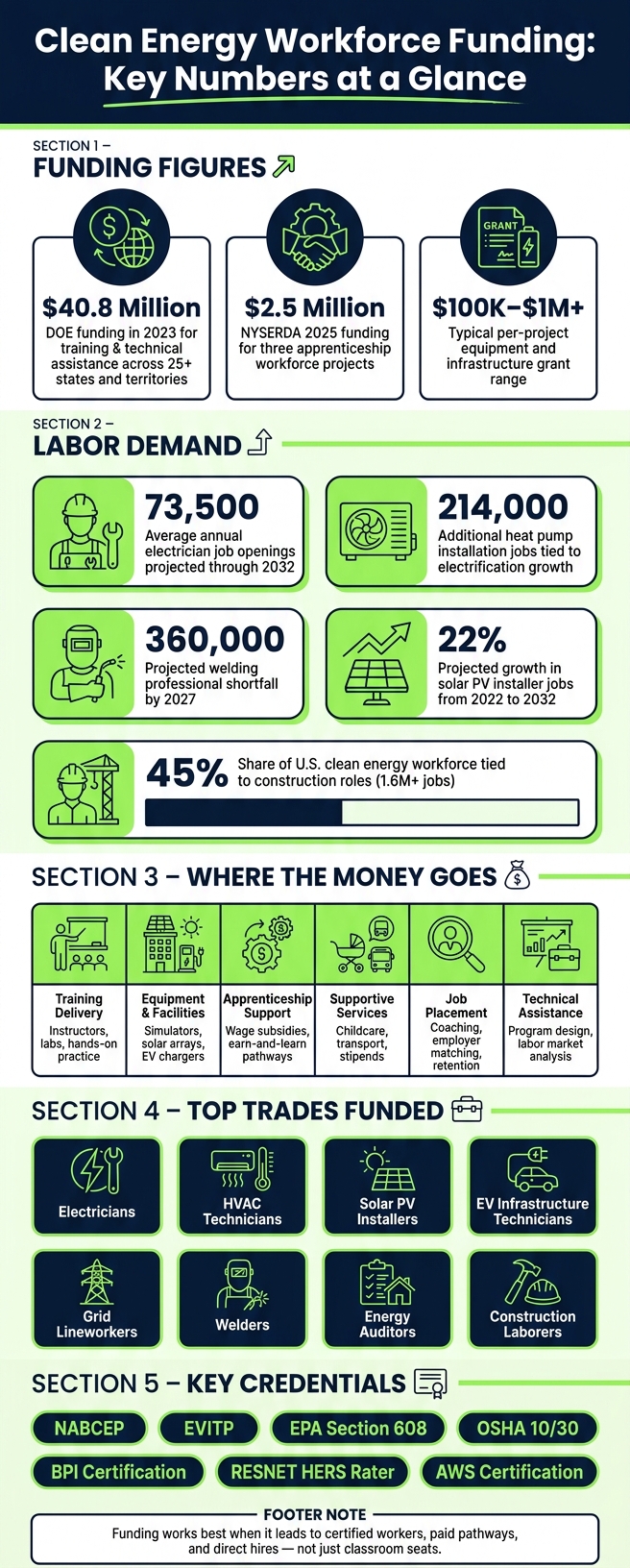
Clean energy funding is mostly paying to get more people job-ready fast. From what I see in this article, the money goes to training, equipment, apprenticeships, support services, job placement, and program setup so employers can fill hard-to-staff roles.
Here’s the short version:
- The main problem is labor supply. Solar PV installer jobs are projected to grow 22% from 2022 to 2032, and electricians face about 73,000+ openings each year.
- Most funding goes to three big areas: training delivery, equipment/facilities, and paid apprentice pathways.
- The trades getting the most support are electricians, HVAC techs, energy auditors, construction crews, welders, lineworkers, solar installers, and EV charging techs.
- Credentials matter. Workers often need things like NABCEP, EVITP, EPA Section 608, OSHA 10/30, or state licenses to get on funded projects.
- For employers, compliance now affects hiring. Apprenticeship rules, wage rules, and timing can shape whether a program leads to people who can start work on time.
- For workers, paid training paths matter most. The article points again and again to programs that connect class time to wages, job placement, and employer-backed credentials.
A few numbers stand out:
- $2.5 million: NYSERDA funding for three apprenticeship-related workforce projects in 2025
- $40.8 million: DOE funding in 2023 for training and technical assistance across 25+ states and territories
- 214,000: extra heat pump installation jobs tied to electrification growth
- 360,000: possible welding shortfall by 2027
- 45%: share of the U.S. clean energy workforce tied to construction roles
If I had to boil the article down to one point, it would be this: funding works best when it leads to certified workers, paid pathways, and direct hires – not just classroom seats. That’s the lens I’d use to read the rest of the piece.
Clean Energy Workforce: Key Stats & Funding Breakdown 2025
State Strategies to Support the Growing Clean Energy Workforce Webinar
sbb-itb-aa28329
Where the money goes across workforce programs
Across federal and state programs, the money usually pays for six things: training, equipment, apprenticeships, supportive services, placement, and technical assistance. How that money gets divided between training, infrastructure, and placement often decides what a program actually delivers: more training seats or more hires.
| Funding use | What it pays for | Why it matters |
|---|---|---|
| Training delivery | Instructors, lab supervision, hands-on practice, and direct training materials | Produces job-ready skills and credentials |
| Training infrastructure | Equipment purchases, simulators, lab buildout, and facility upgrades | Expands capacity so more trainees can be served faster |
| Employer and apprenticeship support | Apprentice wage subsidies, employer reimbursements, stipends, and related instruction | Lowers the cost of taking on trainees and expands paid pathways |
| Supportive services | Childcare, transportation, stipends, boots, uniforms, and other training costs | Helps participants complete training, especially when access barriers exist |
| Placement support | Career coaching, employer engagement, job matching, retention follow-up, and case management | Turns training into hires |
| Technical assistance | Program design, apprenticeship development, partner coordination, and labor market analysis | Helps providers launch or scale programs aligned to real workforce demand |
The first funding priority is usually capacity: instructors, labs, and equipment that can produce more qualified workers.
Training delivery, equipment, and facility capacity
The biggest share of funding usually goes to training delivery. That means paying for qualified instructors, supervised lab time, hands-on practice, and direct training materials. If a program can’t staff classes or run labs, it can’t train people at the pace employers need.
Equipment and facility spending tends to sit right next to that. This is especially common when programs need to grow fast. Grants often pay for solar arrays, EV chargers, and heat pump training equipment so trainees can practice on the same kinds of systems they’ll see on the job. NYSERDA’s 2025 apprenticeship initiative is a good example: it awarded $2.5 million to three workforce projects, and those projects explicitly included heat pump water heater training equipment.
Many funding announcements also set aside separate equipment and infrastructure tracks, often in the $100,000 to $1,000,000+ range per project. That setup matters because it lets operating funds stay focused on instructors, lab time, and participant support instead of getting eaten up by capital costs.
These capital expenses can change capacity fast. Add trainers, extend lab hours, and a program can serve more people without waiting years to rebuild the whole model. DOE’s Building Training and Assessment / Industrial Assessment Center program put $40.8 million to work in 2023 to expand training and technical assistance across more than 25 states and territories.
Apprenticeships, reskilling, and job placement support
A lot of this funding is aimed at paid pathways, not just standalone courses. That’s a big deal because employers don’t just want people who finished a class. They want workers who can move from training into project work with little delay. Registered apprenticeships and pre-apprenticeships mix classroom learning with on-the-job hours, and grants often help cover apprentice wages or offset employer costs for related instruction.
Reskilling money often targets workers from adjacent trades. Think HVAC technicians moving into advanced heat pump installation, or construction crews adding solar and EV infrastructure skills. In those cases, the training is usually short and focused. Instead of starting from scratch, workers build on what they already know. Funding often covers specialized simulators and practice rigs so experienced workers can train on commissioning and troubleshooting in a controlled setting.
One of the biggest shifts lately is that placement is now being funded as a core activity instead of getting treated like a side task. That includes career coaching, employer outreach, job matching, retention follow-up, and case management – the work that helps training turn into actual jobs.
NYSERDA’s case study of St. Nicks Alliance shows how that can play out. Its 8-week, 230-hour HVAC program produced 56 trainees, 43 full-time jobs, and 4 apprenticeship placements.
These spending patterns stand out most in electrical, HVAC, solar, and grid-related trades.
Trades most often supported by clean energy funding
Clean energy funding does not spread evenly across occupations. Study after study, plus public funding announcements, point to the same set of trades: electricians, HVAC technicians, energy auditors, construction laborers, welders, grid lineworkers, solar PV installers, and EV charging technicians.
| Trade Category | Typical Training Need | Common Credentials | Clean Energy Project Relevance |
|---|---|---|---|
| Electricians | Registered apprenticeship or trade-school program | State journeyman/master license | Solar, EV charging, heat pumps, grid interconnection |
| HVAC technicians | 6–24 months, community college or union center | EPA Section 608, heat pump certifications | Building electrification, heat pump deployment, retrofits |
| Energy auditors | Short- to medium-term technical training | BPI certification, RESNET HERS Rater | Weatherization, retrofit verification, efficiency programs |
| Construction laborers and equipment operators | OSHA safety, equipment operation | OSHA 10/30, operator certifications | Utility-scale solar, battery storage, transmission buildout |
| Welders | Specialized procedure training | AWS certification | Wind towers, solar racking, substations, storage tanks |
| Grid lineworkers | Long-term apprenticeship | State/utility lineworker certification | T&D modernization, smart grid, EV infrastructure |
| Solar PV installers | PV and inverter training | NABCEP certification | Rooftop and utility-scale solar installation |
| EV infrastructure technicians | Specialized electrical training | EVITP certification, electrical license | DC fast charger and fleet depot installation |
A big share of funding flows to trades where licensing, equipment, and site-ready crews have the biggest effect on project schedules.
Electrical, HVAC, and building performance roles
The strongest funding signals show up in trades that depend on licensing, field certifications, and hands-on equipment training.
Electricians are at the center of solar, EV charging, heat pump, and grid work. And the hiring gap is already slowing things down. The U.S. is projected to average 73,500 electrician job openings per year through 2032.
HVAC demand is climbing just as hard. Electrification scenarios point to another 214,000 heat pump installation jobs – about a 50% increase in the HVAC workforce – as states push heat pump adoption through utility and state programs.
Energy auditors and building performance technicians are part of this same hiring picture. Credentials such as BPI certification and RESNET HERS Rater often decide who can work on retrofit and weatherization projects. That matters even more in rural and disadvantaged communities, where training providers are harder to find and retrofit activity is growing at the same time.
Construction, welding, grid, solar, and EV infrastructure roles
Licensed trades get a lot of attention, but clean energy buildout also depends on crews that can handle heavy field work safely and on schedule.
Construction trades account for roughly 45% of the U.S. clean energy workforce – more than 1.6 million jobs – because utility-scale solar, wind, battery storage, and transmission projects are, at their core, construction jobs. Laborers, ironworkers, operating engineers, and millwrights usually need OSHA 10/30, fall protection, and rigging basics before they can work on an energy site.
Welders are another pressure point. Industry analyses warn of a shortfall of up to 360,000 welding professionals by 2027, and that gap is already tied to schedule delays across wind, solar, and storage projects. Grid lineworkers face much the same problem. As transmission and distribution modernization picks up, employers are struggling to find workers with high-voltage safety training and live-line work credentials – skills most often built through formal apprenticeships.
For solar and EV jobs, certain credentials now act like a gatekeeper. NABCEP certification and EVITP certification have become standard hiring requirements on federally funded projects and under NEVI guidance. So workers without them are often shut out from the busiest job sites.
Project location also shapes hiring outcomes. A funded training program may look strong on paper, but remote wind, solar, and transmission sites often need pre-vetted crews whose certifications and location already match the job.
How public funding models work and what employers should watch
After looking at where the money goes, the next step is understanding how funding is set up and what employers need to do to qualify. That matters for one simple reason: the funding model often decides whether a program leads to actual hires or just more enrollments.
| Funding Model | Who Receives Funds | Supported Activities | Key Employer Watch Points |
|---|---|---|---|
| State Workforce Grants | Training providers, community colleges, union training centers | Instructor capacity, equipment purchases, cohort-based training | Whether the program fits local hiring needs |
| Federal Training Awards | Workforce boards, labor organizations | Curriculum development, apprenticeship expansion | Registered apprentice documentation and prevailing wage compliance |
| Apprenticeship Support | Labor organizations, employers | Earn-and-learn pathways, registered apprenticeship training | State recognition and federal incentive eligibility |
| Outcome-Based Reimbursement | Training providers, nonprofits | Completion, placement, and retention milestones | Completion rates and 90-day retention |
| Regional Workforce Initiatives | Workforce boards, industry clusters | Multi-employer pipelines, regional credential alignment | Local training capacity and occupation-specific completions |
State grants, federal awards, and apprenticeship support
Many federal clean-energy incentives now require registered apprenticeship documentation. That alone changes the stakes for employers.
State grants often pay for instructor capacity, equipment, and cohort training. But funding on paper doesn’t mean the program will help you hire. Employers need to check whether those programs line up with local hiring demand. If the training doesn’t match the jobs in the market, you’ll end up with a pipeline that looks good in a report but falls short when it’s time to staff roles.
It’s also smart to verify wage levels and schedule fit early. If pay is off or training hours don’t work for the people you want to hire, candidates can drop out fast. Employers should also track apprenticeship relationships from the start, because those ties now affect both funding eligibility and bid readiness.
Outcome-based and regional workforce initiatives
The source of funding is only part of the story. Employers also need to watch how the money gets paid out.
Outcome-based programs tie reimbursement to completions, job placements, or 90-day retention milestones, not just enrollment counts. That’s a big difference. A program may bring in plenty of people, but if few finish or stay on the job, the numbers won’t help much.
Regional programs can work well, but only if local training capacity matches the roles employers need to fill. That’s the catch. A regional pipeline sounds strong until you realize there aren’t enough seats, instructors, or occupation-specific completions in the market.
Employers should also check whether programs lead to recognized credentials such as NABCEP and OSHA 30, and whether training paths line up with registered apprenticeship requirements for commercial-scale incentives. For employers, the test is pretty simple: does the program produce compliant, job-ready workers on time?
Conclusion: What funding patterns signal for hiring and deployment
In 2026, clean energy funding is turning training into deployable labor. Staffing now has to line up with credentials, local labor supply, and project timelines.
That change matters because funding only goes so far if trained workers don’t get to the right job sites on time. A lot of these programs are paying for the crews that keep major buildouts moving, even when equipment delays and regional labor shortages get in the way. For employers, the signals are pretty straightforward.
Key points for employers and workforce planners
Credentials are the first gate. Certifications now decide who can access funded work, not just who gets a hiring edge.
Local labor supply is the second constraint. Training capacity hasn’t kept up with demand in every region, and shortages are hitting hardest where project activity is busiest.
Project dates and compliance rules must stay aligned. Employers that treat compliance like a box to check later can lose bid eligibility and throw off project schedules. The next hurdle is getting trained, compliant workers to job sites fast.
For employers, ABLEMKR matches pre-vetted workers to job sites by certification, safety training, availability, and location. That helps crews mobilize faster while keeping compliance in view.
The funding is there. The demand is there. The gap is getting trained, compliant workers to the right projects at the right time.
FAQs
Which clean energy jobs have the biggest hiring gaps?
The biggest hiring gaps show up in specialized roles, especially:
- electricians
- HVAC technicians
- mechanics
- wind turbine technicians
- solar photovoltaic installers
Demand is also strong for energy auditors, BIM specialists, and experts in grid specialization and hydrogen safety, as clean energy projects depend more on digital monitoring and high-voltage systems.
What credentials do workers need for funded projects?
Workers usually need a mix of safety training, technical credentials, and registered apprenticeship status.
In practice, that often means OSHA 10-hour or 30-hour training, plus sector-specific certifications. For example, solar and storage roles may call for NABCEP PVIP or ESIP, while wind jobs often require GWO training.
Verified apprenticeship credentials matter too. They can help employers meet the 15% labor-hour requirement tied to full federal tax credit multipliers.
How can employers tell if a training program will lead to hires?
Employers should focus on programs tied to measurable business outcomes, not just training hours. What matters is speed to mastery, productivity gains, and certification completion rates that line up with project needs.
Programs are more likely to lead to hires when they run through proven pipelines, like union apprenticeships and labor-management partnerships, and stay in step with real-time labor market data and industry-recognized credentials.


