
Want a path into clean energy without taking on big school debt? I’d sum it up like this: you can get paid to learn, build job skills on active sites, and work toward a credential that can lead to steady work. In 2025, the energy industry had 29,081+ registered apprentices, and federal data shows about 93% of apprenticeship completers stay employed after finishing.
Here’s the short version:
- You earn while you train instead of paying for a four-year degree first
- Most programs run 2 to 5 years
- You usually complete about 2,000 work hours per year plus 144 classroom hours
- Common paths include solar, wind, electrical, energy efficiency, and storage
- Many completers earn about $77,000 in their first year after finishing
- Career paths often move from apprentice → journeyworker → foreman or project management
- To get in, you usually need to be 18+, have a high school diploma or GED, and meet basic math and physical job requirements
- You can find programs through Apprenticeship.gov, unions, community colleges, and state workforce groups
- After training, platforms like ABLEMKR help connect workers to project jobs based on their skills, safety training, and location
What this article shows is simple: if you want a direct route into clean energy work, an apprenticeship can give you pay, training, credentials, and a path to long-term work in one package.
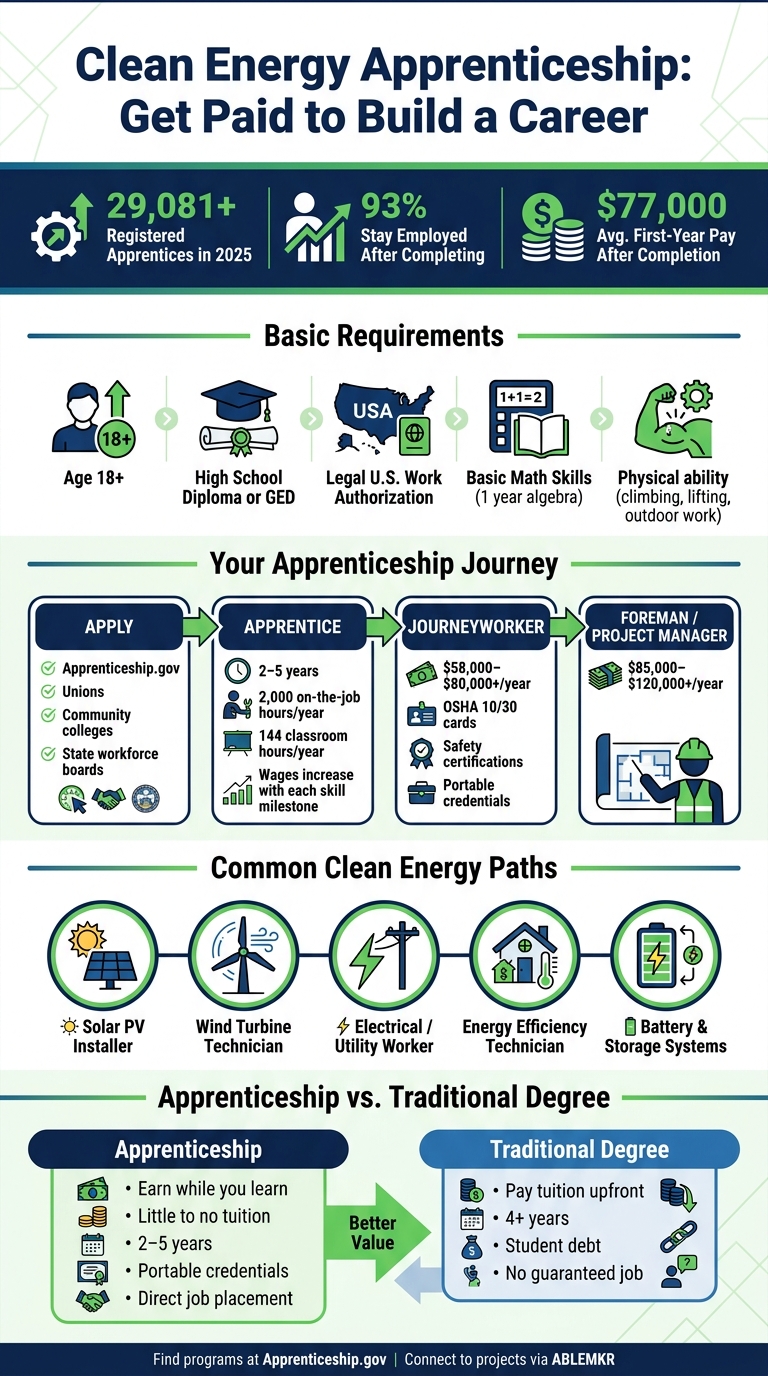
Clean Energy Apprenticeship Career Path: Steps, Pay & Outcomes
Clean Energy Workforce Alliance Webinar Connecting Job Seekers to Registered Apprenticeship Pathways
sbb-itb-aa28329
What a clean energy apprenticeship is
A clean energy apprenticeship is a paid job plus training. You start earning from day one while learning work like solar installer, wind turbine technician, or clean energy electrician. It’s a straight path: you begin as an apprentice and work toward journeyworker status.
Most of these programs are Registered Apprenticeships approved by the U.S. Department of Labor (DOL) or a State Apprenticeship Agency (SAA). That registration sets clear rules for training hours, classroom learning, and safety.
Registered Apprenticeship basics
Most clean energy apprenticeships last 2 to 5 years, depending on the trade. During that time, apprentices usually complete at least 2,000 hours of supervised on-the-job training each year plus about 144 hours of related technical instruction (RTI) annually. That classroom piece can include electrical theory, OSHA safety courses, blueprint reading, and energy systems design. Training is often delivered through community colleges, technical schools, or union training centers.
Three parts shape how the training works day to day:
- Journeyworker – A fully qualified tradesperson who has finished the occupation’s training and earns top pay.
- Mentor – A journeyworker or supervisor who guides the apprentice on the job site, checks the work, and helps build skills.
- Related Technical Instruction (RTI) – Classroom or online learning that covers theory, codes, safety, and technical knowledge.
As apprentices gain skills and complete each training step, their wages go up. That same structure carries across the clean energy roles below.
Common clean energy trades and job sites
Registered apprenticeships cover work in solar, wind, electrical, energy efficiency, and storage. Solar installers may work on rooftops or large solar farms. Wind technicians train at onshore and offshore sites. Electricians may work on substations and grid modernization projects. Other paths focus on building retrofits, such as improving insulation, HVAC, and lighting, or installing battery and storage systems.
Each job site puts apprentices in live working conditions. That might mean heights on turbines, outdoor solar arrays, or tight spaces during retrofits. Safety training starts on day one. That’s what turns entry-level work into a career with room to grow.
The setup is simple: learn on the job, build hours, take classes, and move up.
How clean energy apprenticeships build careers
That setup is what turns training into an actual career path. For employers, this pipeline helps get reliable craft workers to keep projects moving. An apprenticeship gives people a direct route from entry-level work to long-term work with room to move up.
Paid training, wage growth, and lower education debt
Apprentices get paid while they learn, and wages go up as they build skills and log more hours. In clean energy jobs, journey-level solar installers and wind turbine technicians often earn $58,000–$80,000+ per year. Pay can go even higher on projects covered by Inflation Reduction Act prevailing wage rules.
The money side looks even better when debt enters the picture. Unlike many classroom-only programs or college routes, apprenticeships usually come with little to no tuition cost. Training is often paid for by employers, unions, or joint training committees. Studies show that apprenticeship participants out-earn similar workers as early as their first year in the program.
Safety, certifications, and long-term career mobility
There’s more here than wages. Apprentices also leave with credentials they can take from one job to the next.
Clean energy work comes with strict safety demands, and apprenticeships teach those habits on actual job sites under supervision. That hands-on work is backed by formal instruction in OSHA standards, fall protection, lockout/tagout, and electrical safety. Workers in wind often complete wind safety and rescue training. Solar apprentices usually earn OSHA 10- or 30-hour cards and train on rooftop work, harness use, and electrical DC/AC safety. Those credentials stay with the worker.
The path upward is easy to see: apprentice → journeyworker → foreman. Most people who finish an apprenticeship stay employed after the program ends. Many step right into journeyworker roles with no gap in between. In solar and wind, project managers often earn $85,000–$120,000+ per year.
That mix of pay, safety training, and portable credentials gives workers a faster path to more responsibility.
How to enroll in a clean energy apprenticeship
If you’re ready to turn that path into a job, the process is pretty simple on paper: check that you qualify, apply, and keep close track of your progress once you’re in.
Check eligibility and pick a target trade
Most registered clean energy apprenticeships ask for the same basic things. You usually need to be at least 18, have a high school diploma or GED, be legally allowed to work in the U.S., and be able to handle the physical side of the job, like climbing, lifting, and working outdoors.
A lot of solar, wind, and utility programs also want to see one year of high school algebra. If you didn’t take it, or it’s been a while, a community college class or an approved technical math course can often fill that gap.
Then comes the part that matters more than people think: picking the right trade. Go with the one that fits both your strengths and the jobs open near you. Common clean energy paths include solar PV installer, wind turbine technician, energy efficiency technician, and electrical worker on utility-scale projects. The day-to-day work can look very different:
- Solar work often means rooftop or ground-mount installation
- Wind work means climbing turbines and spending time in remote areas
- Energy efficiency roles lean more on diagnostics and customer interaction
- Utility electrical work focuses on grid infrastructure and substations
Find programs and apply
Once you’ve picked a trade, start looking for programs that are hiring in your area.
A good first stop is Apprenticeship.gov. Use the Apprenticeship Job Finder and search terms like "solar", "wind", "electrician", or "energy efficiency." Then narrow the results by your state or city. From there, apply straight to employers or program sponsors. It helps to treat this exactly like a job hunt.
Don’t stop with the federal site. You can also look through American Job Centers, state departments of labor, workforce boards, community colleges, and union training centers. That includes IBEW/NECA programs for electrical work, which can be a strong fit if that’s your target trade.
Before you apply, get your paperwork together. Most programs want:
- High school or GED transcripts
- Any college transcripts
- Copies of certifications you already have
- Your driver’s license
- Work authorization documents
Many programs also require an aptitude test that covers algebra and reading comprehension. After that, you’ll usually have an interview. That’s where they look at things like reliability, safety mindset, and why you want the trade in the first place. A lot of programs rank applicants based on test and interview scores, then contact people as spots open up.
Start the program and track your progress
If you get accepted, things become official fast.
You’ll sign a formal apprenticeship agreement. This training contract lays out the occupation, the required on-the-job learning hours, the related instruction hours, your starting hourly pay, and the schedule for pay increases as you move forward. After that, the agreement is submitted for approval.
From there, you’ll work under a journeyworker or mentor who signs off on your hours and skills. Keep your own records too. Log your hours, classes, and completed skills as you go. It sounds small, but it puts you in charge of your path to journeyworker status and the wage steps tied to that progress.
How ABLEMKR supports career growth after apprenticeship training

Once apprentices finish training, the next challenge is simple: get to the right job fast. After apprenticeship, the goal shifts to steady project work. That’s where ABLEMKR fits in.
Matching trained workers to project needs
ABLEMKR connects pre-vetted workers to energy and infrastructure projects by matching them based on certifications, safety training, availability, and location. That includes electrical, maintenance, and site-support roles across energy and infrastructure job sites.
In plain terms, the certifications and credentials earned during apprenticeship don’t just sit on a resume. They become the criteria used to place workers on projects that need those exact skills.
Compliance, onboarding, and dependable pay
Getting placed is only one part of the process. Workers also need a smooth path through onboarding so they can start work sooner, not get stuck in paperwork.
The mobile-first platform puts hiring, onboarding, and compliance in one place. Workers also get:
- W-2 jobs
- Workers’ compensation coverage
- On-time pay through integrated payroll
That makes the move from credentialed apprentice to active project worker a lot more direct.
Conclusion: From apprenticeship training to a clean energy career
Clean energy apprenticeships give people a direct way into a field that keeps growing.
The upside isn’t vague. It shows up in the data. Federal figures show that 93% of apprenticeship completers remain employed after finishing, with average pay of about $77,000 per year and much less debt than many four-year degree paths.
Those credentials can travel with workers from one jobsite to the next, whether that means a utility-scale solar farm, a wind maintenance site, or a grid modernization project.
Once training is done, the next step is simple: get workers onto active projects fast. ABLEMKR helps place qualified workers in the right projects while keeping compliance and pay on track.
Pick a trade, enroll, finish the program, and turn training into steady project work.
FAQs
Do I need experience to start?
No. You don’t need prior experience to start a career in clean energy, although some advanced or specialized roles do call for it.
A lot of people get their start through pre-apprenticeship programs or entry-level jobs. From there, they build skills through registered apprenticeships, where they earn wages while learning, and add certifications like OSHA 10 or OSHA 30 along the way.
How competitive are clean energy apprenticeships?
Clean energy apprenticeships are highly competitive. Demand for skilled workers is climbing, and federal incentives like the Inflation Reduction Act add more pressure: on large renewable energy projects, 15% of labor hours must be completed by registered apprentices.
That helps explain why these programs draw so much interest. They offer a direct path into well-paid, steady careers, with structured training and strong long-term wage growth over time.
What happens after I finish the program?
After you complete an apprenticeship, you earn nationally recognized, portable credentials that show what you can do across the energy sector.
That matters for one simple reason: those credentials can travel with you. If you want to move into higher-level roles, they can help open the door to jobs in supervision, project management, or even running your own business.
You can also boost your earning potential over time by adding certifications or picking up new skills. And if you’re looking for your next move, platforms like ABLEMKR can help connect you with high-demand opportunities across the U.S.


