
To prepare for ChargePoint DC fast-charging work, I check three things: DC certification, the right product microcredentials, and permission to perform the assigned electrical work. Passing the exam alone isn’t enough.
Here’s the path I follow:
- Check access and eligibility: Start at ChargePoint’s Training & Certification page, create an installer account, and confirm the DC exam requirements.
- Plan the exam: The listed DC exam costs $125 and includes 70 questions in about 90 minutes. I verify current fees and scheduling rules before paying.
- Match training to the job: Choose product courses for installation, commissioning, preventive maintenance, or corrective maintenance.
- Confirm field readiness: Check licensing or permitted supervision, employer approval, safety requirements, and the assigned charger model.
- Track expiration dates: DC certification lasts 3 years; product microcredentials need separate checks.
My rule: <u>check every requirement before dispatch</u>. A training record is not an electrical license.
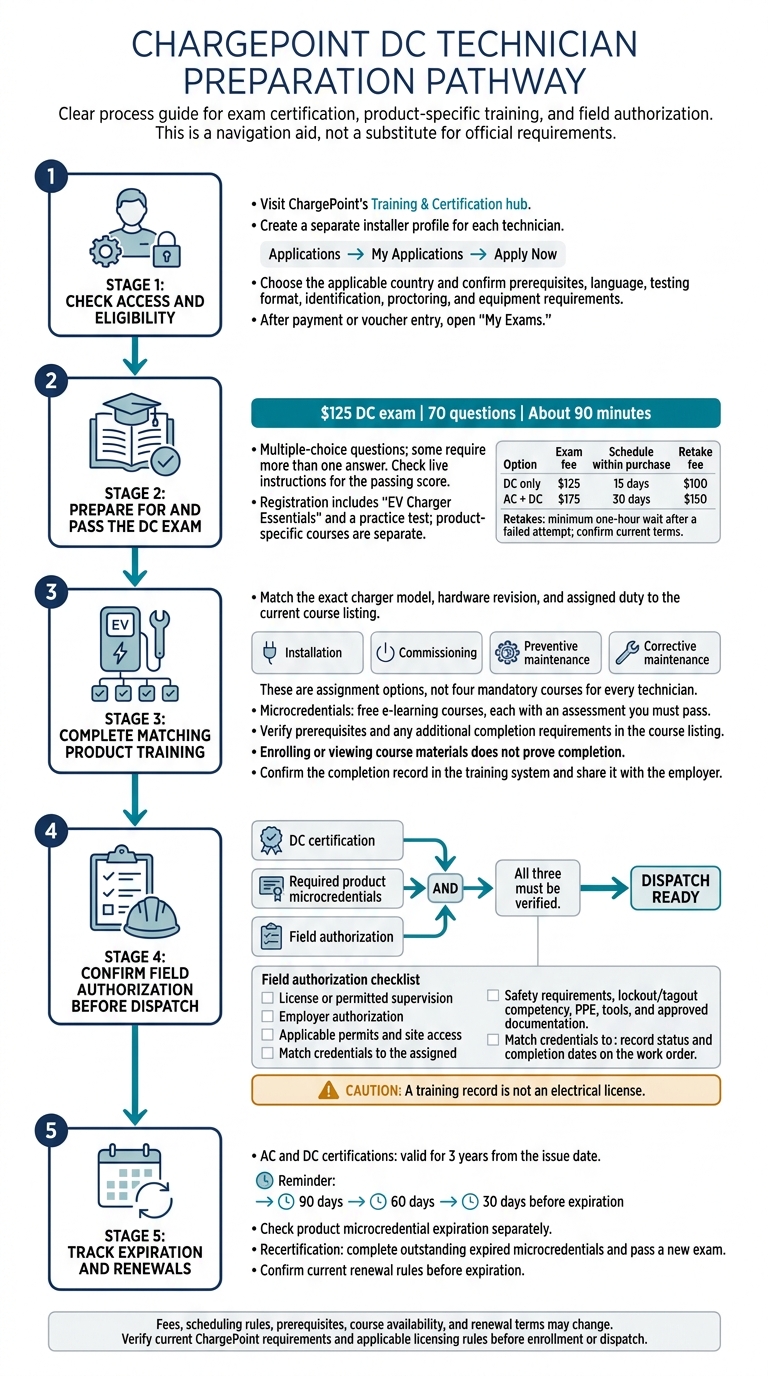
ChargePoint DC Technician Training and Field Readiness
Step 1: Find Official Training and Check Eligibility
Visit ChargePoint’s Training & Certification hub to check the current DC exam and course requirements before enrolling any technicians.
Access Your Account and Find the DC Exam
Create a separate profile for each technician so course and exam records stay with the right person. In the certification dashboard, select Applications → My Applications → Apply Now, choose the applicable country, and complete the DC exam application. After paying or entering a voucher, open My Exams for scheduling details or exam instructions.
Once the account is active, confirm the exact exam path and any linked product courses in the dashboard. Match the product catalog to the assigned station model and service task. If the account can’t access a required course, contact ChargePoint to resolve access before planning the work.
Check Prerequisites and Licensing Requirements
Check the account restrictions, prerequisites, language, and testing format for the selected exam and course. Before scheduling an online test, confirm the identification and proctoring rules, along with computer, internet, camera, and microphone requirements.
Before assigning U.S. fieldwork, verify the technician’s license or permitted supervision status with state and local authorities. Also check permits, employer authorization, site access, safety training, lockout/tagout competency, PPE, and background checks. Record the check date, credential ID, and covered model.
sbb-itb-aa28329
Step 2: Prepare for and Take the DC Certification Exam
ChargePoint’s DC certification exam takes about 90 minutes and has 70 multiple-choice questions. Some questions have more than one correct answer, so follow the answer count shown for each item. Check the live instructions for the passing score.
Confirm Exam Fees and Scheduling Deadlines
ChargePoint lists $125 for the DC exam or $175 for AC and DC together. You must schedule within 15 days of purchase for a single exam or 30 days for the combined option. Before checkout, verify prices, taxes, voucher terms, and appointment rules. Then pay and schedule through the candidate system.
Registration includes EV Charger Essentials and a practice test. Product-specific courses are separate. After payment, take the practice test to spot weak areas before working through the topic list.
Retakes cost $100 for one exam or $150 for the combined option. They require payment and scheduling, with a minimum one-hour wait after a failed attempt. No attempt limit is stated, but confirm the terms before registering again.
Study the Exam Topics and Job Requirements
Use these 10 topic areas as your study checklist:
- Introduction to DC charging
- DC electrical fundamentals
- Charging-station components
- EV charging infrastructure
- Charging and protocol standards
- Site assessment and installation
- Safety and codes
- Charging management and control
- Troubleshooting and maintenance
- User support and education
Use the sample questions to find gaps, then review the matching ChargePoint technical documents. Focus on power conversion, voltage and current, installation requirements, and approved diagnostics.
Study National Electrical Code requirements, OSHA rules, local permitting requirements, and your employer’s lockout/tagout procedures alongside manufacturer instructions. Before testing, use the included practice test to revisit weak topics. During the exam, read each answer-selection instruction carefully – don’t assume AC procedures apply to DC equipment.
After the exam, move to the product-specific course for your assigned charger model.
Step 3: Complete Training for Your Assigned Product
After the DC exam, select the product microcredential for your assigned charger. Match the station’s exact model, hardware revision, and assigned duty to the current ChargePoint University listing. ChargePoint’s current catalog includes product microcredentials for the assigned DC charger and duty. If the work order and course title don’t clearly match, check with your employer or ChargePoint administrator before enrolling.
Match Product Courses to Job Duties
Use the table below to select training. Then check the official listing for prerequisites and covered tasks. This table is only a qualification checklist. It does not authorize field work or replace licensing, employer approval, installer-account access, or ChargePoint requirements.
| Assignment | Product family | Prerequisite certification | Required microcredential | Covered tasks | Completion evidence |
|---|---|---|---|---|---|
| Installation | Assigned DC product family | DC certification where required | Product installation | Site preparation, connections, setup, and safety checks | Course or microcredential record |
| Commissioning | Installed product family | DC certification and applicable product training | Product commissioning | Startup, configuration, testing, and handoff | Course completion and required assessment |
| Preventive maintenance | Product family on maintenance order | DC certification or listed prerequisite | Product preventive maintenance | Inspection, cleaning, scheduled maintenance, and reporting | Course or microcredential record |
| Corrective maintenance | Assigned product and service scope | DC certification and applicable service prerequisites | Product corrective maintenance | Fault isolation, approved repairs, testing, and restoration | Microcredential record and service documentation |
ChargePoint offers product-specific microcredentials for installation, preventive maintenance, commissioning, and corrective maintenance. After selecting a course, check its completion rules before you start training.
Verify Course Completion Requirements
ChargePoint describes microcredentials as free e-learning courses, each with an assessment you must pass. Check the listing for required lessons, practical evaluation, or instructor-led work. Then confirm completion in the training system and share the record with your employer. Enrolling or viewing course materials does not prove completion.
Check Technician, Specialist, and Expert Credentials
Check the current requirements before using a credential title. A certified technician holds one AC or DC certification plus at least one relevant microcredential. A product specialist holds that certification plus all four microcredentials for one product. A DC EVSE expert holds DC certification plus specialist status across all DC products. Use these requirements to check which technicians qualify for assignment to the job.
Conclusion: Confirm Field Readiness and Track Renewals
After Steps 1–3, treat the DC exam, required product microcredentials, and field authorization as separate gates. Confirm each before dispatch.
Verify Credentials Before Assigning Field Work
Add the technician’s name, exam status, microcredentials, and completion dates to the work order. Check that these credentials match the assigned equipment and tasks. Before dispatch, also verify licensing, employer authorization, site safety, PPE, tools, and approved documentation.
Track Renewals and Crew Qualifications
ChargePoint AC and DC certifications are valid for 3 years from the issue date. Set reminders 90, 60, and 30 days before expiration, and confirm the current ChargePoint renewal rules before the credentials expire.
Track microcredential renewals separately from the DC certification. Recertification requires completing any outstanding expired microcredentials and passing a new exam.
FAQs
Can my electrical experience count toward ChargePoint training?
Yes. Your electrical experience applies and often gives you a solid starting point for specialized charging equipment training. ChargePoint training builds on core electrical skills, with a focus on product-specific commissioning, diagnostics, and firmware.
Your installation and troubleshooting experience can also help you move into field support or system commissioning. Modular training or employer-led courses can fill technical gaps without requiring you to start your education from scratch.
How do I confirm training covers an older charger?
Contact the training sponsor or manufacturer to check that the curriculum covers your older charger model. ChargePoint programs typically cover product-specific commissioning, firmware, and diagnostics. A course title doesn’t tell the whole story, so check the syllabus for hands-on labs using the equipment you need to service.
Keep organized records of course titles, provider names, dates, and topic breakdowns. These records help document your skills with specific hardware.
Do hardware updates require additional training?
Yes, hardware updates may require additional training. Being qualified to work on one system or piece of equipment doesn’t automatically qualify a technician to work on another.
Updates may include new components, firmware, or diagnostic procedures. Technicians should seek product-specific training from the manufacturer to learn what’s changed. Before allowing work on updated hardware at an active site, employers must verify each worker’s task-specific training and documented safety credentials.


