
Hazardous materials (hazmat) safety is critical in energy industries like oil, gas, and mining. Proper certifications ensure compliance with federal regulations, reduce risks, and prepare workers for emergencies like chemical spills or toxic gas exposure. Here’s a quick overview of five key hazmat certifications for energy professionals:
- HAZWOPER Certification: Required for high-risk environments; annual renewal with an 8-hour refresher.
- H2S Alive Certification: Focuses on hydrogen sulfide safety; renew every three years.
- Confined Space Entry Certification: Prepares workers for hazardous confined spaces; annual renewal recommended.
- WHMIS Certification: Canada’s standard for handling hazardous materials; reviewed annually.
- Certified Safety Technician (CST): Advanced certification for safety professionals; renew every five years.
Each certification serves specific roles, from emergency response to site safety supervision, ensuring a safer workplace while meeting legal requirements.
1. HAZWOPER Certification
The HAZWOPER (Hazardous Waste Operations and Emergency Response) certification is a must-have for energy workers operating in high-risk, hazardous environments. Governed by OSHA standards 29 CFR 1910.120 and 1926.65, it equips workers to handle uncontrolled hazardous releases, whether from storage tanks, railcars, or chemical fires.
This training is specifically designed for life-threatening situations often encountered in industries like oil, gas, and mining. These include oxygen-deficient atmospheres, exposure to toxic chemicals, and responding to emergency spills. According to OSHA:
HAZWOPER aims to prevent and minimize the possibility of worker injury and illness resulting from potential exposures to hazardous substances.
The certification is a gateway to working on high-risk sites, such as underground storage tank removal locations or treatment, storage, and disposal (TSD) facilities, and involves intensive training modules and hands-on evaluations.
Training Duration
- General workers: 40 hours of classroom instruction plus three days of field experience.
- Occasional site workers: 24 hours of classroom instruction plus one day of field practice.
Practical training includes the use of personal protective equipment (PPE) and air monitoring, ensuring workers are prepared for real-world scenarios.
Renewal Period
The certification remains valid for 12 months. To stay compliant, workers must complete an 8-hour refresher course annually. Failure to renew on time may require retaking the full training course.
Cost Range (USD)
- 40-hour course: $234.99–$264.99
- 24-hour course: Around $179.99
- 8-hour refresher: Approximately $49.00.
Key Energy Applications
HAZWOPER-certified professionals are critical in roles such as emergency response, site remediation, and infrastructure maintenance. Their expertise is also essential for operations at facilities that produce hazardous by-products. Common job titles include:
- General laborers
- Heavy equipment operators
- On-site supervisors
- Hazardous materials technicians
- Incident commanders
This certification ensures workers are fully equipped to handle the challenges of hazardous environments while prioritizing safety and compliance.
2. H2S Alive Certification
The H2S Alive certification is a must-have for anyone working in the oil and gas industry, especially in environments where hydrogen sulfide (H2S) is present. This gas is not only highly toxic but also flammable, making it a serious hazard in sour gas areas. Workers on drilling rigs, in refineries, or involved in pipeline operations often encounter H2S, making this training essential for their safety.
The course focuses on understanding the properties of H2S, its health risks, and the proper steps to take during an emergency. Participants also learn to use critical safety equipment like Self-Contained Breathing Apparatus (SCBA), Supplied Air Breathing Apparatus (SABA), and electronic gas detectors. This hands-on training ensures workers are prepared to handle dangerous H2S exposure scenarios effectively.
Training Duration
The H2S Alive certification course is a one-day program, lasting about 8 hours. Its concise format allows workers to quickly gain the knowledge and skills needed to meet safety standards without significant downtime.
Renewal Period
Recertification timelines can vary depending on the employer or jurisdiction, but many energy companies require workers to renew their certification every three years. This aligns with federal hazardous materials training guidelines and helps maintain a consistent level of safety expertise across the industry.
Key Energy Applications
This certification is particularly vital for those involved in upstream oil and gas operations in areas with high levels of sour gas. Key roles that benefit from H2S Alive certification include field operators, drilling teams, pipeline technicians, and maintenance staff. Proper H2S detection and response are crucial in these roles to ensure workplace safety.
Employers can confirm a worker’s H2S Alive certification through ABLEMKR (https://ablemkr.com), providing a reliable way to verify qualifications.
3. Confined Space Entry Certification
Confined Space Entry Certification prepares workers to safely navigate confined spaces that may pose dangers like toxic gases, low oxygen levels, or engulfment risks. In the energy sector, this training is crucial for those working in environments such as storage tanks, underground vaults, process vessels, pipelines, manholes, or silos. These spaces are common in facilities like refineries, power plants, and fuel distribution hubs, making this certification a key safety standard.
The course focuses on hazard identification, atmospheric testing, ventilation requirements, and emergency response procedures. Participants learn to identify permit-required confined spaces and understand the roles of entrants, attendants, supervisors, and rescue team members. This ensures smooth coordination during operations and quick responses if conditions worsen. Similar to certifications like HAZWOPER and H2S Alive, this training is indispensable for maintaining safety in high-risk energy environments.
Training Duration
The Confined Space Entry course is an 8-hour program designed to deliver a thorough understanding of OSHA’s General Industry standard (29 CFR 1910.146). With its one-day format, workers can acquire essential skills without significant downtime from their jobs.
Renewal Period
While OSHA doesn’t specify a mandatory renewal timeline, annual renewal is recommended. Employers are required to review their permit-required confined space programs annually, and rescue personnel must participate in emergency drills at least once a year to stay prepared.
Cost Range (USD)
The cost for this 8-hour course typically falls between $159.00 and $189.00. The training includes hands-on instruction with atmospheric monitoring tools, ventilation systems, and rescue procedures tailored to energy sector needs.
Key Energy Applications
This certification is vital for various roles in the energy industry. For instance:
- Workers in nuclear power facilities often enter confined spaces to clean and decontaminate equipment or handle radioactive materials.
- Fuel transportation crews need this training to safely clean and inspect tanker trucks and rail car storage compartments.
- Refinery technicians frequently enter process vessels and storage tanks for maintenance and inspections.
- Utility workers rely on this training for repairs in underground vaults and other potentially hazardous areas.
Employers can verify certifications through ABLEMKR (https://ablemkr.com) to ensure compliance before assigning workers to these high-risk tasks.
4. WHMIS Certification
WHMIS, short for Workplace Hazardous Materials Information System, is Canada’s standard for hazard communication, designed to ensure clear and consistent information about chemicals used in various industries, including energy operations. It aligns with the Globally Harmonized System (GHS) to provide standardized labels and Safety Data Sheets (SDSs) for substances commonly found in the oil and gas sector.
This certification consists of two main parts: Education and Training. The Education component focuses on teaching workers about hazard classifications, the meaning of labels, and how to navigate an SDS. On the other hand, the Training component is tailored to specific worksites, covering proper handling, storage, and emergency procedures for hazardous materials. Together, these components equip workers with both general knowledge and site-specific skills, directly supporting safety measures in energy projects. For federally regulated oil and gas operations, compliance with WHMIS falls under the oversight of the Canada Energy Regulator.
To ensure safety, workers must be able to answer four essential questions for every hazardous product they encounter:
- What are the hazards?
- How do I protect myself?
- What should I do in an emergency?
- Where can I find more information?
Training Duration
There’s no federally mandated minimum duration for WHMIS training. Instead, the time required depends on the complexity of the workplace and the variety of hazardous materials present. Training is considered complete when workers can demonstrate their ability to identify hazards and apply safe practices effectively.
Renewal Period
Employers are required to review their WHMIS programs annually in collaboration with their health and safety committees. Refresher training is necessary whenever there are changes in workplace conditions, the introduction of new products, or updates to hazard information. This ensures that workers stay informed about any changes in chemical inventories or safety protocols.
Key Energy Applications
WHMIS certification plays a crucial role in managing chemicals essential to energy production and processing. In the oil and gas industry, training focuses on the safe handling of substances like drilling fluids, fracking agents, and refinery catalysts. Workers are taught how to interpret GHS-compliant labels and locate critical information in SDSs for chemicals used on rigs, in power plants, and during pipeline operations. This knowledge is also vital for managing hazardous materials in storage facilities and responding to spill emergencies.
To streamline compliance, platforms like ABLEMKR (https://ablemkr.com) help employers verify WHMIS credentials for workers involved in energy projects.
sbb-itb-aa28329
5. Certified Safety Technician (CST)
The Certified Safety Technician (CST) certification is designed for professionals responsible for managing safety, health, and environmental measures at energy sites. Unlike basic hazmat training, this certification is aimed at seasoned professionals stepping into leadership roles in emergency response and site safety. It validates skills in hazard identification, safety planning, and compliance with OSHA and DOT regulations for hazardous materials.
To qualify, candidates need at least three years of experience in construction safety, health, or environmental work, with a minimum of 35% of their duties focused on technical safety and health tasks. This makes the CST a smart choice for experienced workers aiming for supervisory or specialized hazmat positions in energy operations. In emergencies, CST-certified professionals play a critical role, such as sealing leaks to stop hazardous material releases. The certification’s structure and renewal process further highlight its focus on maintaining high standards.
Training Duration
The certification is largely based on prior experience, but self-paced online courses like examCORE can help candidates prepare for the exam by strengthening their ability to apply technical safety principles to energy-sector challenges.
Renewal Period
To keep the certification active, professionals must pay an annual renewal fee and complete full recertification every five years by documenting relevant professional activities.
Cost Range (USD)
The cost for the examination is $300 per attempt.
Key Energy Applications
CST-certified experts take on critical tasks like supervising decontamination at drilling sites, ensuring proper PPE use during pipeline work, and managing site safety controls at refineries and power plants. They also oversee the completion of mandatory security awareness training for new hazmat employees within 90 days of their hire date. For energy companies operating across multiple locations, tools like ABLEMKR (https://ablemkr.com) simplify the process of verifying CST credentials, ensuring teams meet safety requirements before starting work on a project.
Certification Comparison
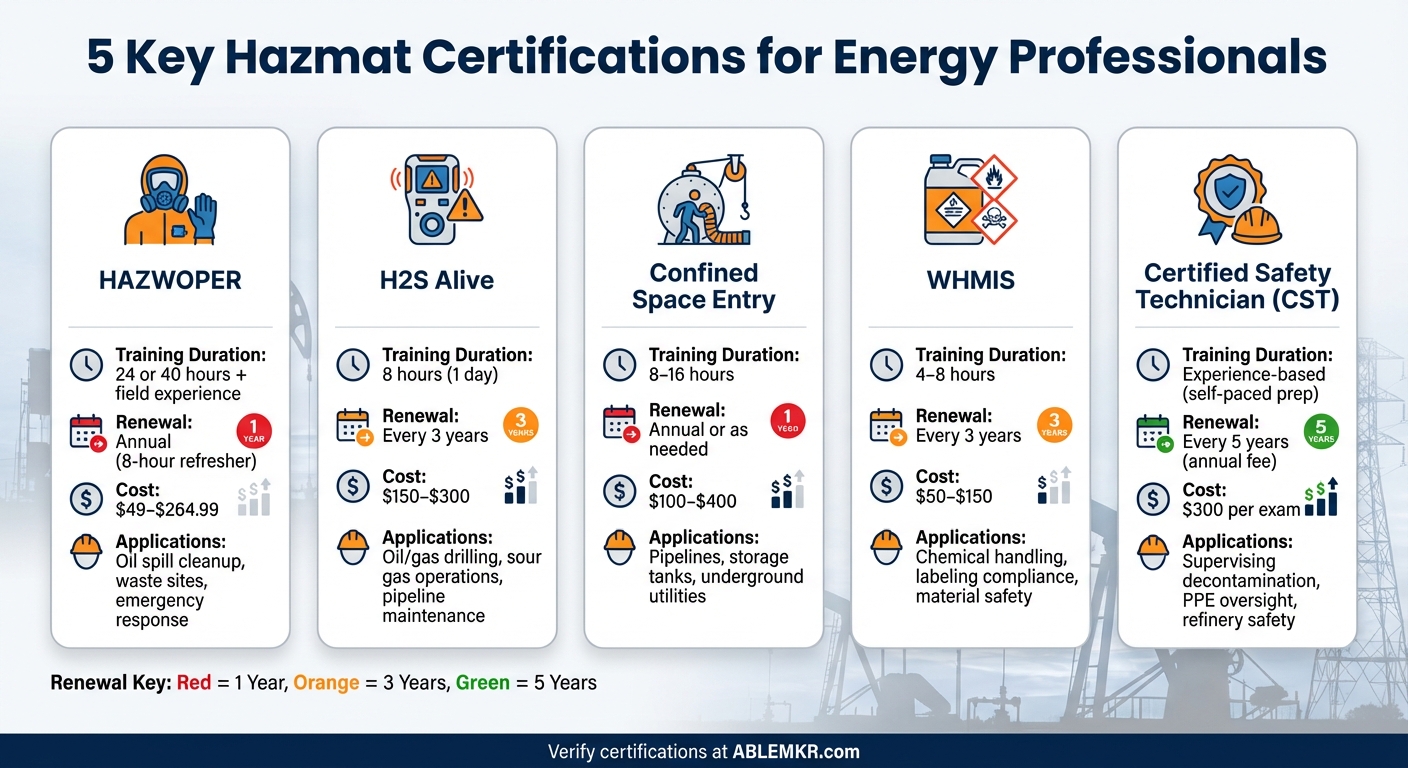
Hazmat Safety Certifications Comparison for Energy Jobs
Choosing the right hazmat certification depends on your role, budget, and how often renewal is required. Understanding the requirements and applications of each certification is crucial for maintaining safety and staying compliant on energy job sites. The table below highlights key details, such as training length, renewal intervals, costs, and areas of application.
| Certification | Training Duration | Renewal Period | Cost Range (USD) | Key Energy Applications |
|---|---|---|---|---|
| HAZWOPER | 24 or 40 hours plus required field experience | Annual (8-hour refresher) | $49–$264.99 | Oil spill cleanup, uncontrolled waste sites, emergency response |
| H2S Alive | 8 hours | Every 3 years | $150–$300 | Oil and gas drilling, sour gas operations, pipeline maintenance |
| Confined Space Entry | 8–16 hours | Annual or as needed | $100–$400 | Pipelines, storage tanks, underground utilities |
| WHMIS | 4–8 hours | Every 3 years | $50–$150 | Chemical handling, labeling compliance, material safety |
| Certified Safety Technician (CST) | Experience-based (self-paced prep available) | Every 5 years (with annual fee) | $300 per exam | Supervising decontamination, PPE oversight, refinery safety |
Each certification serves a specific purpose. For instance, HAZWOPER requires an annual refresher, making timely renewal essential to avoid lapses. On the other hand, H2S Alive offers a longer three-year renewal period, providing more flexibility. If you’re eyeing leadership roles, the CST certification might be a good fit – it requires three years of hands-on experience and full recertification only every five years. Meanwhile, Confined Space Entry and WHMIS focus on specialized skills for working in confined areas or managing hazardous materials.
When mapping out your career, weigh the initial and ongoing costs. For example, the HAZWOPER 40-hour course costs about $234.99, with an additional $49 annual refresher fee. In contrast, the CST exam involves a one-time fee of $300, covering certification for five years. Tools like ABLEMKR (https://ablemkr.com) simplify the verification process for employers, ensuring crews meet safety standards before starting work. This breakdown helps illustrate how these certifications align with the unique safety needs of energy projects.
Conclusion
In the energy sector, safety certifications go beyond simply meeting regulatory mandates – they play a key role in ensuring smooth and secure operations. These certifications, such as those required under OSHA (29 CFR 1910.120) and DOT (49 CFR), are essential for maintaining hazmat safety in energy-related jobs. They not only shield employers from hefty fines – up to $99,756 for knowing violations or $232,762 for severe incidents – but also equip workers with the tools and knowledge to handle hazardous materials effectively. From identifying dangerous substances to using personal protective equipment and applying accident prevention strategies, these programs help protect workers and the communities around them.
On top of compliance, these certifications open doors to better career opportunities. For instance, HAZWOPER training creates a clear pathway for advancement. Workers can progress from roles like First Responder to Hazardous Materials Specialist and, eventually, On-Scene Incident Commander, leading to supervisory positions. This upward mobility often comes with higher pay and the chance to work on critical projects, such as pipeline maintenance or refinery operations.
Platforms like ABLEMKR (https://ablemkr.com) simplify managing certifications by tracking expiration dates – whether it’s HAZWOPER’s annual 8-hour refresher, H2S Alive’s three-year renewal, or CST’s five-year recertification. The platform matches certified workers to job sites based on their credentials, location, and availability, enabling operators to maintain compliance and quickly assemble crews. Together, these certifications and tools not only uphold the highest safety standards but also support worker development and career growth in the energy industry.
FAQs
Why is it beneficial to have multiple hazmat safety certifications in the energy industry?
Having multiple hazmat safety certifications, such as HAZWOPER, DOT §172.704, or specialized training in hydrogen sulfide and lithium battery handling, is a game-changer for professionals in the energy sector. These credentials help workers meet federal standards, align with OSHA and DOT regulations, and confidently manage hazardous materials. Beyond compliance, they equip workers with essential skills like identifying hazards, using protective gear, and handling emergencies – key to preventing accidents and reducing environmental risks.
For employers, hiring a workforce with a variety of certifications boosts efficiency. Certified employees bring flexibility, cutting down on training time and allowing quicker deployment to critical, high-risk tasks like pipeline repairs or shutdowns. This not only helps keep projects on track but also reduces costs by avoiding mistakes and damage. Platforms like ABLEMKR simplify the process, connecting companies with pre-vetted, certified workers to ensure safety and compliance across energy projects.
How do hazmat certification renewal periods impact career planning in energy jobs?
Renewing hazmat certifications is a key part of career planning for energy workers. Most credentials have expiration dates, requiring regular updates to stay valid. For example, OSHA’s HAZWOPER certification must be refreshed every three years, whether it’s the comprehensive 40-hour training or the 24-hour site-specific course. Similarly, federal regulations require DOT hazmat endorsements to be renewed every three years. Missing these deadlines can lead to temporary disqualification from critical projects, so staying proactive is essential.
Strategic planning for certification renewals – such as scheduling them during slower work periods – helps workers maintain uninterrupted eligibility for jobs. While some certifications need more frequent updates, others, like the 40-hour HAZWOPER, offer longer validity. This allows workers to focus on advancing their skills or obtaining additional credentials, opening doors to higher-paying roles in sectors like oil and gas, utilities, and other high-risk industries.
Which energy industry jobs require HAZWOPER certification?
Workers in the energy sector must obtain HAZWOPER certification if their job involves handling hazardous waste, responding to emergencies with hazardous materials, or participating in site cleanup and remediation efforts. This requirement applies to roles such as oil field crews, refinery staff, pipeline teams, and utility workers.
This certification equips workers with the knowledge and skills needed to safely navigate hazardous situations while adhering to stringent safety standards. It’s a critical step in safeguarding both the workers and the environment.


