
Certification tracking helps stop unsafe work before it starts. If you check each worker’s current status before assignment, you can catch expired, missing, or fake credentials before someone enters a confined space, runs heavy equipment, or does electrical work.
Here’s the short version:
- Current status matters more than old training records.
- Manual tracking misses lapses, especially across many crews and sites.
- Digital checks cut assignment errors by flagging expirations early and blocking workers who do not meet the job requirement.
- Research links structured tracking with lower incident rates.
- The cost of failure can be high: in February 2026, the CSB reported 13 accidental release events, tied to workers who had finished training but could not show they could do the work during the incident. Those events led to 2 deaths, 10 serious injuries, and about $1 billion in property damage.
- Audit and inspection prep gets easier when records are time-stamped, current, and easy to pull.
A few numbers stand out:
- Firms using manual tracking report 5% to 15% of workers may have expired certifications at a given time.
- With automated systems, that figure drops to under 2%.
- OSHA serious citation penalties can reach $16,131 per violation, and willful violations can reach $161,323.
- One 2026 field example cut audit prep from weeks to 20 minutes with digital records.
If I had to sum it up in one line, it would be this: training teaches the job, but tracking decides who should be allowed to do it today.
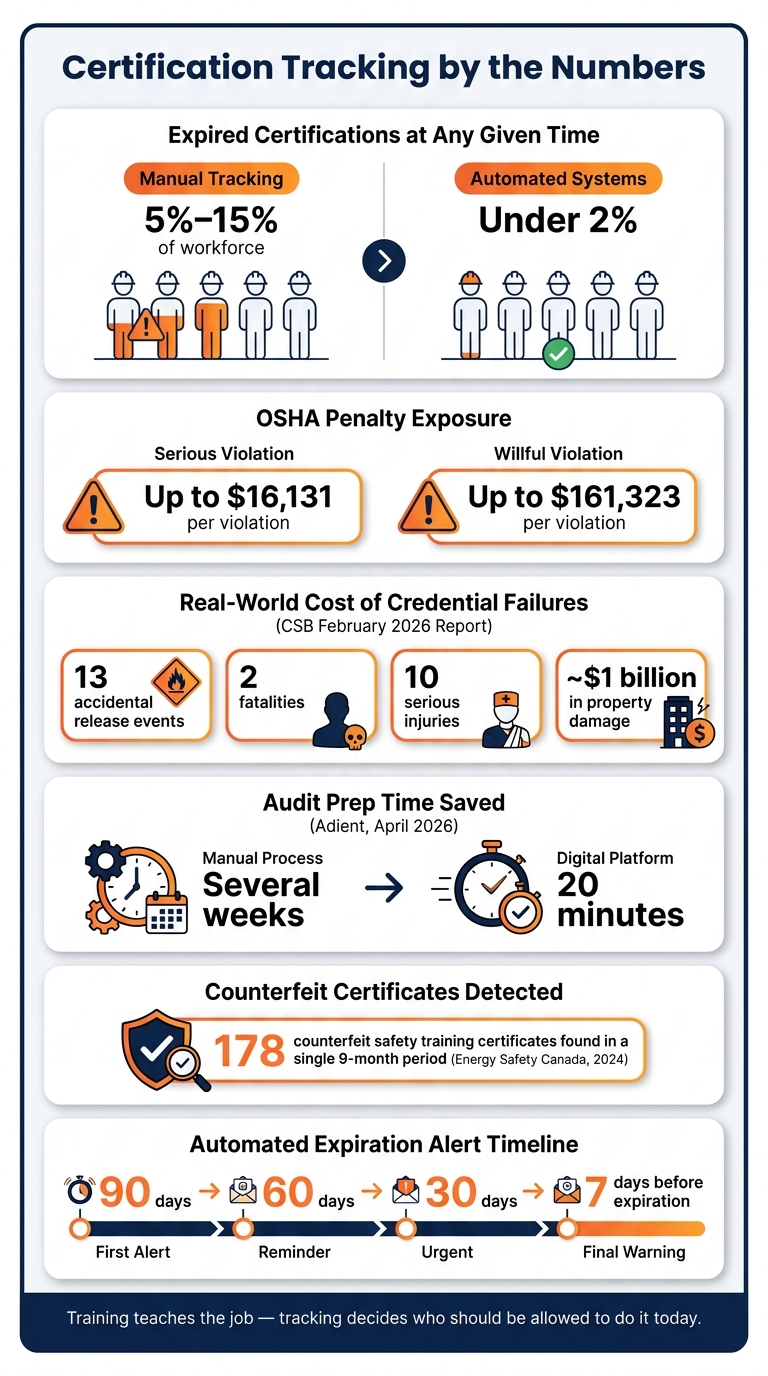
Certification Tracking by the Numbers: Safety, Compliance & Cost
What Research Says About Certification Tracking and Safety
What Certification Tracking Means in High-Risk Work
Certification tracking is the process of checking, storing, and renewing the licenses and safety credentials workers need to do high-risk jobs legally and safely. In construction and energy, these credentials are more than HR paperwork. They act as safety controls on the ground.
That usually means tracking:
- expiration dates
- renewal rules
- supporting documents
- the person who approved the credential
Common examples include OSHA training, MSHA training, equipment qualifications, fall protection, and medical or trade licenses.
Before someone touches a crane, enters a confined space, or handles hazardous electrical repairs, the system should confirm that the needed credential is still active. If a worker is assigned without that check, permits can become invalid, compliance risk goes up, and the jobsite can face legal exposure.
That last point is the key one. The safety gain doesn’t come from simply storing records. It comes from stopping unqualified people from being assigned in the first place.
Evidence Linking Current Credentials to Lower Incident Rates
Research keeps pointing in the same direction: structured certification tracking is tied to fewer recordable incidents. Companies with structured safety management systems, including documented training records, have significantly fewer recordable incidents. On the job, current credentials help stop bad assignments before work even starts.
A 2026 case study from a Fortune 500 oil and gas facility shows how that works in practice. The site linked training records to access control, blocked uncertified workers from restricted areas, and removed a manual filing role.
The U.S. Chemical Safety and Hazard Investigation Board’s February 2026 report shows what’s at stake. It documented 13 accidental release events, with 2 fatalities, 10 serious injuries, and about $1 billion in property damage. In many cases, the report pointed to missing verified competence as a root cause.
The big risk isn’t a worker’s old training history sitting in a file. It’s expired credentials staying active in day-to-day assignments.
Why Tracking Matters More Than One-Time Training
A one-time course completion isn’t enough. Many credentials, including First Aid and confined space training, expire and need to be checked in real time. A record showing that someone passed a course years ago doesn’t prove the credential is valid on the day the assignment starts.
This is where manual systems often fall apart. Spreadsheets and paper logs can miss expirations, role changes, and worker transfers, which creates compliance gaps that get harder to manage as crews grow. Firms that rely on manual tracking report that 5% to 15% of their workforce may have expired certifications at any given time. For organizations using automated systems, that figure is under 2%.
On an active jobsite, those gaps don’t stay hidden for long. They turn into missed checks, unsafe assignments, and delays that could have been avoided.
sbb-itb-aa28329
How Certification Tracking Improves Safety on U.S. Jobsites
Better Task Assignment for High-Risk Roles
Assigning crane work, confined-space entry, or energized electrical work is a safety call, not just a scheduling task. With structured tracking, certifications become part of the job requirement. Before a work order is assigned, the system checks the worker’s credentials and confirms they match the task. That moves verification to the front of the process and keeps unqualified workers away from high-risk work.
That check needs to happen at dispatch, before the worker even gets to the site. If the wrong person is assigned, the problem goes far beyond paperwork. It puts workers in direct danger right away.
Once that dispatch check is in place, the next weak spot is expired certifications across active crews.
Fewer Lapses, Near Misses, and Compliance Failures
Automated systems help stop lapses before a shift begins by sending alerts at 90, 60, and 30 days before a certification expires. The idea is straightforward: paperwork that was valid yesterday does nothing for an expired credential tomorrow.
At scale, even a low lapse rate can create avoidable risk across a lot of crews and shifts. Manual tracking tends to break down at the worst moments – during dispatch, at shift start, or in the middle of an audit. Real-time dashboards with green, yellow, and red status markers give supervisors a quick way to check crew qualifications from a mobile device before each shift.
That’s why live status matters more than a static record sitting in a folder.
Stronger Documentation for OSHA, MSHA, and Post-Incident Review
Fast, site-specific reporting can make OSHA and MSHA inspections much easier to handle. OSHA serious citation penalties can reach $16,131 per violation, while willful violations can reach $161,323. Good records help show that safety checks were completed before work started.
In April 2026, Adient‘s Training Coordinator Tim Clansey reported that a digital certification platform cut audit prep time from several weeks of manual data gathering to just 20 minutes. It also gave managers live visibility across sites and stopped unqualified assignments before they happened.
The same record trail matters after an incident. Time-stamped digital logs can show who was qualified, what task they were assigned, and when each credential was checked. When records are missing, inspections get harder and incident reviews get weaker. The hard part then becomes keeping those records current without relying on manual work.
Why Digital Tracking Systems Outperform Manual Methods
Manual Records vs. Digital Certification Tracking
This is where digital tracking shifts safety from reactive to preventive.
Manual tracking starts to fall apart once the number of crews, sites, and credential types grows. At that point, the main issue isn’t whether a record exists. It’s whether the site can trust that credential at the exact moment a worker is assigned.
Even small lapse rates can turn into safety problems when high-risk roles depend on current credentials. In 2024, Energy Safety Canada identified 178 counterfeit safety training certificates in a single nine-month period. Paper and PDF certificates are easy to forge, which is why point-of-use verification matters.
Digital systems help by keeping records more reliable, sending expiration alerts on time, blocking unqualified assignments, and giving supervisors fast access during audits.
That difference shows up most clearly when dispatch calls are made before a worker even gets to the site.
Core Features That Support Safer Workforce Deployment
These features matter because they stop an unsafe assignment before it begins.
Centralized credential records give each worker one digital profile that includes certification types, expiration dates, and training history. Supervisors can search those records by site or trade. Automated expiration alerts sent by SMS and email at 90, 60, 30, and 7 days before expiration help teams start renewals before a lapse happens.
Compliance gating can block workers with expired or missing credentials from restricted tasks. At the same time, role-based mapping updates job requirements when a worker moves to a new role or site.
Where ABLEMKR Fits in a Safety-Critical Workflow

ABLEMKR supports this kind of workflow by matching pre-vetted workers to jobs based on certifications, safety training, availability, and location. Employers also get real-time status and built-in compliance tracking. In practice, that makes credential tracking part of live deployment control, not just a back-office record.
Training, Implementation, and Key Takeaways
What Each User Group Needs to Know
Tracking only works when each person knows what to do when something goes off track. Once the requirements are set, training turns tracking into a day-to-day safety check. Every role that uses the system needs a clear job to do, not just a login. That matters because unsafe assignments often start with missed exceptions.
| User Group | Key System Task | Required Training | Why It Matters |
|---|---|---|---|
| Safety Manager | Validate records & set role requirements | Data integrity & audit reporting | Ensures only verified credentials allow site access |
| Project Manager | Monitor compliance dashboards before mobilization | Pre-shift planning & subcontractor onboarding | Prevents scheduling gaps due to missing credentials |
| Foreman/Dispatcher | Verify status before task assignment | Mobile app usage & compliance gating | Blocks unqualified personnel from high-risk tasks |
| Worker | Upload new records via mobile; respond to alerts | Self-service portal & SMS notifications | Maintains continuous personal eligibility |
Keep the training simple. Each role should learn one action path: review, escalate, or correct the exception. It also helps to assign one owner to review alerts, resolve exceptions, and maintain the credential library.
How to Measure Whether Tracking Is Working
Once roles are clear, the next step is to see whether the system is changing what happens in the field. A small set of practical metrics can show that pretty fast:
- Workers compliant at shift start – shows whether credential gaps are making it to the job site
- Renewals completed before expiration – shows whether alerts are pushing action early enough
- Stopped noncompliant assignments – a direct sign that compliance gating is doing its job
Over time, also watch incident rates and near-miss trends. If those numbers move in the right direction, tighter credential management is helping make operations safer. That’s where tracking starts to prove its worth as a preventive control.
Conclusion: Current Credentials Help Prevent Avoidable Incidents
The research points in the same direction: structured credential oversight reduces incidents, and expired or unverifiable certifications create avoidable risk. Tracking matters because crews change, requirements shift, and expired credentials can lead to preventable problems. Digital, mobile-accessible tracking helps teams make better assignment decisions, keeps compliance records ready for OSHA and MSHA, and cuts out the guesswork that comes with manual records.
That’s the core issue. User training, clear role ownership, and active enforcement help fix it. When each person in the workflow knows what the system expects and acts on it, certification tracking becomes more than a compliance tool. It becomes a dependable layer of protection before work starts.
Skills & Safety Certifications Tracking Management | HCSS Safety Software Feature
FAQs
How often should certifications be checked?
Certifications need to be checked all the time, not just during occasional manual reviews. Expiration dates can vary a lot depending on the industry and the type of training. Some certifications expire every year, some every two years, and some even every quarter.
Automated tracking makes this much easier to see and manage. It can alert safety teams and workers 90, 60, 30, or 7 days before a certification expires. ABLEMKR supports this with real-time validation and automated notifications before workers arrive on-site.
Which certifications matter most on high-risk jobsites?
The right certifications depend on the job and the equipment being used.
Common requirements include OSHA 10-hour or 30-hour construction safety training, along with credentials for crane and rigging work, forklift and telehandler use, and aerial lifts.
Many roles also need authorization for:
- Fall protection
- Lockout/tagout
- Confined space entry
- Hazard communication
Some places ask for extra credentials tied to local rules. For example, certain jobs in New York City require NYC Site Safety Training (SST) cards.
What should a company track besides expiration dates?
Beyond expiration dates, companies should track the types of certifications linked to each role, piece of equipment, and job task. That gives them a clearer picture of whether the workforce is ready to do the work at hand.
They should also tie certifications to training records, documented evaluations, and competency checks. On top of that, it helps to monitor site-specific regulatory rules, insurance standards, licensing requirements, and day-to-day job details like site access, asset assignments, and work orders.


