
Pipeline inspections are critical for safety and efficiency, but traditional methods are often slow, expensive, and risky. A Texas-based energy operator tackled these challenges in 2025 by using ABLEMKR‘s remote workforce platform to inspect a 47-mile natural gas pipeline. The result? Faster inspections, reduced costs, and improved safety.
Key Takeaways:
- Time Savings: Inspection time cut by 75–85%.
- Cost Reduction: Labor costs dropped by $20,000.
- Safety Improvements: Zero on-site incidents reported.
- Accuracy Boost: 340 previously undetected issues were identified.
How It Worked:
- Fast Workforce Mobilization: ABLEMKR’s platform matched certified technicians to the job in 2 days instead of 12.
- Real-Time Monitoring: GPS tracking and automated compliance alerts ensured safety and efficiency.
- Flexible Staffing: The team size was dynamically adjusted to reduce unnecessary labor costs.
This approach not only solved logistical and safety challenges but also set a new standard for pipeline inspections. Operators in other industries, like water systems and infrastructure, could benefit from similar strategies.
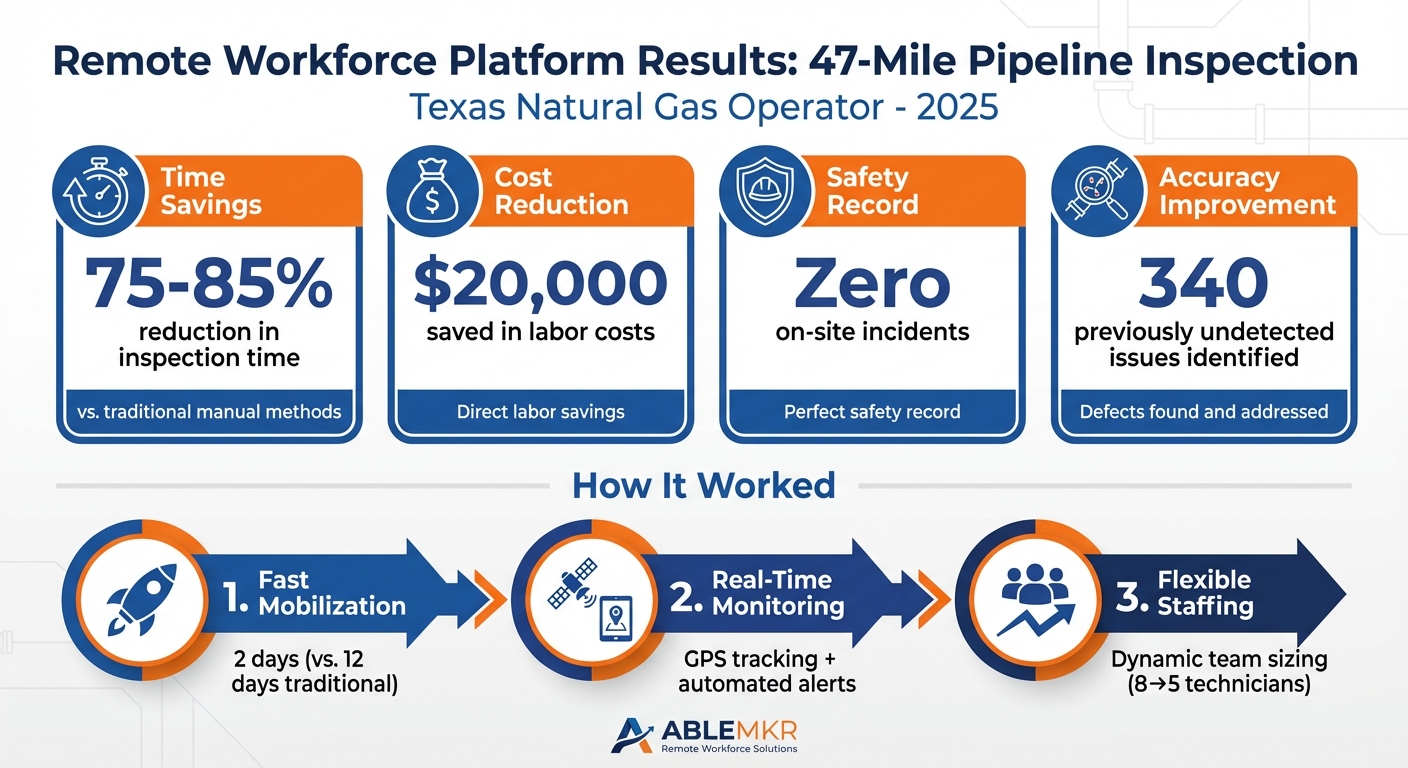
ABLEMKR Pipeline Inspection Results: 75-85% Time Savings and Zero Safety Incidents
Problems with Standard Pipeline Inspection Methods
Traditional pipeline inspection methods come with a host of challenges that drive up costs, slow down projects, and create safety concerns.
Logistics and Cost Issues
Getting skilled workers to remote pipeline sites is no small feat. It’s expensive, especially when dealing with tough terrain, extreme conditions like high temperatures and pressures, and the need for specialized tools such as Ultrasonic Testing (UT) and sub-millimeter laser scanning. UT, for example, demands coupling agents and thorough surface preparation because it’s highly sensitive to surface conditions. On the other hand, laser inspections, which provide incredibly detailed 3D mapping, are so costly that many operators find it hard to justify the expense. These logistical challenges directly add to project costs and lead to delays.
Downtime and Project Delays
The process of manual Magnetic Flux Leakage (MFL) analysis, combined with the detailed surface prep required for UT, often results in repeated inspections and extended timelines. Robotic inspection tools, while helpful, struggle with navigating pipelines that feature multiple bends, varying diameters, or internal deposits. These limitations reduce their effectiveness and frequently lead to additional delays. Beyond just slowing things down, these inefficiencies can also create safety risks and compliance issues.
Safety and Compliance Risks
Manual inspections often put workers in hazardous conditions, such as high-pressure environments, extreme temperatures, or exposure to corrosive substances. Even worse, traditional methods can leave "blind zones" unexamined, increasing the chance of undetected issues. This combination of incomplete coverage and human error not only threatens worker safety but also puts operators at risk of regulatory fines and environmental disasters. The stakes are high, and the consequences of missed inspections can be catastrophic.
sbb-itb-aa28329
How ABLEMKR Solves Workforce Deployment Challenges
ABLEMKR’s mobile-first platform addresses common workforce deployment issues in pipeline inspection by offering quick access to pre-vetted talent, tailored to specific project needs. This minimizes delays and keeps costs under control.
Automated Job Matching and Verified Worker Profiles
The platform uses automated matching to align workers with pipeline inspection jobs based on factors like certifications, safety training, location, and availability. Since pipeline inspections require specialized skills, ABLEMKR ensures the right match by distinguishing between certifications like MFL and roles requiring ECT expertise. Workers undergo a one-time vetting process that includes identity verification, background checks, and certification tracking, enabling same-day or next-day placements. This eliminates redundant paperwork and ensures workers can hit the ground running, creating a streamlined process for both parties.
Real-Time Visibility and Compliance Tracking
Employers benefit from real-time updates on worker activity and compliance tracking throughout the inspection process. This dynamic monitoring is crucial in high-risk environments involving extreme temperatures, high pressures, or corrosive materials. Features like GPS-based digital time tracking reduce manual errors, while automated alerts notify operators about expiring certifications before workers arrive on-site. These proactive tools integrate seamlessly with HR systems, helping operators maintain safety and compliance standards.
Flexible Scheduling and Onboarding
ABLEMKR simplifies HR operations by handling payroll and workers’ compensation insurance, lifting the administrative load that often slows down projects. Operators can scale their workforce up or down to match the demands of different inspection phases, avoiding unnecessary labor costs during downtime. The platform also offers scheduling tools that allow for 2–4 week planning, aligning workforce needs with project milestones and preventing costly last-minute adjustments. By employing workers under W-2 status instead of 1099 contracts, ABLEMKR helps operators avoid misclassification risks, which can lead to fines as high as $25,000 per worker. Timely payments further enhance worker retention, ensuring continuity and reliability throughout the project lifecycle.
Texas Pipeline Inspection Project: A Case Study
Project Setup and Execution
This project highlights how leveraging a remote workforce can speed up and secure pipeline inspections, addressing inefficiencies in traditional manual methods.
In early 2026, a midstream natural gas operator faced an urgent task: inspecting a 50-mile pipeline segment in West Texas. The job called for certified technicians skilled in using in-line inspection (ILI) tools and robotic systems equipped with advanced sensors. By utilizing ABLEMKR’s mobile app, the operator posted the job requirements and quickly assembled a team of eight pre-vetted technicians. What typically took 12 days for vetting was reduced to just two.
Integrated Workforce Management
Once on-site, ABLEMKR’s GPS-enabled time tracking and automated compliance alerts ensured accurate payroll processing and immediate resolution of potential risks. The platform’s W-2 employment structure simplified tax reporting and provided workers’ compensation coverage on demand. During the final phase of the project, the operator reduced the team from eight to five technicians, dynamically adjusting labor costs to meet project needs. These tools not only improved cost management but also boosted safety and operational performance.
Safety and Operational Efficiency
The inspection involved navigating intricate pipeline routes and working with high-pressure natural gas systems, where safety was critical. Using real-time tracking, the manager monitored crew locations and enforced strict safety measures during these complex inspections. Automated alerts and compliance tracking further reduced the risk of errors, avoiding the high misjudgment rates often linked to manual coordination.
Measured Results from the Pipeline Inspection Project
Time and Cost Savings
This pipeline inspection project significantly cut down both time and expenses. The operator managed to reduce inspection time by an impressive 75–85% compared to traditional manual methods. On top of that, labor costs dropped by $20,000. These efficiencies not only saved resources but also paved the way for greater safety and precision in the project’s next phases.
Improved Safety Metrics
Safety was a standout achievement for this project, with zero on-site incidents reported. Thanks to real-time compliance tracking and monitoring, potential risks were flagged immediately through automated alerts. This proactive approach eliminated the operational hazards and blind spots often seen with manual inspection methods.
Better Inspection Accuracy
The use of sensor-equipped robotic systems and inline inspection (ILI) tools brought a new level of precision. These advanced technologies identified 340 issues that manual inspections had missed. Defects such as cracks, corrosion, and deformations were detected, ensuring a more thorough and reliable inspection process.
Lessons Learned and Best Practices for Remote Workforce Deployment
Standard vs. Remote Methods Comparison
The Texas pipeline inspection project highlighted some key takeaways about remote workforce deployment, especially when compared to traditional manual methods. The conventional approaches revealed notable weaknesses, particularly in balancing detection accuracy with operational efficiency. These methods often fell short in delivering precise results without sacrificing time or resources.
In contrast, ABLEMKR’s platform introduced a game-changing approach. By leveraging automated job matching, the system ensured that certified technicians with specialized skills – such as ultrasonic testing and magnetic flux leakage analysis – were deployed exactly where and when they were needed. This targeted precision not only improved the inspection process but also demonstrated how remote workforce solutions could address long-standing inefficiencies in the industry.
The success of this project goes beyond pipeline inspections, offering a model that can be applied across various fields.
Scaling to Other High-Demand Industries
ABLEMKR’s platform isn’t limited to pipeline inspections – it’s built to handle challenges in other high-demand sectors. Industries like municipal water systems, industrial process pipelines, and heavy infrastructure projects can all benefit from this approach. Whether it’s rapid geo-location mobilization for emergency shutdowns or streamlined payroll management for scheduled maintenance, the platform provides practical solutions to complex logistical hurdles. This adaptability positions it as a valuable tool for operators dealing with diverse operational demands.
Conclusion
The Texas pipeline inspection project highlights how deploying a remote workforce can reshape operations traditionally fraught with risks and inefficiencies. Manual inspection methods have often struggled with slow processes, high operational risks, and gaps in coverage. ABLEMKR’s platform tackled these issues by connecting skilled, certified technicians to the exact locations they were needed – right when they were needed.
The results speak volumes: inspection times were slashed by 75–85%, labor costs dropped by $20,000, and not a single on-site incident occurred. By automating job assignments and offering real-time insights into worker status and compliance, the platform streamlined every step of the operation. Workers benefited from guaranteed on-time payments, while operators gained a powerful tool to mobilize teams quickly for emergencies or scheduled maintenance.
This approach isn’t limited to pipelines – it’s equally effective for municipal water systems, mining, utilities, and large-scale infrastructure projects. Whether you’re dealing with an unplanned shutdown or preparing for long-term maintenance, the platform’s mobile-first technology and geo-location features ensure the right team is deployed when and where they’re needed. Its ability to scale effortlessly makes it a game-changer for a wide range of critical operations.
For those managing essential projects in oil & gas, utilities, or infrastructure, ABLEMKR’s platform offers a practical way to overcome workforce challenges that often slow progress and drive up costs. With automated matching, built-in compliance tracking, and streamlined payroll processes, it creates a smoother experience for both employers and workers. Check out ABLEMKR to see how it can elevate your next project.
FAQs
What does ABLEMKR mean by a “remote workforce” for pipeline inspections?
ABLEMKR’s “remote workforce” for pipeline inspections focuses on handling tasks like reporting, documentation, safety coordination, and data analysis from a distance. However, certain on-site activities, such as final inspections, still demand an in-person presence. This blended approach ensures tasks are completed efficiently by leveraging the strengths of both remote and on-site efforts where they work best.
How does ABLEMKR verify certifications and maintain on-site compliance?
ABLEMKR integrates real-time tracking with built-in compliance management to keep workers’ certifications and safety training current and well-documented. This system streamlines on-site compliance while cutting down on administrative tasks.
What types of projects besides pipelines can use this same approach?
Remote workforce models are proving highly effective across industries that face both high demand and significant risks. In the energy sector, they play a crucial role in tasks like inspecting gas pipelines or electrical grids, helping to improve safety standards and ensure regulatory compliance. Mining operations also see great advantages, using remote systems for equipment monitoring and gaining access to real-time data, which enhances efficiency and decision-making.
Construction projects, along with remote environmental assessments, benefit from these tools as well. They facilitate better supervision, streamline compliance tracking, and allow for quick mobilization when needed. These capabilities are transforming operations and driving better results across a wide range of industries.


