
If I had to boil this down to one point, it’s this: no workers’ comp coverage is the costliest problem, and contingent labor can make every other risk worse. In California, an employer can face criminal fines starting at $10,000, civil penalties up to $100,000, jail time up to 1 year, and added costs for late payments, fraud, or misclassification. When labor moves through staffing firms, subcontractors, or labor contractors, the chance of a coverage gap, reporting miss, or payroll error goes up.
If you use contingent crews, I’d focus on four risk areas right away:
- No coverage: the harshest penalties, stop-work orders, and direct claim exposure
- Late reporting or claims mistakes: 10% automatic late-payment penalties and up to 25% for unreasonable delay
- Payroll underreporting or premium fraud: fines up to $50,000 or double the fraud amount, with prison time in some cases
- Worker misclassification: $5,000 to $15,000 per worker, or $10,000 to $25,000 per worker for a pattern
What matters most? I’d verify who employs the worker, who carries the policy, whether payroll matches hours worked, and how injuries get reported the same day. In multi-employer construction and energy setups, those four checks can make the difference between a single claim and a much bigger problem.
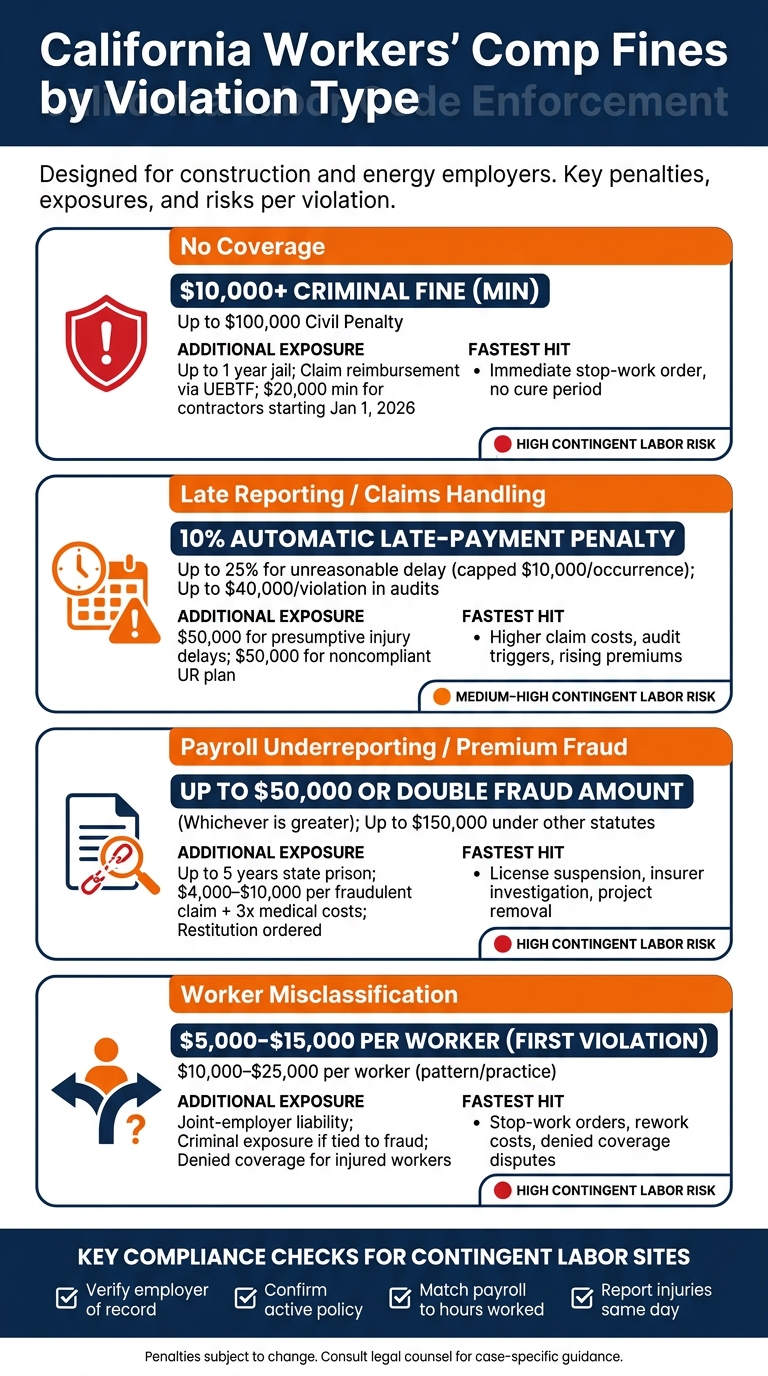
California Workers’ Comp Violations: Penalty Ranges & Contingent Labor Risk
Tell me about penalties in CA workers’ comp. What kind of penalties can I get for late payments?
sbb-itb-aa28329
Quick Comparison
| Violation type | Main penalty range | Other exposure | What hits employers fastest | Contingent labor risk |
|---|---|---|---|---|
| No coverage | $10,000+; civil penalties up to $100,000 | Misdemeanor charges, jail, claim reimbursement | Stop-work orders, lost work, bid problems | High |
| Late reporting / claims handling | 10% late-payment penalty; up to 25% for unreasonable delay | Audit penalties, UR penalties | Higher claim costs and audit issues | Medium to high |
| Payroll underreporting / premium fraud | Up to $50,000 or double the fraud amount | Prison, restitution, license trouble | Back premiums, investigations, project fallout | High |
| Misclassification | $5,000–$15,000 per worker; $10,000–$25,000 per worker for a pattern | Added wage, coverage, and fraud claims | Rework, penalties, denied coverage fights | High |
Put simply: if you rely on outside labor, you can’t assume the contract fixes the problem. I’d treat workers’ comp compliance like a job-site control, not a back-office task.
1. No Coverage or Failure to Secure Workers’ Compensation
In contingent labor settings, one uninsured worker can put the whole site at risk.
Penalty range
A first conviction under Labor Code § 3700.5 brings a minimum $10,000 fine or twice the unpaid premium, plus up to one year in county jail. A second conviction pushes the minimum to $50,000 or triple the unpaid premium. On top of that, DIR can assess up to $100,000 in administrative penalties.
For contractors, the rules get even tougher on January 1, 2026. Uninsured sole-owner contractors face a $10,000 minimum, and other uninsured contractors face a $20,000 minimum, even without intent.
And the pain doesn’t end with the fine.
Criminal and civil exposure
Failure to secure coverage is a misdemeanor. That means owners, officers, and managing agents can face prosecution personally, not just through the business entity.
On the civil side, the Uninsured Employers Benefit Trust Fund pays injured workers first, then comes after the employer for reimbursement. In construction and energy, those claim costs can climb fast. Once medical treatment and wage replacement kick in, it’s not hard to hit six figures.
Operational impact
California can issue a stop-work order with no cure period, which means employee labor can be shut down as soon as the state confirms a coverage gap. If you’re on a tight construction timeline or working inside a fixed outage window at an energy site, that kind of halt can blow up the whole plan. Contract penalties start stacking up. Business gets lost.
Project owners, utilities, and public agencies may also end agreements or block an uninsured contractor from future bids. One DIR enforcement report logged 56 violations and $1,999,080 in assessed penalties for lack of coverage in a single reporting period.
That problem gets worse when labor runs through staffing firms and subcontractors.
Contingent labor risk
This is where things get messy. A staffing firm, subcontractor, or labor platform may let a policy lapse or misstate coverage. Maybe the policy expires in the middle of the job. Maybe a worker is labeled as an independent contractor when that label doesn’t hold up. Either way, someone can end up on site without coverage.
And here’s the hard part: the entity directing the work may still face exposure if the actual employer lacks coverage or the worker was misclassified.
For construction and energy employers, the job is pretty clear:
- Verify which entity is the employer of record
- Confirm the active policy matches the number of workers
- Check that job classifications are correct
- Make sure reported payroll lines up with what is happening on site
Platforms like ABLEMKR can help by adding W-2 employment, real-time worker visibility, and embedded compliance tracking.
2. Late Reporting and Claims-Handling Violations
Late reporting and claims-handling mistakes get expensive fast. In contingent labor, the risk climbs because host employers and staffing firms often split notice duties.
Penalty range
Under Labor Code § 4650(d), a late indemnity payment – including temporary disability benefits – sets off an automatic 10% penalty on the late amount. If the delay or refusal to pay is unreasonable, Labor Code § 5814 can add up to 25% of the delayed amount, capped at $10,000 per occurrence.
For some presumptive injury claims, including certain public safety personnel cases, Labor Code § 5814.3 goes much further: five times the delayed benefit amount, up to $50,000.
The DWC can also issue audit penalties when it finds unpaid or late-paid compensation. Under the full compliance audit schedule, some violations can reach $40,000 per violation. Late expedited UR decisions can bring $250-per-hour penalties, up to $18,000, and a noncompliant UR plan can cost $50,000.
Operational impact
These penalties do more than tack on extra cost. They push claim costs higher and can drive future premiums up too. For construction and energy employers, that can throw off project budgets and future premium calculations – especially during outage work, where schedules are fixed and delays stack up fast. If late reporting becomes a pattern, it can also lead to audits, repayment duties, and added penalties across affected claims.
Contingent labor risk
Here’s where things often go sideways: a worker gets hurt, but the host employer, staffing agency, and insurer each handle part of the notice and payment process. One missed email, one late handoff, and the first report of injury gets delayed. Benefit payments can slow down right behind it, which creates exposure under § 5814.
Liability for benefit-level penalties usually lands on the party responsible for paying compensation – often the staffing agency’s insurer or a self-insured employer. Administrative penalties under § 5814.6 and § 129.5, though, can be assessed against employers, insurers, or others acting on their behalf when delay turns into a general business practice.
The fix is simple in theory, even if teams don’t always follow it in practice: use one reporting protocol.
- Site supervisors report injuries within hours
- Staffing partners follow fixed notice deadlines
- One coordinator tracks every open claim
That’s why one reporting chain beats multiple handoffs. ABLEMKR’s embedded compliance tracking and real-time worker visibility keep coverage data and job-site records in one place, so the correct insurer gets notice on time.
3. Payroll Underreporting and Workers’ Comp Premium Fraud
Payroll underreporting cuts workers’ comp premiums by keeping wages off the insurer’s books. If it’s done on purpose, it can cross the line into fraud. That risk gets a lot higher when the same payroll is touched by a prime contractor, a staffing firm, and a subcontractor. In construction and energy staffing, things can go off the rails fast when payroll data passes through several companies before it reaches the insurer.
Penalties, Criminal Exposure, and Civil Liability
The legal risk here is steep.
Under Insurance Code § 11760, anyone who knowingly makes false statements to lower workers’ comp insurance costs can face fines of up to $50,000 or double the value of the fraud, whichever is more, plus up to five years in state prison. And this doesn’t stop with the company itself. Owners, executives, and payroll managers can face personal exposure too.
Other insurance fraud statutes can push the fine cap even higher, to $150,000 or double the fraud amount. On top of that, Labor Code § 3820 creates civil exposure of $4,000–$10,000 per fraudulent claim, plus up to three times the medical and medical-legal costs paid because of the fraud. Courts also often order restitution for unpaid premiums in addition to fines.
One California roofing case shows how bad this can get. The contractor received a 10-year prison sentence and was ordered to pay $500,000 in restitution after systematically underreporting employee wages.
Operational Impact
Once an insurer finds the gap, the fallout spreads far past the premium bill. A contractor’s license can be suspended, which can stop active work on the spot and open the door to disgorgement claims. Project owners and utilities may also remove the contractor from vendor lists in the middle of a job. That can set off contract terminations, payment fights, and more legal trouble.
Contingent Labor Risk
For construction and energy employers that rely on contingent labor, the risk is built into the setup. Payroll duties are often split among several parties. A prime contractor, subcontractor, staffing firm, or labor broker may each manage part of the workforce, and each may assume someone else is handling reporting the right way. That’s where gaps start to form.
Two patterns show up again and again in these industries:
- Paying field crews in cash and leaving those wages out of carrier reports
- Using shell or paper companies to underreport wages or hide payroll
ABLEMKR can help by connecting job-site assignments, hours, and payroll in real time. That gives employers a clearer view of contingent crews and helps keep reporting in line.
The next risk is misclassification, where the worker is put in the wrong class before payroll is even underreported.
4. Worker Misclassification in Contingent Labor Arrangements
Unlike payroll underreporting, misclassification starts before wages ever get reported. It happens when a worker who should be treated as an employee is treated as an independent contractor instead. In California construction and energy staffing, that can lead to penalties, unpaid premiums, and injuries that were never properly covered.
Penalty Range
California Labor Code § 226.8 makes willful misclassification unlawful. It allows civil penalties of $5,000 to $15,000 per misclassified worker for a first violation, and $10,000 to $25,000 per worker when there is a pattern or practice of violations. That adds up fast. Even a small crew can turn into a major liability.
One enforcement case reached $2,327,257 in total, including misclassification penalties, uninsured-worker penalties, liquidated damages, and other civil penalties. Of that amount, $2,203,384 was owed to workers. That number makes the point pretty clearly: once misclassification overlaps with uninsured-worker and payroll problems, the cost can snowball.
Criminal and Civil Liability
Misclassification can also move beyond labor penalties. When it is tied to intentional fraud, such as false payroll records, premium avoidance, or false statements, it can create criminal exposure.
If a misclassified worker gets hurt on a job site, the employer may face workers’ compensation claims and, depending on the facts, possible direct civil claims too. In places like oil and gas sites or heavy construction projects, where the work itself carries more danger, that risk can spike in a hurry.
Operational Impact
The damage is not limited to fines. Misclassification can disrupt the job itself. Stop-work orders can shut a project down on the spot. Claims may be denied if workers were not covered the right way. Contractors can lose access to state-funded contracts, and energy companies can face CPUC audits and funding risk.
Then comes the cleanup: re-onboarding workers, fixing payroll records, and dealing with agencies. That takes time, money, and attention away from the project.
Those problems often get worse when labor moves through several layers.
Contingent Labor Risk
The legal issue is not what the contract calls the worker. It is who actually controls the work. Risk goes up when a prime contractor, labor broker, and subcontractor each assume someone else handled classification. California regulators look past labels. If a company controls the worker’s schedule, tools, safety rules, supervision, or site access, that worker is more likely to be treated as an employee.
Joint-employer liability makes this even harder to ignore. A California appellate decision confirmed that host employers can be held liable under Labor Code § 226.8 if they knew a co-employer was willfully misclassifying workers and failed to correct it. In plain English, site owners and general contractors can’t just dump the risk on a staffing firm and walk away.
ABLEMKR addresses this head-on by hiring W-2 workers with workers’ comp coverage built in and tracking assignments, certifications, and payroll in one place.
Compliance Approaches: Pros and Cons for Construction and Energy Employers
Those penalties force a practical decision: how you set up your workforce. In contingent labor, that setup decides who handles coverage, payroll, reporting, and classification – and who takes the hit when something goes sideways.
Direct W-2 employment gives employers the most control. Coverage, payroll, and injury reporting all move through one system, which makes audits easier to handle. The downside is more admin work around certifications, class codes, and renewals.
Staffing-agency labor cuts down on in-house payroll and coverage admin, but client employers still need to verify active coverage under Labor Code § 2810.3. In most cases, host employers get invoices, not full wage detail. That can make audit prep a headache.
At the core, the difference comes down to this: is compliance checked later, or is it built into the model from day one?
Platform-based W-2 deployment puts coverage, payroll, and injury reporting in one place. Because workers are W-2 employees and coverage follows that setup, coverage verification is built in. Real-time payroll visibility also helps reduce fragmented reporting. For construction and energy employers running contingent crews, ABLEMKR uses this model with integrated payroll workflows and embedded compliance tracking.
Poorly documented independent-contractor models bring the most risk. Cash payments, missing coverage certificates, and high-control work arrangements can create overlapping exposure for misclassification, uncovered injuries, and underreported payroll.
The table below lays out those tradeoffs side by side.
| Compliance Approach | Coverage | Payroll | Reporting | Classification |
|---|---|---|---|---|
| Platform-based W-2 (ABLEMKR) | High – built into the employment model | High – integrated digital workflows | High – centralized through the employer of record | Low – legally classified as W-2 employees |
| Direct Employment | High – managed internally | High – full internal visibility | High – direct site oversight | Low – clear employer-employee relationship |
| Staffing-Agency Labor | Moderate – requires active certificate verification | Moderate – limited to agency invoices | Moderate – shared responsibility; communication gaps possible | Low – agency typically acts as employer of record |
| Independent Contractor | Low – often incomplete or contractor-provided | Low – 1099 payments; higher audit risk | Low – no defined reporting structure | Very High – AB 5 exposure and strict classification tests |
Conclusion
California workers’ comp exposure changes a lot based on the type of violation. No coverage, payroll fraud, and willful misclassification create the biggest risk. Late reporting can still get expensive, but it’s usually not as severe.
That risk climbs fast on multi-employer construction and energy sites. Why? Because labor, payroll, and reporting duties are often split across several parties. On contingent-labor sites, coverage gaps and reporting mistakes can ripple through staffing firms, subcontractors, and host employers.
The answer isn’t more paperwork. It’s tighter job-site control.
That means:
- Require written proof of who owns coverage
- Verify active workers’ comp
- Document worker classification
- Train supervisors on injury reporting
- Reconcile payroll across vendors and job sites
Poor records can turn a one-off mistake into a repeat violation. ABLEMKR brings worker status, payroll, and compliance tracking into one system. When those controls are built into day-to-day site work, compliance stays more predictable even as crews move from project to project. Coverage checks, classification, and reporting become job-site controls, not back-office chores.
FAQs
Who is liable if a staffing firm’s workers’ comp policy lapses?
Liability often reaches the client employer through upstream liability. Under joint employer standards, the staffing agency and the host employer may both be on the hook for keeping workers’ compensation coverage in place.
If a worker gets hurt during a coverage gap, both sides can face lawsuits, regulatory penalties, and major financial exposure.
What records should I check first to catch payroll or classification problems?
Start by reviewing records against IRS and Department of Labor standards, with close attention to behavioral control, financial control, and the working relationship.
Look at contracts, job descriptions, payment terms, and payroll data side by side. The goal is simple: make sure the paperwork matches what’s happening day to day, including actual hours worked, schedules, and the level of supervision.
When these records live in one place and update in real time, it’s much easier to build an auditable trail and spot mistakes before they turn into bigger problems.
How can construction and energy employers reduce same-day injury reporting mistakes?
Construction and energy employers can cut same-day injury reporting mistakes by using digital workforce platforms with mobile-first incident reporting. These tools let crews document incidents right away and flag hazards on the spot, which helps improve accuracy and keeps teams on track with reporting deadlines.
They also give employers real-time worker visibility, built-in compliance workflows, and clear auditable records. That means less admin friction and fewer reporting slipups, while making sure injury details are logged correctly when an incident happens.


